Stem & Leaf Spinal Teas: Which One Is Right for You?

Willard Sheppy Dipl. OM, LAc, BS
Willard Sheppy is a licensed acupuncturist (LAc) and Founder of Valley Health Clinic specializing in using Traditional Chinese Medicine to treat acute injuries and chronic conditions, and to improve sports performance and rehabilitation.
Table of Contents
Most people don’t have “back pain.” They have neck pain that starts at the base of the skull, or a spot between the shoulder blades that no one takes seriously, or a low back that decides what they can lift, or a tailbone that makes an hour in a chair feel like a punishment.
In the clinic those are four different conversations. They have different postures behind them, different aggravating movements, and different treatment plans. So it has always struck me as odd that most herbal back formulas treat the spine as one undifferentiated object.
The Stem & Leaf line doesn’t. It is four separate teas, one per region, each built around herbs that classical Chinese medicine understands as directing a formula’s action to a particular part of the body. This is the guide to the whole line: what the idea is, which tea matches which pain, what the research honestly does and doesn’t support, and when back pain needs a doctor rather than a tea.
Quick answer
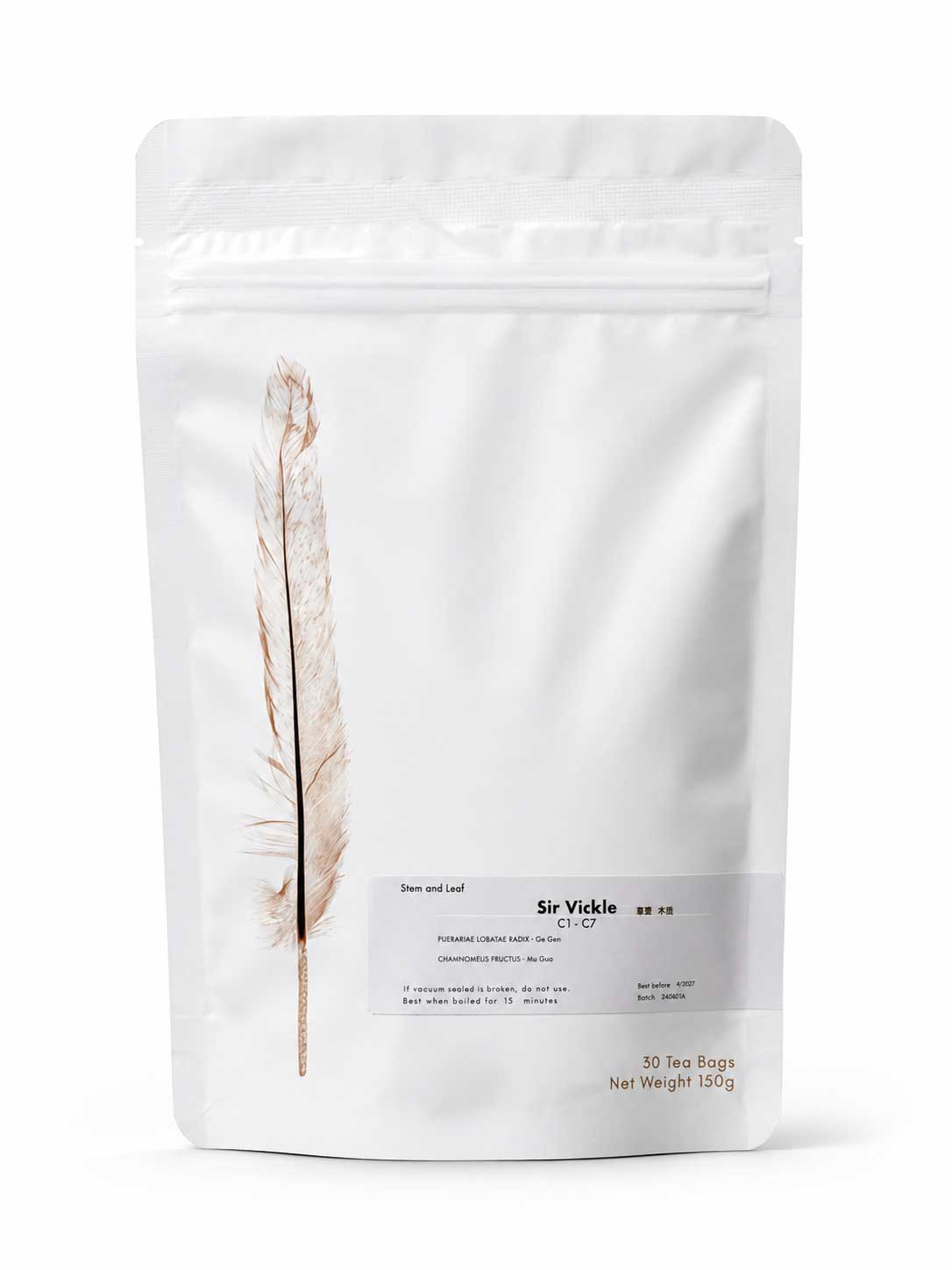
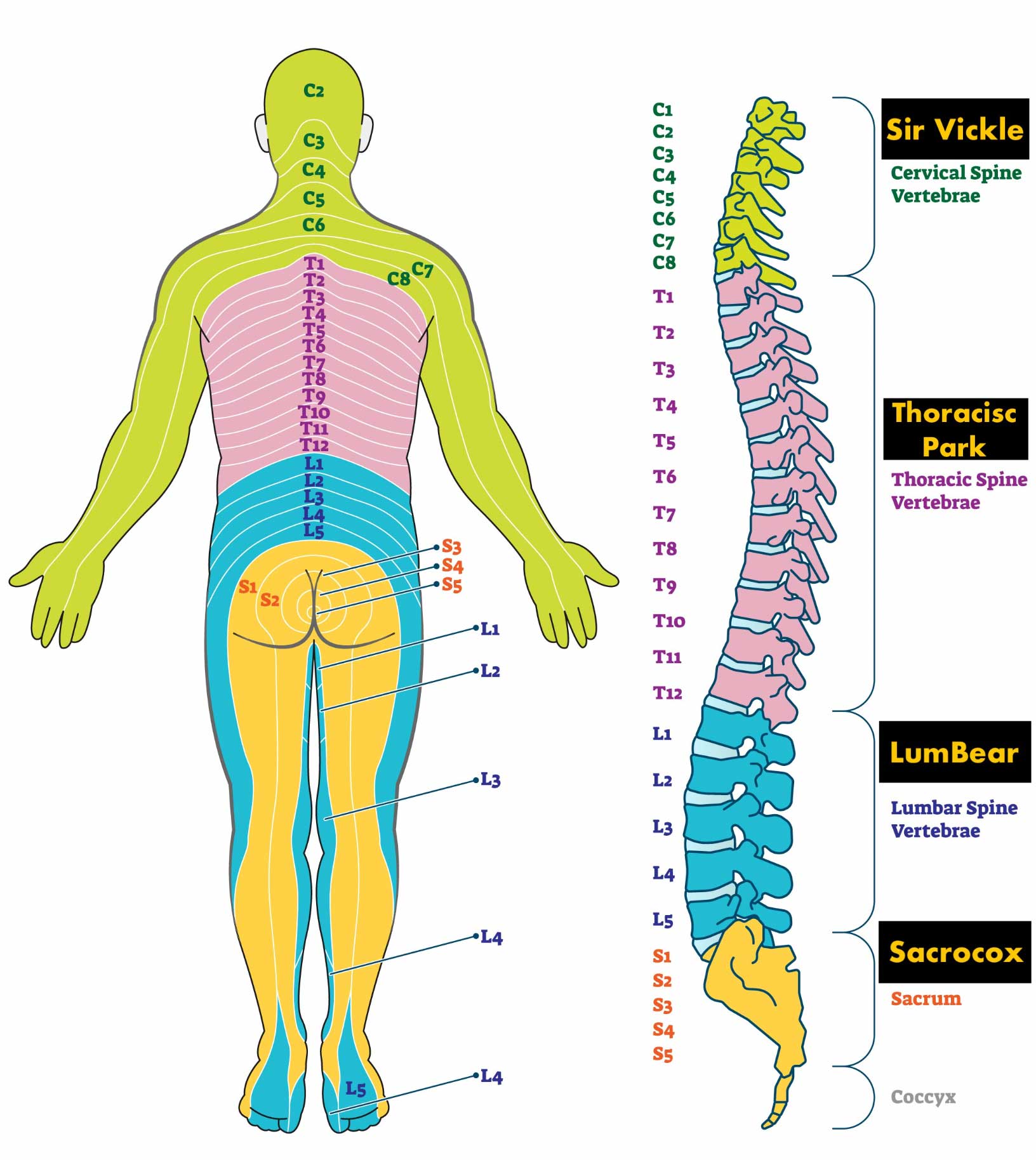
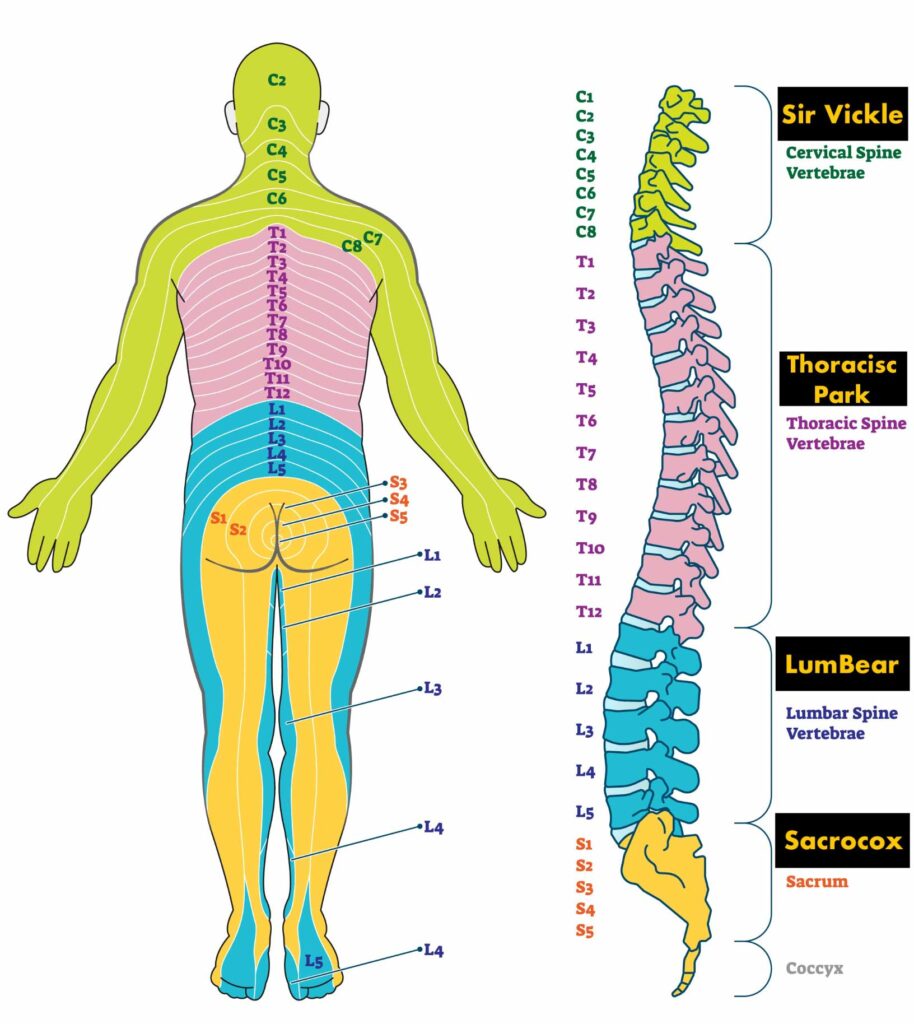
Stem & Leaf is a set of four herbal teas from Botanical Biohacking, each aimed at one region of the spine: Sir Vickle for the neck (C1–C7), Thoracic Park for the mid-back (T1–T12), LumBear for the low back (L1–L5), and Sacrocox for the sacrum and tailbone. Each is built on classical “guide herbs” — herbs traditionally understood to carry a formula’s action toward a specific region. They are a companion to movement, posture, sleep, and hands-on care, not a replacement for them. New, severe, or radiating back pain — or pain with numbness, weakness, or loss of bladder or bowel control — needs prompt medical evaluation, not tea.
What the Stem & Leaf Line Actually Is
Four teas. Thirty teabags each, about a month’s supply. Every one of them is short — two or three herbs — which is unusual for a Chinese herbal product and is the point rather than a shortcut.
A classical formula usually runs eight to fifteen herbs, because it is trying to do several things at once: address the root, address the branch, protect the digestion, and harmonize the rest. Stem & Leaf takes the opposite approach. Each tea is a small, targeted preparation aimed at a region, designed to be used on its own or layered with the others.
They are made by Botanical Biohacking, the same house behind Microgard, the Tibetan Herbal Foot Soak, and the tea line we’ve written about elsewhere. The Stem & Leaf formulations came to us through Christopher M. Volesky, L.Ac., of Rocky Mountain Herb Supply, with the neck pairing credited to Dr. Jin Zhao.
The spine is not one thing. In the clinic, a neck, a mid-back, a low back, and a tailbone are four different conversations — so it never made sense to me that they should all get the same tea.
— Will Sheppy, L.Ac.
What Is a Guide Herb?
In classical formula construction, herbs are not only chosen for what they do — they are chosen for where they go. Certain herbs are described as leading the rest of a formula toward a region or a channel: upward to the head and neck, downward to the legs and pelvis, outward to the surface. A courier, not a cure.
Modern research doesn’t test “channel tropism” directly — it isn’t a construct that translates cleanly into a trial. What it does study is the closely related idea of the herb pair, the smallest fixed unit of a Chinese formula. That literature is real: reviews describe herb pairs as the fundamental building block of formula design, chosen to amplify an effect or offset a harshness. There’s even analytical work showing that when two herbs are extracted together, the resulting chemistry differs from either herb extracted alone — new compounds appear. Combining isn’t just addition.
So when I tell you Sir Vickle is “aimed at the neck,” I want you to hear it accurately: that is a two-thousand-year-old design principle with modern chemistry that makes it plausible, not a clinical trial result.
Which Tea Matches Your Back?
Start with where the pain actually lives. Not where it radiates to — where it starts.
- Sir Vickle — the neck, C1 through C7. Two guide herbs: Ge Gen (kudzu root), the herb the tradition reaches for when the shoulders have crept up toward the ears, and Mu Gua (chaenomeles fruit), which addresses dampness in the muscles.
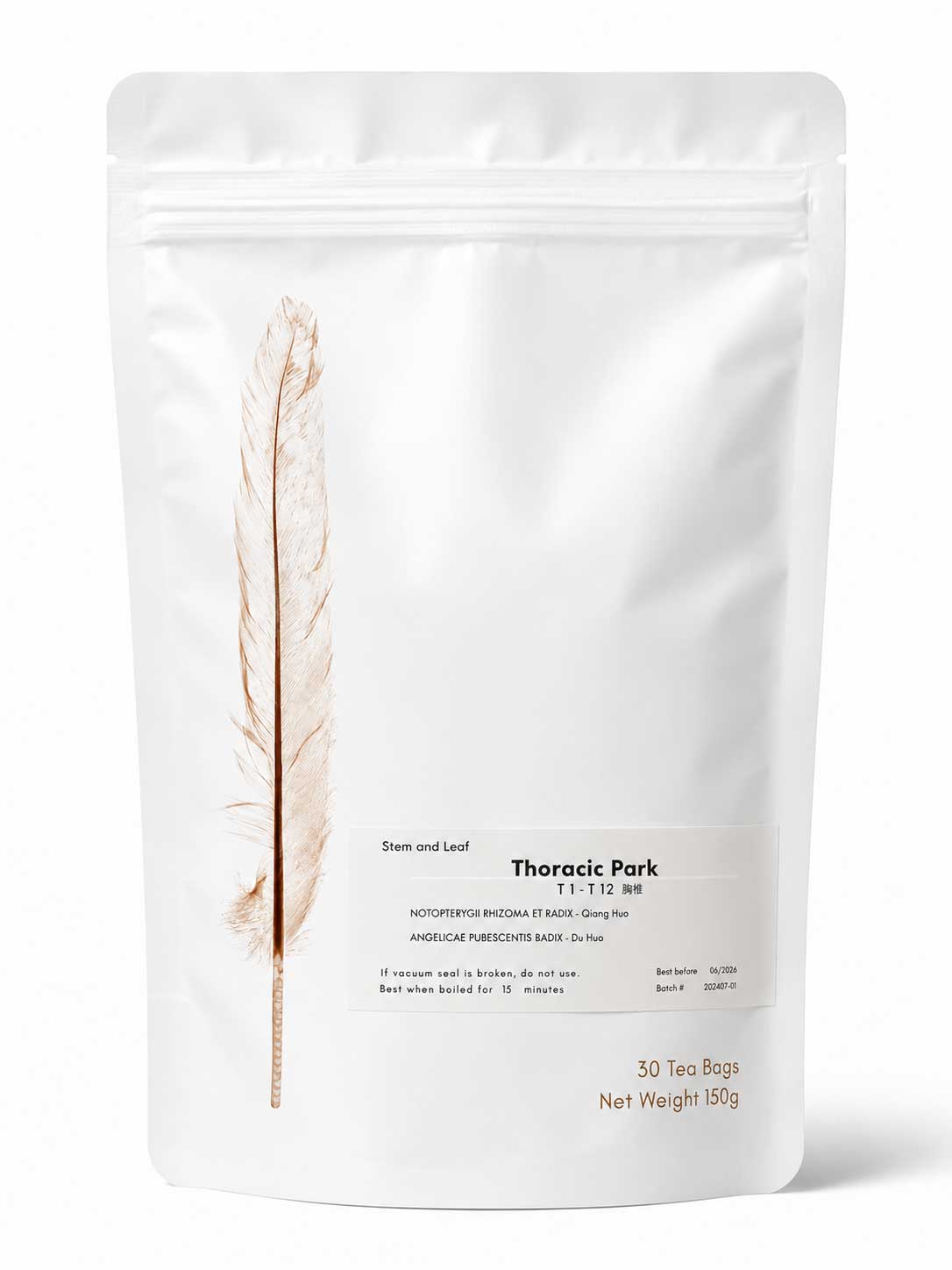
- Thoracic Park — the mid-back, T1 through T12. Built on Qiang Huo (ascending, upper body) and Du Huo (descending, lower body); the pairing covers the long stretch between them.
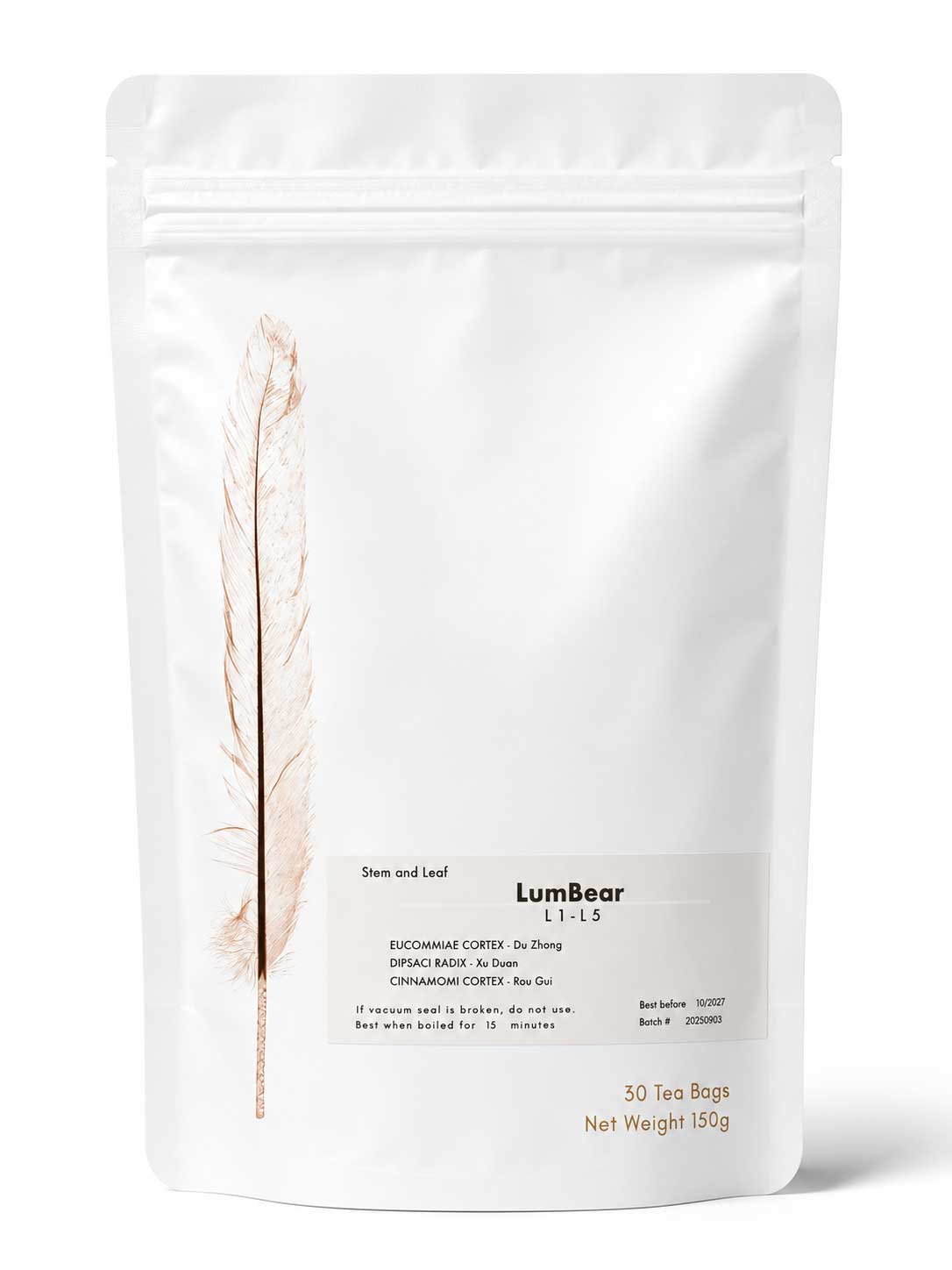
- LumBear — the low back, L1 through L5. Three herbs, because the lumbar spine carries the most load: Du Zhong (eucommia bark), Xu Duan (dipsacus root, whose name means "restore what is broken"), and Rou Gui (cinnamon bark) for warmth.
- Sacrocox — the sacrum and tailbone. Chuan Niu Xi (cyathula root) is the classical downward-guiding herb, used to send a formula's action all the way to the base; Ba Ji Tian (morinda root) warms and supports that base.
If the pain sits at a boundary — the base of the neck into the top of the shoulder blades, or the low back into the tailbone — pick the region where the pain starts in the morning, or use the two teas that border it. Each of the four has its own detailed write-up if you want the full herb-by-herb reasoning.
What the Research Actually Shows
This is where I’d rather be useful than impressive. The evidence behind these herbs is real in places and thin in others, and you deserve to know which is which.
Where the evidence is strongest
Duhuo Jisheng decoction — the classical formula built on Du Huo, one of Thoracic Park’s two herbs — has a genuine clinical literature behind it. A 2024 evidence-based guideline in the Journal of Evidence-Based Medicine used the GRADE system to review traditional Chinese treatments for lumbar disc herniation and included it among its recommendations. A meta-analysis pooling fourteen trials and more than 1,500 patients found modified Duhuo Jisheng decoction outperformed NSAIDs on pain scores with fewer adverse events, and a BMJ Open review found it improved knee osteoarthritis outcomes when added to conventional drugs.
That same BMJ Open review also stated plainly that the underlying trials carried a high risk of bias — which is the honest caveat that belongs on almost everything in this section.
The bone-support herbs have good laboratory evidence and little human data. Du Zhong and Xu Duan, the two lumbar herbs, are among the most-studied bone herbs in the materia medica: reviews across dozens of studies describe them consistently pushing bone metabolism toward formation and away from breakdown, with asperosaponin VI (Xu Duan’s marker compound) concentrated by the traditional frying processes. Almost all of that is cell and animal work. The human data is described by the researchers themselves as preliminary.
Where there are no human trials at all
Mu Gua, in Sir Vickle, has analgesic and anti-arthritic activity demonstrated in rats and none in people. Ba Ji Tian, in Sacrocox, is the same story. And Ge Gen — the neck herb — is the most frequently used ingredient across Chinese patent medicines for cervical spondylosis, which tells you what practitioners reach for, not that it has been proven to work. There is no English-language randomized trial of Ge Gen Tang for neck pain, and I’m not going to pretend otherwise.
What that adds up to
Rou Gui is the one place with clean human data, and it isn’t about backs: a meta-analysis of twelve randomized trials found cinnamon supplementation measurably lowered inflammatory markers in people with cardiometabolic conditions. Suggestive. Not the same as pain relief.
So: traditional use that runs a thousand years deep, a real evidence base for one branch of the family, and honest gaps everywhere else. That’s the picture, and you should be suspicious of anyone who paints it more confidently.
Using the Four Together
The teas can be used alone or combined. Two adjacent regions is the common case — most backs don’t respect anatomical boundaries.
- Start with one. Pick the region that bothers you most and give it a few weeks before adding anything. If you start with two, you learn nothing about either.
- Combine adjacent regions when pain spans a boundary — neck into mid-back, or low back into tailbone. Together the four cover the better part of the spine.
- Layer topically if you want to — a topical like Evil Bone Water works on the surface while a tea works from the inside. They aren't competing.
What none of them do is replace the boring fundamentals. Movement, sleep, how you sit, and hands-on care do the heavy lifting for chronic back pain. I say that to patients constantly, and it stays true when I’m the one selling the tea.
How They're Sourced and Tested
The same protocol runs across the entire Botanical Biohacking line. Every batch is tested before formulation for three classes of contamination: heavy metals (lead, cadmium, arsenic, mercury), pesticide residue — which even herbs labeled organic can pick up from neighboring fields — and microbial load, including bacteria, mold, and aflatoxins. Growers test first; the company re-tests at a contracted lab. A batch that fails either round doesn’t enter the line.
I mention this because it’s the question I’d want asked of me. If a supplier can’t tell you their contamination-testing protocol, that’s the thing to ask about — not the marketing.
The Stem & Leaf Line
All four spinal teas — Sir Vickle, Thoracic Park, LumBear, and Sacrocox. Region-specific guide herbs, thirty teabags each. Practitioner-formulated and batch-tested, available at Valley Health Market.
When Back Pain Needs a Doctor, Not a Tea
Get evaluated promptly for back pain that is new and severe, pain that radiates down a limb, or pain accompanied by numbness, weakness, fever, unexplained weight loss, or any loss of bladder or bowel control. That last one is an emergency, not a wait-and-see.
Herbal formulas also aren’t neutral. If you are pregnant or nursing, taking anticoagulants, managing a chronic condition, or on prescription medication, talk to a qualified practitioner before starting any of these — Rou Gui in particular is a warming herb that doesn’t suit everyone, and herb-drug interactions are real. If you’re local to Albany and want help choosing, call the clinic at 541-760-9670.
Related Reading
- Sir Vickle: For the Neck That Has Hurt for Years — the full write-up on Ge Gen and Mu Gua
- Thoracic Park: For Mid-Back Pain That Gets Minimised — Qiang Huo, Du Huo, and the region no one takes seriously
- Stem & Leaf LumBear: Three Guide Herbs for the Low Back — Du Zhong, Xu Duan, and Rou Gui
- Stem & Leaf Sacrocox: For Tailbone Pain You Can’t Sit Through — sending a formula all the way down
- How to Fix Chronic Neck Tension — the movement and posture side of the same problem
- Ao Yi Acupoint Pain Patches: Needle-Free Herbal Support — the topical companion to a spinal tea
- Botanical Biohacking Teas: Which Formula Fits You? — the companion guide to the rest of the line
References
- Qin X, Sun K, Xu W, et al. An evidence-based guideline on treating lumbar disc herniation with traditional Chinese medicine. Journal of Evidence-Based Medicine. 2024;17(1):187–206. Link
- Xiong Z, Yi P, Zhang L, et al. Efficacy and Safety of Modified Duhuo Jisheng Decoction in the Treatment of Lumbar Disc Herniation: A Systematic Review and Meta-Analysis. Evidence-Based Complementary and Alternative Medicine. 2020;2020:2381462. Link
- Zhang W, Wang S, Zhang R, et al. Evidence of Chinese herbal medicine Duhuo Jisheng decoction for knee osteoarthritis: a systematic review of randomised clinical trials. BMJ Open. 2016;6(1):e008973. Link
- Wang Y, et al. Traditional medicine in a modern light: a scoping review on the osteoprotective potential of Eucommia ulmoides. Frontiers in Pharmacology. 2026;16:1673870. Link
- Tao Y, Huang S, Yan J, Cai B. Traditional uses, processing methods, phytochemistry, pharmacology and quality control of Dipsacus asper Wall. ex C.B. Clarke: A review. Journal of Ethnopharmacology. 2020;258:112912. Link
- Huang D, et al. Analgesic and Anti-Arthritic Activities of Polysaccharides in Chaenomeles speciosa. Frontiers in Pharmacology. 2022;13:744915. (Animal study.) Link
- Liu M, et al. A systematic review on polysaccharides from Morinda officinalis How. Journal of Ethnopharmacology. 2024;328:118090. (Preclinical.) Link
- Meng KY, et al. Achyranthes bidentata Bl. and Cyathula officinalis Kuan: ethnopharmacology, phytochemistry, and pharmacology. Journal of Pharmacy and Pharmacology. 2025;77(11):1461–1490. Link
- Zhu C, Yan H, Zheng Y, et al. Impact of Cinnamon Supplementation on cardiometabolic Biomarkers of Inflammation and Oxidative Stress: A Systematic Review and Meta-Analysis of Randomized Controlled Trials. Complementary Therapies in Medicine. 2020;53:102517. Link
- Fan Y, et al. Chinese Patent Medicines for Cervical Spondylosis: A Comprehensive Review and Current Status of Clinical Research. International Journal of General Medicine. 2026;19:575879. Link
- Wang S, Hu Y, Tan W, et al. Compatibility art of traditional Chinese medicine: from the perspective of herb pairs. Journal of Ethnopharmacology. 2012;143(2):412–423. Link
- Xie Q, et al. A Comprehensive Review of Coptidis Rhizoma and Magnoliae Officinalis Cortex Drug Pair. Drug Design, Development and Therapy. 2024;18:4413–4426. Link
- Christopher M. Volesky, L.Ac., Rocky Mountain Herb Supply. Stem and Leaf guide herb formulations. Distributor product note, July 2026.
- Bensky D, Clavey S, Stöger E. Chinese Herbal Medicine: Materia Medica, 3rd ed. Eastland Press, 2004.
A note on evidence: the Stem & Leaf line is a practitioner-formulated support product. We are not attaching clinical-trial claims to it. What we can tell you is which herbs are in it, why they were chosen, who formulated them, and — as above — where the published research is strong and where it is thin.
Educational content rooted in 20+ years of clinical practice in Traditional Chinese Medicine. The information provided is for educational purposes and is not intended to replace consultation with a qualified healthcare practitioner. Please consult your physician before starting any new herbal protocol, especially if pregnant, nursing, on anticoagulants, or managing a chronic condition.

FAQ's
Which Stem & Leaf tea should I choose?
Choose by where the pain starts, not where it radiates. Sir Vickle is the neck (C1–C7), Thoracic Park is the mid-back (T1–T12), LumBear is the low back (L1–L5), and Sacrocox is the sacrum and tailbone. If your pain spans a boundary, pick the region that bothers you first thing in the morning, or use the two teas that border it.
What is a guide herb?
In classical Chinese formula construction, some herbs are chosen not only for what they do but for where they carry the rest of the formula — upward to the head and neck, downward to the pelvis and legs. Modern research doesn’t test that idea directly, but it does study herb pairs as the smallest fixed unit of a formula, and there is analytical work showing that extracting two herbs together produces different chemistry than extracting either alone.
Is there research behind these teas?
Partly, and it’s uneven. The strongest evidence belongs to Duhuo Jisheng decoction, the classical formula built on Du Huo (one of Thoracic Park’s herbs), which appears in a 2024 GRADE-based guideline and in meta-analyses for lumbar disc herniation and knee osteoarthritis — though reviewers consistently note the underlying trials carry a high risk of bias. Du Zhong and Xu Duan have strong laboratory bone data and preliminary human data. Mu Gua, Ba Ji Tian, and Ge Gen for neck pain have no human trials in the English literature. We’d rather tell you that than imply otherwise.
Can I take more than one at the same time?
Yes. The teas can be used alone or combined, and combining two adjacent regions is common because backs don’t respect anatomical boundaries. That said, start with one and give it a few weeks — if you start two at once, you learn nothing about either.
When should I see a doctor about back pain instead?
Promptly, for back pain that is new and severe, pain that radiates down a limb, or pain with numbness, weakness, fever, unexplained weight loss, or any loss of bladder or bowel control — that last one is an emergency. Herbal formulas are a companion to movement, posture, sleep, and hands-on care, not a replacement, and anyone pregnant, nursing, on anticoagulants, or managing a chronic condition should talk to a qualified practitioner first.
Recent Posts
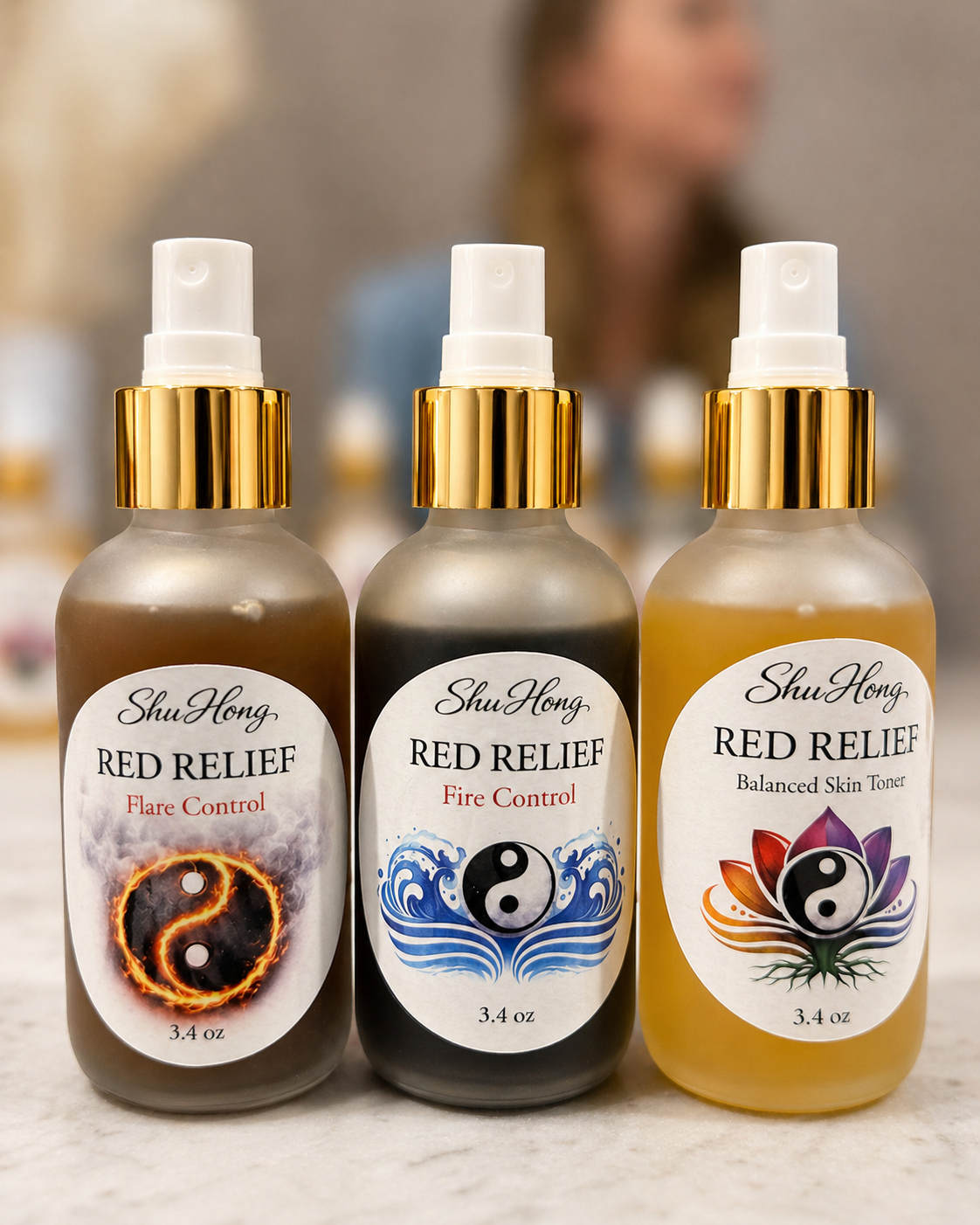
Psoriasis Flare Ups and Why You Need Three Sprays
Dr. Meli, in her own words, on why she and her husband built the Shu Hong
Does Evil Bone Water Work? An Acupuncturist Reads the Research
Does Evil Bone Water work? An acupuncturist reviews the evidence for Zheng Gu Shui, camphor, menthol,

Acupuncture for Ménière’s Disease: The Points I Use
Learn which acupuncture points Will Sheppy uses for Ménière’s disease, vertigo and dizziness, plus treatment frequency