Category: Topical Medicine

What Is a Dit Da Jiao? Fu Medicinals

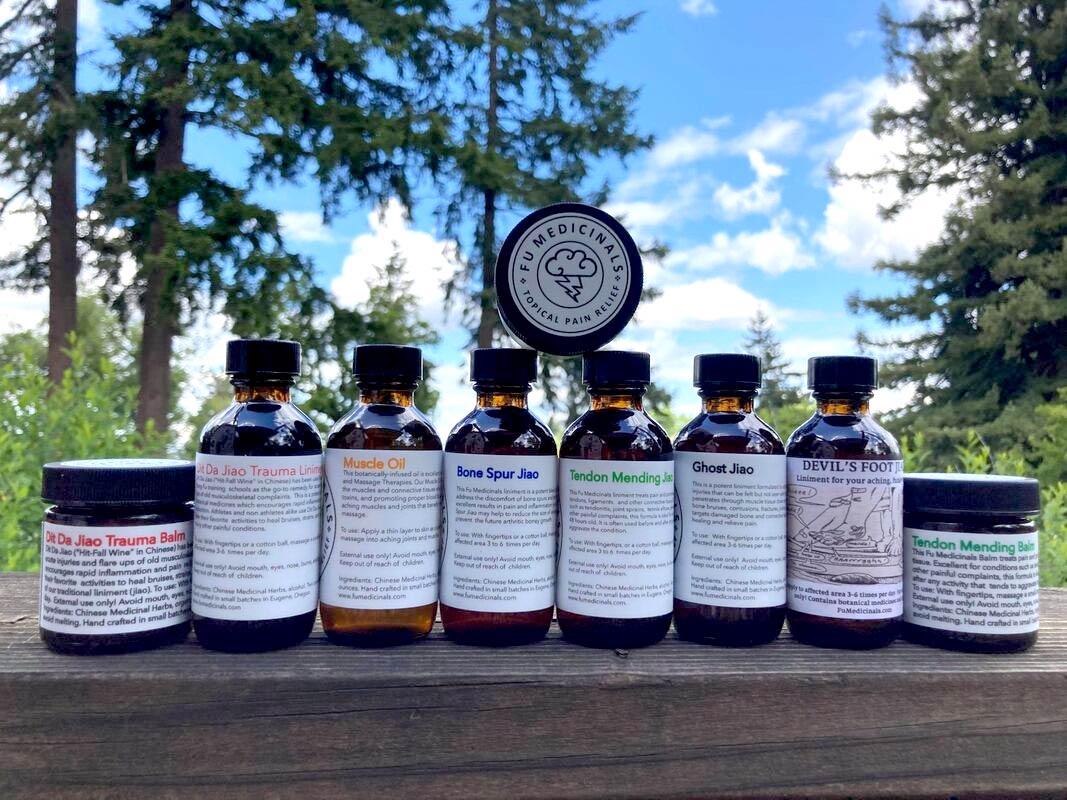
Fu Medicine Formulas Herbal Line up
17 minutes read

What Is a Dit Da Jiao? Fu Medicinals

Willard Sheppy Dipl. OM, LAc, BS

Willard Sheppy is a licensed acupuncturist (LAc) and Founder of Valley Health Clinic specializing in using Traditional Chinese Medicine to treat acute injuries and chronic conditions, and to improve sports performance and rehabilitation.

Fu Medicine Formulas Herbal Line up

Table of Contents

When you buy something for pain, you assume newer is better. Fresher herbs, a more recent batch, more punch.

With liniments it runs the other way. Some of the bottles we carry are more than ten years old — on purpose. That isn’t old stock sitting around. That’s the medicine finishing itself.

I’ve been using Fu Medicinals on patients in my Albany clinic for a while now, and it’s one of the few topical lines where I can point to a person, a place, and a process. That person is John, an acupuncturist who spent fourteen years developing these formulas in a working treatment room. Here’s what a jiao actually is, what the aging does, and which of the three formulas fits which kind of pain.

Quick answer

A jiao (roughly “jee-yow”) is a traditional Chinese herbal liniment — medicinal herbs steeped in alcohol and applied to the skin, never swallowed. Fu Medicinals makes three of them, handcrafted in small batches in Oregon, and nothing is released until it has aged at least two years. Each formula targets a different depth of injury: PNW Dit Da Trauma for acute injury and bruising, Tendon Mending for tendons and ligaments, Bone Spur for chronic joint and bone pain. External use only — talk to your doctor first if you are pregnant.

What Is a Jiao — and Why Does Age Matter?

A jiao is an alcohol extraction. Herbs go into high-proof spirits, and the alcohol pulls the medicinal constituents out of the plant material over time. Unlike a cream or a gel, it isn’t finished the day it’s bottled — the extraction keeps going.

That’s the whole argument for aging it. The longer the herbs and the alcohol sit together, the more completely the formula comes out, and the more the individual herbs stop behaving like a list and start behaving like one medicine. John’s rule is that nothing leaves his shop under two years old, and some of what ends up on our shelf is well past a decade.

Dit da jiao is the most famous member of the family. It translates, almost comically literally, to “hit fall wine” — the medicine you reach for when someone got hit, or fell. It has been the standard first-aid topical in Chinese martial arts halls for a very long time, which is exactly the pedigree you want in something meant for a fresh bruise.

"When it comes to liniments, the older the more potent."
— John Ditmars, maker of Fu Medicinals

Meet John Ditmars, the Maker Behind Fu Medicinals

Fu Medicinals didn’t start as a product line. It started as an acupuncturist making liniments for his own aches — John is an athlete, and he specializes in pain-based conditions — and then for the patients in front of him. Fourteen years of adjusting the recipes based on what actually worked in the treatment room is how three formulas came out the other side. The name nods to the Kung Fu healing tradition these recipes come from.

He’s clear about what he was reacting against. He had tried the brands sitting in his acupuncture school clinics and on store shelves and didn’t want any of it: no synthetic chemicals, no overpowering odor, and nothing formulated to produce a dramatic tingle. As he puts it, that sensation doesn’t necessarily mean the product is working — it just means people have been trained to expect it.

Here is what actually separates these from the topical aisle:

I care about that history for a practical reason. A topical made by someone who has to look a patient in the eye next week gets revised. A topical made to hit a price point does not. That’s the standard anything has to clear before it earns shelf space at Valley Health Market.

The Three Formulas, and When I Reach for Each

Chinese medicine thinks about injury in layers — blood and muscle nearest the surface, then sinew and connective tissue, then bone. Fu Medicinals color-codes the labels to match: red for the blood and muscle level, green for tendon, blue for bone. Once you know that, choosing is mostly a matter of asking how deep the problem sits and how long it has been there.

PNW Dit Da Trauma — the acute one

Fresh injury, bruising, swelling, the ankle you rolled on Saturday

This is the “hit fall wine” formula, and it’s the one to have in the cupboard before you need it. The Pacific Northwest version leans on mugwort (Ai Ye) to answer the cold and damp we actually live in, and it combines warming and cooling herbs so it can be used while things are still hot and swollen. Twenty-eight herbs in total.

Tendon Mending — the connective-tissue one

Tendonitis, a ligament sprain that hasn’t settled, any nagging tweak in a tendon. It’s built around Gu Sui Bu (drynaria), the herb whose name translates roughly as “mender of shattered bones,” and the base is organic coconut oil and beeswax in the balm version. Worth knowing: this one is warming, which is the point of it — and which is why it isn’t the right choice in the first day or two after a fresh injury.

Bone Spur — the deep, chronic one

Bone spurs and osteoarthritis — which in Chinese medicine is always read as a long-standing pattern rather than an acute event. E Zhu (zedoary rhizome) does the heavy lifting here, aimed at blood and qi stagnation that has had years to set in. Thirty-plus herbs, and the one I reach for when someone’s joint pain has been part of their life long enough that they’ve stopped mentioning it.

  PNW Dit Da Traumared — blood & muscle Tendon Mendinggreen — sinew Bone Spurblue — bone
Best forBruises, sprains, knocks, fresh swellingTendonitis, ligament sprains, nagging tweaksBone spurs, osteoarthritis, deep joint ache
StageAcute — hours to days oldSub-acute to chronic — weeks to monthsChronic — months to years
Signature herbAi Ye (mugwort)Gu Sui Bu (drynaria)E Zhu (zedoary rhizome)
TemperatureWarming and cooling together — usable while hot and swollenWarming — wait 1–2 days after a fresh injuryWarming — built for long-standing stagnation
Comes asJiao (2 oz liniment) or balmJiao (2 oz liniment) or balmJiao (2 oz liniment) or balm

Jiao or Balm? How to Choose

Every recipe comes two ways: the traditional jiao — a 2 oz alcohol liniment — and a modern balm that puts the same formula in an organic coconut oil and beeswax base. They aren’t competing versions of the same thing. They suit different situations, and plenty of patients end up owning both.

Reach for the jiao when…

You want fast penetration and you’re applying several times a day

The alcohol carries the herbs in and then evaporates, so nothing is left sitting on the skin. That makes it easy to reapply through the day without building up a greasy layer, and it’s the form that has been aged.

Reach for the balm when…

The skin is dry or irritated, you’re using it as a glide medium for massage or cupping, or you’re traveling and would rather not carry a liquid. The balm stays put longer and is gentler on skin that’s already unhappy.

The gauze trick

For a longer soak, put the jiao on a piece of gauze and tape it over the area rather than rubbing it in. It’s a traditional method and it keeps the herbs in contact with the tissue far longer than a two-minute massage does. Good for an evening on the couch or overnight on a stubborn joint.

What the Research Actually Shows

I want to be straight about this: these specific formulas have not been through clinical trials. Handmade, small-batch liniments almost never are — there is nobody to fund the study. What has been studied, in laboratories and in animals, is the individual herbs, and some of that work lines up neatly with what the tradition has been claiming for centuries.

Frankincense and myrrh, tested as a pair

The combination outperformed either resin used alone

Ru Xiang and Mo Yao appear together in nearly every trauma formula in the Chinese materia medica, and researchers have tested whether the pairing is actually doing something. In mouse models of inflammation and pain, the combined extract suppressed swelling and reduced pain behavior more effectively than frankincense or myrrh on their own (Su et al., 2012).

Gu Sui Bu and the bone-and-sinew claim

Drynaria, the anchor of Tendon Mending, has a connective-tissue reputation going back centuries. In cell studies its water extract protected osteoblasts — the cells that build bone — from oxidative damage and pushed them toward maturity (Hsu et al., 2011). Naringin, its main constituent, sped up fracture healing in rats by improving blood-vessel growth at the fracture site (Song et al., 2017).

Ai Ye, the herb that makes it a Pacific Northwest formula

More than 200 compounds have been identified in mugwort’s essential oil, with anti-inflammatory and analgesic activity documented across a wide body of work — alongside a clear note from the same reviewers that the oil is not harmless in quantity (Liu et al., 2021).

None of that proves a liniment will fix your shoulder. It is laboratory and animal evidence about ingredients, not human trials of a finished product. But it is a good deal more than nothing, and it is consistent with what I see when I use these in the treatment room.

"That sensation doesn't necessarily mean that the product is working — but people are familiar with those tingles via products they've previously tried, and might expect it to be a sign that the topical is working."
— John Ditmars, on why Fu Medicinals doesn't chase the burn

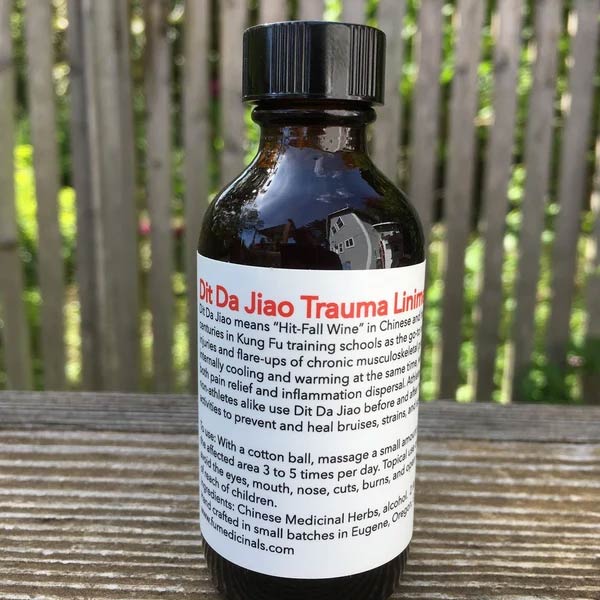
PNW Dit Da Jiao Trauma Liniment by Fu Medicinals

Fu Medicinals at Valley Health Market

Three formulas. Two forms. Aged at least two years.

We carry all three Fu Medicinals formulas at Valley Health Market, in both the traditional jiao and the balm, starting at $25 for a 2 oz liniment. There are also two bundles if you’d rather keep the acute and the chronic option on hand at the same time.

How to Use a Liniment — and When Not To

Application is simple, and doing it often matters more than doing it heavily.

  1. Massage a small amount into the sore area with your fingertips or a cotton ball until it’s absorbed.
  2. Repeat several times a day — three or four is reasonable for something you’re actively working on.
  3. For deeper contact, apply the liniment to a piece of gauze and tape it over the area for a longer stretch.
  4. Wash your hands afterward, and keep it well away from your eyes.

Cautions, and I mean these

External use only — never take a jiao internally

  • Not on broken skin, open wounds, or mucous membranes. Avoid sensitive areas and keep it out of reach of children.
  • If you are pregnant, talk to your doctor before using any of these. Several of the herbs in these formulas move blood, which is exactly why they work on bruises and exactly why pregnancy is a different conversation.
  • Tendon Mending is warming — that’s the point of it — which makes it the wrong choice in the first day or two after a fresh injury, while things are still hot and swollen. Use the Dit Da formula in that window instead.
  • If you have herbal or plant allergies, read the full ingredient list on the product page first. The equipment these are made on contacts a wide range of medicinal herbs.

When to stop rubbing and get it looked at

A liniment supports tissue while it heals. It is not a way of finding out what’s wrong. Get the injury assessed if you can’t bear weight, the joint looks deformed, the swelling came on hard and fast, or you have numbness, tingling, or weakness anywhere downstream of it. The same goes for pain that hasn’t budged after a couple of weeks of sensible self-care — that’s information, and it’s worth acting on rather than covering up.

Which Formula Should You Start With?

If you’re standing in front of the three of them trying to decide, the question isn’t “which is strongest.” It’s how deep is the problem, and how long has it been there. Something that happened this week, at the level of muscle and bruise, wants the Dit Da. Something in a tendon that has been grumbling for a month wants Tendon Mending. Something in a joint that has been part of your life for years wants Bone Spur.

And if you genuinely can’t tell — which is common, because pain is a bad narrator — start with the acute formula. It’s the most broadly useful of the three, it’s the one martial artists have kept on the shelf for centuries for exactly that reason, and it won’t be wasted.

Your Next Step

Not sure which one fits what you’re dealing with?

Call the clinic at (541) 760-9670 or stop by at 220 5th Ave SW in Albany and ask. That’s a two-minute conversation and it’s free — and if what you’re describing sounds like something a topical won’t touch, I’d rather tell you that than sell you a bottle.

These statements have not been evaluated by the Food and Drug Administration. These products are not intended to diagnose, treat, cure, or prevent any disease. This article is educational and is not a substitute for individual medical advice.

References

Su S, Hua Y, Wang Y, et al. Evaluation of the anti-inflammatory and analgesic properties of individual and combined extracts from Commiphora myrrha and Boswellia carterii. Journal of Ethnopharmacology. 2012;139(2):649–656. Link →

Hsu CK, Liao MH, Tai YT, et al. Nanoparticles prepared from the water extract of Gusuibu (Drynaria fortunei J. Sm.) protects osteoblasts against insults and promotes cell maturation. International Journal of Nanomedicine. 2011;6:1405–1413. Link →

Song N, Zhao Z, Ma X, et al. Naringin promotes fracture healing through stimulation of angiogenesis by regulating the VEGF/VEGFR-2 signaling pathway in osteoporotic rats. Chemico-Biological Interactions. 2017;261:11–17. (animal study) Link →

Liu Y, He Y, Wang F, et al. From longevity grass to contemporary soft gold: Explore the chemical constituents, pharmacology, and toxicology of Artemisia argyi H.Lév. & Vaniot essential oil. Journal of Ethnopharmacology. 2021;279:114404. Link →

Ditmars J. About John Ditmars the Maker — interview and product FAQ. Valley Health Clinic. Link →

Share on

Will Sheppy, Founder and Acupuncturist at Valley Health Clinic
Willard Sheppy
Willard Sheppy is a licensed acupuncturist (LAc) and Founder of Valley Health Clinic specializing in using Traditional Chinese Medicine to treat acute injuries and chronic conditions, and to improve sports performance and rehabilitation.

FAQ's

What does "dit da jiao" mean?

It translates almost literally as “hit fall wine” — the medicine you use after someone has been hit or has fallen. It’s an alcohol-based herbal liniment that has been the standard first-aid topical in Chinese martial arts for a very long time, and it’s the tradition the PNW Dit Da Trauma formula comes out of.

A jiao is an alcohol extraction, and the alcohol keeps drawing constituents out of the herbs long after the bottle is sealed. Fu Medicinals releases nothing under two years old, and some bottles are well over ten. As maker John Ditmars puts it: with liniments, the older the more potent.

Same formula, different carrier. The jiao is the traditional 2 oz alcohol liniment — it penetrates quickly and evaporates, which suits applying several times a day. The balm puts the same herbs in an organic coconut oil and beeswax base, so it stays on the skin longer and is gentler on dry or irritated skin. Plenty of people keep both.

Tendon Mending is the one built for connective tissue — tendonitis, ligament sprains, and lingering tweaks. It’s a warming formula, though, so it isn’t the right choice in the first day or two after a fresh injury while things are still hot and swollen. Use PNW Dit Da Trauma in that window instead.

Talk to your doctor first. Several of the herbs in these formulas move blood — which is precisely why they help with bruising and stagnation — and that makes pregnancy a conversation to have with your provider rather than a decision to make from a label. All of these are for external use only, and none should go on broken skin.

Recent Posts

How Real St. John’s Wort Oil Is Made

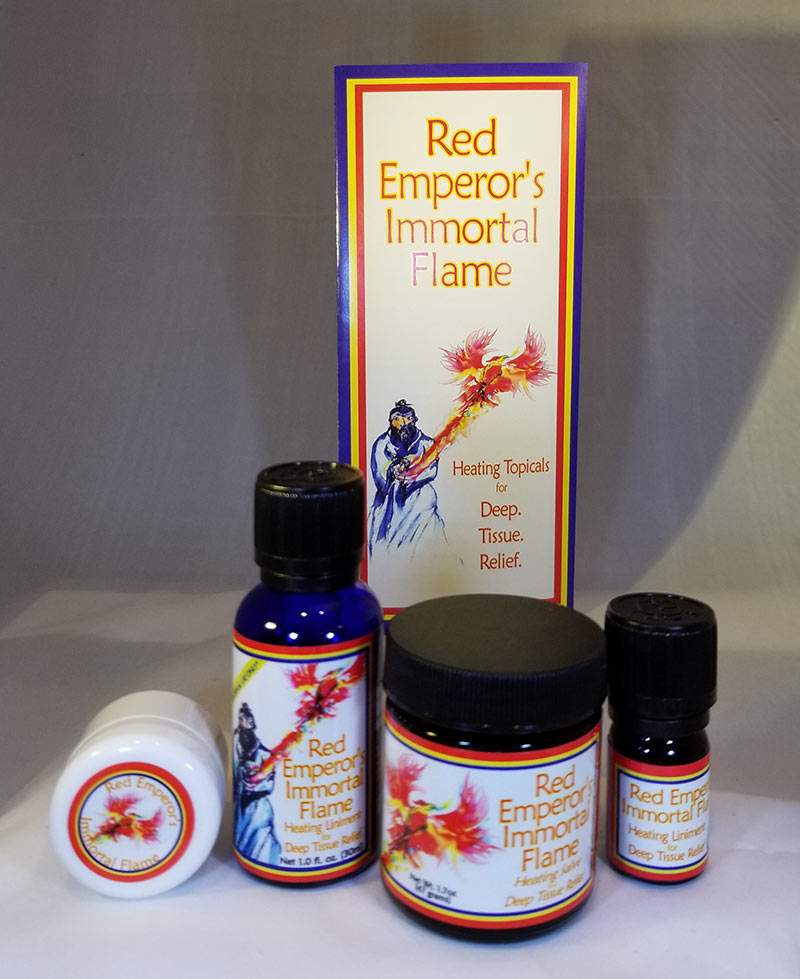
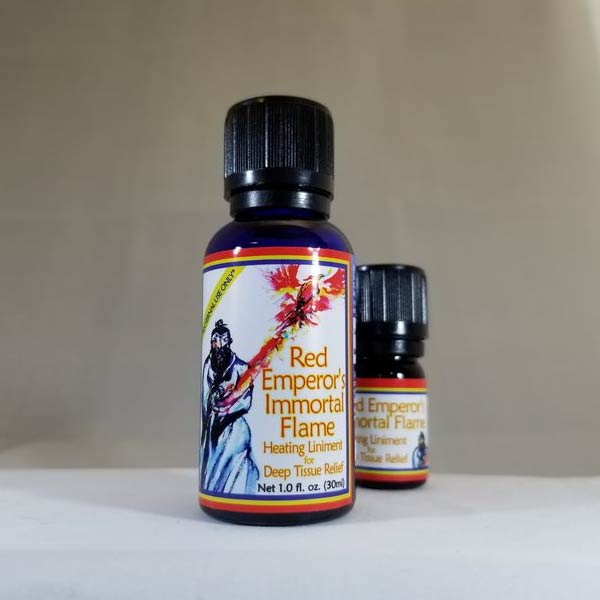
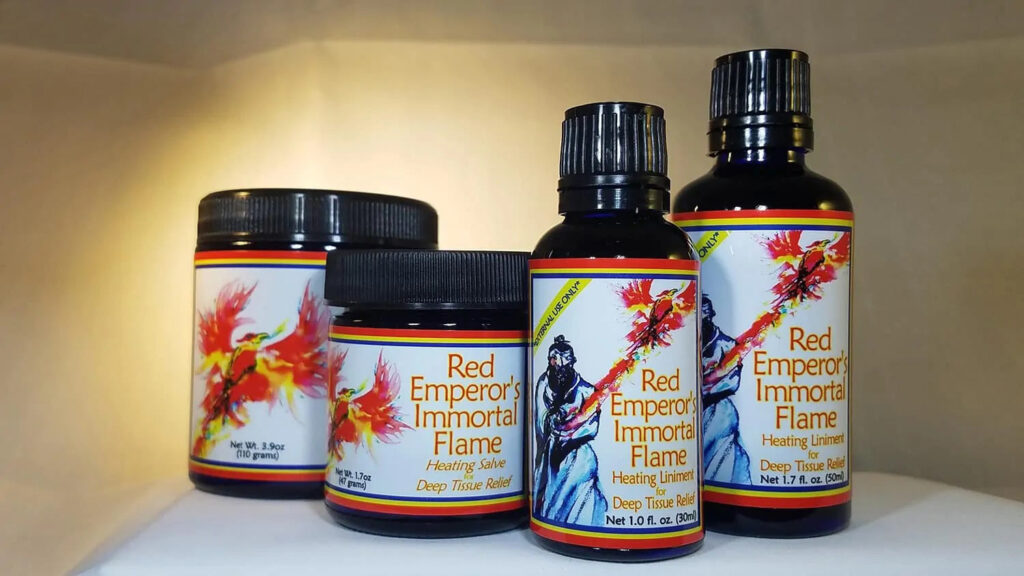
Red Emperor's Immortal Flame
16 minutes read

How Real St. John’s Wort Oil Is Made

Willard Sheppy Dipl. OM, LAc, BS

Willard Sheppy is a licensed acupuncturist (LAc) and Founder of Valley Health Clinic specializing in using Traditional Chinese Medicine to treat acute injuries and chronic conditions, and to improve sports performance and rehabilitation.

Red Emperor's Immortal Flame

Table of Contents

If you have ever bought an herbal oil and wondered whether there was really any herb in it, you are asking exactly the right question. A lot of what gets sold as “St. John’s wort oil” is a pale yellow-green liquid that has been sitting on a shelf under fluorescent light for a year, and there is no easy way for a customer to tell the difference.

I carry Red Emperor’s Immortal Flame in the clinic and on the shelf at Valley Health Market, and the question patients ask me about it is almost never “does it work.” It is “what is actually in it.” So I asked Hugh Turcotte, L.Ac. — the acupuncturist and clinical herbalist who makes it — to walk through the part nobody usually gets to see: how the St. John’s wort goes from a field in the last week of June to the red oil in the bottle.

Here is that process, and the two things you can look at to judge any St. John’s wort oil for yourself.

Quick answer

St. John’s wort (Hypericum perforatum) is identified in the field by squeezing a flower bud — the real plant stains your fingers purple. For medicinal oil, the flowering tops are harvested at full flower in late June, cold-packed the same day, screen-dried about 48 hours to drive off water, then packed into glass with organic olive oil and left in full sun for roughly two weeks. A properly made oil turns deep red. Red Emperor’s Immortal Flame is built on that infused oil and is for external use only.

Not Every Yellow Flower Is St. John's Wort

There are a lot of yellow, five-petalled flowers in a summer field, and most of them are not Hypericum perforatum. Hugh’s test is the one herbalists have used for centuries, and it takes about two seconds.

Squeeze an unopened flower bud between your thumb and forefinger. If it is real St. John’s wort, your finger turns purple-red. That stain is the hypericin — the same pigment that will eventually color the oil. The species name perforatum points at the second check: hold a leaf up to the light and it looks pinpricked, because it is dotted with translucent oil glands.

This matters more than it sounds like it should. In a study of twenty-one home-made and commercial St. John’s wort olive-oil macerates, the researchers’ conclusion was blunt: the infused oils contained active components if the correct plant material was used. Identification is not a botany-nerd detail. It is the first quality-control step, and everything downstream depends on it.

“That red is one of the ways we know that it is what we say it is.”

— Hugh Turcotte, L.Ac., maker of Red Emperor’s Immortal Flame

From Field to Workshop in 24 Hours

This is the part of the process Hugh had never really shown before, and it is the part that separates a medicinal oil from a decorative one. There is nothing exotic in it — just a sequence where every step exists to protect the last one.

Here is the sequence, start to finish:

Nothing in that list is glamorous. But skip the cold pack and you lose actives to heat in transit; skip the drying and you get mold; use plastic instead of glass and you lose the sun infusion entirely. Each step is there to protect the one before it.

Why the Last Week of June Matters

Hugh sources his St. John’s wort from domestic organic farmers who harvest it in the last week of June — not because of a production schedule, but because that is when the plant has put the most into its flowering tops.

Research

Actives peak at full flowering (Pharmaceutical Biology, 2013)

In a study tracking two Hypericum species across five growth stages — vegetative, floral budding, full flowering, fresh fruiting and mature fruiting — hypericin and pseudohypericin reached their highest levels at full flowering. The authors’ recommendation was direct: harvest during flower development when the material is intended for medicinal use.

Harvest two weeks early or three weeks late and you are working with weaker raw material. No amount of careful processing afterward puts back what was never picked.

The folklore, and why it lines up

The traditional name comes from the same week. The Feast of St. John the Baptist falls on June 24, and the plant is at full flower right around it. Medieval Europeans hung it in doorways to ward off evil spirits — which is a folk memory of a plant people clearly took seriously, tied to exactly the window when it is strongest.

What to ask a maker

“When was this harvested?” is a fair question to put to anyone selling an herbal oil, and the answer tells you whether they are buying on a spec sheet or on a season. A maker who can name the week is paying attention to the plant. One who cannot is buying whatever was available.

Why Glass, and Why the Sun

Glass is, in Hugh’s own words, “very inconvenient, actually.” It is heavy, it breaks, and it costs more to ship. Plastic would be easier at every step. He uses glass anyway, because the extraction method depends on it: the jars have to sit in direct sunlight and take on heat, and that gentle solar warming is what pulls hyperforin and hypericin out of the plant material and into the oil.

This is a slow method by design. There is no press, no solvent, no heated tank turning out a batch in an afternoon. Two weeks of sun does the work that industrial processing does faster and cruder. You are paying for time here as much as for ingredients — which is also why a small-batch oil like this will never compete on price with a mass-market liniment, and is not trying to.

Research

What actually ends up in an infused oil (Food Chemistry, 2013)

Researchers profiled twenty-one St. John’s wort olive-oil macerates — some home-made, some commercial — and analyzed them by LC-DAD-MS. Hypericin and pseudohypericin turned up in all of the oils. Hyperforin, which is far less stable, was detected in only four of the twenty-one, and adhyperforin in six.

That spread is the whole argument for method. Same plant, same solvent, wildly different results depending on how the oil was made. The authors’ conclusion was that infused Hypericum oils can carry active components — provided the correct plant material is used to begin with.

Why the slow way survives

If hyperforin is the fragile one, then heat, light exposure at the wrong stage, and time on a warehouse shelf all work against it. Sun infusion in sealed glass is a compromise: enough warmth to extract, gentle enough not to cook. It is not the most efficient method available. It is the one that has kept producing usable oil for several hundred years.

What this costs, practically

Two weeks per batch, a fixed harvest window once a year, glass that has to be shipped carefully, and a raw material that has to be flown in cold. That is the real price of the method, and it is why this is made in small batches rather than continuously.

The botanical approach

St. John’s wort is one part of a longer formula. The infused oil is the base, not the whole story. Red Emperor’s Immortal Flame also carries menthol, wintergreen, arnica, calendula, ginger, mustard seed and cayenne in an olive-oil carrier — a warming, circulating combination aimed at stiff, cold, achy tissue rather than at hot, acutely inflamed injury.

Made by Hugh Turcotte, L.Ac., Dipl. O.M. — carried at Valley Health Market because it earns the shelf space.

What the Red Color Actually Tells You

Olive oil goes into the jar green-gold. Two weeks later it comes out deep red. That color change is the single most useful thing a customer can look at, because it is hard to fake and it is the visible signature of the compounds you are buying the oil for.

Research

Topical Hypericum has been studied in real wound healing

In a randomized, double-blind trial of 144 women following cesarean delivery, a topical Hypericum perforatum ointment applied three times daily for 16 days produced significantly better wound healing at day 10 and less scarring, pain and itching at day 40 than either placebo or no treatment. A separate seven-week pilot study of a St. John’s wort, calendula and garlic ointment on venous leg ulcers reported 99.1% epithelialization.

Neither of those studies is about muscle or joint pain, and I am not going to stretch them into a claim they do not make. What they do establish is that topical preparations of this plant have been taken seriously enough to be tested properly — which is more than most liniment ingredients can say.

What you can check yourself

Hold the bottle up to a window. If a product sold as St. John’s wort oil is pale and yellow, something in the chain — the identification, the harvest window, the drying, or the infusion — did not happen the way it should have.

It is not a laboratory assay, and I would not want anyone to read it as one. Plenty of variables sit between color and potency. But it is a real marker, and it is one you can see without taking anyone’s word for it.

Two questions worth asking

Beyond the color, ask any maker two things: when was it harvested, and how was it extracted. Those two answers cover most of what separates a medicinal oil from a cosmetic one. If nobody can answer them, that tells you something too.

“The reason I use glass — it’s very inconvenient, actually. But the reason I use glass is because we’re going to get the heat infusion with the sunlight exposure.”

— Hugh Turcotte, L.Ac.

Red Emperor's Immortal Flame

Red Emperor's Immortal Flame

Sun-infused St. John’s wort, made the slow way

A warming herbal oil for stiff joints and soft tissue — the kind of ache that likes a heating pad. Made in small batches by Hugh Turcotte, L.Ac., and a good glide medium for cupping, gua sha and bodywork. External use only.

How I Use It in the Clinic

Red Emperor’s Immortal Flame is a warming oil, and I reach for it with the patients whose pain is worse in the cold and better with heat — stiff joints that take twenty minutes to loosen up in the morning, old injuries that ache when the weather turns, the necks and shoulders that show up in an Oregon January. In Chinese medicine terms it is aimed at Bi syndrome patterns with a cold-damp character. In plainer language: it is for the pain that likes a heating pad.

Where it fits

A treatment-room tool, not just a shelf product

The olive-oil base makes it genuinely useful under cupping, gua sha and hands-on bodywork, which is a large part of why it lives in my treatment room and not only on the retail shelf. If I am working a stiff shoulder with a cup, I want something with slip that is also doing something.

For an acute, hot, swollen injury I reach for something cooling instead. Matching the herb to the tissue state matters more than picking a favorite bottle.

How to apply it

The oil is concentrated. Six to eight drops is a liberal application, and a 30 ml bottle holds over 500 drops — roughly 60 to 80 applications. Work it in for several minutes rather than dabbing it on; the massage is part of the point.

Topical herbal preparations like this are traditionally used to support comfort in muscles and joints. They are not a treatment for any named disease, and nothing here is a substitute for evaluation of a new or worsening problem.

Before You Use It

External use only. This is a medicinal-strength topical formula and should be used with care. Do not take it internally, keep it away from eyes and mucous membranes, and do not apply it to broken skin.

If you are pregnant or nursing, talk to your healthcare provider before using it. If you have not used a warming liniment before, test a small area first — menthol, wintergreen, ginger and cayenne together produce real heat, and skin sensitivity varies a lot from person to person.

References

Orhan IE, Kartal M, Gülpinar AR, Cos P, Matheeussen A, Maes L, Tasdemir D. Assessment of antimicrobial and antiprotozoal activity of the olive oil macerate samples of Hypericum perforatum and their LC-DAD-MS analyses. Food Chemistry. 2013;138(2-3):870–875. Link →

Cirak C, Radusiene J, Camas N, Caliskan O, Odabas MS. Changes in the contents of main secondary metabolites in two Turkish Hypericum species during plant development. Pharmaceutical Biology. 2013;51(3):391–399. Link →

Samadi S, Khadivzadeh T, Emami A, Moosavi NS, Tafaghodi M, Behnam HR. The effect of Hypericum perforatum on the wound healing and scar of cesarean. Journal of Alternative and Complementary Medicine. 2010;16(1):113–117. Link →

Kundaković T, Milenković M, Zlatković S, Nikolić V, Nikolić G, Binić I. Treatment of venous ulcers with the herbal-based ointment Herbadermal®: a prospective non-randomized pilot study. Forschende Komplementärmedizin. 2012;19(1):26–30. Link →

Citations located via PubMed. Product details from the Red Emperor’s Immortal Flame product page.

Share on

Will Sheppy, Founder and Acupuncturist at Valley Health Clinic
Willard Sheppy
Willard Sheppy is a licensed acupuncturist (LAc) and Founder of Valley Health Clinic specializing in using Traditional Chinese Medicine to treat acute injuries and chronic conditions, and to improve sports performance and rehabilitation.

FAQ's

How can I tell if a plant is really St. John's wort?

Squeeze an unopened flower bud between your fingers. Real Hypericum perforatum stains your skin purple-red from the hypericin it contains. As a second check, hold a leaf up to the light — it looks perforated with tiny translucent dots, which is where the species name comes from.

The red comes from hypericin and related compounds moving out of the flowering tops and into the oil during the sun infusion. Olive oil goes into the jar green-gold and comes out deep red. It is a visible marker that the right plant was used and that the extraction actually happened — not a potency measurement, but a real signal.

Because the gentle, sustained warmth of two weeks of direct sunlight is what draws hyperforin and hypericin out of the plant material and into the olive oil. That is also why the jars are glass rather than plastic, despite glass being heavier, more fragile and less convenient at every stage.

Water left in the flowering tops creates a mold risk once the material is submerged in oil. Screen-drying for about 48 hours brings the moisture down far enough that the infusion stays stable. It is a shelf-stability step, not a shortcut.

It is a warming formula, so it suits pain that feels better with heat — stiff joints, old aches that flare in cold weather, muscles that need loosening. It is for external use only. If you are pregnant or nursing, check with your provider first, and get new or worsening pain properly evaluated rather than managing it with a topical.

Recent Posts

Tibetan Herbal Foot Soak: For Heavy, Swollen Summer Feet

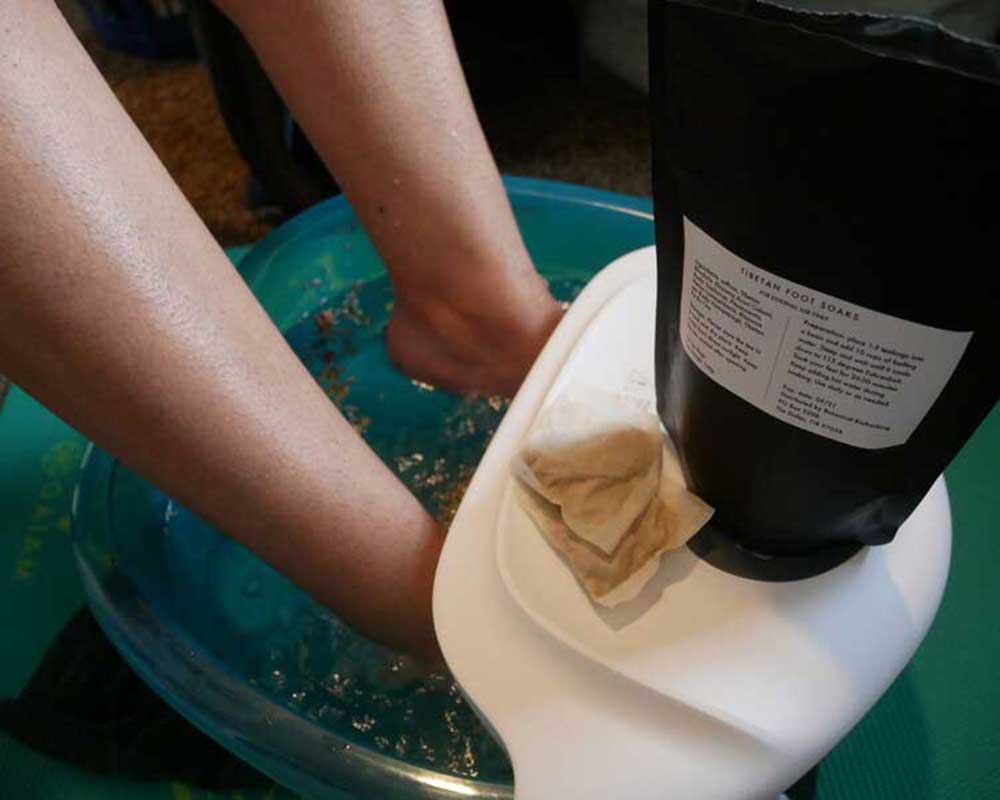
Tibetan Herbal Foot Soaks in Foot Bath
6 minutes read

Materia Medica · The Ritual Series

Tibetan Herbal Foot Soak: For Heavy, Swollen Summer Feet

Willard Sheppy Dipl. OM, LAc, BS

Willard Sheppy is a licensed acupuncturist (LAc) and Founder of Valley Health Clinic specializing in using Traditional Chinese Medicine to treat acute injuries and chronic conditions, and to improve sports performance and rehabilitation.

Tibetan Herbal Foot Soaks in Foot Bath

Table of Contents

This one is for the patients who feel heavy in summer.

Warm herbal foot soaking is one of the oldest self-care rituals in the world. In the Tibetan tradition it draws on plants that grow where almost nothing else will — at brutal altitude and cold. Those are the herbs this soak is built around.

Here’s the pattern it was written for, the one instruction that matters most, and what’s inside.

Quick Answer

The Tibetan Herbal Foot Soak is a warm evening soak built on high-altitude Tibetan plateau herbs and mineral-rich Tibetan salt, for the summer damp-heat pattern: swollen feet by evening, sleep that breaks in the second half of the night, and a leaden heaviness that lifts only with movement. The protocol is specific — twenty minutes, not longer, three to four times a week through the warmer months. If you have diabetes, neuropathy, reduced sensation, or open wounds, check the water temperature carefully and talk with your provider first.

Who This Soak Is For

Dr. Xuelan Qiu of Botanical Biohacking describes the person these were built for with real precision: swollen feet by evening. Sleep that begins well and then breaks in the second half of the night. A leaden quality through the lower body that lifts only with movement.

That’s a damp-heat pattern — one that rises with the season and refuses to clear with diet alone. The company’s own shorthand for the product is direct: high-altitude Tibetan growers, damp-heat.

The Protocol: Twenty Minutes, Not Longer

This is the most useful thing we can pass along, and it comes straight from the formulator. It is refreshingly specific, and it corrects the most common mistake.

Inside the Formula

The blend leans on some of the most revered plants of the Tibetan plateau, grouped by the job each does.

Regenerate

Relax and Warm

Replenish

Before You Soak

If you have diabetes, neuropathy, reduced sensation in your feet, or any open wounds, check the water temperature carefully and talk with your provider first. Skip it entirely on broken skin.

An evening foot soak draws heat downward and quiets the upward churn that keeps a busy mind from settling. That is the whole mechanism, and it is why people sleep better the same night. — Will Sheppy, L.Ac.

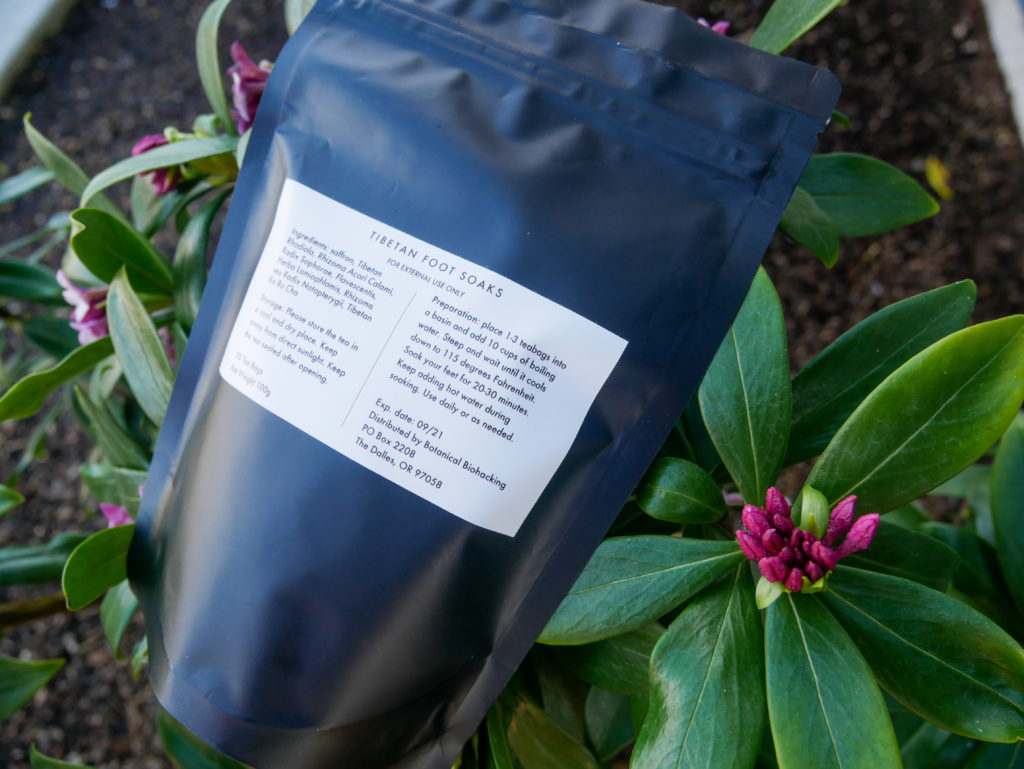
Tibetan Foot Soak Product Photo

Tibetan Herbal Foot Soak

20 tea bags. High-altitude Tibetan herbs and mineral-rich salt, for the heavy, swollen, damp-heat pattern that rises with the season. Available at Valley Health Market.

Research & Resources

  1. Qiu X, Botanical Biohacking. Summer use of Tibetan Herbal Foot Soaks. Practitioner note distributed via Rocky Mountain Herb Supply, June 2026.
  2. Bensky D, Clavey S, Stöger E. Chinese Herbal Medicine: Materia Medica, 3rd ed. Eastland Press, 2004. (Reference for Hong Hua, Ai Ye, Qiang Huo, and Ku Shen.)
  3. Cui ZH, Qin SS, Zang EH, et al. Traditional uses, phytochemistry, pharmacology and toxicology of Lamiophlomis rotata (Benth.) Kudo: a review. RSC Adv. 2020;10(19):11463–11474. PubMed →

Educational content rooted in 20+ years of clinical practice in Traditional Chinese Medicine. The information provided is for educational purposes and is not intended to replace consultation with a qualified healthcare practitioner. Please consult your physician before starting any new herbal protocol, especially if pregnant, nursing, on anticoagulants, or managing a chronic condition.

Share on

Will Sheppy, Founder and Acupuncturist at Valley Health Clinic
Willard Sheppy
Willard Sheppy is a licensed acupuncturist (LAc) and Founder of Valley Health Clinic specializing in using Traditional Chinese Medicine to treat acute injuries and chronic conditions, and to improve sports performance and rehabilitation.

FAQ's

What is the Tibetan Herbal Foot Soak for?

It was built for a summer damp-heat pattern: swollen feet by evening, sleep that begins well and then breaks in the second half of the night, and a leaden heaviness through the lower body that lifts only with movement. It draws on high-altitude Tibetan plateau herbs and mineral-rich Tibetan salt.

Twenty minutes is the working window — not longer. Three to four times a week through the warmer months. Longer is not better; soaking for an hour does not improve the result, and people often describe deeper sleep the same night.

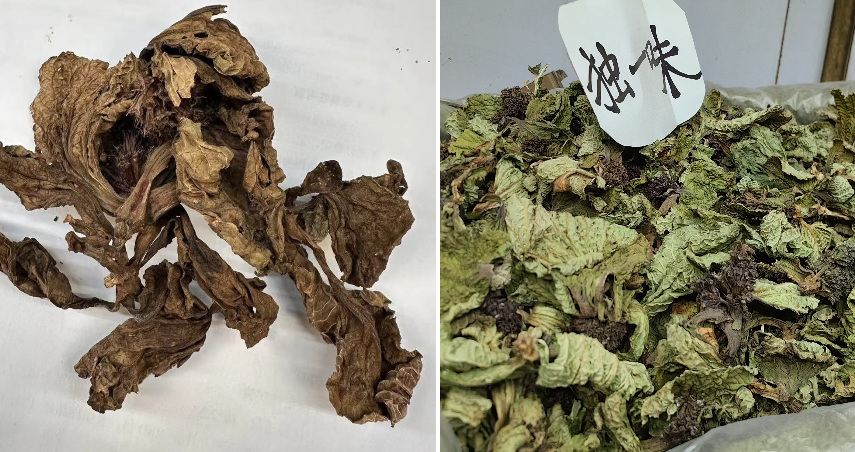
Some of the most revered plants of the Tibetan plateau, grouped by job: to regenerate — Du Yi Wei (Lamiophlomis rotata), Hong Jing Tian (Rhodiola), and Hong Hua (safflower); to relax and warm — Zang Chang Pu (Acorus), Qiang Huo, Ai Ye (mugwort), and Gan Jiang (dried ginger); and to replenish — mineral-rich Tibetan salt and Ku Shen.

If you have diabetes, neuropathy, reduced sensation in your feet, or any open wounds, check the water temperature carefully and talk with your provider first. Skip it entirely on broken skin.

Recent Posts

American Made Chinese Medicine | Valley Health Market Wholesale

8 minutes read

American Made Chinese Medicine | Valley Health Market Wholesale

Willard Sheppy Dipl. OM, LAc, BS

Willard Sheppy is a licensed acupuncturist (LAc) and Founder of Valley Health Clinic specializing in using Traditional Chinese Medicine to treat acute injuries and chronic conditions, and to improve sports performance and rehabilitation.

Table of Contents

Quality Chinese Medicine, American Made: Valley Health Market

A practitioner curated wholesale program built around small batch, American made Chinese herbal products that actually deliver results.
If you’re an acupuncturist, herbalist, or wellness practitioner, you already know the problem.
You went to school, you studied the classics, you learned what real Chinese herbal medicine is supposed to do. Then you go online to source products for your patients and… it’s a sea of cheap, mass-produced, low-grade junk. Watered-down formulas. Mystery ingredients.
You want Chinese medicine that works. The kind that gives the results your teachers described. The kind that earns your patients’ trust on the first application.
That’s exactly the problem Valley Health Market was built to solve and today, we’re opening our practitioner wholesale program to the broader acupuncture and bodywork community.

Real medicine. Real people. Done the right way.

Fifteen Years of Sourcing. One Curated Catalog.

My name is Will Sheppy, L.Ac. I’m a licensed acupuncturist and the founder of Valley Health Clinic in Albany, Oregon. I’ve spent the last fifteen years doing one thing obsessively: tracking down the highest quality Chinese herbal products on the market especially American made, small-batch formulas from makers who give a damn.
Every single product in our catalog has been personally tested in my clinic. On my patients. On their bruises, nerve pain, tendinopathies, chronic gut issues, eczema flares, and everything in between.
And until now, that catalog was only available to the my patients through our retail store. Today, we’re extending it to fellow practitioners through Valley Health Market Wholesale.

What Makes Valley Health Market Different

There are a lot of places to buy Chinese herbal products. Here’s what sets us apart from the rest:

Practitioner-curated

Every product is clinically tested in my acupuncture clinic before it earns shelf space. No theoretical formulas. No ‘we hope it works.’ Real results, real patients, real outcomes.

Small-batch, American-made

We focus on American made, small batch formulas from independent makers who source their own herbs and craft their own products. These are family businesses, master herbalists, and clinicians making medicine the way it’s supposed to be made.

Imperial-grade herbs

Most of the brands we carry source their raw ingredients through the Botanical Biohacking quality network the same network founded by Andrew Miles and Xuelan Qiu, PhD, DOM, who’ve dedicated their lives to safeguarding the integrity of Chinese herbal medicine globally.

No junk. No filler

We carry a small, focused catalog. You won’t find shelves cluttered with hundreds of redundant SKUs. You’ll find the products that actually move the needle in clinic.

We use what we sell.

We’re not a faceless distributor. We’re a working acupuncture clinic plus a marketplace plus a third-party fulfillment operation. We understand what you need because we use these products every day.

Wholesale High Quality American Made Chinese Medicine.

Get exclusive wholesale access to a curated catalog of clinically tested, American-made Chinese medicine designed for licensed practitioners. Elevate your clinic with premium, small-batch formulas that prioritize patient results over mass-produced quality.

The Brands We Carry

These aren’t names you’ll recognize from Amazon. They’re makers we’ve personally vetted, often known and respected by other practitioners. Here’s a quick tour of the lineup.

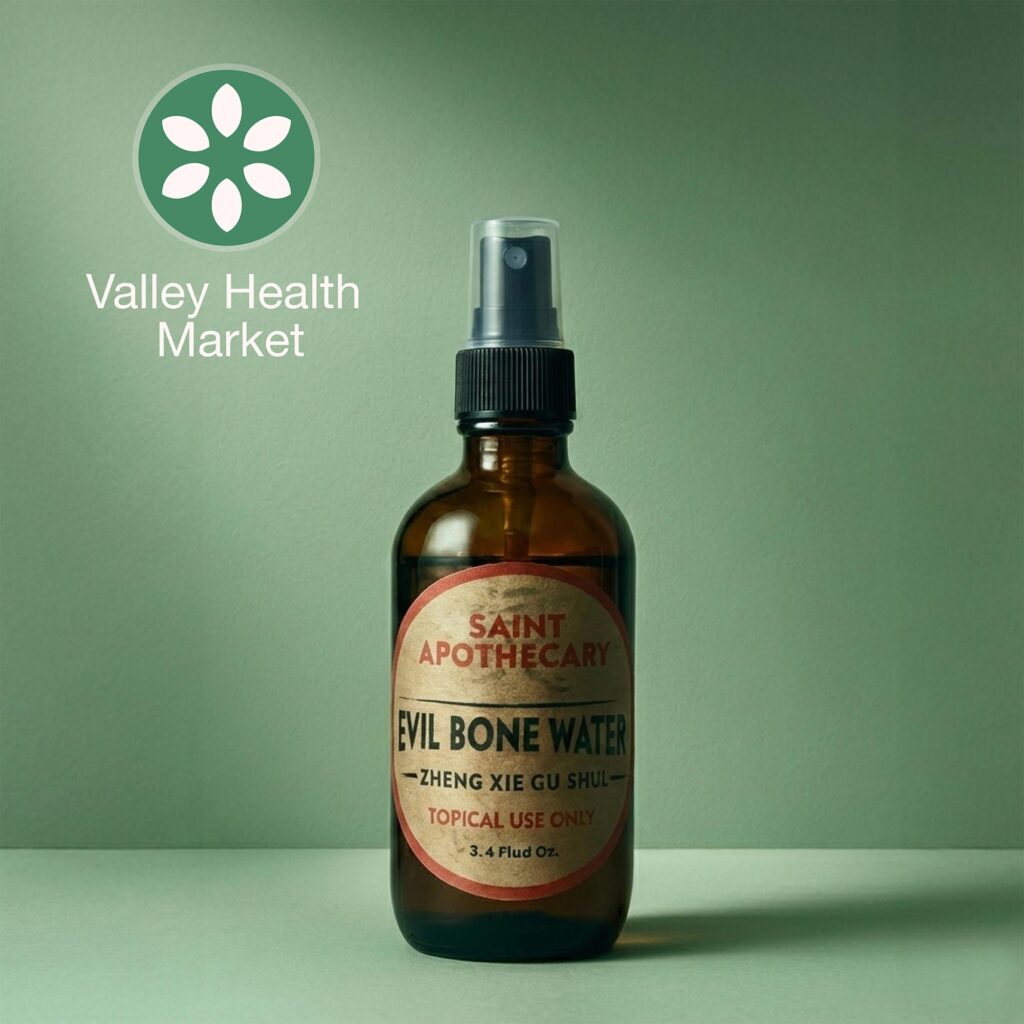
Evil Bone Water (Saint Apothecary)

Our best-selling product, period. A traditional Zheng Gu Shui formula rebuilt from the original Imperial-grade ingredients by Mark Brinson, DOM, AP. Mark was so frustrated by the watered down versions on the market that he went back to the classical texts, sourced the legacy herbs, and rebuilt it the right way. The result is a fast-acting, broad-use liniment that works on muscle pain, bruises, sprains, bug bites, stiff joints almost anything. If you carry only one topical, this is it.

Red Emperor's Immortal Flame

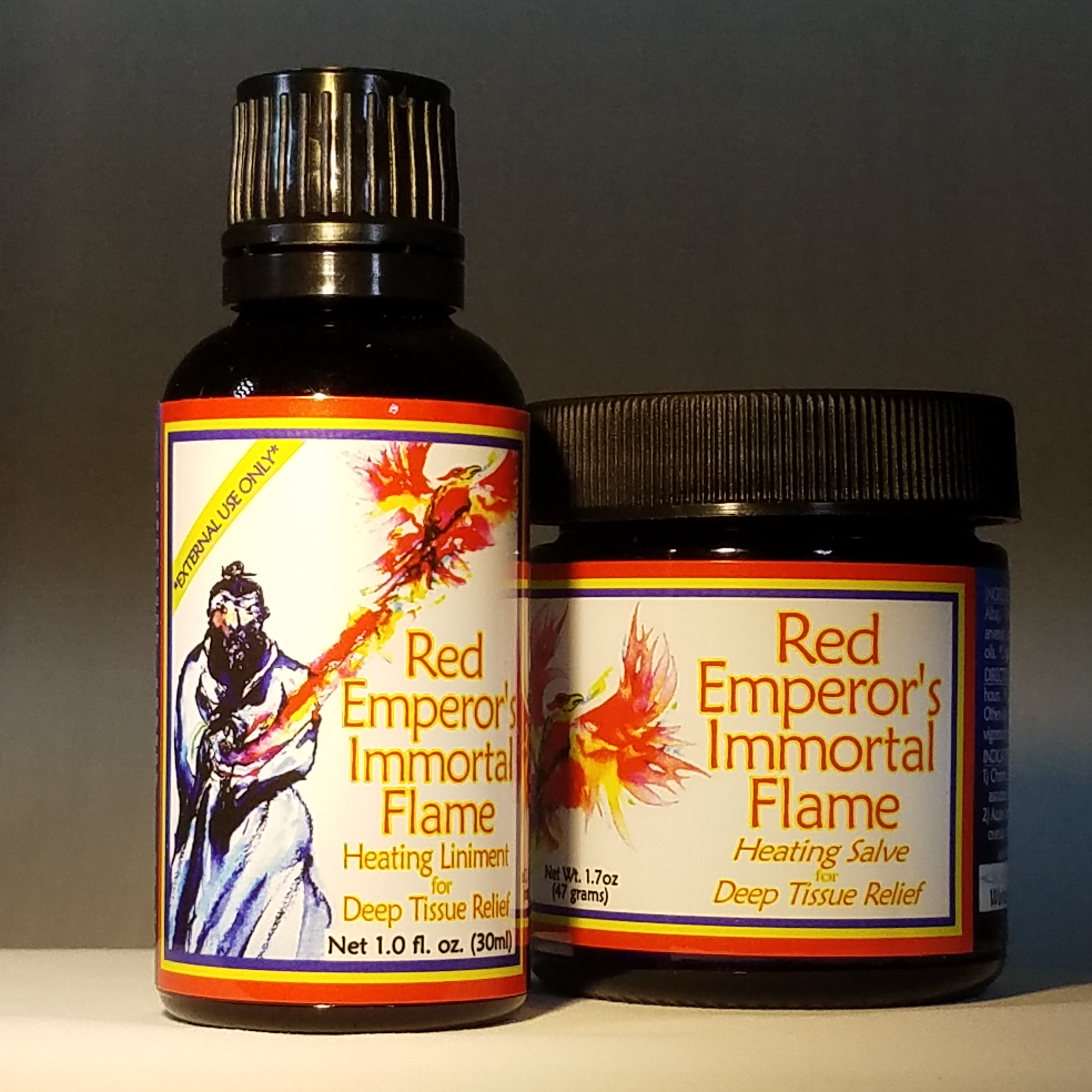
A warming herbal oil hand-crafted by Hugh Turcotte, L.Ac., from a family recipe passed down from his uncle and sensei, Sifu Tom Turcotte, DOM. Olive oil base, organic wintergreen, ginger, cinnamon, cayenne, mustard seed. Ideal for cold-type pain, stiff joints, and as a glide medium for cupping, gua sha, or massage. Pairs beautifully with Evil Bone Water for full-spectrum hot/cold therapy.

Corydalis PLUS Relief Salve

Our go-to for nerve pain including chemotherapy- and diabetes-induced neuropathy. Created by Eliz Britton, DTCM, L.Ac., who developed it to manage her own pain after back surgery. Built around Yan Hu Suo (Corydalis), it’s gentle, no overwhelming smell, no aggressive hot/cold sensation. Patients with sensitive skin love it. We pair it with Evil Bone Water as our Pain Power Combo.

Gut Harmony (Chorus for Life)

A clinical-grade dietary supplement that supports the microbiome, gut barrier integrity, and the gut-brain axis. Sixteen-herb proprietary blend including Fu Ling, Huo Xiang, Cang Zhu, Ge Gen, and more. This is our most-recommended internal formula for patients dealing with chronic inflammation, digestive complaints, or any chronic pain pattern with a gut component (which, if you’ve been in clinic any length of time, you know is most of them).

Botanical Biohacking

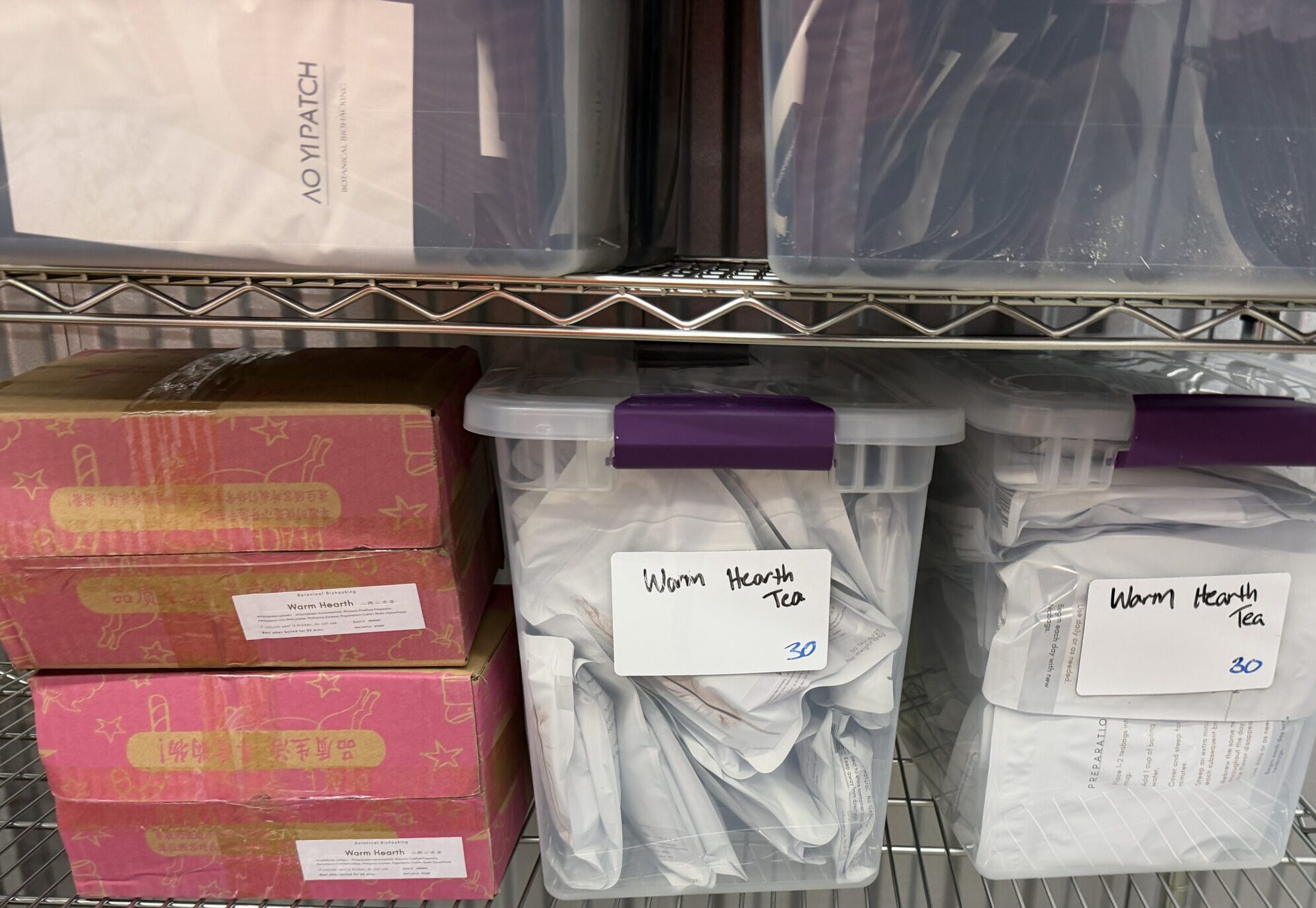
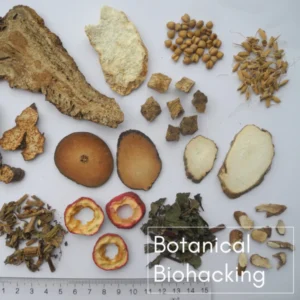
The quality network at the heart of much of what we carry. Andrew Miles and Xuelan Qiu, PhD, DOM, have spent decades sourcing the freshest, most potent herbs directly from origin including annual trips to the Tibetan plateau for Du Yi Wei. We carry their AO YI Acupoint Patches, AO YI Herbal Tea, and Tibetan Herbal Foot Soaks at practitioner wholesale pricing.

Fu Medicinals

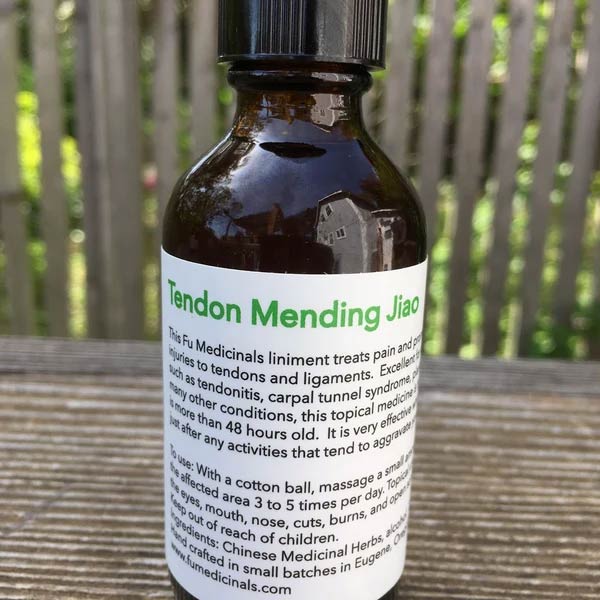
John Ditmars, L.Ac., crafts focused, single-purpose trauma liniments using a traditional decoction process that takes one to three years per batch. His Tendon Mending Jiao, Bone Spur Jiao, and PNW Dit Da Trauma Salve were developed for the extreme kayaking community in the cold Pacific Northwest. If you treat athletes, climbers, or anyone with stubborn tendinopathy, these belong in your dispensary.

Emily Skin Soothers

Family-made topicals for eczema, psoriasis, baby rashes, and sensitive skin. We carry their Herbal Ice Skin Soothing Bar Soap, Unscented Skin Soother, and Sage & Palo Santo room spray. Simple, clean ingredients. No synthetic fragrances, parabens, or aerosols. The kind of products you can recommend to patients with confidence.

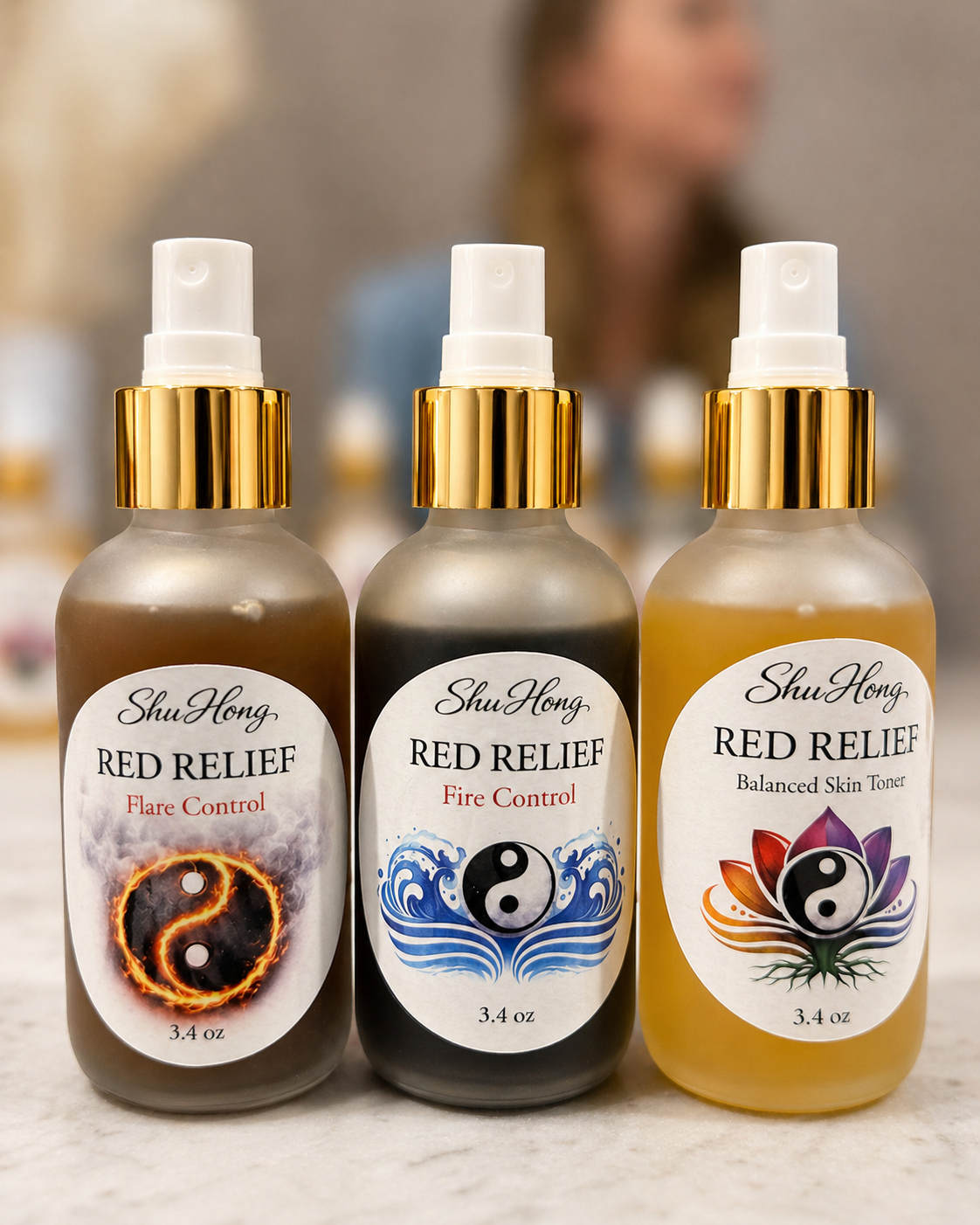
Shu Hong Balanced Skin Toner

Clinical-strength skin support spray for reactive, inflamed, or barrier-compromised skin. Built on a classical core with Huang Qi, Mai Men Dong, and Yin Er (Tremella fuciformis). Twenty-five percent alcohol base for rapid absorption. Great for rosacea-type presentations, post-procedure skin, and patients you’d otherwise be sending to a dermatologist with a prescription pad.

Who This Is For (And Who It Isn't)

Let me be direct: we’re not opening this up to everyone.
This wholesale program is for licensed clinicians and serious wellness practitioners who do good work and represent these brands well. That means:
There’s an application process. We’re not opening the floodgates to dropshippers, Amazon resellers, or anyone looking to slap these labels on a cheap-products page. The makers we work with care deeply about how their products are represented, and so do we.
If you’re a clinician doing real work and you want access to Chinese medicine that actually works, apply for wholesale access here.

Why This Matters for the Profession

Chinese medicine has a credibility problem in the West and a lot of it is self-inflicted. When patients buy cheap, ineffective products online and don’t get results, it reflects on all of us. They don’t blame the product; they blame the medicine.
Every time a practitioner stocks high-quality, American-made Chinese herbal products and a patient experiences real, lasting relief, that’s a win for the whole profession. It rebuilds trust. It validates what we do. It raises the bar.
That’s the bigger picture here. Valley Health Market Wholesale isn’t just a business it’s a way for those of us who care about quality to support each other, support American small-business herbal makers, and put better tools in more hands.

Real people. Real medicine . Done the Right way

How to Apply

Ready to stock products that actually work? Here’s how to get started:

Visit

shop.valleyhealthclinic.com. Browse the full catalog and brand lineup.

Submit a wholesale application

We review every application personally. Tell us about your practice, the products you’re interested in, and how you plan to use them.

Get approved

If approved, you get access to practitioner wholesale pricing, fulfillment through our 3PL operation, and ongoing support from a working acupuncture clinic.

Share on

Will Sheppy, Founder and Acupuncturist at Valley Health Clinic
By Will Sheppy, L.Ac
Will Sheppy, L.Ac., is the founder of Valley Health Clinic and Valley Health Marketplace in Albany, Oregon. He specializes in sports acupuncture, pain management, and Chinese topical medicine. Valley Health Marketplace carries only products he has personally tested in his clinic.

Recent Posts

Zheng Gu Shui (Evil Bone Water)

13 minutes read

Zheng Gu Shui (Evil Bone Water)

Will Sheppy, Founder and Acupuncturist at Valley Health Clinic
Willard Sheppy Dipl. OM, LAc, BS

Willard Sheppy is a licensed acupuncturist (LAc) and Founder of Valley Health Clinic specializing in using Traditional Chinese Medicine to treat acute injuries and chronic conditions, and to improve sports performance and rehabilitation.

Table of Contents

Evil Bone Water

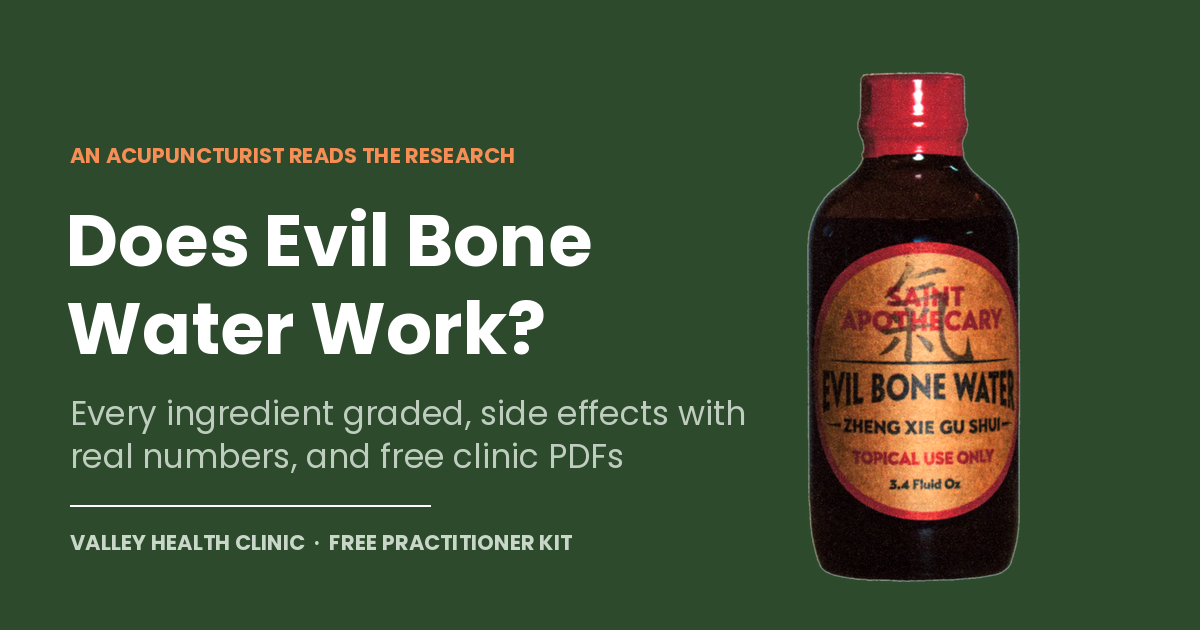
Evil Bone Water (Zheng Gu Shui) is a Chinese topical medicinal hand-crafted with only empirical grade herbal ingredients in an approved facility.
ZHENG GU SHUI · ZHENG XIE GU SHUI · 正骨水

The Finest Zheng Gu Shui Ever Made

Introducing Evil Bone Water — the imperial-grade Zheng Xie Gu Shui spray. For 500 years, Zheng Gu Shui has set bones, cleared bruises, and eased pain. Evil Bone Water restores the original formula — all eight herbs, double-extracted with 190-proof grain alcohol — the way traditional Chinese medicine intended.

What Is Zheng Gu Shui?

Zheng Gu Shui (also written Zheng Xie Gu Shui, 正骨水) is one of the oldest and most celebrated liniments in traditional Chinese medicine. Developed over 500 years ago by a master herbalist, its name translates as “bone-setting liquid” — a formula born in martial arts clinics to heal bruises, fractures, sprains, and joint injuries fast.
For centuries, families and martial arts lineages guarded their Zheng Gu Shui recipes like fighting secrets. The formula spread through practitioners across China, each version slightly different, each adapted to local herbs and techniques.
Today, most commercially available Zheng Gu Shui has been stripped down to just 7 of its original 26 ingredients to meet mass-market demand. Evil Bone Water is different. It restores the full formula with imperial-grade sourcing and a traditional double-extraction process.

What Does Zheng Xie Gu Shui Mean?

Zhèng (正)

To rectify, to correct

Xié (邪)

Something that must be expelled (the “evil” that must leave the body)

Gǔ (骨)

Bone

Shuǐ (水)

Water, liquid

What Does Zheng Xie Gu Shui Mean?

Zhèng (正)

To rectify, to correct

Xié (邪)

Something that must be expelled (the “evil” that must leave the body)

Gǔ (骨)
Bone

Shuǐ (水)

Water, liquid

What Does Zheng Gu Shui Treat?

"As an acupuncturist with years of clinical practice, Evil Bone Water is the topical I reach for first — because it works for the widest range of pain conditions of anything I've used."

— Willard Sheppy, M.S. Acupuncture & Oriental Medicine, Valley Health Clinic

Zheng Gu Shui vs. Evil Bone Water vs. Biofreeze

Not all Zheng Gu Shui sprays are equal. Here’s how the mass-market version compares — and why practitioners consistently choose Evil Bone Water for real healing.
Key Features Biofreeze Pharmaceutical gel Zheng Gu Shui — Solstice Mass-market formula Evil Bone Water ★ Imperial-grade Zheng Xie Gu Shui
Price $11–$15 / 3 oz $20–$35 / 3 oz $40 / 3.4 oz (often more)
Active Ingredients Menthol 4% (synthetic) Camphor 5.6% + Menthol 5.6% Natural camphor + natural menthol
Herbal Content Aloe, arnica — supporting extracts only 5 herbs (left from original) 9 imperial-grade herbs, full formula restored
Alcohol Base Isopropyl alcohol Alcohol + water 190-proof Everclear grain alcohol
Residue Leaves filmy, crusty residue on skin and surfaces Dyes may stain; dries cleanly Dries clean, no film
Healing Support Temporary symptom relief only Traditional support for acute injuries Circulation, inflammation, chronic & acute pain
Verdict
Good for quick cooling and massage lubrication. Not a healing formula.
Authentic lineage, but missing key herbs. Better for acute, short-term use.
The only Zheng Gu Shui spray I use in clinical practice for lasting tissue healing.

How Evil Bone Water Is Made.

Most liniments use a single extraction. Evil Bone Water uses a meticulous double-extraction process that captures both water-soluble and fat-soluble medicinal compounds — delivering the full healing spectrum of every herb.
1

Water Decoction

Each batch starts as ~135 gallons of traditional water decoction. Roots, barks, and rhizomes are simmered to extract polysaccharides, glycosides, and hydrophilic compounds. Cinnamon bark (Gui Pi) is pre-soaked in Everclear for 12–72 hours to preserve its volatile oils.

2

Alcohol Extraction

190-proof Everclear is introduced, bringing the batch to 300+ gallons. As alcohol concentration climbs toward the critical 74–76% threshold, fat-soluble medicinals — camphor, menthol, essential oils — enter solution alongside the water-based compounds.

3

Clarifying Day

Natural Zhang Nao (camphor) and Bo He Nao (menthol) are carefully dissolved through agitation, air exposure, and patient mixing. Weather matters — temperature and humidity affect how compounds dissolve. This step cannot be rushed.

4

Double Extraction Finish

Herb dregs are never discarded. They go into fresh alcohol for weeks or months, pulling residual medicine for the next batch generation — a traditional step that ensures maximum potency in every bottle.

5

Lab Testing

Every herb is microscopically tested for proper variety, contaminants, and potency before use. No animal products, no GMOs, no synthetic pesticides. Sustainably and ethically sourced.

6

Handcrafted Bottling

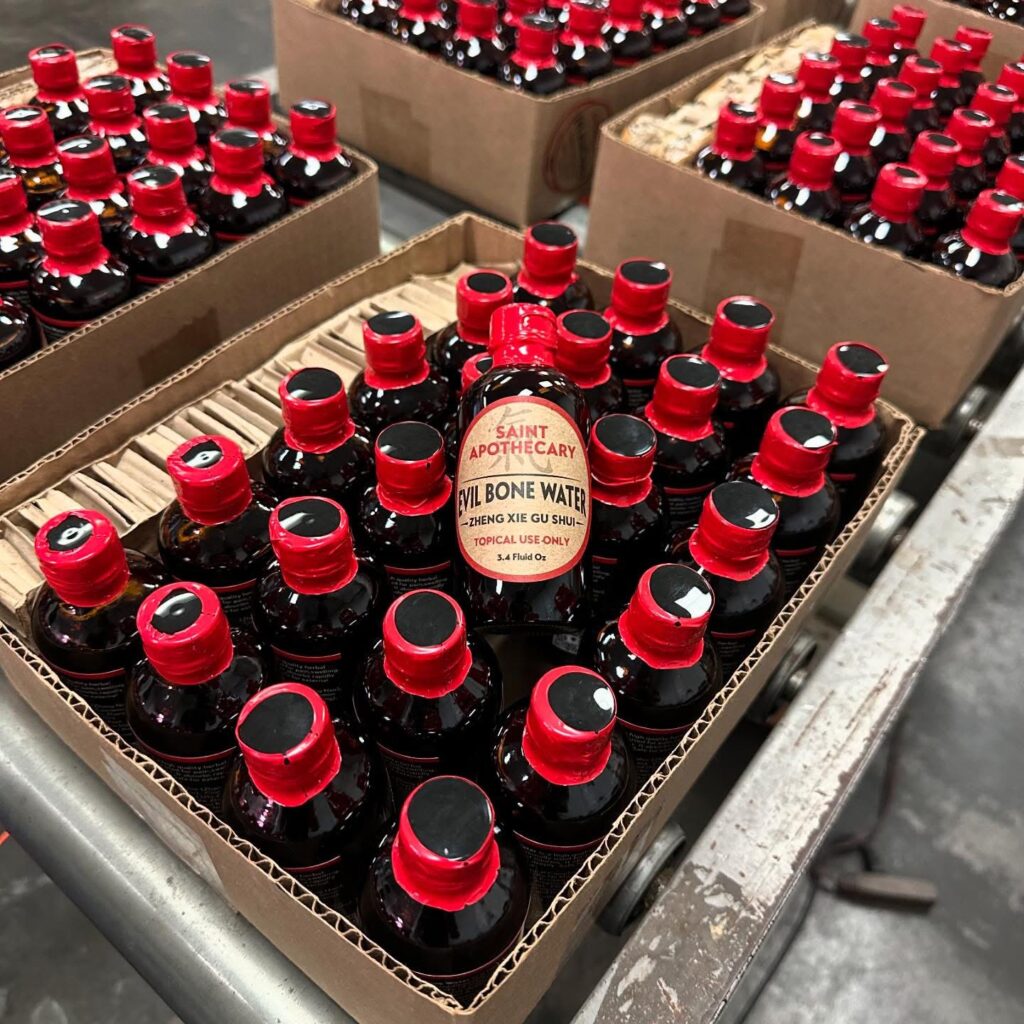
Each batch is handcrafted in an approved facility. The amber glass Boston Round protects the formula from UV degradation. Bottles are filled above the labeled 3.4 fl oz — you always get a full bottle.

How to Use Zheng Gu Shui Spray

Spray Method — Direct Application

Apply Evil Bone Water directly to the affected area up to 4 times daily. Spray or pour onto a cotton ball and rub in fully. Allow the formula to dry naturally — removing it too early stops it from working. Best absorbed into warm skin after a shower or light massage.

Compress Method — Deep-Penetrating Wrap

Saturate a cotton ball or gauze pad with Evil Bone Water. Apply to the area and wrap lightly for 30–90 minutes. Especially effective for tendon injuries, fractures, and stubborn chronic pain. Do not use plastic wrap — let the formula breathe.

Layering Method — Combined Protocol

Apply Evil Bone Water first — its alcohol base opens the skin barrier. Then layer an oil or salve over the top. This dramatically increases absorption of the second product. Foundation of our Pain Power Combo and Trifecta protocols.

Soak Method — Hand & Foot Soak

Add Evil Bone Water to a basin of warm water. Soak hands or feet for targeted relief of arthritis, carpal tunnel, and neuropathy. Warm water increases blood flow, allowing the formula to penetrate more deeply.

Safety Notes:

Do not apply to open wounds or broken skin — Evil Bone Water is alcohol-based and will sting. Do not ingest. Keep away from eyes and mouth. Camphor crosses the placental barrier — consult a practitioner before use during pregnancy. In children with a history of febrile convulsions, use with caution.

Ready to Heal?

Get the Best Zheng Gu Shui Available Today

Evil Bone Water is the only Zheng Xie Gu Shui spray crafted with the full imperial-grade formula, double-extracted for maximum potency. Clinic-tested. Ships in 3 days.
Free shipping on orders over $60 · Ships from Oregon · Practitioner-vetted

These statements have not been evaluated by the Food and Drug Administration.
This product is not intended to diagnose, treat, cure, or prevent any disease

Share on

Will Sheppy, Founder and Acupuncturist at Valley Health Clinic
Willard Sheppy
Willard Sheppy is a licensed acupuncturist (LAc) and Founder of Valley Health Clinic specializing in using Traditional Chinese Medicine to treat acute injuries and chronic conditions, and to improve sports performance and rehabilitation.

Zheng Gu Shui & Evil Bone Water FAQ

What is the difference between Zheng Gu Shui and Zheng Xie Gu Shui?
They refer to the same formula. “Zheng Gu Shui” is the shortened common name meaning “bone-setting liquid.” “Zheng Xie Gu Shui” is the full traditional name — Xie (邪) refers to the pathogenic factor that must be expelled. Western practitioners nicknamed this “Evil” Bone Water, and the name stuck. Evil Bone Water uses the full Zheng Xie Gu Shui formulation.
Yes — significantly. Mass-market Zheng Gu Shui uses only 7 herbs and commodity-grade ingredients. Evil Bone Water restores four essential herbs, uses imperial-grade sourcing (2–5 grades above standard), natural camphor and menthol instead of synthetic versions, and 190-proof Everclear instead of cheap ethanol. The double-extraction process captures compounds that single extractions miss entirely.
Evil Bone Water comes in a 3.4 fl oz amber glass bottle. A spray top is available as an add-on (typically about $1) and makes application much more convenient. Many practitioners prefer the spray for quick, targeted application before or after treatment.
Evil Bone Water is intentionally not sold on Amazon. It distributes through practitioner networks and clinic storefronts to honor its traditional lineage and maintain quality control. Amazon carries similarly-named Zheng Gu Shui products, but these are NOT Evil Bone Water — they use lower-grade herbs and different formulations.
Up to 4 times daily for consistent results. For best absorption: apply to warm skin after a shower or massage, rub in fully, and let it dry before covering with clothing. The most common mistake is not applying frequently enough. If skin becomes dry or irritated, reduce to 2x daily.
Yes — Evil Bone Water is very safe with few to no side effects when used as directed topically. It contains no animal products, is non-GMO, gluten-free, cruelty-free, and pesticide-free. Natural camphor takes more than double the dose of synthetic camphor to reach toxicity. Do not ingest. Do not apply to open skin.
It can stain light or white fabrics. Fan the area dry before dressing, or apply before putting on clothing. Stains typically wash out in a normal laundry cycle. Evil Bone Water dries cleanly on skin with no tacky or filmy residue — unlike Biofreeze, which leaves a visible crust on surfaces.
INGREDIENTS

Imperial-Grade Herbs in Zheng Xie Gu Shui

Mass-market Zheng Gu Shui uses 5 herbs. Evil Bone Water restores the full formula — 9 medicinals at imperial grade, 2–5 grades above standard commercial quality.

Zhang Nao · Natural Camphor (Cinnamomum camphora)

Increases local circulation and relieves pain. Natural camphor from 50-year-old camphor laurel trees in Southeast Asia — more than twice as safe as the synthetic version used by competitors.

Bo He Nao · Natural Menthol (Mentha haplocalyx)

Aromatic cooling agent that clears heat and vents inflammation. Natural peppermint-derived menthol — not synthesized — for a cleaner cooling sensation.

San Qi · Notoginseng (Panax notoginseng)

Stops bleeding without clotting. Reduces swelling, bruising, and inflammation. A rare herb requiring special extraction, with unmatched circulatory benefits.

Gui Pi · Cinnamon Bark (Cinnamomum cassia)

Releases muscles, promotes circulation, warms cold channels. Sourced from trees 20–30 years old. Pre-soaked in Everclear to preserve volatile oils that would otherwise escape during decoction.

Ji Gu Xiang - Japanese Knot Weed

This potent ingredient is incredibly rare and difficult to source, even in its native country of China. Ji Gu Xiang is effective in treating bruises, sprains, and inflammation. It also helps to alleviate pain.

E Zhu · Zedoary Rhizome (Rhizoma Curcumae)

Promotes blood circulation and breaks accumulations. Contains curdione, a bioactive compound with demonstrated anti-platelet aggregation and antithrombotic activity.

Bai Zhi · Angelica Root (Angelica dahurica)

Deeply aromatic — gives Evil Bone Water its distinctive warm, maple-like scent. Anti-inflammatory, analgesic, antiviral, and antimicrobial properties.

Qian Jin Ba · Flemingia Root (Flemingia philippinensis)

Strengthens tendons and bones. Acrid and warming — removes cold and dampness underlying arthritis, bone pain, and sciatica. Wildcrafted for maximum potency.

Hu Zhang · Knotweed Root (Reynoutria japonica)

Invigorates blood and disperses stasis. Clears heat and discharges toxins. Rich in resveratrol, polysaccharides, and flavonoids for inflammation control.

Recent Posts