
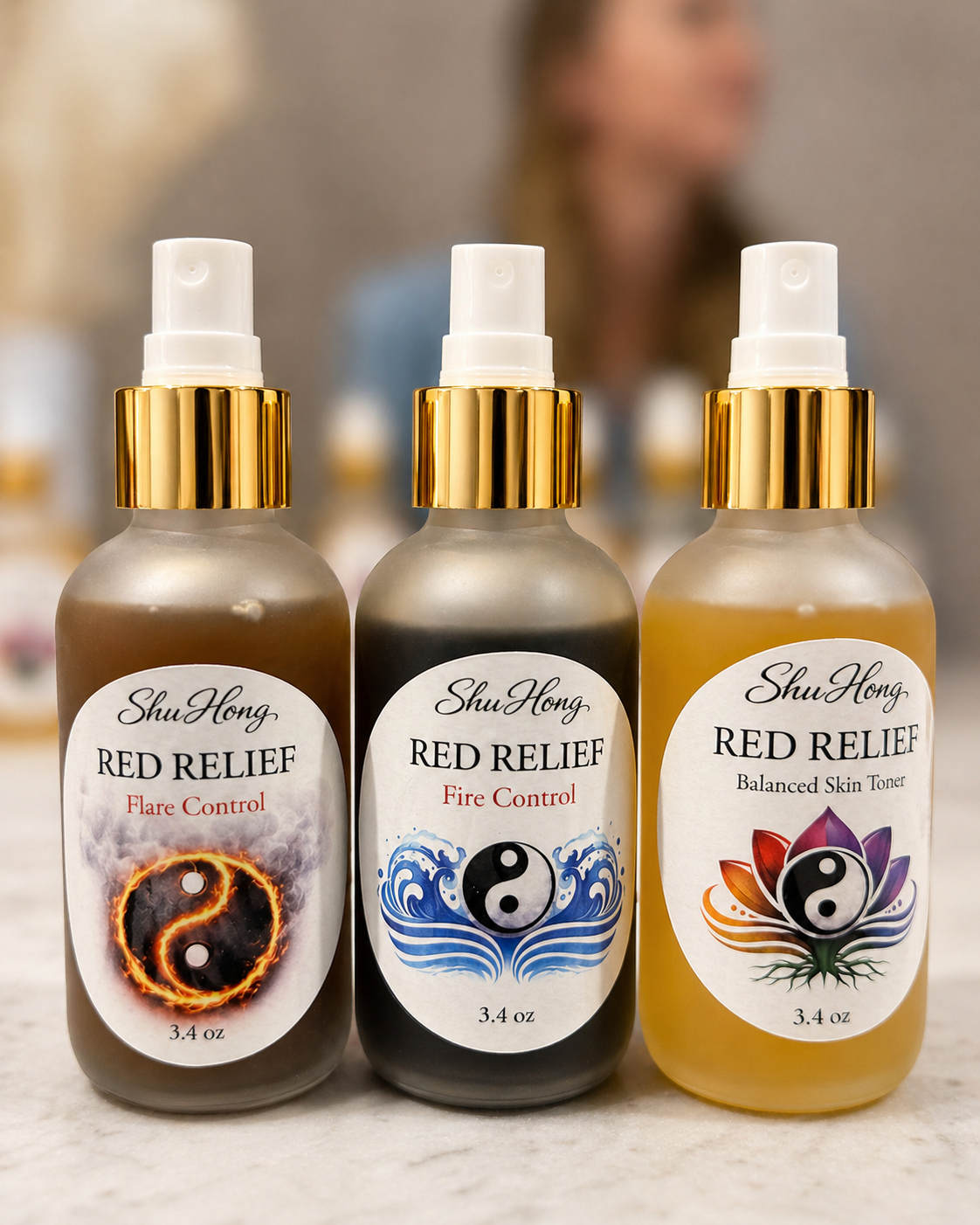
Psoriasis Flare Ups and Why You Need Three Sprays
Dr. Meli, in her own words, on why she and her husband built the Shu Hong

Materia Medica · The Formula Series

Willard Sheppy is a licensed acupuncturist (LAc) and Founder of Valley Health Clinic specializing in using Traditional Chinese Medicine to treat acute injuries and chronic conditions, and to improve sports performance and rehabilitation.
Educational content from Valley Health Market. Not medical advice. Statements have not been evaluated by the FDA. This product is not intended to diagnose, treat, cure, or prevent any disease.
Everything below the waist gets described the same way — heavy, swollen, damp, something not draining — and then the advice splits in completely opposite directions.
Sol and Aquada are both aimed at the lower terrain, and they are close to opposites. One warms and moves fluid that has pooled because there isn’t enough heat to shift it. The other clears heat out of dampness that has turned stagnant and hot. Give someone the wrong one and you don’t get a smaller result — you often get a worse one. The Tibetan foot soak sits alongside both, and it is not a third choice in the same sense at all.
Here’s the sorting logic: the two questions that separate them, the one sign that trips almost everyone up, what the research honestly supports, and where the line is between a terrain problem and something that needs testing.
Sol is for the cold, waterlogged version — puffiness and bags under the eyes, chronic fatigue, frequent or night-time urination, clear or white discharge, a body too depleted to tolerate being tonified. Aquada is for the hot version — yellowed discharge and urine, sweating and odor through the groin and feet, a thick coat at the back of the tongue. The Tibetan foot soak isn’t a third formula; it’s a different way in, through the feet, for people who need the work to arrive gently or who need it at the channel level. One question sorts the first two: is what’s coming out clear and pale, or is it yellow? Sol is safe for long, slow use. Aquada is bitter and cold, and is not meant to run indefinitely.
Temperature and moisture differentiate every biome on earth — rainforest to desert — and equally in the living gardens inside you. That’s the idea the whole Botanical Biohacking line is organized around, and in the upper respiratory and digestive zones it produces a clean spectrum: a cold formula, a damp formula, a hot formula.
The lower zone is arranged differently, and it’s worth being straight about why. There are really only two formulas here, and they sit at opposite ends of one line. What occupies the middle of the chart is the Tibetan foot soak — and a foot soak is not a diagnosis. It’s a delivery route. It works at the channel level, and it can accompany either formula.
So the map for this zone looks like this:
Two questions, in this order, and the first one does most of the work.
This is the fork, and in this zone it has an unusually plain tell: colour. Cold and damp runs clear, white, pale and puffy. Damp-heat runs yellow, and it usually smells.
That is the cold picture, and it points to Sol. The hot picture looks like this instead, and it points to Aquada:
Some people can’t, or shouldn’t yet. Digestion is too sensitive, they’re on a stack of medications, they’re elderly or frail, or they simply won’t drink a tea every day and both of you know it. That’s the situation the foot soak was built for — the gentlest way to get herbs into a sensitive patient is through the feet.
Three screening questions get you most of the way through this zone in under a minute: Do you have now, or a history of, urinary or sexually transmitted infection? Do you have now, or a history of, candida? Do you have excessive sweating or odor through the groin?
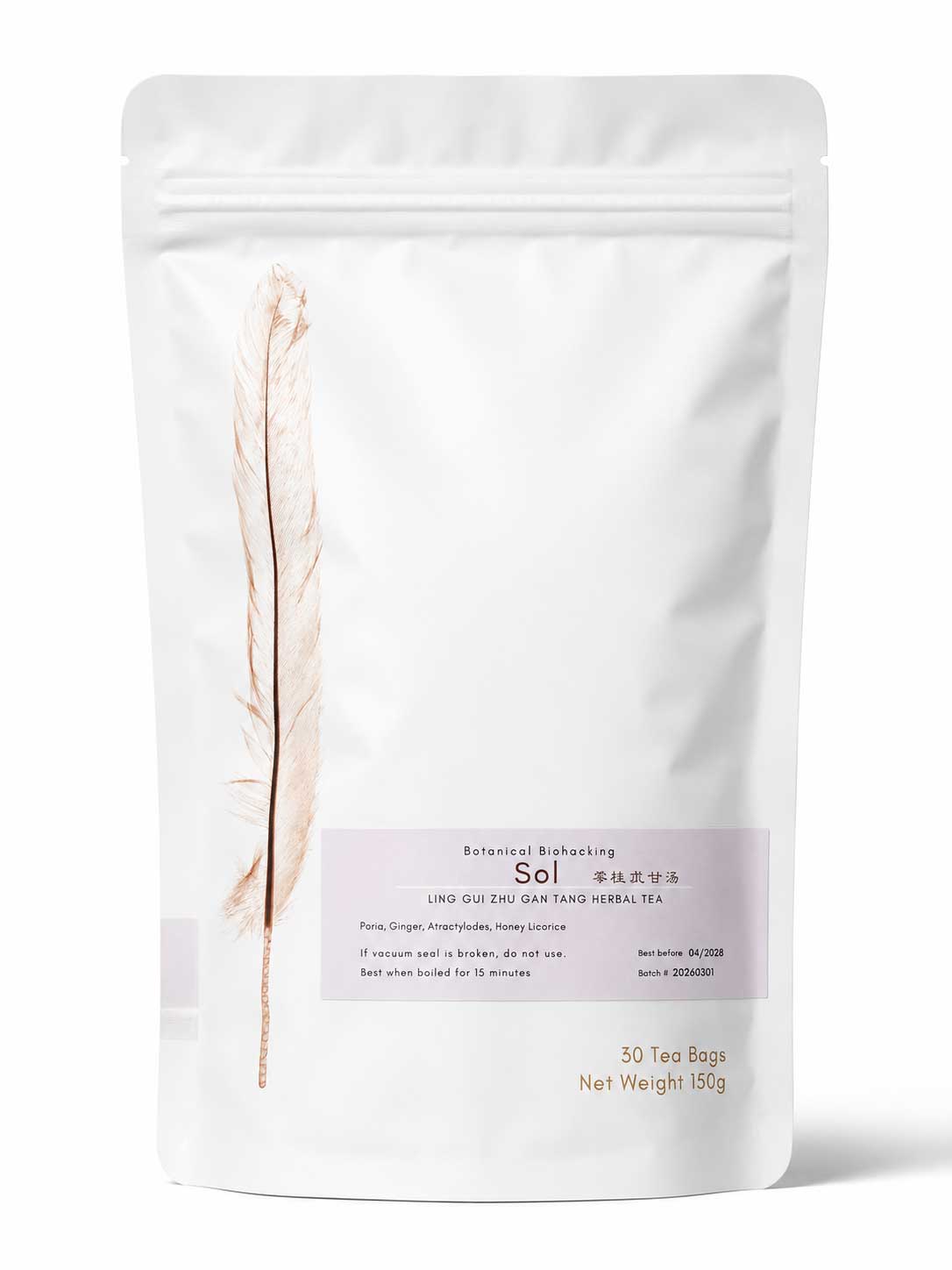
Sol is built on Ling Gui Zhu Gan Tang — Poria, Cinnamon Twig, Atractylodes and Licorice Decoction — four herbs from the Shang Han Lun, in continuous use for roughly two thousand years. It warms yang, strengthens the way the spleen handles fluid, and moves the thin, sloshing dampness that pools when there isn’t enough warmth to shift it.
The reason it belongs at the cold end of this zone rather than filed under “dizziness” is that the pattern it names shows up below the waist as readily as it does in the head. Fluid that isn’t being moved settles: under the eyes, in the ankles, in the bladder overnight.
The clinical signature that makes Sol unmistakable is the one nobody expects:
Four of the safest herbs in the entire pharmacopeia, doing one job cleanly. The full breakdown lives in the Sol Tea post. The practical note: Sol is gentle and has a genuinely pleasant sweet flavour, which matters more than it sounds — this is a formula people actually keep taking.
Aquada is Er Miao San — “the Two Marvels.” Two herbs: Cang Zhu, which dries dampness, and Huang Bai, which clears heat from the lower burner specifically. That’s the whole formula. Several centuries of use, one job, and it is delivered as a micro-pill rather than a tea, so there’s nothing to brew.
Er Miao San is the tradition’s representative prescription for what the classical texts call damp-heat pouring downward — dampness that has stopped moving, turned hot, and settled below the waist. That is a specific picture, not a general one, and the signs are the yellow-and-odor set above rather than the pale-and-puffy set.
Two things about Aquada are worth knowing before you reach for it. The first is that it is bitter and cold by design — that’s how it does the job, and it is also why it’s a targeted tool rather than a daily forever-formula, particularly in someone who already runs cold and depleted. The second is seasonal: this pattern intensifies at the peak of summer, and Aquada is at its most useful in exactly the weeks when everything below the waist feels swampiest.
On sourcing, the detail Botanical Biohacking makes noise about is the Huang Bai — thirty-year semi-wild, cork removed, selected for berberine content. Whether that shows up in a person’s experience is not something I can prove to you. It does show up in the price.
The Tibetan Herbal Foot Soak sits in the middle column of the chart, and it is the piece people most often misread. It isn’t the “medium” option between Sol and Aquada. It’s a different way of getting herbs into a body.
The blend leans on plants that grow where almost nothing else will — Du Yi Wei (Lamiophlomis rotata), Hong Jing Tian (Rhodiola), Hong Hua (safflower), with Ai Ye, Qiang Huo, Gan Jiang, Ku Shen, and mineral-rich Tibetan salt. The described action is at the channel level: move blood, clear wind and cold and phlegm out of the channels, and draw yang downward at the end of the day.
That last part is the mechanism that matters, and it’s why the soak belongs in this conversation at all. Heat and agitation that rise upward in the evening get pulled back down. People describe better sleep the same night, which is a suspiciously fast result until you consider that the intervention is essentially thermoregulatory as well as herbal.
The protocol is refreshingly specific, and it corrects the most common mistake: twenty minutes, three to four times a week — and longer is not better. An hour does not improve the outcome. Full detail in the foot soak post.
The gentlest way to get herbs into a sensitive patient is through the feet. That's not a consolation prize — for some people it's the only route that works, and it's often the one that gets used every night when a tea would have been abandoned in week two.
— Will Sheppy, L.Ac.
This zone combines more readily than the others, partly because one of its three pieces is topical and therefore stacks with almost anything.
The sequencing point underneath all of this is the same one that runs through the whole series: clearing what’s stagnant is often what makes the rest of the case legible. Once the terrain settles, what’s left is usually a simpler problem than the one you started with.
Here, as everywhere in this series, I’d rather be honest than impressive — and in this zone the honest version has a sharp edge to it.
Ling Gui Zhu Gan Tang, behind Sol, has real pooled human data — on something else. A 2025 systematic review and meta-analysis pulled together twelve randomized controlled trials covering 970 people, and found the formula improved outcomes in non-alcoholic fatty liver disease, alone or added to standard care. The authors say plainly that the underlying studies are few and methodologically weak. So: humans, randomized, real — and about the liver, not about the urogenital terrain. It tells you the formula does something measurable in people. It does not tell you it does this.
Er Miao San, behind Aquada, has no human trials at all in the English-indexed literature. What exists is a substantial body of animal and laboratory work, and essentially all of it is in rheumatoid arthritis rather than anything urogenital — Er Miao San reducing joint inflammation in arthritic rats, shifting gut bacteria and butyrate production in arthritic mice, and a stack of network-pharmacology papers modelling which of its compounds bind what. Interesting. Not people, and not this zone.
Du Yi Wei, the signature herb in the foot soak, has a real pharmacological literature — a peer-reviewed review documents anti-nociceptive, hemostatic and anti-inflammatory activity for Lamiophlomis rotata. That’s about the plant, not about soaking your feet in it.
What actually stands behind these three is documented clinical use — two thousand years for Ling Gui Zhu Gan Tang, several centuries for Er Miao San. That’s a real form of evidence, and I won’t pretend it isn’t. It also isn’t a trial, and anyone selling you the difference should make you suspicious.
This zone carries more real medicine adjacent to it than any other in the line, so the limits matter more here.
And the line that matters most in this zone: burning or painful urination, fever or flank pain, blood in the urine, a discharge that is new or has changed, or any possibility of a sexually transmitted infection needs testing and real medical care — not tea. Urinary and genital infections are diagnosed with a test, and they are treated with medicine. These formulas are about the terrain those things happen in. They are not a substitute for finding out what is actually growing.
Sol, Aquada, and the Tibetan Herbal Foot Soak — practitioner-formulated, batch-tested, and stocked at Valley Health Market. Sol as a thirty-teabag tea, Aquada as a micro-pill with nothing to brew, the soak as twenty sachets.
Educational content rooted in 20+ years of clinical practice in Traditional Chinese Medicine. The information provided is for educational purposes and is not intended to replace consultation with a qualified healthcare practitioner. Please consult your physician before starting any new herbal protocol, especially if pregnant, nursing, on anticoagulants, or managing a chronic condition.
They’re close to opposites, which is why getting it wrong matters. Sol is built on Ling Gui Zhu Gan Tang and works the cold, waterlogged version of the lower terrain — puffiness, night-time urination, clear or white discharge, deep fatigue, and the telling detail that ordinary tonics make the person feel worse. Aquada is Er Miao San and works the hot version — yellow discharge and urine, sweating and odor through the groin and feet, a thick coat at the back of the tongue. The quickest sort is colour: pale and puffy points to Sol, yellow points to Aquada.
Not in the same sense. Sol and Aquada are internal formulas at opposite ends of one line. The Tibetan Herbal Foot Soak is a different route in — herbs through the feet — and it works at the channel level, moving blood and drawing heat and agitation downward in the evening. It runs alongside either formula rather than instead of one, and it’s often the right answer for someone whose digestion is too sensitive for a daily tea, or who simply won’t keep taking one.
Twenty minutes is the working window, three to four times a week through the warmer months. Longer is not better — an hour does not improve the result. People frequently describe sleeping better the same night.
The foot soak layers with either formula without much difficulty. On the internal side, the source material’s stated combination is Aquada with Peak or with Microgard when lower-jiao damp-heat is severe — Peak brings heat-clearing from above, Microgard works the gut terrain the lower zone sits downstream of. Check with your practitioner before layering formulas rather than assuming.
Unevenly, and it’s worth being straight about it. Ling Gui Zhu Gan Tang, behind Sol, has pooled human trial data — twelve randomized trials and 970 people — but in non-alcoholic fatty liver disease, not in anything urogenital, and the review itself calls the underlying studies few and methodologically weak. Er Miao San, behind Aquada, has no human trials indexed in English at all; what exists is animal and laboratory work, almost all of it in rheumatoid arthritis. Du Yi Wei, the signature herb in the foot soak, has a genuine pharmacological literature behind the plant itself. What stands behind these formulas is centuries of documented clinical use, which is a real form of evidence and is not the same thing as a trial.
Burning or painful urination, fever or flank pain, blood in the urine, a discharge that is new or has changed, or any possibility of a sexually transmitted infection — those need testing and medical care, not tea. Urinary and genital infections are diagnosed with a test and treated with medicine. These formulas are about the terrain those things happen in, not a substitute for finding out what’s actually growing.
Dr. Meli, in her own words, on why she and her husband built the Shu Hong
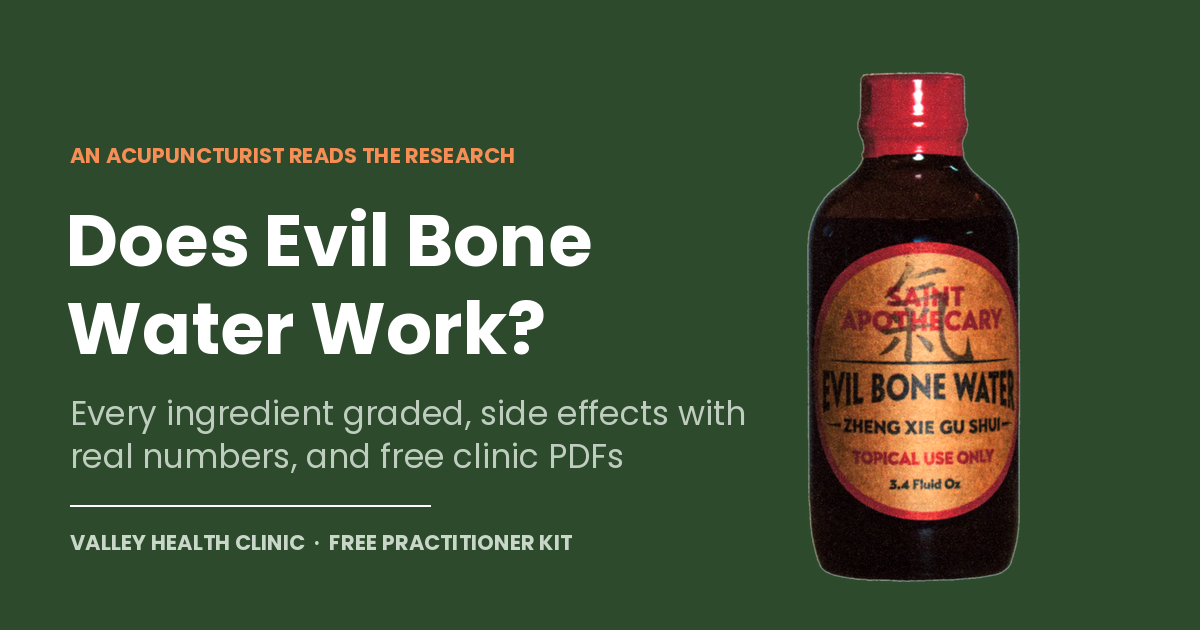
Does Evil Bone Water work? An acupuncturist reviews the evidence for Zheng Gu Shui, camphor, menthol,

Learn which acupuncture points Will Sheppy uses for Ménière’s disease, vertigo and dizziness, plus treatment frequency