
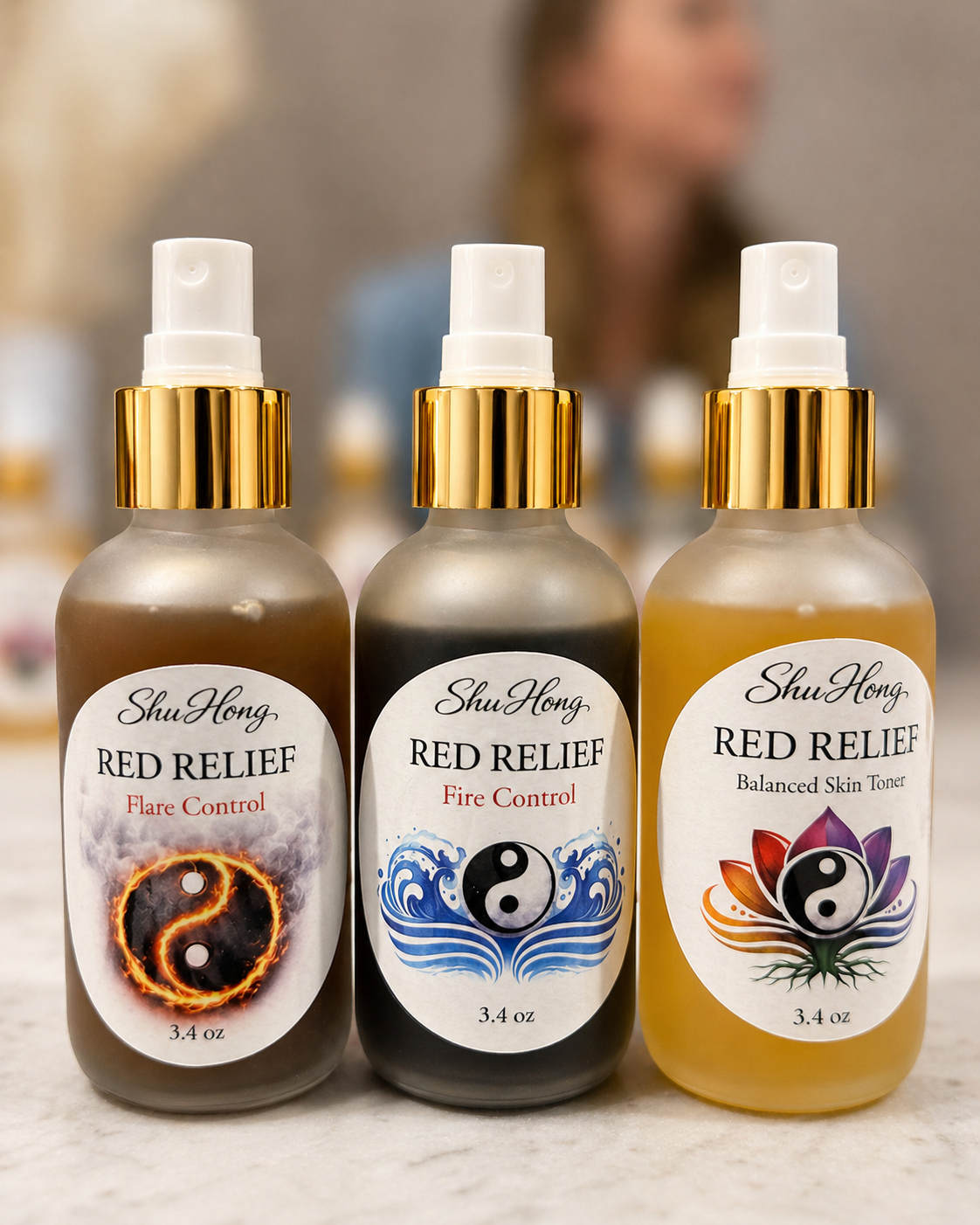
Psoriasis Flare Ups and Why You Need Three Sprays
Dr. Meli, in her own words, on why she and her husband built the Shu Hong

Materia Medica · The Formula Series

Willard Sheppy is a licensed acupuncturist (LAc) and Founder of Valley Health Clinic specializing in using Traditional Chinese Medicine to treat acute injuries and chronic conditions, and to improve sports performance and rehabilitation.
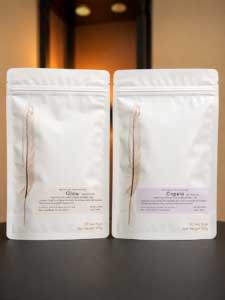
Two teas, one question. Here is how I sort them.
Glow and Copeia both come from the same book. Same author, same chapter, written around 200 CE. Two thousand years later, they are still the two halves of the same question: is there too much, or not enough? Glow dissolves. Copeia nourishes. Get that backward, and you spend months moving blood in a patient who didn’t have enough to move.
Both are built for the lower abdomen. Both were written for women. Both come out of the Jin Gui Yao Lue — the Essential Prescriptions of the Golden Cabinet — attributed to Zhang Zhongjing in the Eastern Han, roughly 200 CE. Gui Zhi Fu Ling Wan appears in the chapter on the diseases of pregnant women, and Zhang placed Dang Gui Shao Yao San in that same pregnancy chapter and in the general gynecological chapter.
So this isn’t two competing products. It’s one classical author writing down two answers to two different presentations, in the same text, and the choice between them has been documented continuously ever since.
Both share three herbs — Fu Ling, Bai Shao, and a blood herb. Both drain damp while doing something to blood. That shared architecture is why they get confused. What separates them is the direction of the work.
Botanical Biohacking spent two years building a minimalist fertility line, and by their own account most of that work was deciding what not to include.
The reasoning started from the patterns rather than the products. The presentations they kept meeting were cold, damp, phlegm, and blood stasis. From there, candidate formulas had to clear five bars:
Two formulas came out the other end. Then a year and a half of sourcing.
That last criterion is the one practitioners should notice. A fertility clinic carrying two teas that also earn their shelf space in pain and mood cases is a different proposition than a clinic carrying two single-purpose products.
Neither of these solves every fertility case. What they do is cover the most common terrain well, with formulas that have been in continuous use long enough that we know how they behave.
The strategy: warm and dissolve. Built for blood stasis with cold congealing — something has hardened, and the job is to soften it without force. Botanical Biohacking builds theirs on the decoction form and adds Ai Ye (mugwort) to warm the lower abdomen.
Look for:
The strategy: nourish and resolve. Built for liver depression with spleen deficiency and dampness — the picture of being depleted and waterlogged at the same time. Sha Ren is added so the richer blood herbs don’t sit heavily on a sensitive stomach.
Look for:
The mechanism that makes Copeia make sense: dampness prevents blood from replenishing. So you cannot simply tonify your way out of this pattern — pile blood-building herbs onto a damp, malabsorbing middle and most of it goes nowhere. Copeia nourishes spleen qi and blood while draining damp, which is why it works in chronic malabsorption where straight tonics stall. That is also the idea behind the name: copia is the Latin word for abundance.
Fertility sits outside the Qi Diagram, so these three are mine rather than the manufacturer’s. They do most of the sorting.
The single most useful question. Pale points to Copeia. Dark or purple points to Glow. Dr. Lan’s whole description of Copeia is builds blood for the pale-tongue patient — that shorthand does most of the work.
Fixed and stabbing, in one spot, worse with pressure — that’s stasis. Glow. Dull, diffuse, crampy, sometimes better with pressure and warmth — that’s deficiency with damp. Copeia.
Palpable masses, a history of hard things — Glow’s territory. Nothing hard, just depletion and fluid — Copeia’s. When you genuinely cannot tell, treat the deficiency first. Nourishing a stasis patient wastes a month. Moving blood in a depleted patient costs her more than a month.
This section carries the traditional indications as the source texts recorded them. It is a description of historical use, not a claim about what these teas do.
The classical fork is excess versus deficiency, and it is unusually clean here.
Gui Zhi Fu Ling Wan was written for a mass. Traditionally it was used for what the texts called abdominal masses and for infertility understood as arising from dampness and mucus leading to blood stagnation. It contains two dedicated blood-breaking herbs — Tao Ren and Mu Dan Pi — held in check by Gui Zhi warming the channels and Fu Ling draining damp. The original method called for pills the size of rabbit droppings, one daily before meals, increasing gradually only if there was no effect. That is a formula designed to apply steady pressure over time, not force.
Dang Gui Shao Yao San was written for the opposite problem: a body quietly under-nourishing itself. Traditionally used for cramping abdominal pain with bloating, for harmonizing liver and spleen, and for infertility understood as arising from deficiency leading to qi and blood stagnation. Its architecture is symmetrical — three herbs building and moving blood, three draining fluid. It supports without being cloying and drains without depleting.
The sequencing matters. In the Botanical Biohacking framework, fertility work starts by restoring the microbiomes first, and only then choosing a direction: warm and dissolve with Glow, or nourish and resolve with Copeia. The formula is the second move, not the first.
Three blood-movers and one warmer.
Cinnamon Twig (Gui Zhi), Poria (Fu Ling), Peony Root Bark (Mu Dan Pi), White Peony Root (Bai Shao), Wild Mountain Peach Kernel (Processed) (Dan Tao Ren), Mugwort Leaf (Qi Ai Ye)
One mover, and three herbs that build or drain.
Dang Gui, Shao yao, Fu Ling, Bai Zhu, Ze Xie, Chuan Xiong, Sha Ren
Neither formula is the first move. Both sit downstream of clearing the terrain, and Botanical Biohacking is explicit about the order: use Wind, Peak, or Atone first to clear away the majority of the dampness. Then Copeia holds the ground — a safe, reliable way to keep dampness from returning while nourishing liver blood.
That is the whole series in one instruction. The upper respiratory zone formulas do the clearing. Copeia does the holding. Skip the clearing step and you are nourishing into a swamp — which is exactly the failure mode the “dampness prevents blood from replenishing” logic predicts.
If the terrain is still throwing contradictory signs — hot and cold and damp and depleted all at once — that gets addressed before either fertility formula goes in.
This is the question every fertility patient asks, and my answer probably isn’t the one you expect.
Chinese medicine is very safe to use during pregnancy. In general I have no problem with people taking formulas while they’re pregnant. That’s not the issue.
The issue is that pregnancies stop for many reasons. And if one stops while a woman is taking an herbal formula, she is going to ask herself a question: Did I do something wrong? Could I have done something different? Did I cause this? It doesn’t matter how much reassurance she gets. That question lingers.
So what I tell my patients is to stop taking formulas when they're pregnant. Not because the formulas are bad, not because they're wrong, not because they will hurt the baby — but because you will always wonder. It's just human nature. Stop the formulas mainly for peace of mind.
— Will Sheppy, L.Ac.
That’s the rule I use, and it’s a rule about the woman rather than about the herbs. The longer version of that reasoning is here.
Where the two formulas differ. Copeia is the gentler case — it sits in the pregnancy chapter of the source text and is used through pregnancy in Japan under its Kampo name. If a patient and her practitioner decide to continue it, that’s defensible ground.
Glow is different, and this part is not just psychology. It contains Tao Ren and Mu Dan Pi — two herbs whose whole job is breaking blood. The Chinese Pharmacopoeia labels the formula “pregnant women should use with caution,” and many clinical references upgrade that to prohibited, because both herbs activate blood circulation and can stimulate uterine contractions. Its classical association with pregnancy was a narrow one — resolving a pathological mass that was complicating a pregnancy, under close supervision — not general use in a normal, wanted pregnancy.
So for Glow the two reasons stack. Stop it for peace of mind, and stop it because the tradition itself puts a caution on this particular formula.
Practically: stop at a positive pregnancy test. Both formulas, unless your practitioner tells you otherwise.
A traditional case record supplied by Botanical Biohacking, reproduced as an illustration of how the pattern presents. One patient’s course is not evidence of what a tea will do for anyone else.
Shao, 28, female. Carrying a diagnosis of chronic pelvic inflammatory illness.
She was given Dang Gui Shao Yao San. Abdominal pain and dizziness settled after three doses, and the discharge followed. She stayed on the formula for three months — not to chase the symptoms, which were already gone, but to strengthen the root.
The tongue and pulse are the whole diagnosis. Pale with a slight coat, a pulse between soft and slippery — deficiency and damp, together. That is the Copeia picture exactly, and it is why the formula that both nourishes and drains was the right one rather than a straight blood tonic.
The three months after the symptoms resolved is the actual lesson. Fast symptomatic relief is not the same as a repaired foundation. Patients stop when they feel better; this pattern comes back when they do. Tell them the duration up front.
Here the two formulas are genuinely unequal, and it’s worth being straight about it.
Glow’s base formula has human fertility outcome data. A 2023 systematic review and meta-analysis pooled 16 randomized controlled trials covering 1,385 women with polycystic ovary syndrome. Adding the Guizhi Fuling formula to conventional treatment improved the ovulation rate (RR 1.24, 95% CI 1.15–1.34) and the pregnancy rate (RR 1.53, 95% CI 1.38–1.69) compared with conventional treatment alone, alongside reductions in FSH, total testosterone, LH, and insulin resistance. There was no significant difference in miscarriage rate. The authors note the evidence carries uncertainty and call for larger multicenter trials. A separate 2025 Bayesian network meta-analysis of 47 randomized trials in endometriosis after laparoscopic surgery found Guizhi Fuling pill combined with hormone therapy the most likely best option for overall response rate, with no serious adverse reactions reported in the included studies.
Trying to conceive without success for twelve months — or six months over thirty-five — warrants a workup, not a tea. So does severe pain, pain that is new or rapidly worsening, bleeding between cycles, or pain with fever.
Herbs are a reasonable layer alongside that evaluation. They are not a substitute for finding out what’s actually going on, and a good practitioner will tell you the same.
If you are on hormonal medication, anticoagulants, or in an IVF cycle, talk to both providers before adding either formula.

The two fertility formulas, thirty teabags each, practitioner-formulated and batch-tested. Stocked at Valley Health Market.
Educational content rooted in 20+ years of clinical practice in Traditional Chinese Medicine. Not intended to replace consultation with a qualified healthcare practitioner. Please consult your physician before starting any new herbal protocol, especially if pregnant, nursing, on anticoagulants, or managing a chronic condition.
Both come from the Jin Gui Yao Lue, around 200 CE, and both work on the lower abdomen. Glow is built on Gui Zhi Fu Ling with Ai Ye and warms and dissolves — it is for blood stasis with cold congealing. Copeia is built on Dang Gui Shao Yao San with Sha Ren and nourishes and drains — it is for deficiency with dampness. Glow dissolves what is there; Copeia supplies what is missing.
Three questions sort most people. What colour is the tongue — pale points to Copeia, dark or purple to Glow. What kind of pain is it — fixed and stabbing is Glow, dull and diffuse is Copeia. And is there something to dissolve or something to fill. When you genuinely cannot tell, treat the deficiency first.
No documented protocol exists for running these two together, and they pull in opposite directions. Pick the pattern in front of you, give it a fair trial of eight to twelve weeks, and reassess.
Yes — stop both at a positive pregnancy test unless your practitioner tells you otherwise. My general reason is peace of mind: pregnancies stop for many reasons, and no woman should be left wondering whether a tea caused it. For Glow there is a second, specific reason — it contains Tao Ren and Mu Dan Pi, and the Chinese Pharmacopoeia flags the formula for caution in pregnancy.
They are unequal. Glow’s base formula has human data: a 2023 meta-analysis of 16 randomized trials in 1,385 women with PCOS found improved ovulation and pregnancy rates when it was added to conventional treatment. Copeia’s human trial evidence is for period pain; its fertility evidence is animal and laboratory only. Two thousand years of use is why it is on the shelf — the fertility trials have not been run.
Dr. Meli, in her own words, on why she and her husband built the Shu Hong
Does Evil Bone Water work? An acupuncturist reviews the evidence for Zheng Gu Shui, camphor, menthol,

Learn which acupuncture points Will Sheppy uses for Ménière’s disease, vertigo and dizziness, plus treatment frequency