
Psoriasis Flare Ups and Why You Need Three Sprays
Dr. Meli, in her own words, on why she and her husband built the Shu Hong

Materia Medica · The Formula Series

Willard Sheppy is a licensed acupuncturist (LAc) and Founder of Valley Health Clinic specializing in using Traditional Chinese Medicine to treat acute injuries and chronic conditions, and to improve sports performance and rehabilitation.
Three formulas, one zone, and the same question every time: which one?
Warm Hearth, Wind, and Peak all work on the upper respiratory terrain. They are not interchangeable, and the difference between them is not subtle once you know what you’re looking at — but nobody tells you what to look at. So people guess, or they buy the one with the best description, or they buy all three and rotate.
Here’s the actual sorting logic: the two questions that separate them, what to do when the answer is “both,” what the research honestly supports, and where the line is between a tea problem and a doctor problem.
Warm Hearth is for mucus and biofilm — the chronic snoring, post-nasal drip, heavy foggy morning picture. Wind is for lingering damp in someone who is running on empty; it carries real ginseng so clearing doesn’t cost them what little they have. Peak is the same terrain when heat is leading — thirst, headache, yellow mucus, red eyes — and it leaves the ginseng out. Two questions sort them: is this mucus or is this fluid, and is heat riding on top. Wind and Peak are both built on San Ren Tang, which is a targeted tool and not a forever tea — roughly two weeks, never longer than three months.
Temperature and moisture differentiate every biome on earth — rainforest to desert — and equally in the living gardens inside you. That’s the whole idea the Botanical Biohacking line is organized around.
When the microbiota in a zone drift out of balance, contradictory signs show up. A patient reads hot and cold, dry and damp, deficient and excess all at once, and the picture refuses to resolve into one tidy diagnosis. In the clinic that’s the moment people usually start second-guessing themselves. It isn’t a diagnostic failure. It means you’re not looking at one organ — you’re looking at growing conditions that drifted.
So the upper respiratory zone doesn’t get one formula. It gets a spectrum, and you pick the position on it:
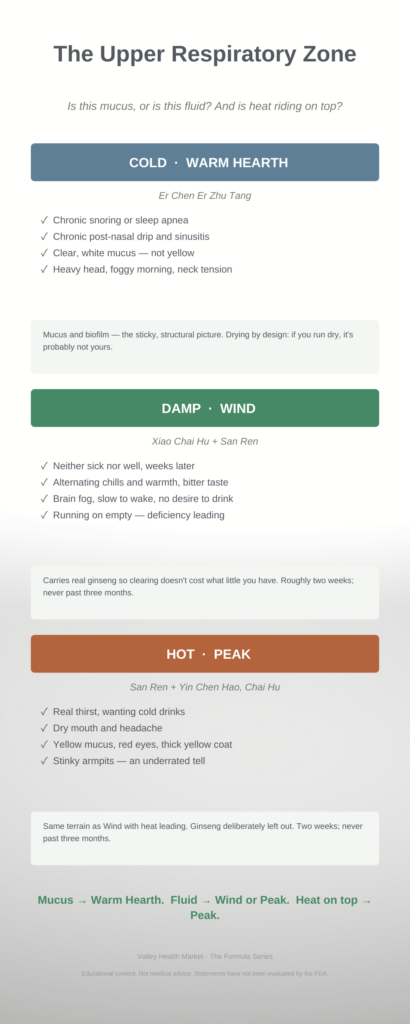
Position on the spectrum is decided by two questions, in this order.
Mucus and biofilm is the chronic, sticky, structural picture — snoring, sleep apnea, post-nasal drip that has been there for years. Fluid retention is the heavy, sluggish, foggy picture — slow to wake, brain fog, a generalized feeling of dread, dreams of being chased, no real desire to drink water, needing to bear down to use the bathroom.
Mucus sends you to Warm Hearth. Fluid sends you to Wind or Peak.
Four screening questions get you most of the way there in under a minute: Do you have a dry mouth? Do you feel thirsty? Do you bear down with bowel movements? Do you have environmental sensitivities or allergies?
Er Chen Tang — the Two-Aged Decoction — is the base formula for damp-phlegm in Chinese herbal medicine. Nearly every phlegm formula in the tradition is built on top of it. Practitioners think of it the way builders think of a footing: it rarely gets the credit, and almost everything sits on it.
Warm Hearth is the classical modification Er Chen Er Zhu Tang — that base plus Bai Zhu and Cang Zhu, the two great damp-drying atractylodes, for more drying and strengthening power.
Reach for it when the picture is structural rather than foggy:
The full formula breakdown lives in the Warm Hearth post. One caution worth repeating here: this is a drying formula built for a damp picture. If you tend to run dry, it is probably not your formula.
Some people don’t get knocked down by a bug. They get stuck halfway — not sick enough to stay in bed, not well enough to get their life back. Wind is the formula for that stage.
It’s built on Xiao Chai Hu Tang, the Minor Bupleurum Decoction, the definitive formula for the Shaoyang stage: the in-between layer where a pathogen is neither fully outside the body nor fully settled inside it. Alternating chills and warmth, a bitter taste, no appetite, that half-well feeling weeks after everyone else bounced back. The formula’s job is not to attack. It’s to harmonize — to help the body finish what it started. Botanical Biohacking then layers in San Ren Tang herbs for the damp-heat sluggishness that rides along with modern constitutions.
The detail that decides Wind versus Peak is one herb. Wind carries super high-grade white ginseng, added by pharmacology professor Dr. Zhong Shi Hong specifically so the formula doesn’t drain qi over a course of use. Most Xiao Chai Hu Tang on the market substitutes Dang Shen to cut cost; Wind uses real Ren Shen. That’s structural, not a marketing bullet.
So: more relative deficiency → Wind. The ginseng holds the person up while the dampness clears. Full breakdown in the Wind post.
Peak is the same two classical formulas — San Ren Tang and Xiao Chai Hu Tang — aimed at a different person entirely. The heat-clearing side is strengthened with Yin Chen Hao and Chai Hu sourced from the Tibetan Plateau, and the ginseng is deliberately left out.
San Ren Tang itself has a datable origin, which is more than most herbal products can claim: the Wen Bing Tiao Bian, published in 1813 by Wu Ju Tong. His description of the pattern still reads like a modern chart note — headache, aversion to cold, a heavy aching body, a pale tongue without thirst, chest tightness, no appetite, fever rising in the afternoon. What makes his account genuinely sophisticated is the section on errors: sweating the patient makes them foggy, purging makes qi leak away, and moistening drives the dampness deeper. A catch-22. San Ren Tang was his answer to it.
So: more excess and heat → Peak. Full breakdown in the Peak post.
One zone can run cold in one corner and hot in another at the same time. That isn't a contradiction in the patient. It's information about the terrain.
— Will Sheppy, L.Ac.
The three-column layout implies you pick one. Often you don’t — and the source material is explicit about the most common overlap.
There’s a sequencing point underneath all of this that’s easy to miss. Clearing the lingering dampness is often what makes the rest of the case legible — once it clears, the simple pattern is finally visible underneath, and what’s left is frequently one or two bags of something straightforward rather than a complicated protocol.
This is where I’d rather be honest than impressive, because the honest version is more useful to you.
Xiao Chai Hu Tang has genuine human trial data — but not on this. The published randomized trials on modified Xiaochaihu Decoction are in gastroesophageal reflux disease and in persistent depression, not in lingering respiratory illness. The reflux trial is a reasonable piece of work: 288 participants, randomized, double-blind, double-simulation against omeprazole, with comparable symptom-score improvement and a lower relapse rate at one and three months. That tells you the formula does something measurable in humans. It does not tell you it does this.
Er Chen Tang is preclinical. The most relevant study is a mouse model of what the authors call dyslipidemia phlegm-dampness retention syndrome, where Erchen decoction reversed lipid indexes and reduced markers of oxidative stress. Mechanistically interesting, mice.
San Ren Tang has essentially nothing in the English-indexed literature — no human trial I can point you to. What stands behind it is two hundred years of documented clinical use since Wu Ju Tong wrote it down, and Er Chen Tang has roughly a thousand.
That’s a real form of evidence and I’m not going to pretend otherwise. It is also not the same thing as a trial, and anyone telling you it is should make you suspicious.
Three limits, all of them from the formulators themselves rather than from me.
And the line that matters most: a high fever, a severe or worsening infection, or trouble breathing needs real medical care, not tea. If you’re pregnant, nursing, on anticoagulants, or managing a chronic condition, talk with your practitioner or physician before starting any of these.

Warm Hearth, Wind, and Peak — practitioner-formulated by Dr. Jin Zhao, fine-tuned by Dr. Zhong Shi Hong, batch-tested, and stocked at Valley Health Market. Thirty teabags each.
Educational content rooted in 20+ years of clinical practice in Traditional Chinese Medicine. The information provided is for educational purposes and is not intended to replace consultation with a qualified healthcare practitioner. Please consult your physician before starting any new herbal protocol, especially if pregnant, nursing, on anticoagulants, or managing a chronic condition.
Both are San Ren Tang remixed with Xiao Chai Hu Tang by the same team, and they are not interchangeable. Wind carries high-grade white ginseng and suits more relative deficiency — it holds the person up while the dampness clears. Peak leaves the ginseng out and strengthens the heat-clearing side with Yin Chen Hao and Tibetan Plateau Chai Hu, so it suits the more excess, heated presentation. The formulators state the rule that plainly: more deficiency, Wind; more excess and heat, Peak.
Ask whether the problem is mucus or fluid. Warm Hearth is for mucus and biofilm — chronic snoring, sleep apnea, long-standing post-nasal drip, sinusitis with clear white mucus. Wind and Peak are for fluid retention — the heavy, foggy, slow-to-wake picture with little desire to drink water. If it’s chronic and sticky, that’s Warm Hearth’s lane.
Sometimes, yes. The most common combination in the source material is Warm Hearth with Peak, for mucus and biofilm that has heat riding on top — yellow mucus, red eyes, red tongue, sore throat alongside the chronic drip. Peak is also used with Aquada when lower-jiao damp-heat is severe. Check with your practitioner before layering formulas.
Both are built on San Ren Tang, and the makers’ own guidance is roughly two weeks, and not longer than three months, because over time the formula can drain qi. These are targeted tools rather than daily forever-teas. Note that both are also seasonal products — they ship September through June and pause in July and August.
Honestly, it’s uneven. Modified Xiaochaihu Decoction — the base of Wind and Peak — has real randomized human trials, but in gastroesophageal reflux and persistent depression rather than in lingering respiratory illness. Er Chen Tang, behind Warm Hearth, has mechanistic animal work. San Ren Tang has no English-indexed human trial at all. What stands behind these formulas is centuries of documented clinical use, which is a real form of evidence but is not the same as a trial.
Dr. Meli, in her own words, on why she and her husband built the Shu Hong
Does Evil Bone Water work? An acupuncturist reviews the evidence for Zheng Gu Shui, camphor, menthol,

Learn which acupuncture points Will Sheppy uses for Ménière’s disease, vertigo and dizziness, plus treatment frequency