7 minutes read

Materia Medica · The Formula Series

Glow Tea: For Period Pain

Willard Sheppy Dipl. OM, LAc, BS

Willard Sheppy is a licensed acupuncturist (LAc) and Founder of Valley Health Clinic specializing in using Traditional Chinese Medicine to treat acute injuries and chronic conditions, and to improve sports performance and rehabilitation.
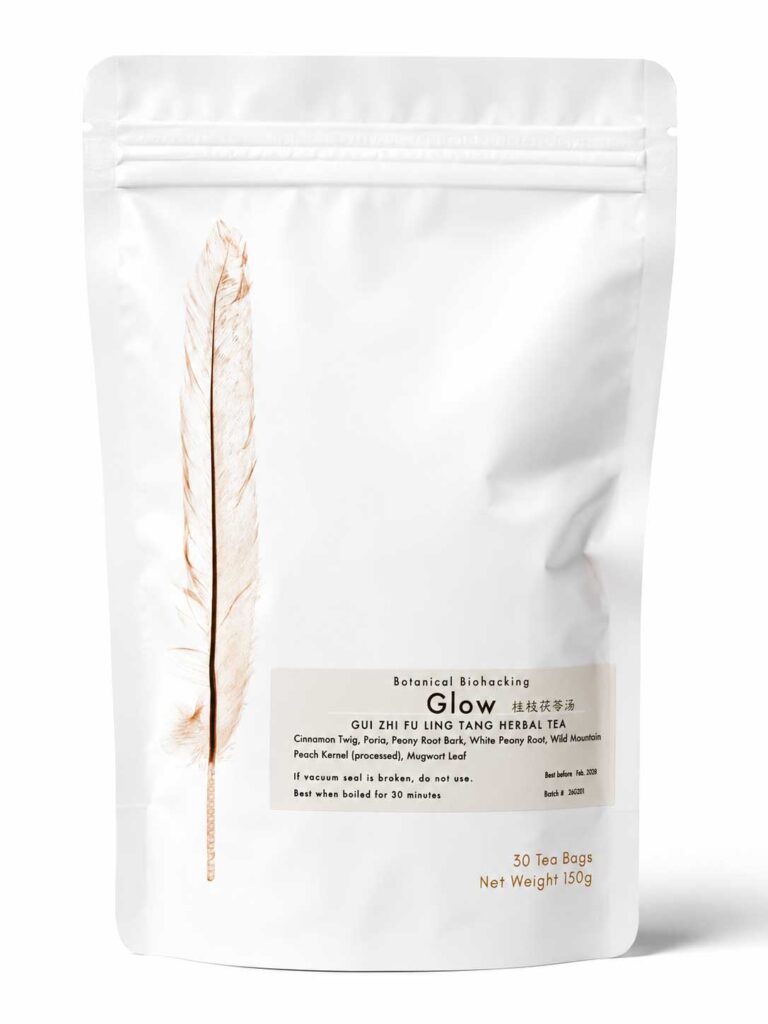
Glow Herbal Tea product mockup

Table of Contents

This one is for period pain that keeps getting called normal.

In classical medicine, moving blood is a strategy — not a catch-all. Glow Tea is for stasis-type patterns: blood stasis with cold congealing. It is a specific pattern, and it has a specific answer.

Here’s what the formula actually is, who it was written for, and what’s inside.

Quick Answer

Glow Tea is built on Gui Zhi Fu Ling — Cinnamon Twig and Poria — with Ai Ye (mugwort) added, made for one specific pattern: blood stasis with cold congealing. That pattern looks like heaviness in the days before the cycle, period pain that over-the-counter options don’t quite settle, and spotting on no predictable schedule. It is not used during pregnancy — and if you take anticoagulant medication or have a bleeding condition, talk with your practitioner first.

What Glow Tea Actually Is

Glow is built on Gui Zhi Fu Ling — Cinnamon Twig and Poria — one of the most enduring formulas in the canon. You will see it written both as Wan (a pill) and Tang (a decoction). Botanical Biohacking builds theirs on the decoction form, with Ai Ye (mugwort) added.

The traditional strategy is deliberately balanced: warm the channels enough that blood moves, soften what has hardened, drain the damp — without ever being harsh. It is a formula of steady pressure rather than force.

That balance is why it has survived two thousand years of continuous use, and why it remains one of the most-studied formulas in modern Chinese medicine research.

The Patient This Was Written For

Botanical Biohacking’s herbal pharmacologist, Dr. Lan, PhD, is specific about who this is for, and her description is worth reading closely.

Heaviness in the days before the cycle. Period pain that no over-the-counter option quite settles. Spotting on no predictable schedule. Skin that loses its composure in the warmer months. She notes this pattern shows up most in her colleagues’ practices through May and June.

She also flags something practitioners care about more than patients expect: the taste is mild. She frames that as a compliance issue, not a luxury. People finish it.

How It's Sourced and Tested

Botanical Biohacking’s contamination protocol covers heavy metals, pesticide residue, and microbial load.

Inside the Formula

Glow layers its herbs the way the classical formula does — each with a defined job.

The Movers

The Softeners

Before You Start

Moving blood is a specific strategy, not a general tonic. This formula is not used during pregnancy. If you take anticoagulant medication or have a bleeding condition, talk with your practitioner or physician first.

In classical medicine, moving blood is a strategy — not a catch-all. Glow is for stasis-type patterns. That precision is the point. — Will Sheppy, L.Ac.

Glow Tea

Gui Zhi Fu Ling with Ai Ye. Thirty teabags, one month’s supply. Mild enough that people actually finish it. Available at Valley Health Market.

Research & Resources

  1. Lei Y, et al. The efficacy and safety of Chinese herbal medicine Guizhi Fuling capsule combined with low dose mifepristone in the treatment of uterine fibroids: a systematic review and meta-analysis of 28 randomized controlled trials. BMC Complement Med Ther. 2023;23(1):54. Link →
  2. Bensky D, Barolet R. Chinese Herbal Medicine: Formulas & Strategies. Eastland Press. (Standard reference for Gui Zhi Fu Ling Wan.)
  3. Dr. Lan, PhD, Botanical Biohacking. Glow Tea, a practical note. Practitioner letter, May 2026.

Educational content from Valley Health Market. Not medical advice. Statements have not been evaluated by the FDA. This product is not intended to diagnose, treat, cure, or prevent any disease. Valley Health Market Educational content rooted in 20+ years of clinical practice in Traditional Chinese Medicine. The information provided is for educational purposes and is not intended to replace consultation with a qualified healthcare practitioner. Please consult your physician before starting any new herbal protocol, especially if pregnant, nursing, on anticoagulants, or managing a chronic condition.

© Valley Health Market · Albany, Oregon

Share on

Will Sheppy, Founder and Acupuncturist at Valley Health Clinic
Willard Sheppy
Willard Sheppy is a licensed acupuncturist (LAc) and Founder of Valley Health Clinic specializing in using Traditional Chinese Medicine to treat acute injuries and chronic conditions, and to improve sports performance and rehabilitation.

FAQ's

What is the most common trigger for Meniere’s attacks?
Stress is the most consistently reported trigger, and research backs it: one large study found attack odds nearly tripled on stressful days. Just before an attack, the sympathetic nervous system spikes — which is why a stress-pattern attack often feels like a panic attack.
For some people, yes — especially those with a damp, fluid-retaining pattern. Honestly, the research on strict salt restriction is mixed, so it helps some people far more than others. It’s a low-risk lever worth trying, but it isn’t a guaranteed fix, and it matters most for the congested pattern rather than the stress-driven or heat-driven ones.
The inner ear is pressure-sensitive, and falling barometric pressure and higher temperatures are documented to correlate with more attacks — risk is roughly 1.3 times higher when pressure drops below 1013 hectopascal. This hits the hot, inflamed pattern hardest. You can’t change the weather, but you can use the forecast as an early-warning system and tighten your routine on those days.
Because your underlying terrain is different. The same diagnosis sits on top of different patterns — stressed, damp, or hot — and each is loaded by a different lever. That’s why a generic trigger list helps less than learning your own pattern, and why two people with Meniere’s often need different plans.
Start by confirming the diagnosis itself — Meniere’s is often confused with BPPV, vestibular neuritis, and vestibular migraine, which are treated very differently. Our companion article, “Meniere’s vs. BPPV vs. Vestibular Disorders,” walks through how to tell them apart by duration, trigger, and hearing change.

Recent Posts