Category: Herbal Teas & Formulas

Chinese Herbs for Tendons and Ligaments: Gu Sui Bu

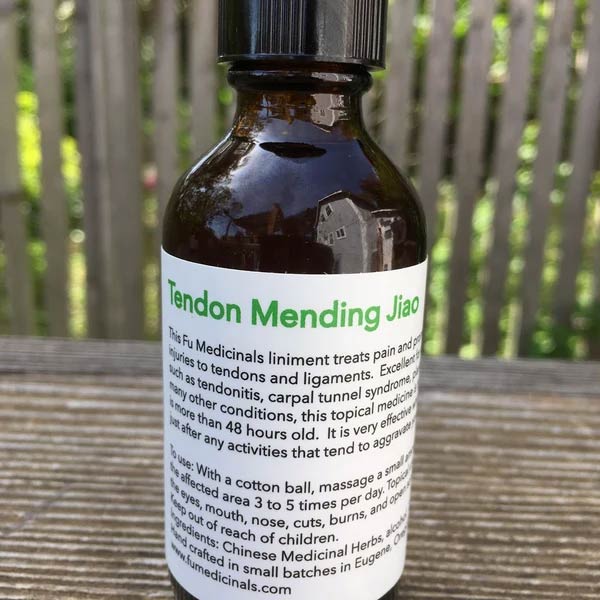
Tendon Mending Jiao by Fu Medicinals
12 minutes read

Chinese Herbs for Tendons and Ligaments: Gu Sui Bu

Willard Sheppy Dipl. OM, LAc, BS

Willard Sheppy is a licensed acupuncturist (LAc) and Founder of Valley Health Clinic specializing in using Traditional Chinese Medicine to treat acute injuries and chronic conditions, and to improve sports performance and rehabilitation.

Tendon Mending Jiao by Fu Medicinals

Table of Contents

Tendons and ligaments are the slowest-healing tissue most of us ever injure. Muscle strains settle down in a couple of weeks. A cranky Achilles, a tennis elbow, an ankle you rolled last spring that still complains on uneven ground — those drag on for months, and the advice you get is usually some version of rest it.

In the clinic, that is the conversation I have most often about tendons: not “what is wrong with it,” but “why is this taking so long, and is there anything I can actually do while I wait?” It is a fair question. Poor blood supply is a real part of the answer, and it is also the part traditional Chinese medicine has been aiming at for a very long time.

Which brings me to a herb with an unforgettable name. Below, what Gu Sui Bu is, what the research does and does not show, and how to tell whether a topical Chinese herbal formula belongs in your recovery plan.

Quick answer

Gu Sui Bu (Drynaria rhizome) is a Chinese herb whose name translates roughly as “mender of shattered bones.” It is traditionally used for broken bones and for tendon and ligament injuries, and it is the chief herb in Fu Medicinals’ Tendon Mending Jiao, a topical salve for chronic tendonitis, tendinosis, and old sprains.

The modern research on Drynaria is real but mostly about bone — lab and animal work on bone formation, plus some evidence it supports blood-vessel growth and cell migration. Direct human research on tendons is not there yet. Treat it as a well-established traditional strategy with promising mechanism data behind it, not a proven tendon cure. External use only; check the safety section before you use it.

Why Tendons and Ligaments Heal So Slowly

Muscle is thick with blood vessels. Tendon and ligament are not. They are dense, fibrous, built for tensile strength rather than metabolic activity — which is exactly what makes them good at their job and bad at repairing themselves. Less circulation means fewer of the raw materials of repair arriving, and it means they arrive slowly.

That is also why the picture changes name over time. What starts as tendonitis — genuine inflammation in the first days and weeks — often becomes tendinosis, where the inflammation has largely burned out and what is left is disorganised, degenerated tissue that simply never finished rebuilding. Anti-inflammatories are aimed at the first problem. Most people who are still hurting at the six-month mark have the second one.

In Chinese medicine the framing is different but it points at the same target: an old injury leaves behind stagnant blood and obstructed circulation in the sinews, and the job is to move it. Whatever vocabulary you prefer, the practical question is the same — how do I get more circulation into a tissue that does not have much?

Which is where one particular herb has been the traditional answer for a very long time.

"Gu Sui Bu in Chinese means the mender of broken bones. And not only is it fantastic for broken bones, it is really good for your tendons and ligaments."
— John Ditmars, Fu Medicinals

Gu Sui Bu: The Herb Called Mender of Shattered Bones

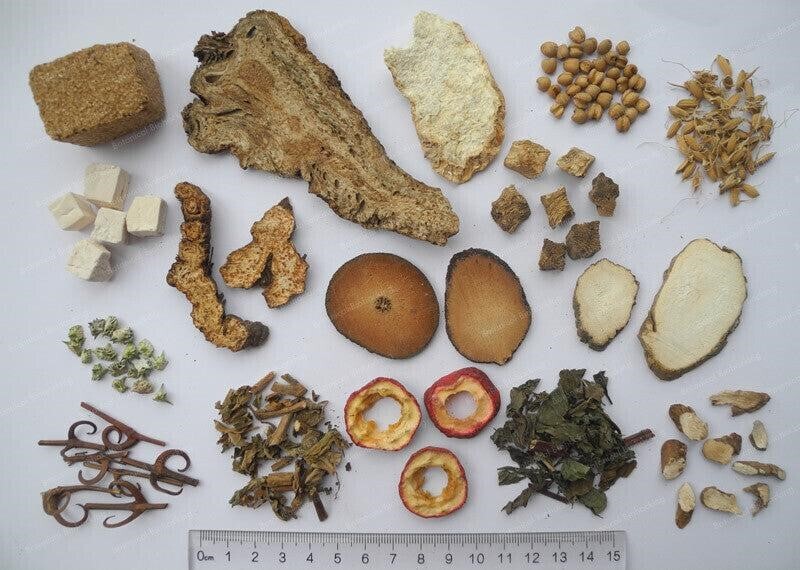
Gu Sui Bu (骨碎补), known botanically as Drynaria fortunei, is the rhizome of a fern that grows on rocks and tree trunks. It is covered in a golden-brown fuzz, and it looks nothing like a pharmaceutical. It has been used in Chinese medicine for bone and sinew injuries for centuries, and it is the reason John Ditmars — the practitioner-maker behind Fu Medicinals, whose liniments we carry — built the Tendon Mending formula around it.

What does the name actually mean?

Gu Sui Bu translates literally as something close to “mend the shattered bone.” Ditmars calls it the Great Mender of Broken Bones, and that is a fair reading of the classical use. What is less obvious to English speakers is that in Chinese medicine, bone and sinew are treated as neighbours rather than separate departments — the same herbs that address one are routinely reached for with the other. So a bone herb heading up a tendon formula is not a stretch of the tradition. It is the tradition.

The research

Drynaria has a genuine and growing modern literature — but nearly all of it is about bone. Animal and cell studies show its flavonoid fraction stimulates bone-forming cells and improves bone density and bone strength, and a 2023 study traced that effect to the TGF-β signalling pathway. A small randomised trial in older women with postmenopausal osteoporosis found improvements in bone density and inflammatory markers.

The finding most relevant to a tendon, though, is a 2018 Taiwanese study showing that Drynaria extract promoted new blood-vessel formation and cell migration in lab and embryo models, working through VEGF and matrix metalloproteinase pathways. Circulation and cell migration are precisely what a poorly-vascularised tendon is short of. That is a mechanism worth taking seriously.

What does not exist is a human trial of Gu Sui Bu for tendonitis, and none of the research above tested a topical preparation. 

A long traditional track record, plausible mechanism, real bone data, and no direct tendon proof. That is better than most herbs and less than a guarantee. Sources are listed at the end.

Why a topical, and not a pill?

A jiao is a salve — herbs extracted into an oil-and-wax base and rubbed in. The appeal for tendon problems is location: an Achilles, a lateral elbow, a wrist or a finger sits close to the surface, and you can put the medicine directly over it and massage it in, several times a day, for as long as it takes. You are combining the herbs with mechanical work on the tissue, which is a large part of why topicals earn their keep in a sports practice.

The Other Herbs Working Alongside It

Gu Sui Bu is the chief, but a jiao is a formula, not a single herb. Tendon Mending Jiao carries 28 botanicals in an organic coconut oil and beeswax base. A few of the ones doing recognisable work:

The full ingredient list is on the product page. If you have a known herbal allergy, read it before you buy — with 28 botanicals, that is not a formality.

Is Tendon Mending Jiao Right for Your Injury?

Fu Medicinals does not make one universal liniment — the line is deliberately split by injury type, and picking the wrong one is the most common way people get a disappointing result. Here is how I sort it.

Reach for it when...

Look elsewhere when...

Tendon Mending Jiao by Fu Medicinals

Tendon Mending Jiao

Fu Medicinals’ Tendon Mending Jiao is the formula built around Gu Sui Bu — 2 fl oz, small-batch, made in Oregon in an organic coconut oil and beeswax base. We carry it because it is the one I reach for with the chronic tendon and old-sprain cases that come through the clinic, and because John makes it the way it should be made.

These statements have not been evaluated by the FDA. This product is not intended to diagnose, treat, cure, or prevent any disease.

Keep Reading

References

Research located via PubMed.

Huang ST, Chang CC, Pang JS, et al. Drynaria fortunei promoted angiogenesis associated with modified MMP-2/TIMP-2 balance and activation of VEGF ligand/receptors expression. Front Pharmacol. 2018;9:979. Link

Zhao Y, Cai X, Sun J, Bi W, Yu Y. Active components and mechanisms of total flavonoids from Rhizoma Drynariae in enhancing cranial bone regeneration. J Ethnopharmacol. 2023;319(Pt 3):117253. Link

Lee YE, Liu HC, Lin YL, Liu SH, Yang RS, Chen RM. Drynaria fortunei J. Sm. improves the bone mass of ovariectomized rats through osteocalcin-involved endochondral ossification. J Ethnopharmacol. 2014;158(Pt A):94-101. Link

Wong KC, Pang WY, Wang XL, et al. Drynaria fortunei-derived total flavonoid fraction and isolated compounds exert oestrogen-like protective effects in bone. Br J Nutr. 2013;110(3):475-485. Link

Lu L, Wang Z, Zhang H, Liu T, Fang H. Drynaria improves lipid profiles of elderly patients with postmenopausal osteoporosis via regulation of Notch1-NLRP3 inflammasome-mediated inflammation. Gynecol Endocrinol. 2022;38(2):176-180. Link

Ditmars J. Fu Medicinals: Gu Sui Bu and the Tendon Mending formula. Video interview, 2026.

Share on

Will Sheppy, Founder and Acupuncturist at Valley Health Clinic
Willard Sheppy
Willard Sheppy is a licensed acupuncturist (LAc) and Founder of Valley Health Clinic specializing in using Traditional Chinese Medicine to treat acute injuries and chronic conditions, and to improve sports performance and rehabilitation.

FAQ's

Does Gu Sui Bu have side effects?

Most reported concerns about Gu Sui Bu come from taking it internally, which should be supervised by a trained herbalist. Used topically in a salve, the main cautions are about the formula as a whole: external use only, never on broken skin, avoid sensitive areas, and keep it away from children. Stop if your skin reacts, and check the full ingredient list if you have known herbal allergies.

Tendon tissue turns over slowly, so a week is not a verdict. Use it consistently, several times a day over several weeks, while you keep loading the tendon sensibly. If nothing has shifted after a fair trial, or the problem is getting worse, get the injury properly examined rather than continuing on your own.

For fresh trauma that is hot, swollen, and bruised, a dit da trauma liniment is the better fit. Tendon Mending Jiao is built for the chronic stage. If you cannot bear weight, the joint looks deformed, or you have numbness or tingling, that needs imaging and a hands-on exam first.

Evil Bone Water is the broad-use foundation for general aches, bruises, sprains, and stiff joints, and it is what most people apply first. Tendon Mending Jiao is targeted at chronic tendon and ligament injury. They layer rather than compete, foundation first and the targeted salve on top.

Consult your doctor before using it if you are pregnant or might be, as several herbs in this formula are blood-moving, which is traditionally avoided in pregnancy. If you take anticoagulants or have a bleeding disorder, run it past your prescriber first.

Recent Posts
Where to Buy Chinese Herbs Online

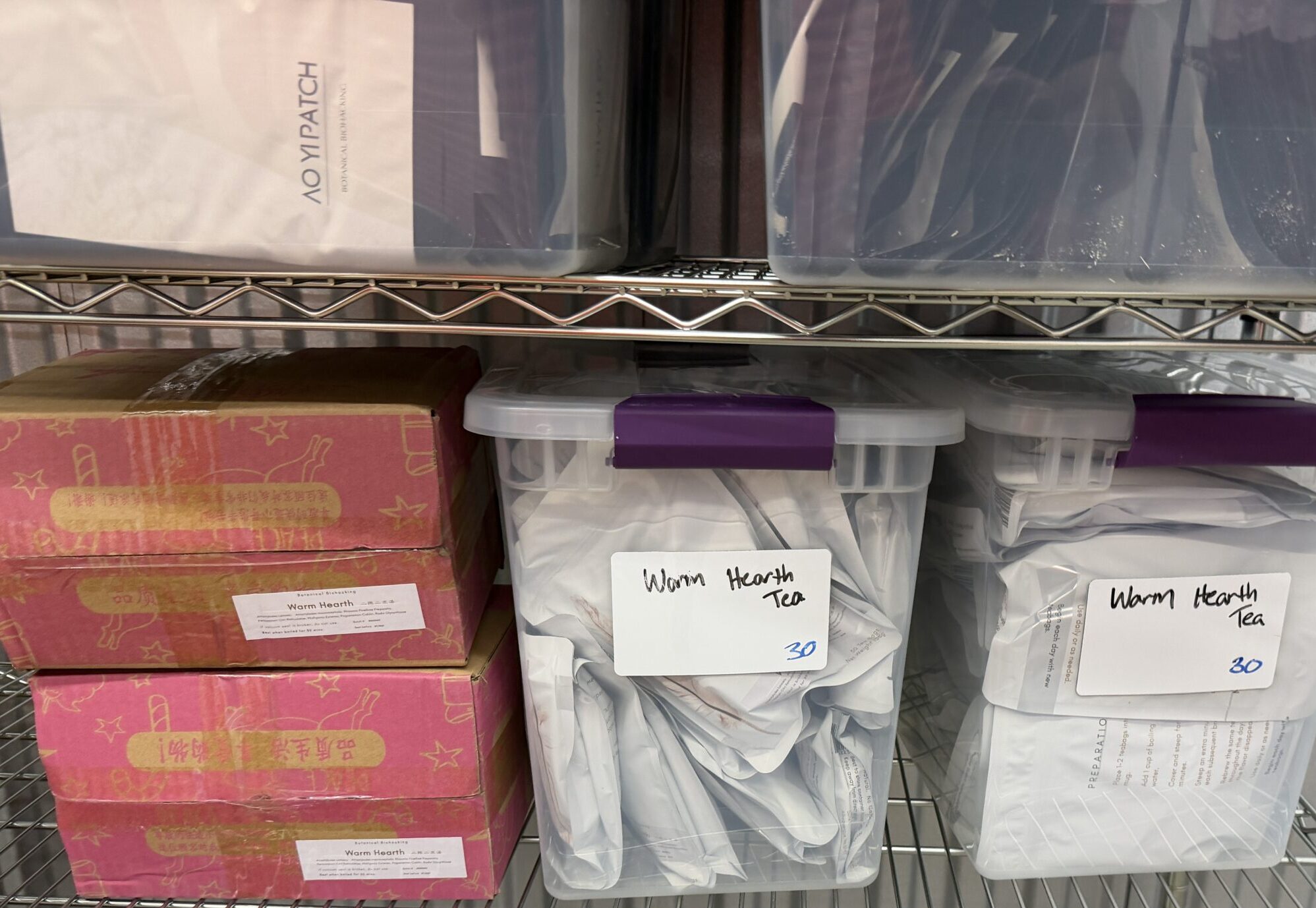
Shelf in the Valley Health Logistics storage unit holding pink Warm Hearth cartons and two clear bins hand-labeled Warm Hearth Tea 30, with bagged Yo Yi Patch inventory on the shelf above.
15 minutes read

Where to Buy Chinese Herbs Online

Willard Sheppy Dipl. OM, LAc, BS

Willard Sheppy is a licensed acupuncturist (LAc) and Founder of Valley Health Clinic specializing in using Traditional Chinese Medicine to treat acute injuries and chronic conditions, and to improve sports performance and rehabilitation.

Shelf in the Valley Health Logistics storage unit holding pink Warm Hearth cartons and two clear bins hand-labeled Warm Hearth Tea 30, with bagged Yo Yi Patch inventory on the shelf above.

Table of Contents

Every week someone asks me where to buy Chinese herbs online. It’s a fair question with an annoying answer, because most of the good stuff isn’t sold to the public at all.

I’ve been prescribing these herbs for twenty years. In that time I’ve watched practitioners decide that herbal medicine doesn’t really work, when what actually happened is they only ever used cheap product at a dose too low to do anything. I’ve also watched patients pay triple on a marketplace for something a clinic down the street would have sold them for less, with guidance included.

So here’s what I actually use, what I’d tell you to skip, and the one thing that fixes more herbal failures than switching brands ever will.

Full disclosure: I own Valley Health Market and I carry Botanical Biohacking there. I used their formulas in my clinic first and started carrying them because of what I saw. There are no affiliate links in this article and nobody paid to be included or left out.

Quick answer

The best Chinese herbal brands — Botanical Biohacking and Classical Pearls — sell only to licensed practitioners, and they cost more. Affordable lines like Evergreen and Treasures of the East still work if you take enough. That last part is where most people go wrong: a capsule holds about 500 mg and a scoop of powder holds a gram, so a real daily dose in capsule form means swallowing a dozen or more. If you’re not licensed, call an acupuncture clinic first, try a good local Asian market second, and don’t buy herbs on Amazon, where the same product routinely costs two to three times more.

How the Chinese herb market actually works

Almost every company in this article sells to licensed practitioners only. You send in a copy of your license, they approve your account, and then you can order. That’s it — that’s the whole gate.

It’s worth understanding because it explains a lot. The material that produces the results you read about is largely invisible from the outside, which is why an honest search for “where to buy Chinese herbs” usually dead-ends at whatever a marketplace is willing to ship you. It also explains why so much of what’s easy to buy is mediocre.

Everything I recommend below reached me the same way: an herbalist I respect, a teacher or a mentor, told me to try it. Then I used it on real patients and it worked. That’s the entire vetting process, and it’s the one I’d suggest you use too.

The brands I use

There’s a tension nobody mentions in school. The best herbs cost more, patients don’t always want to pay for the best herbs, and a patient who never starts because the price scared them off gets zero benefit from the world’s finest granules.

So I run two tiers. Quality, for the results you were taught to expect. And an affordable entry point, because once somebody has felt a cheaper formula work, the conversation about a better one gets much easier.

First, what is a "school"?

You’ll hear practitioners talk about the warming school or the damp school and it sounds like jargon. It isn’t. Chinese medicine didn’t develop in one place — it developed across an enormous country with wildly different climates, and the doctors in each region were looking at different problems out their window.

Cold regions produced traditions built around restoring warmth and circulation. Wet regions produced traditions built around clearing dampness, that heavy, foggy, sluggish quality. Neither is more correct than the other. They’re answers to different questions, and that history is still sitting inside the formulas you buy today.

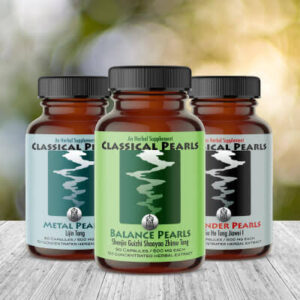
classical pearls supplememnt

Classical Pearls

Classical Pearls comes out of the warming school, so it’s most effective for people who run chronically cold. That’s exactly why their cold-invasion formulas — the ones for the early stage of a cold — perform as well as they do. Quality is excellent, and the material holds up even in capsule form, which is unusual and tells you something.

You do have to find the formulas that work. These are the ones I reach for consistently:

Where I’m less impressed is some of their tonifying formulas — the ones meant to build a depleted person back up. That’s my clinical read, not a knock on the company. Every line has a center of gravity and theirs is warming and dispersing.

You can see the full line at Classical Pearls.

Botanical Biohacking

Botanical Biohacking sits more in the damp school, which is what’s relevant for people in damp conditions like Oregon. It’s also well suited to a typical American diet, which produces its own internal dampness no matter where somebody lives.

That’s why I like the formulas and it’s why I carry them — see the disclosure at the top. You can see the line at Valley Health Market.

The affordable tier

I like Evergreen formulas in the powder, not the pill. They’re complex formulas you can mix together, the quality is good but it’s not amazing, and they’re affordable and easy to use. Treasures of the East I like in the pill — easy to use, reasonable quality, does the job.

There are other companies in the same class. KPC is similar to Evergreen. I haven’t experimented with all of them so I won’t pretend to a clinical opinion I don’t have, but it comes recommended by people I trust.

Pills or powder?

This is where most people go wrong, and it’s just arithmetic.

A concentrated extract capsule is typically about 500 mg. A scoop of granules — powdered extract, loose in a jar — is 1 gram. That’s roughly two capsules per scoop.

Why cheaper herbs need to be powder

Now picture the dose you actually want in a patient — say six to nine grams a day. That’s twelve to eighteen capsules. Nobody is doing that three times a day for six weeks.

So the rule is this: the cheaper the product, the more of it you need, and the harder that is to do in capsule form. That’s the whole reason I want Evergreen as granules. A scoop and a half is easy. Fifteen capsules is not.

Capsules also cost more to manufacture, so you’re frequently paying extra for the form that makes proper dosing hardest. Sometimes that’s still the right trade — for a first-timer, for travel, for compliance. Just make it on purpose.

Taste is doing real work

Granules taste earthy and people complain. Here’s why I don’t apologize for it.

Taste is part of the mechanism. Bite a lemon and your body reacts before you’ve swallowed anything. Eat something savory and your gallbladder starts releasing bile in anticipation of fat. And you don’t only have taste receptors on your tongue — they’re distributed throughout your digestive tract. Your body will taste it either way, but the tongue comes first, and that early signal matters.

It’s not a bad taste. It’s an earthy taste. Reframing it that way with patients helps more than you’d expect. And if it’s somebody’s first time with herbs, start them on capsules and a cheaper product, get them a result they can feel, then move them up.

You wouldn’t ask whether an onion works.

— Will Sheppy, L.Ac.

Why your herbs aren't working

Herbs work. That’s not a promise, it’s a category statement — the same way I’d say carrots work, or garlic works. When they don’t seem to, there are three explanations, and it’s almost always one of them:

Think about aspirin. Aspirin works. But if you take aspirin for the wrong thing you don’t feel better, and nobody concludes from that that pharmacology is fake. The aspirin just wasn’t what you needed.

If you’re consistently disappointed with herbal results, I’d bet on cheap product plus low dosing before anything else on that list.

How long should it take?

Depends what you’re treating. For pain, expect something fairly quickly — often close to immediately. For most other things, think of herbs the way you think of diet.

Eat a Big Mac, you feel like garbage. Eat a salad, you feel better that day. Eat well for a week and your body starts to actually change. Herbs are a strong diet — same curve, steeper slope.

Can you combine formulas?

Yes, and I recommend it. You need to know the formulas or work with someone who does, but combining is normal practice — no stranger than taking vitamin C alongside zinc.

Topicals: the herbs anyone can buy

The topicals are the one category with no license gate, and they’re some of the best products I use. All of them are American made and handcrafted — made by people, not corporations.

They’re all sourcing top quality herbs, which I respect, and you feel the difference in the results.

How to buy Chinese herbs without a license

Everything above except the topicals requires a license. So here’s what to do instead.

Is it safe?

Are the herbs clean?

Largely, yes. Testing for heavy metals and pesticides isn’t federally mandated before market the way it is for drugs, but every major Chinese herbal pharmacy company I’ve looked into treats it as standard practice. The worry about contaminated imports belongs to an earlier era.

My rule is to buy from American-based manufacturers, the ones whose testing you can actually ask about, rather than something produced overseas and shipped straight to a marketplace listing. If a company can’t produce a certificate of analysis, that tells you what you need to know.

Taking herbs without a diagnosis is mostly safe, but it probably won’t be effective, which is its own kind of waste. And if you’re sensitive to herbs, guessing can genuinely go badly.

Medications worth a conversation first

Blood thinners. Many of the major blood-moving herbs in Chinese medicine interact with anticoagulants. Chuan Xiong is the clearest example, and Dan Shen and Dang Gui warrant the same caution. If you’re on warfarin, apixaban, rivaroxaban or anything similar, this needs to be a conversation before you start rather than after.

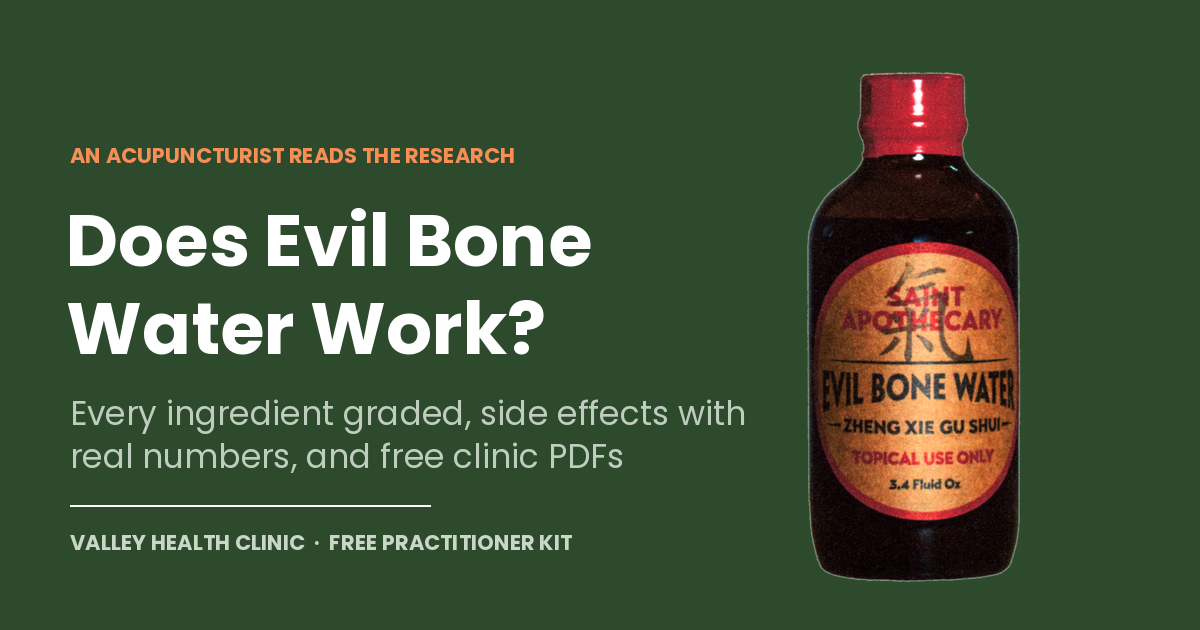
The interesting exception is San Qi, the herb in Evil Bone Water. It moves blood and stops bleeding — a coagulant as well as a mover. That paradox is exactly why it’s the star of so many famous trauma liniments.

Mood medications — antipsychotics and mood stabilizers — are the other category that needs a conversation first. Outside of those two, most people are fine. But “most people” isn’t “you,” which is why the conversation matters.

For a much deeper treatment of herb–drug interactions, including liver and kidney function, SSRIs and diabetes medications, Brehan Crawford wrote a thorough guide to it. Brehan and I went to school together and he’s one of the best herbalists around — someone I trust. It’s built around one formula but the framework applies broadly.

If you only try one thing

Start with Evil Bone Water or Wind Tea.

Evil Bone Water because you can actually buy it without a license, it’s useful for a lot of things, and it works fast enough that you stop wondering whether this stuff is real. Wind Tea for the early stage of a cold, for the same reason — it’s the formula most likely to make a believer out of a skeptic.

Once you’ve felt one of them do its job, everything else in this article gets easier to take seriously.

And if you’re not getting results from Chinese herbs, it’s almost never that the herbs don’t work. It’s cheap product, or not enough of it, or the wrong formula. Fix the dose first — it’s free, and it solves the problem more often than switching brands does.

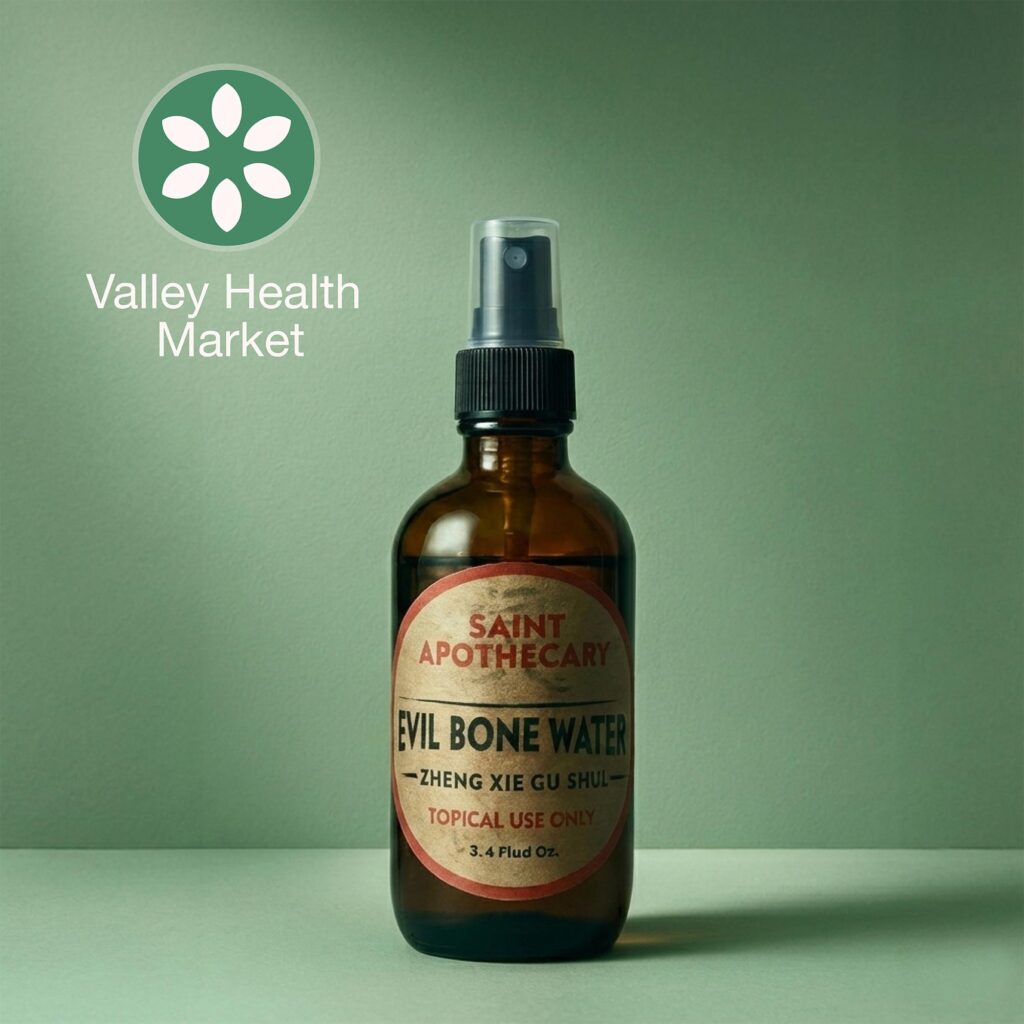
Evil Bone Water Front Label

Evil Bone Water

Zheng Gu Shui, Restored

The topical liniment I reach for first — no license required, fast on bruises, strains and sore joints.

References

Classical Pearls Herbal Formulas. Legacy Series. Link →

Crawford B. Gut Harmony Drug Interactions: Is It Safe With Your Medications? Crawford Wellness. Link →

Fu Medicinals. Topical pain relief, hand-crafted in Oregon. Link →

Botanical EZ, LLC. Corydalis for natural pain relief. Link →

This article is educational and is not medical advice. Chinese herbal formulas are not intended to diagnose, treat, cure or prevent any disease. Talk to a qualified practitioner before starting herbs, especially if you take prescription medication.

Share on

Will Sheppy, Founder and Acupuncturist at Valley Health Clinic
Willard Sheppy
Willard Sheppy is a licensed acupuncturist (LAc) and Founder of Valley Health Clinic specializing in using Traditional Chinese Medicine to treat acute injuries and chronic conditions, and to improve sports performance and rehabilitation.

FAQ's

Can I buy Chinese herbs online without a license?

Most of the top herbal companies sell to licensed practitioners only — you have to send in a copy of your license to get approved. Topicals are the exception and anyone can buy them. For internal herbs, call an acupuncture clinic or try a local Asian market that has someone on staff who knows the formulas.

You can, but the same products routinely cost two to three times what a clinic or a local Asian market charges, and you get no guidance with the purchase. It’s the worst combination available: highest price, least information.

Testing isn’t federally required before market, but every major Chinese herbal pharmacy company I’ve looked into treats it as standard practice. Buy from American-based manufacturers whose testing you can ask about, and if a company can’t produce a certificate of analysis, that tells you what you need to know.

It’s a dosing decision. A capsule holds about 500 mg and a scoop of powder holds a gram, so a real daily dose of six to nine grams means twelve to eighteen capsules. With a cheaper formula, use the bulk powder so the patient can actually reach a therapeutic dose.

Almost always one of three things: it’s the wrong formula for you, it isn’t dosed high enough, or you haven’t taken it long enough. If you’re consistently disappointed, cheap product combined with low dosing is the most likely cause.

Many of the major blood-moving herbs do, including Chuan Xiong, Dan Shen and Dang Gui. If you take warfarin, apixaban, rivaroxaban or a similar anticoagulant, talk to a practitioner before starting. Antipsychotics and mood stabilizers are the other category worth a conversation first.

Recent Posts

Atone vs Microgard Plus vs Microgard: Which One Is for You?

18 minutes read

Materia Medica · The Formula Series

Atone vs Microgard Plus vs Microgard: Which One Is for You?

Willard Sheppy Dipl. OM, LAc, BS

Willard Sheppy is a licensed acupuncturist (LAc) and Founder of Valley Health Clinic specializing in using Traditional Chinese Medicine to treat acute injuries and chronic conditions, and to improve sports performance and rehabilitation.

Table of Contents

Quick answer

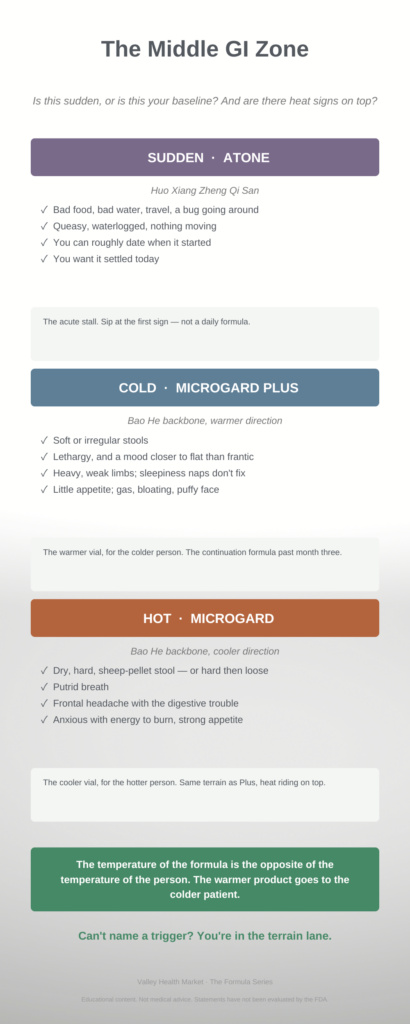
Atone is for the sudden stall — bad food, bad water, travel, a bug going around. It’s a tea you sip at the first sign of trouble. Microgard and Microgard Plus are for the terrain underneath: how your digestion runs on an ordinary week. Between those two, Microgard Plus is the warmer formula for the person who runs cold — soft irregular stools, heaviness, fatigue, low mood — and Microgard is the cooler formula for the person who runs hot — dry hard stools, bad breath, frontal headache, anxious with energy to burn. Two questions sort them: is this sudden or is this your baseline, and are there heat signs on top.

Three formulas, one zone, and the same question every time: which one?

Atone, Microgard Plus, and Microgard all work on the middle — the gastrointestinal terrain. They are not interchangeable, and the difference between them is not subtle once you know what you’re looking at. But there’s a wrinkle in this zone that catches almost everybody, including practitioners: the temperature of the formula is the opposite of the temperature of the person. The warmer product is for the colder patient. Miss that and you will reach for exactly the wrong one.

Why One Zone Gets Three Formulas

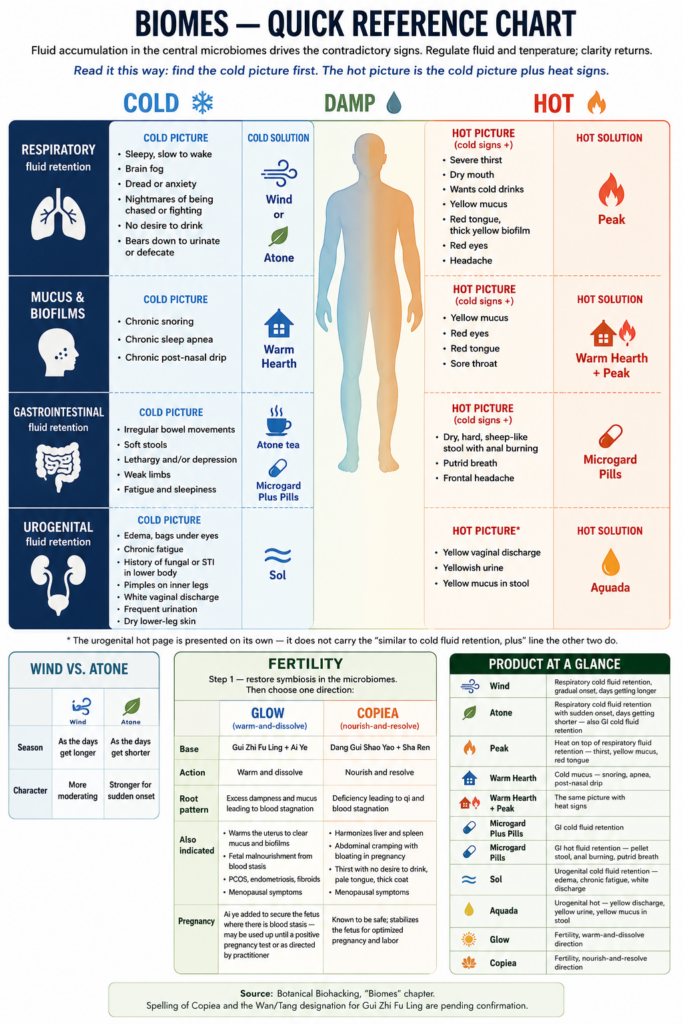
Temperature and moisture differentiate every biome on earth — rainforest to desert — and equally in the living gardens inside you. That’s the whole idea the Botanical Biohacking line is organized around.

When the microbiota in a zone drift out of balance, contradictory signs show up. A patient reads hot and cold, dry and damp, deficient and excess all at once, and the picture refuses to resolve into one tidy diagnosis. That isn’t a diagnostic failure. It means you’re not looking at one organ — you’re looking at growing conditions that drifted.

So the gastrointestinal zone doesn’t get one formula. It gets positions, and you pick the one that matches:

The Two Questions That Sort Them

Two questions, in this order.

Question One: Is this sudden or your baseline?

Sudden is the questionable takeout, the travel week, the summer bug, the water that wasn’t quite right. It arrived, you can roughly date it, and you want it settled today. That’s Atone’s lane.

Baseline is how your digestion runs on an ordinary Tuesday when nothing in particular has happened. That’s the terrain, and terrain is what the two Microgard vials are built for. If you can’t name a trigger, you’re in the terrain lane.

Question Two: Cold or Hot?

Once you’re in the terrain lane, the hot picture is the cold picture plus heat signs, not a separate presentation. So learn the cold one first and watch for what gets added.

And here is what heat adds on top of that picture:

The three-question screen from the original comparison still does most of the work in under a minute: How is your appetite — normal, diminished, or strong? What are your stools like — loose or hard? And emotionally, are you closer to depressed, or closer to anxious?

Atone: When It Came On Suddenly

Huo Xiang Zheng Qi San — Agastache Powder to Rectify the Qi — is the classic prescription for external damp obstructing the middle. The summer-bug, questionable-takeout, travel-tummy, damp-and-queasy picture. It is a household staple across much of Asia for exactly this reason: it’s what you reach for when your gut feels waterlogged and rebellious and you want it settled today.

It works by aromatically waking the digestion up, releasing the exterior, and getting stuck qi and fluid moving again in the right direction. Not by attacking anything. Huo Xiang (agastache) is the monarch herb; Zi Su Ye and Bai Zhi release the exterior; Da Fu Pi and Hou Po move qi and relieve fullness; Chen Pi and Fa Ban Xia dry damp and settle nausea; Bai Zhu and Fu Ling strengthen the spleen and drain damp; Jie Geng and Gan Cao open the chest and harmonize. Eleven herbs, full aromatic architecture kept intact rather than trimmed for cost.

The source material’s own rule of thumb on timing is worth borrowing here: Atone is the stronger choice for sudden onset, and it’s most generally used as the days are getting shorter. Full breakdown in the Atone post.

Microgard Plus: When Your Digestion Runs Cold

This is the vial for the person whose baseline is heavy and slow. Soft or irregular stools, limbs that feel weak, sleepiness that naps don’t fix, an appetite that never quite shows up, and a mood that sits closer to flat than to frantic. Weight that goes on anyway. Often a puffy face.

Microgard Plus is the warmer of the two vials, and the herbs unique to it tell you why: Shan Zha (hawthorn), Shen Qu (medicated leaven), and Gu Ya (rice sprout) are the classical food-moving trio for overeating, eating too fast, and food that sits; Shi Chang Pu (acorus) is the orifice-opening herb the line uses for the gut-brain layer; Bai Ji Li (tribulus) calms the liver and dispels wind.

Positioned in the catalog as the continuation vial — the one that carries the work past month three. On body type, the original comparison is blunt about it: this suits the cold, yin-leaning constitution rather than the lean, hot, wired one. Full breakdown in the Microgard Plus post.

Microgard: When It Runs Hot

Same terrain, heat on top. Stools that are dry and hard — sheep pellets — or that start hard and finish loose, with a burning sensation after. Putrid breath. A frontal headache that shows up with the digestive trouble rather than separately. Anxious, but with energy behind it rather than the flat exhaustion of the cold picture.

Microgard is the more neutral, less warming of the two, and again the unique herbs say so: Ju Hua (chrysanthemum) releases wind-heat, Hou Po (magnolia bark) regulates qi and relieves fullness, Ji Li extinguishes wind, and Dao Ya (rice husk) works on food stagnation. It suits either the lean, acute, yang constitution — the skinny vegan end of the spectrum — or the larger, very yang presentation where heat and damp are both loud.

Here is the sentence to reread if only one thing sticks: you give the cooler formula to the hotter person. It sounds backwards for about five seconds and then it’s obvious. Full breakdown in the Microgard post, and the full side-by-side herb lists live in the original Microgard vs Microgard Plus comparison.

The temperature of the formula is the opposite of the temperature of the person. The warmer product is for the colder patient. Almost every wrong pick in this zone comes from getting that backwards.

— Will Sheppy, L.Ac.

What All Three Share

The two vials overlap more than they differ, which is why the sorting question matters rather than the ingredient list. Both are described as clearing phlegm and dampness, relieving food stagnation, reducing inflammation and repairing the digestive system, supporting good gut bacteria, and counteracting what the standard American diet does to a middle.

They share a backbone of herbs, grouped by job:

That last name is worth pausing on. Huo Xiang is in both vials, and it is the monarch herb of Atone. The aromatic damp-transformer that settles an acute stall is the same herb doing quiet background work in the daily formulas. That’s not a coincidence — it’s the through-line of the whole zone.

Yi Yi Ren (coix seed) is the other shared name that carries weight. The line describes it as doing two jobs: washing the intestines by improving fecal moisture and promoting peristalsis, and repairing the intestinal wall by supporting the growth and differentiation of epithelial cells. Note that coix seed is frequently confused with Job’s tears; they are not the same thing.

What the Research Actually Shows

This is where I’d rather be honest than impressive, because the honest version is more useful to you. In this zone the evidence is genuinely lopsided — the acute formula has human trials, and the daily formulas have mice.

Huo Xiang Zheng Qi has real randomized human data. A multicenter randomized trial gave the oral liquid alongside standard anti-nausea drugs to sixty chemotherapy patients on a multiday cisplatin regimen, and the complete-response rate for acute nausea and vomiting was roughly 63% against 33% for placebo, with more nausea-free days overall. A separate randomized trial of 283 COVID-19 patients found no significant difference in overall symptom improvement, but a specific advantage for nausea, vomiting, and limb soreness. Two more trials are registered — for diarrhea-predominant IBS and for atopic dermatitis with a dampness pattern — but as of this writing only the protocols are published in the English literature, not the results. So: the formula measurably does something in humans, and the something is nausea, vomiting, and damp-type symptoms. That is a narrower claim than “it works,” and it is the claim the data supports.

Bao He Wan — the backbone under both vials — is preclinical, but unusually on-point preclinical. The published work is in mice fed a high-fat, high-protein diet until they developed diarrhea. Baohe pill decoction raised intestinal microbial counts and lactase activity, shifted the structure of the lactase-producing bacterial community, and improved amylase, protease, and sucrase activity. Mechanistically that lines up remarkably well with what the product claims to do — restore flora, restore digestive function — which is more than most herbal products can say about their animal data. It’s still mice.

Coix seed is also mice. In a five-week feeding study, adding coix seed to a high-fat diet partly counteracted the weight, fat-mass, and cholesterol effects, and increased Akkermansia muciniphila and Lactobacillus — organisms that track inversely with obesity and metabolic disease. Interesting, and not a human outcome.

What stands behind these formulas is centuries of documented clinical use, which is a real form of evidence and I’m not going to pretend otherwise. It is also not the same thing as a trial, and anyone telling you it is should make you suspicious.

Limits, and When This Isn't a Tea Problem

Four limits worth stating plainly.

And the line that matters most: signs of dehydration, blood in the stool, black or tarry stool, high fever, severe or persistent abdominal pain, unexplained weight loss, or symptoms lasting more than a couple of days need real medical care, not more tea. A change in bowel habit that doesn’t resolve deserves a workup. If you’re pregnant, nursing, on anticoagulants, or managing a chronic condition, talk with your practitioner or physician before starting any of these.

Botanical Biohacking, maker of Microgard Plus

The Middle GI Trio

Atone, Microgard, and Microgard Plus — practitioner-formulated, batch-tested, and stocked at Valley Health Market. Atone is thirty teabags; the Microgard vials are micro-pill format.

References

  1. Zhu Zhen Heng (Zhu Dan Xi). Dan Xi Xin Fa (丹溪心法, Teachings of Master Dan Xi). c. 1481. (Source text for Bao He Wan.)
  2. Tai Ping Hui Min He Ji Ju Fang (太平惠民和劑局方, Imperial Grace Formulary of the Tai Ping Era). 1107. (Source text for Huo Xiang Zheng Qi San.)
  3. Bensky D, Barolet R. Chinese Herbal Medicine: Formulas & Strategies. Eastland Press. (Standard reference for Bao He Wan and Huo Xiang Zheng Qi San.)
  4. Bensky D, Clavey S, Stöger E. Chinese Herbal Medicine: Materia Medica, 3rd ed. Eastland Press, 2004.
  5. Wei H, Sun Y, Xie L, et al. Huo Xiang Zheng Qi oral liquid combined with 5-HT3 receptor antagonists and dexamethasone can prevent chemotherapy-induced nausea and vomiting for patients receiving multiday cisplatin-based regimen: a multicenter trial. J Integr Complement Med. 2023;29(8):501–509. Link →
  6. Xiao M, Tian J, Zhou Y, et al. Efficacy of Huoxiang Zhengqi dropping pills and Lianhua Qingwen granules in treatment of COVID-19: a randomized controlled trial. Pharmacol Res. 2020;161:105126. Link →
  7. Guo X, Xuan M, Zheng H, et al. The Chinese herbal formula Huoxiang Zhengqi for diarrhea-predominant irritable bowel syndrome (CHAIRS): a study protocol for a double-blinded randomized controlled trial. Trials. 2021;22(1):491. Link → (Protocol only — results not yet published in the English literature.)
  8. Zhou K, Yi X, Tan Z, Peng M, Xiao N. Baohe pill decoction treats diarrhea induced by high-fat and high-protein diet by regulating lactase-producing bacteria in intestinal mucosa. Front Microbiol. 2023;14:1157475. Link → (Animal study.)
  9. Guo K, Yan Y, Zeng C, Shen L, He Y, Tan Z. Study on Baohe pills regulating intestinal microecology and treating diarrhea of high-fat and high-protein diet mice. Biomed Res Int. 2022;2022:6891179. Link → (Animal study.)
  10. Liu S, Li F, Zhang X. Structural modulation of gut microbiota reveals Coix seed contributes to weight loss in mice. Appl Microbiol Biotechnol. 2019;103(13):5311–5321. Link → (Animal study.)
  11. A note on evidence: a PubMed search returns no English-indexed human clinical trial for Bao He Wan in any form. The Baohe studies above are in mice. The Huo Xiang Zheng Qi trials are in chemotherapy-induced nausea and in COVID-19 — not in ordinary digestive upset. We would rather say so than overstate a thin literature.

Educational content rooted in 20+ years of clinical practice in Traditional Chinese Medicine. The information provided is for educational purposes and is not intended to replace consultation with a qualified healthcare practitioner. Please consult your physician before starting any new herbal protocol, especially if pregnant, nursing, on anticoagulants, or managing a chronic condition.

Share on

Will Sheppy, Founder and Acupuncturist at Valley Health Clinic
Willard Sheppy
Willard Sheppy is a licensed acupuncturist (LAc) and Founder of Valley Health Clinic specializing in using Traditional Chinese Medicine to treat acute injuries and chronic conditions, and to improve sports performance and rehabilitation.

FAQ's

What's the difference between Microgard and Microgard Plus?

They point in opposite temperature directions. Microgard Plus is the warmer formula, meant for the person whose digestion runs cold — soft or irregular stools, heaviness, fatigue, poor appetite, low mood. Microgard is the more neutral, less warming formula, meant for the person running hot — dry hard stools, putrid breath, frontal headache, anxious with energy. The confusing part is that the warmer product goes to the colder person, which is standard practice in Chinese herbal medicine but reads backwards at first glance.

Ask whether you can date it. Atone is for the sudden stall — bad food, bad water, travel, a bug going around — and it is built on Huo Xiang Zheng Qi San, the formula households across Asia keep on hand for exactly that. The two Microgard vials are for the terrain underneath: how your digestion runs on an ordinary week when nothing in particular has happened. If you can’t name a trigger, you’re looking at terrain.

Microgard and Microgard Plus are positioned as a sequence rather than a pair to take simultaneously — Microgard Plus is described as the continuation vial that carries the work past month three. Atone is a different tool for a different moment and is generally used acutely rather than daily. Layering formulas is a conversation to have with your practitioner rather than something to work out from a product page.

All three address bloating, which is exactly why bloating alone is a poor sorting question. Look at the company it keeps instead. Bloating with soft stools, fatigue, and low mood points cold. Bloating with hard stools, bad breath, and anxious energy points hot. Bloating that arrived on Tuesday after a questionable meal points to Atone.

It’s lopsided, and worth knowing which way. Huo Xiang Zheng Qi — the formula behind Atone — has genuine randomized human trials, though in chemotherapy-induced nausea and in COVID-19 rather than in everyday digestive upset. Bao He Wan, the backbone under both Microgard vials, has no English-indexed human trial at all; what exists is mouse work on gut flora and digestive enzyme activity, which happens to line up well with what the products claim to do. Coix seed, shared by both vials, is also mice. Centuries of documented clinical use stand behind all of it, and that is a real form of evidence — just not the same thing as a trial.

Recent Posts

Warm Hearth vs Wind vs Peak: Which One Is for You?

15 minutes read

Materia Medica · The Formula Series

Warm Hearth vs Wind vs Peak: Which One Is for You?

Willard Sheppy Dipl. OM, LAc, BS

Willard Sheppy is a licensed acupuncturist (LAc) and Founder of Valley Health Clinic specializing in using Traditional Chinese Medicine to treat acute injuries and chronic conditions, and to improve sports performance and rehabilitation.

Table of Contents

Three formulas, one zone, and the same question every time: which one?

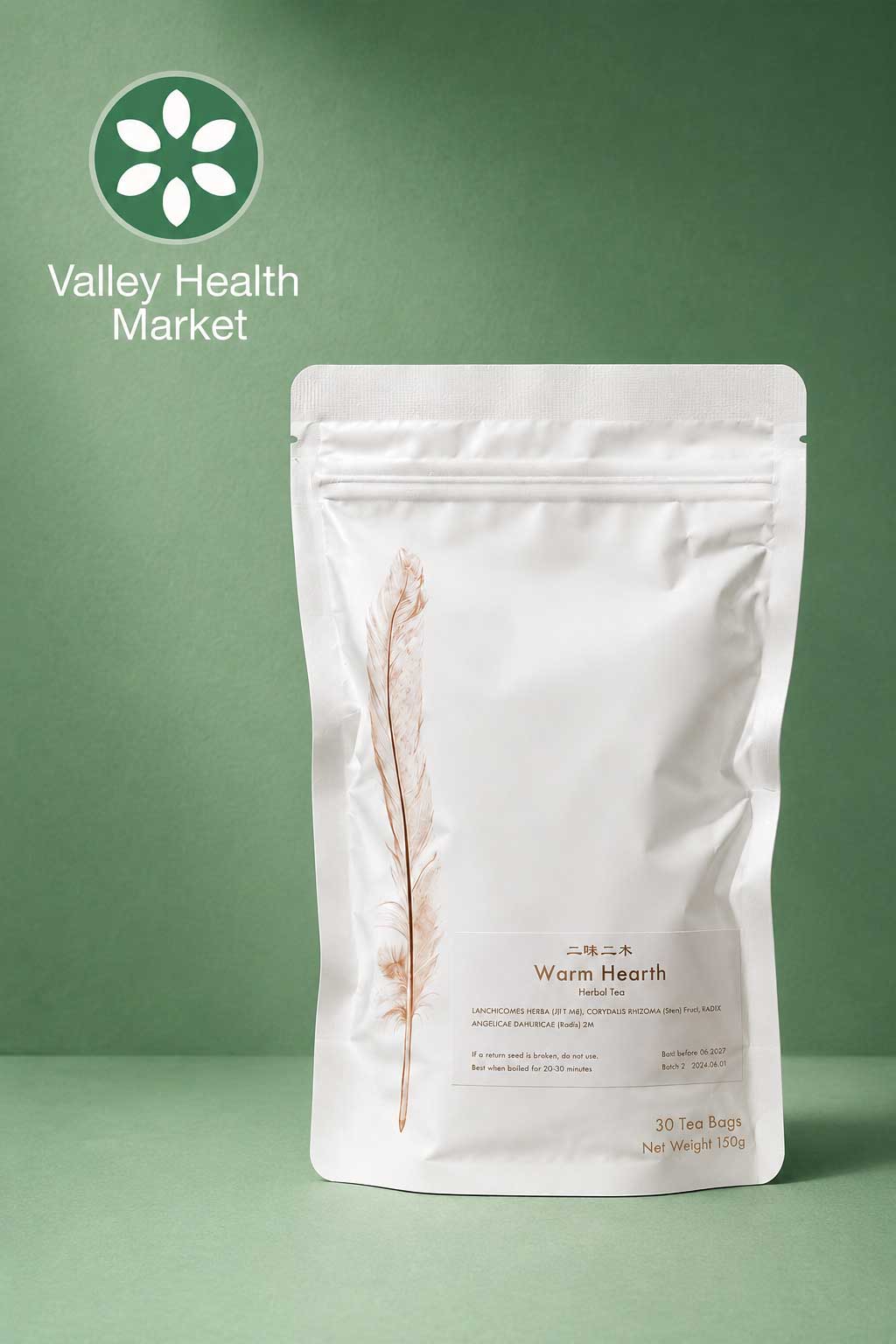
Warm Hearth, Wind, and Peak all work on the upper respiratory terrain. They are not interchangeable, and the difference between them is not subtle once you know what you’re looking at — but nobody tells you what to look at. So people guess, or they buy the one with the best description, or they buy all three and rotate.

Here’s the actual sorting logic: the two questions that separate them, what to do when the answer is “both,” what the research honestly supports, and where the line is between a tea problem and a doctor problem.

Quick answer

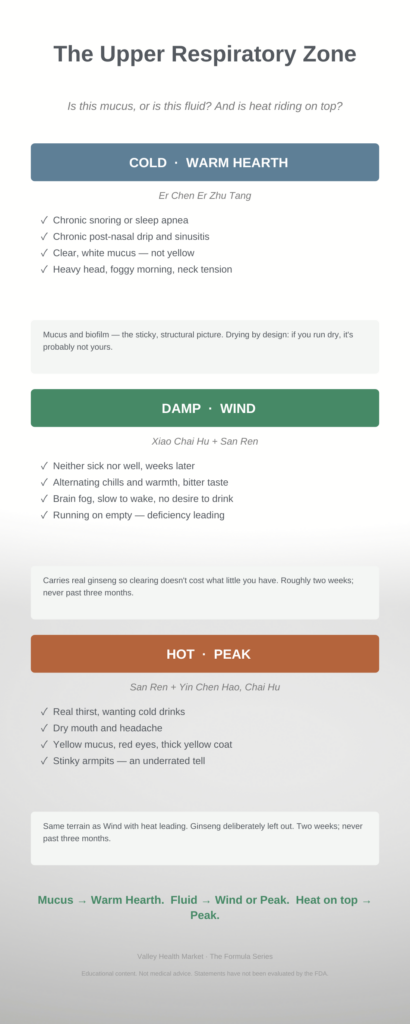
Warm Hearth is for mucus and biofilm — the chronic snoring, post-nasal drip, heavy foggy morning picture. Wind is for lingering damp in someone who is running on empty; it carries real ginseng so clearing doesn’t cost them what little they have. Peak is the same terrain when heat is leading — thirst, headache, yellow mucus, red eyes — and it leaves the ginseng out. Two questions sort them: is this mucus or is this fluid, and is heat riding on top. Wind and Peak are both built on San Ren Tang, which is a targeted tool and not a forever tea — roughly two weeks, never longer than three months.

Why One Zone Gets Three Formulas

Temperature and moisture differentiate every biome on earth — rainforest to desert — and equally in the living gardens inside you. That’s the whole idea the Botanical Biohacking line is organized around.

When the microbiota in a zone drift out of balance, contradictory signs show up. A patient reads hot and cold, dry and damp, deficient and excess all at once, and the picture refuses to resolve into one tidy diagnosis. In the clinic that’s the moment people usually start second-guessing themselves. It isn’t a diagnostic failure. It means you’re not looking at one organ — you’re looking at growing conditions that drifted.

So the upper respiratory zone doesn’t get one formula. It gets a spectrum, and you pick the position on it:

The Two Questions That Sort Them

Position on the spectrum is decided by two questions, in this order.

Question One: is this mucus or fluid?

Mucus and biofilm is the chronic, sticky, structural picture — snoring, sleep apnea, post-nasal drip that has been there for years. Fluid retention is the heavy, sluggish, foggy picture — slow to wake, brain fog, a generalized feeling of dread, dreams of being chased, no real desire to drink water, needing to bear down to use the bathroom.

Mucus sends you to Warm Hearth. Fluid sends you to Wind or Peak.

Question Two: is heat on top?

In this zone the hot picture is usually the cold picture plus heat signs, not a separate presentation. So learn the cold one first and watch for what gets added:

Four screening questions get you most of the way there in under a minute: Do you have a dry mouth? Do you feel thirsty? Do you bear down with bowel movements? Do you have environmental sensitivities or allergies?

Warm Hearth: When It's Mucus, Not Fluid

Er Chen Tang — the Two-Aged Decoction — is the base formula for damp-phlegm in Chinese herbal medicine. Nearly every phlegm formula in the tradition is built on top of it. Practitioners think of it the way builders think of a footing: it rarely gets the credit, and almost everything sits on it.

Warm Hearth is the classical modification Er Chen Er Zhu Tang — that base plus Bai Zhu and Cang Zhu, the two great damp-drying atractylodes, for more drying and strengthening power.

Reach for it when the picture is structural rather than foggy:

The full formula breakdown lives in the Warm Hearth post. One caution worth repeating here: this is a drying formula built for a damp picture. If you tend to run dry, it is probably not your formula.

Wind: When You're Neither Sick nor Well

Some people don’t get knocked down by a bug. They get stuck halfway — not sick enough to stay in bed, not well enough to get their life back. Wind is the formula for that stage.

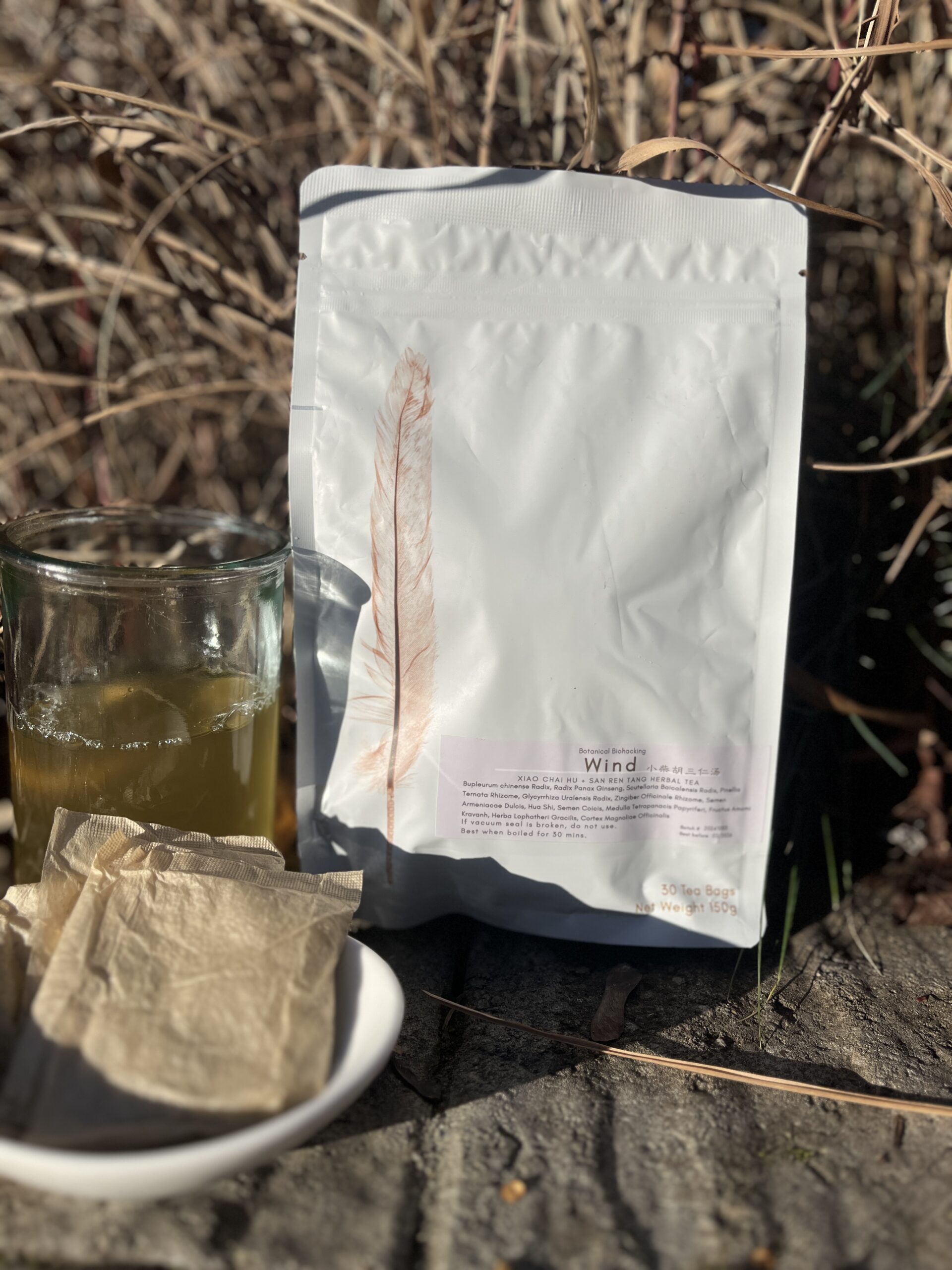
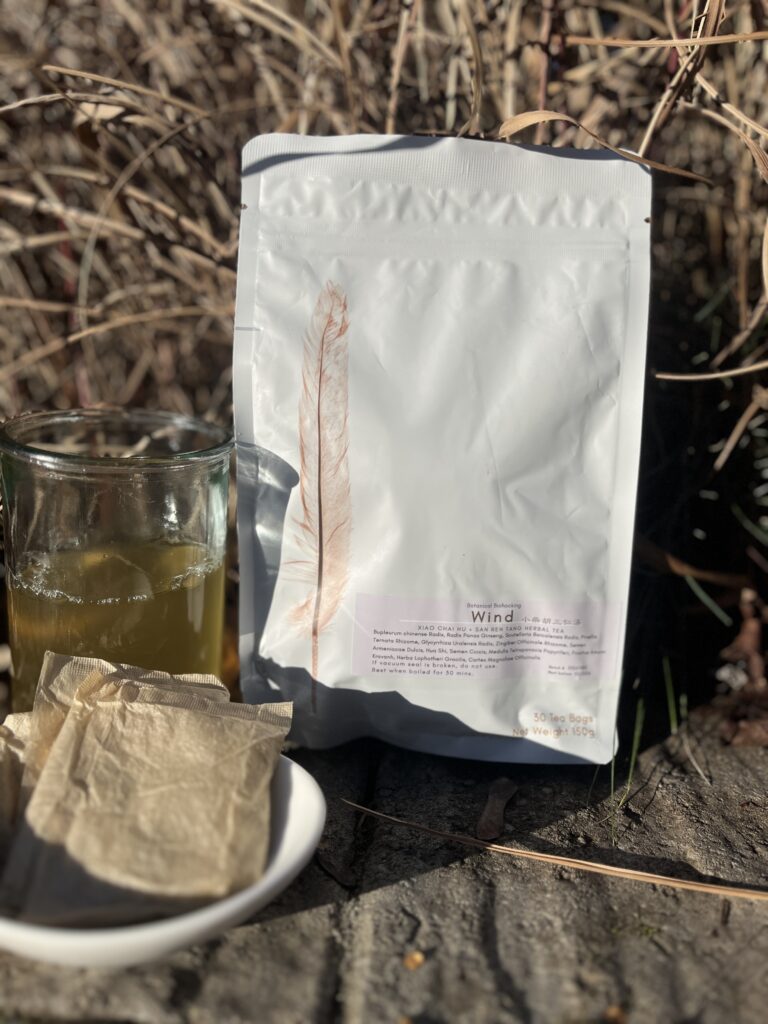
It’s built on Xiao Chai Hu Tang, the Minor Bupleurum Decoction, the definitive formula for the Shaoyang stage: the in-between layer where a pathogen is neither fully outside the body nor fully settled inside it. Alternating chills and warmth, a bitter taste, no appetite, that half-well feeling weeks after everyone else bounced back. The formula’s job is not to attack. It’s to harmonize — to help the body finish what it started. Botanical Biohacking then layers in San Ren Tang herbs for the damp-heat sluggishness that rides along with modern constitutions.

The detail that decides Wind versus Peak is one herb. Wind carries super high-grade white ginseng, added by pharmacology professor Dr. Zhong Shi Hong specifically so the formula doesn’t drain qi over a course of use. Most Xiao Chai Hu Tang on the market substitutes Dang Shen to cut cost; Wind uses real Ren Shen. That’s structural, not a marketing bullet.

So: more relative deficiency → Wind. The ginseng holds the person up while the dampness clears. Full breakdown in the Wind post.

Peak: When Heat Is Driving It

Peak is the same two classical formulas — San Ren Tang and Xiao Chai Hu Tang — aimed at a different person entirely. The heat-clearing side is strengthened with Yin Chen Hao and Chai Hu sourced from the Tibetan Plateau, and the ginseng is deliberately left out.

San Ren Tang itself has a datable origin, which is more than most herbal products can claim: the Wen Bing Tiao Bian, published in 1813 by Wu Ju Tong. His description of the pattern still reads like a modern chart note — headache, aversion to cold, a heavy aching body, a pale tongue without thirst, chest tightness, no appetite, fever rising in the afternoon. What makes his account genuinely sophisticated is the section on errors: sweating the patient makes them foggy, purging makes qi leak away, and moistening drives the dampness deeper. A catch-22. San Ren Tang was his answer to it.

So: more excess and heat → Peak. Full breakdown in the Peak post.

One zone can run cold in one corner and hot in another at the same time. That isn't a contradiction in the patient. It's information about the terrain.

— Will Sheppy, L.Ac.

When to Combine Instead of Choose

The three-column layout implies you pick one. Often you don’t — and the source material is explicit about the most common overlap.

There’s a sequencing point underneath all of this that’s easy to miss. Clearing the lingering dampness is often what makes the rest of the case legible — once it clears, the simple pattern is finally visible underneath, and what’s left is frequently one or two bags of something straightforward rather than a complicated protocol.

What the Research Actually Shows

This is where I’d rather be honest than impressive, because the honest version is more useful to you.

Xiao Chai Hu Tang has genuine human trial data — but not on this. The published randomized trials on modified Xiaochaihu Decoction are in gastroesophageal reflux disease and in persistent depression, not in lingering respiratory illness. The reflux trial is a reasonable piece of work: 288 participants, randomized, double-blind, double-simulation against omeprazole, with comparable symptom-score improvement and a lower relapse rate at one and three months. That tells you the formula does something measurable in humans. It does not tell you it does this.

Er Chen Tang is preclinical. The most relevant study is a mouse model of what the authors call dyslipidemia phlegm-dampness retention syndrome, where Erchen decoction reversed lipid indexes and reduced markers of oxidative stress. Mechanistically interesting, mice.

San Ren Tang has essentially nothing in the English-indexed literature — no human trial I can point you to. What stands behind it is two hundred years of documented clinical use since Wu Ju Tong wrote it down, and Er Chen Tang has roughly a thousand.

That’s a real form of evidence and I’m not going to pretend otherwise. It is also not the same thing as a trial, and anyone telling you it is should make you suspicious.

Limits, and When This Isn't a Tea Problem

Three limits, all of them from the formulators themselves rather than from me.

And the line that matters most: a high fever, a severe or worsening infection, or trouble breathing needs real medical care, not tea. If you’re pregnant, nursing, on anticoagulants, or managing a chronic condition, talk with your practitioner or physician before starting any of these.

Botanical Biohacking, maker of Microgard Plus

The Upper Respiratory Trio

Warm Hearth, Wind, and Peak — practitioner-formulated by Dr. Jin Zhao, fine-tuned by Dr. Zhong Shi Hong, batch-tested, and stocked at Valley Health Market. Thirty teabags each.

References

  1. Wu Ju Tong. Wen Bing Tiao Bian (溫病條辨, Systematic Differentiation of Warm Diseases). 1813. (Source text for San Ren Tang.)
  2. Bensky D, Barolet R. Chinese Herbal Medicine: Formulas & Strategies. Eastland Press. (Standard reference for Er Chen Tang, Xiao Chai Hu Tang, and San Ren Tang.)
  3. Bensky D, Clavey S, Stöger E. Chinese Herbal Medicine: Materia Medica, 3rd ed. Eastland Press, 2004.
  4. Li Z, Tao L, Zhang SS, et al. Modified Xiaochaihu Decoction for gastroesophageal reflux disease: a randomized double-simulation controlled trial. World J Gastroenterol. 2021;27(28):4710–4721. Link →
  5. Li X, Li X, Gong M, et al. Modified Xiaochaihu Decoction combined with mirtazapine in the treatment of persistent depression: a pilot randomized controlled trial. Contrast Media Mol Imaging. 2022;2022:8682612. Link →
  6. Chen J, Ye C, Yang Z, et al. Erchen decoction to reduce oxidative stress in dyslipidemia phlegm-dampness retention syndrome mice. Phytomedicine. 2023;115:154808. Link → (Animal study.)
  7. A note on evidence: a PubMed search returns no English-indexed human clinical trial for San Ren Tang, and none for the specific Er Chen Er Zhu blend. The trials above are on modified Xiaochaihu Decoction in conditions other than lingering respiratory illness. We would rather say so than overstate a thin literature.

Educational content rooted in 20+ years of clinical practice in Traditional Chinese Medicine. The information provided is for educational purposes and is not intended to replace consultation with a qualified healthcare practitioner. Please consult your physician before starting any new herbal protocol, especially if pregnant, nursing, on anticoagulants, or managing a chronic condition.

Share on

Will Sheppy, Founder and Acupuncturist at Valley Health Clinic
Willard Sheppy
Willard Sheppy is a licensed acupuncturist (LAc) and Founder of Valley Health Clinic specializing in using Traditional Chinese Medicine to treat acute injuries and chronic conditions, and to improve sports performance and rehabilitation.

FAQ's

What's the difference between Wind Tea and Peak Tea?

Both are San Ren Tang remixed with Xiao Chai Hu Tang by the same team, and they are not interchangeable. Wind carries high-grade white ginseng and suits more relative deficiency — it holds the person up while the dampness clears. Peak leaves the ginseng out and strengthens the heat-clearing side with Yin Chen Hao and Tibetan Plateau Chai Hu, so it suits the more excess, heated presentation. The formulators state the rule that plainly: more deficiency, Wind; more excess and heat, Peak.

Ask whether the problem is mucus or fluid. Warm Hearth is for mucus and biofilm — chronic snoring, sleep apnea, long-standing post-nasal drip, sinusitis with clear white mucus. Wind and Peak are for fluid retention — the heavy, foggy, slow-to-wake picture with little desire to drink water. If it’s chronic and sticky, that’s Warm Hearth’s lane.

Sometimes, yes. The most common combination in the source material is Warm Hearth with Peak, for mucus and biofilm that has heat riding on top — yellow mucus, red eyes, red tongue, sore throat alongside the chronic drip. Peak is also used with Aquada when lower-jiao damp-heat is severe. Check with your practitioner before layering formulas.

Both are built on San Ren Tang, and the makers’ own guidance is roughly two weeks, and not longer than three months, because over time the formula can drain qi. These are targeted tools rather than daily forever-teas. Note that both are also seasonal products — they ship September through June and pause in July and August.

Honestly, it’s uneven. Modified Xiaochaihu Decoction — the base of Wind and Peak — has real randomized human trials, but in gastroesophageal reflux and persistent depression rather than in lingering respiratory illness. Er Chen Tang, behind Warm Hearth, has mechanistic animal work. San Ren Tang has no English-indexed human trial at all. What stands behind these formulas is centuries of documented clinical use, which is a real form of evidence but is not the same as a trial.

Recent Posts

Botanical Biohacking: Which Formula is Right for You?

Microgard Plus Herbal photo
19 minutes read

Botanical Biohacking: Which Formula is Right for You?

Willard Sheppy Dipl. OM, LAc, BS

Willard Sheppy is a licensed acupuncturist (LAc) and Founder of Valley Health Clinic specializing in using Traditional Chinese Medicine to treat acute injuries and chronic conditions, and to improve sports performance and rehabilitation.

Microgard Plus Herbal photo

Table of Contents

A patient sits down and tells me she’s cold all the time but wakes up sweating. Her tongue is red but her stools are loose. She’s exhausted and she can’t fall asleep. She’s thirsty and she doesn’t want to drink anything.

By the textbook, that’s three diagnoses at once, and two of them contradict each other. Early in my career I’d chase that in circles. What I understand now is that when the signs won’t resolve into one tidy picture, the disturbance usually isn’t a single organ. It’s an ecosystem — and ecosystems can run hot in one place and cold in another at the same time.

That is the idea the entire Botanical Biohacking catalog is organized around, and it’s why the line looks the way it does. This is the guide to the whole thing: who makes it, how the formulas map onto the terrain they’re meant for, what the published research honestly supports, and where to start.

Quick answer

Botanical Biohacking is a practitioner-founded Chinese herbal line built around the idea that many stubborn, contradictory symptom pictures come from disturbance in three internal ecosystems — the respiratory, gastrointestinal, and urogenital terrain. Each terrain has a cold-and-damp presentation and a hot-and-damp presentation, and each has a formula built for it. If you’re new to the line, most people start with Microgard for daily gut ground, then add the one tea that matches their pattern. Herbs aren’t neutral — anyone pregnant, nursing, on anticoagulants, or managing a chronic condition should talk to a qualified practitioner before starting.

Who is Botanical Biohacking

Botanical Biohacking is a small practitioner-facing herb house. Their formulas are developed and fine-tuned by clinicians — Dr. Jin Zhao, DTCM, formulates; Dr. Zhong Shi Hong, a pharmacology professor, adjusts; Dr. Xuelan Qiu, PhD, writes the practitioner education — and the herbs are sourced from specific growing regions rather than bought on the open market. Their Chai Hu is wildcrafted from the Tibetan plateau. Their Bai Zhu comes with a terroir story and a quality marker you can actually see when you cut the root.

I carry a product after it has earned shelf space in my own clinic, not before. That’s the whole standard at Valley Health Market, and it’s the reason this line is here: the formulas are classical, the herb quality is visibly better than commodity grade, and the company can tell you exactly how each batch was tested. Not the cheapest. The most trustworthy I’ve found.

The catalog splits into teas (one-month supplies, thirty teabags each), herbal micro-pills that need no brewing, and topicals — a foot soak and acupoint patches. There’s also the Stem & Leaf spinal line, four region-specific back teas, which has its own guide.

When the signs won't resolve into one tidy diagnosis, the problem usually isn't a single organ. It's an ecosystem — and ecosystems can run hot in one place and cold in another at the same time.

— Will Sheppy, L.Ac.

Why Your Symptoms Contradict Each Other

Temperature and moisture are what separate a rainforest from a desert. They’re also what separate one internal terrain from another — and the living communities inside you respond to those two variables exactly the way an ecosystem outside you does.

When those communities fall out of balance, the signs they produce stop lining up. You get hot and cold at once, dry and damp at once, depleted and congested at once. The picture refuses to resolve, because you’re not looking at one tissue misbehaving. You’re looking at growing conditions that have drifted.

The working method that follows from that is simple, and it’s the opposite of chasing symptoms:

  1. Look for signs of fluid accumulation in the three central terrains.
  2. Change the growing conditions — regulate fluid and temperature.
  3. Let balance return, and watch the contradictory signs resolve on their own.

That’s not a claim that herbs cure anything. It’s a description of where to aim.

The Three Terrains, and the Formula for Each

Three central terrains: respiratory, gastrointestinal, and urogenital. Each one has a cold presentation and a hot presentation, and in the first two the hot picture is simply the cold picture plus heat signs — so learn the cold one first.

The Respiratory Terrain

When it runs cold and damp: sleepy and slow to wake, brain fog, a generalized feeling of dread, dreams of being chased, no real desire to drink water, and needing to bear down to use the bathroom. When heat is added on top: real thirst, dry mouth, wanting cold drinks, yellow mucus, red eyes, headache, and a red tongue with a thick yellow coat.

The Gastrointestinal Terrain

Cold and damp: irregular bowel movements, soft stools, a pull toward lethargy or low mood, weak limbs, sleepiness. With heat: dry, hard, pellet-like stool with burning afterward, foul breath, frontal headache.

The Urogenital Terrain

Cold and damp: puffiness and water retention under the skin (the bags under the eyes), chronic fatigue, a history of fungal infections in the lower body, frequent urination, dry skin on the lower legs. With heat: the same terrain with yellowed discharge and urine, and often the dry “snake-skin” lower legs, sore or swollen knees, and toenail changes that go with damp-heat below the waist.

The Formulas That Aren't About Terrain

Not every complaint is an ecosystem problem. Some are circulation, some are the nervous system, some are the cycle, and some are simply pain that needs addressing while the slower work happens.

For back and neck pain specifically, the Stem & Leaf spinal teas take a different approach again — one tea per region of the spine, built on classical guide herbs. That line has its own guide.

What the Research Actually Shows

Herbal marketing has a bad habit of citing a mouse study as though it were a clinical trial. Here’s an honest map of this catalog, strongest evidence first.

Where there's real human trial evidence

Four formulas in this line stand on placebo-controlled or multicenter human data. Gui Zhi Fu Ling Wan — the base of Glow Tea — was tested in a randomized, double-blinded, placebo-controlled trial of 128 women with period pain and produced significantly greater reduction in pain and symptom scores over three cycles. Huo Xiang Zheng Qi, the base of Atone, was tested across 14 hospitals in 212 adults with diarrhea-predominant IBS and beat placebo on symptom relief.

Berberine — the compound Huang Bai is prized for, and which appears in both Microgard and Aquada — cut HbA1c roughly twice as much as placebo in a 409-patient multicenter diabetes trial, with the effect traced directly to a change in gut bacteria. And herbal foot baths have been studied properly for neuropathy: a systematic review of 63 trials found hand and foot baths reduced chemotherapy-induced nerve symptoms by about 31%.

A tier down, there is human data of modest quality. Xiao Yao San — Purple Star — has meta-analyses behind it for anxiety with insomnia and for post-stroke depression. Both found benefit; both also state clearly that the underlying trials were small and methodologically weak. Ling Gui Zhu Gan Tang, the formula behind Sol, has pooled human evidence for fatty liver and for cardiac arrhythmia, with the same caveat.

Where the evidence is laboratory-only

The mechanism stories that make this line interesting are mostly animal work, and I’ll say so. Er Chen Tang’s effect on lipids and blood-vessel lining is a mouse study. Coix seed’s effect on gut bacteria is a mouse study. San Ren Tang — inside both Wind and Peak — has no human trials indexed in English at all. Er Miao San, behind Aquada, is rodent and computational only. Berberine’s much-discussed ability to disrupt bacterial biofilms and quorum sensing is real and quite striking — and entirely in test tubes.

What that adds up to

None of this means the formulas don’t work. Two thousand years of clinical use is a form of evidence, and it’s the form most of Chinese medicine rests on. It means you should be suspicious of anyone — including me — who tells you a tea has been proven to do something.

How It's Sourced and Tested

Every batch is tested before formulation for three classes of contamination: heavy metals (lead, cadmium, arsenic, mercury), pesticide residue — which even herbs labeled organic can pick up from neighboring fields — and microbial load including bacteria, mold, and aflatoxins. Growers test first, then the company re-tests at a contracted lab. A batch that fails either round doesn’t enter the line.

Batches are also checked for active-compound concentration and water content. Herbs are sulfur-free, ground and sieved, with thicker pieces reground so they dissolve evenly, then dried and UV-sterilized before packing.

If a supplier can’t tell you their contamination-testing protocol, that’s the question to ask. It’s a fair question to ask me, too.

Microgard

The Botanical Biohacking Line

Teas, herbal micro-pills, foot soaks, and acupoint patches — practitioner-formulated, batch-tested, and stocked at Valley Health Market.

Where to Start

The most common mistake is starting three things at once and learning nothing from any of them.

If you’d rather not guess, that’s what a consultation is for. Bring your tongue, your sleep, and your bathroom habits — those three tell me more than a symptom list does.

Who Should Talk to a Practitioner First

Talk to a qualified practitioner before starting any of these if you are pregnant or trying to become pregnant, nursing, taking anticoagulants or antiplatelet medication, managing a chronic condition, or taking prescription medication of any kind. Herb-drug interaction is not theoretical: an exploratory study in healthy volunteers found Er Chen Tang increased the anti-platelet effect of low-dose aspirin.

Two more specifics worth naming. Tian Hua Fen, in Microgard Plus, is contraindicated in pregnancy. And Wind and Peak are built on San Ren Tang, which the tradition itself warns is no panacea — used indefinitely it can deplete the qi it’s meant to free up.

Herbs also don’t replace a diagnosis. Symptoms that are new, severe, rapidly worsening, or accompanied by fever, unexplained weight loss, or blood need medical evaluation first. A tea is a companion to good care, not a substitute for finding out what’s wrong. If you’re local to Albany and want help, call the clinic at 541-760-9670.

References

  1. Luo Y, Mao P, Chen P, et al. Effect of Guizhi Fuling Wan in primary dysmenorrhea: A randomized controlled trial. Journal of Ethnopharmacology. 2023;307:116247. Link
  2. Guo X, Cheng T, Xuan M, et al. Huoxiang Zhengqi oral liquid for irritable bowel syndrome with diarrhea: a multicenter, double-blind, randomized controlled trial. Phytomedicine. 2025;149:157567. Link
  3. Zhang Y, Gu Y, Ren H, et al. Gut microbiome-related effects of berberine and probiotics on type 2 diabetes (the PREMOTE study). Nature Communications. 2020;11(1):5015. Link
  4. Liu Y, May BH, Zhang AL, et al. Integrative Herbal Medicine for Chemotherapy-Induced Peripheral Neuropathy and Hand-Foot Syndrome in Colorectal Cancer: A Systematic Review and Meta-Analysis. Integrative Cancer Therapies. 2018;18:1534735418817833. Link
  5. Huang HY, Lin YP, Wei H, et al. Effect and Safety of Herbal Medicine Foot Baths in Patients with Diabetic Peripheral Neuropathy: A Multicenter Double-Blind Randomized Controlled Trial. Chinese Journal of Integrative Medicine. 2024;30(3):195–202. Link
  6. Hu J, Teng J, Wang W, et al. Clinical efficacy and safety of traditional Chinese medicine Xiao Yao San in insomnia combined with anxiety. Medicine (Baltimore). 2021;100(43):e27608. Link
  7. Bak J, Jin H, Yun JM, Leem J. Effects of modified Soyo-san combined with antidepressants on post-stroke depression and functional recovery: a systematic review and meta-analysis. Frontiers in Pharmacology. 2026;16:1651831. Link
  8. Lu Y, Nie L, Yang X, et al. Lingguizhugan Decoction in the Treatment of Non-Alcoholic Fatty Liver Disease: A Systematic Review and Meta-Analysis. Endocrine, Metabolic & Immune Disorders Drug Targets. 2025;25(13):1060–1072. Link
  9. Chen J, Ye C, Yang Z, et al. Erchen decoction to reduce oxidative stress in dyslipidemia phlegm-dampness retention syndrome mice. Phytomedicine. 2023;115:154808. (Animal study.) Link
  10. Liu S, Li F, Zhang X. Structural modulation of gut microbiota reveals Coix seed contributes to weight loss in mice. Applied Microbiology and Biotechnology. 2019;103(13):5311–5321. (Animal study.) Link
  11. Aswathanarayan JB, Vittal RR. Inhibition of biofilm formation and quorum sensing mediated phenotypes by berberine in Pseudomonas aeruginosa and Salmonella Typhimurium. RSC Advances. 2018;8(63):36133–36141. (In vitro.) Link
  12. Shan B, Chen T, Huang B, et al. Untargeted metabolomics reveal the therapeutic effects of Ermiao wan categorized formulas on rats with hyperuricemia. Journal of Ethnopharmacology. 2021;281:114545. (Animal study.) Link
  13. Zhang S, Li B, Han X, et al. Sanren decoction ameliorates ulcerative colitis by modulating gut microbiota and macrophage polarization. Chinese Medicine. 2025;20(1):128. (Animal study.) Link
  14. He X, Chen X, Yang Y, et al. Acorus calamus var. angustatus Besser: ethnopharmacological use, phytochemistry, pharmacology, toxicology, and pharmacokinetics. Phytochemistry. 2023;210:113626. Link
  15. Hwang I, Kim JH, Song J, et al. Pharmacokinetic and pharmacodynamic herb-drug interaction of aspirin with Ijintang (Er Chen Tang): An exploratory study in healthy adults. Journal of Ethnopharmacology. 2025;356:120776. Link
  16. Seo J, Lee H, Lee D, Jo HG. Dangguijagyag-san for primary dysmenorrhea: A PRISMA-compliant systematic review and meta-analysis of randomized-controlled trials. Medicine (Baltimore). 2020;99(42):e22761. Link

A note on evidence: several formulas in this line have genuine human trial data behind them and several do not. Where the research is animal or laboratory work, the text above says so. Traditional use is not the same as clinical proof, and we won’t present it as such.

Educational content rooted in 20+ years of clinical practice in Traditional Chinese Medicine. The information provided is for educational purposes and is not intended to replace consultation with a qualified healthcare practitioner. Please consult your physician before starting any new herbal protocol, especially if pregnant, nursing, on anticoagulants, or managing a chronic condition.

Share on

Will Sheppy, Founder and Acupuncturist at Valley Health Clinic
Willard Sheppy
Willard Sheppy is a licensed acupuncturist (LAc) and Founder of Valley Health Clinic specializing in using Traditional Chinese Medicine to treat acute injuries and chronic conditions, and to improve sports performance and rehabilitation.

FAQ's

What is Botanical Biohacking?

Botanical Biohacking is a practitioner-founded Chinese herbal line — teas, herbal micro-pills, a foot soak, and acupoint patches — formulated by clinicians and batch-tested for heavy metals, pesticide residue, and microbial load before formulation. Valley Health Market carries the line because it has earned shelf space in the clinic first.

Most people start with Microgard for daily gut ground, then add one tea matched to their pattern. Match by terrain: respiratory (Wind, Peak, Warm Hearth, Atone), gastrointestinal (Microgard, Microgard Plus, Atone), or urogenital (Sol, Aquada). Add one thing at a time and give it a few weeks — starting three at once teaches you nothing about any of them.

Because temperature and moisture differentiate every ecosystem, including the ones inside you — and an ecosystem can run hot in one place and cold in another at the same time. When the internal terrain drifts, the signs it produces stop lining up into one tidy diagnosis. The approach is to change the growing conditions rather than chase each contradictory sign.

For some, yes. Gui Zhi Fu Ling Wan (behind Glow Tea) beat placebo in a randomized double-blind trial for period pain; Huo Xiang Zheng Qi (behind Atone) beat placebo in a 14-hospital IBS trial; berberine, in Microgard and Aquada, outperformed placebo in a 409-patient diabetes trial; and herbal foot baths have systematic-review evidence for neuropathy symptoms. For others — San Ren Tang, Er Miao San, Er Chen Tang’s lipid effects, coix seed’s microbiome effects — the published work is animal or laboratory only, and we say so rather than dressing it up.

Yes. Anyone pregnant, trying to conceive, nursing, taking anticoagulant or antiplatelet medication, managing a chronic condition, or on prescription medication should talk to a qualified practitioner first — herb-drug interactions are real, and one study found Er Chen Tang increased the anti-platelet effect of low-dose aspirin. Tian Hua Fen, in Microgard Plus, is contraindicated in pregnancy. And symptoms that are new, severe, rapidly worsening, or come with fever, unexplained weight loss, or blood need medical evaluation first.

Recent Posts

Stem & Leaf Spinal Teas: Which One Is Right for You?

Stem and Leaf Spinal Tea body chart
16 minutes read

Stem & Leaf Spinal Teas: Which One Is Right for You?

Willard Sheppy Dipl. OM, LAc, BS

Willard Sheppy is a licensed acupuncturist (LAc) and Founder of Valley Health Clinic specializing in using Traditional Chinese Medicine to treat acute injuries and chronic conditions, and to improve sports performance and rehabilitation.

Stem and Leaf Spinal Tea body chart

Table of Contents

Most people don’t have “back pain.” They have neck pain that starts at the base of the skull, or a spot between the shoulder blades that no one takes seriously, or a low back that decides what they can lift, or a tailbone that makes an hour in a chair feel like a punishment.

In the clinic those are four different conversations. They have different postures behind them, different aggravating movements, and different treatment plans. So it has always struck me as odd that most herbal back formulas treat the spine as one undifferentiated object.

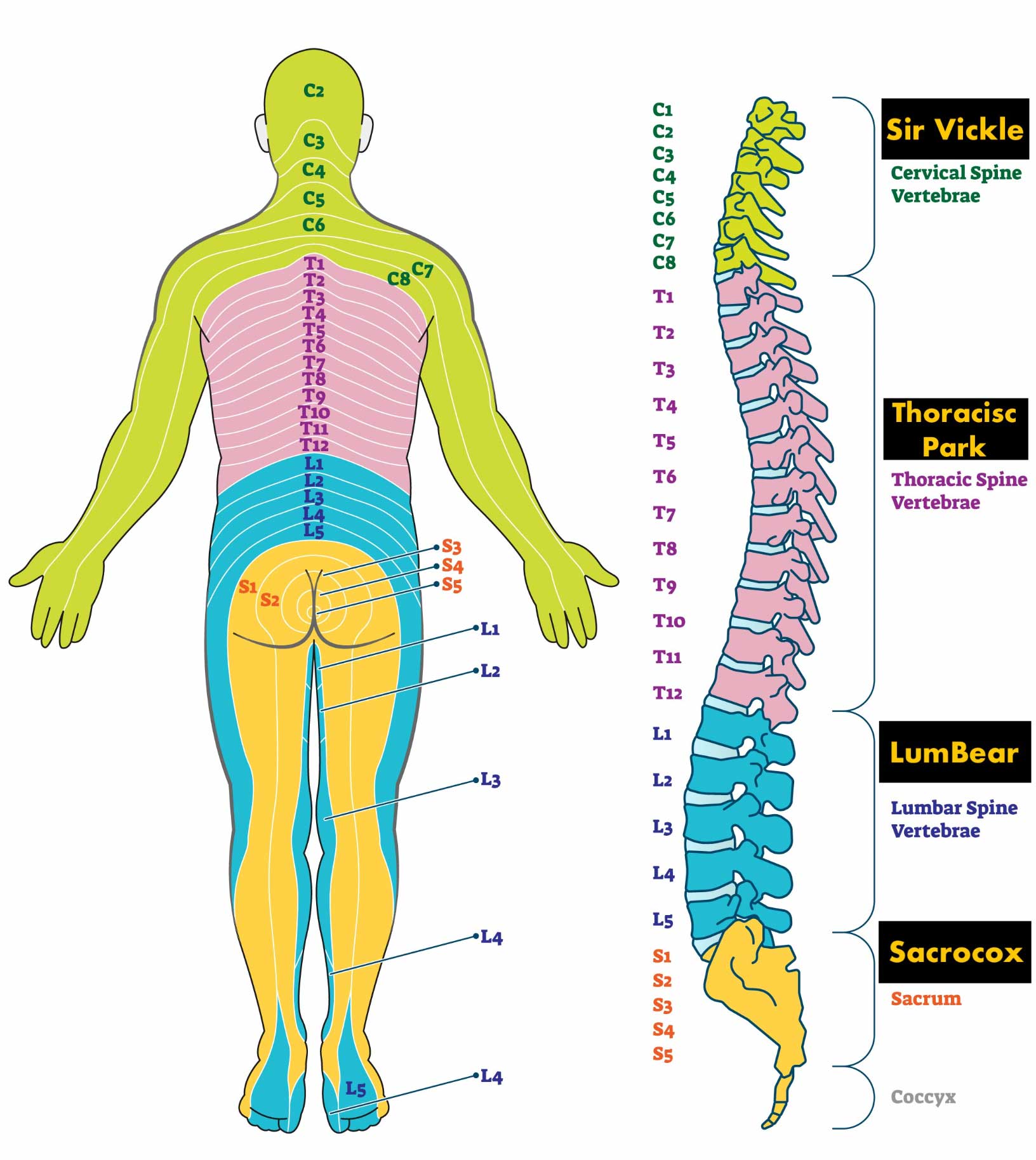
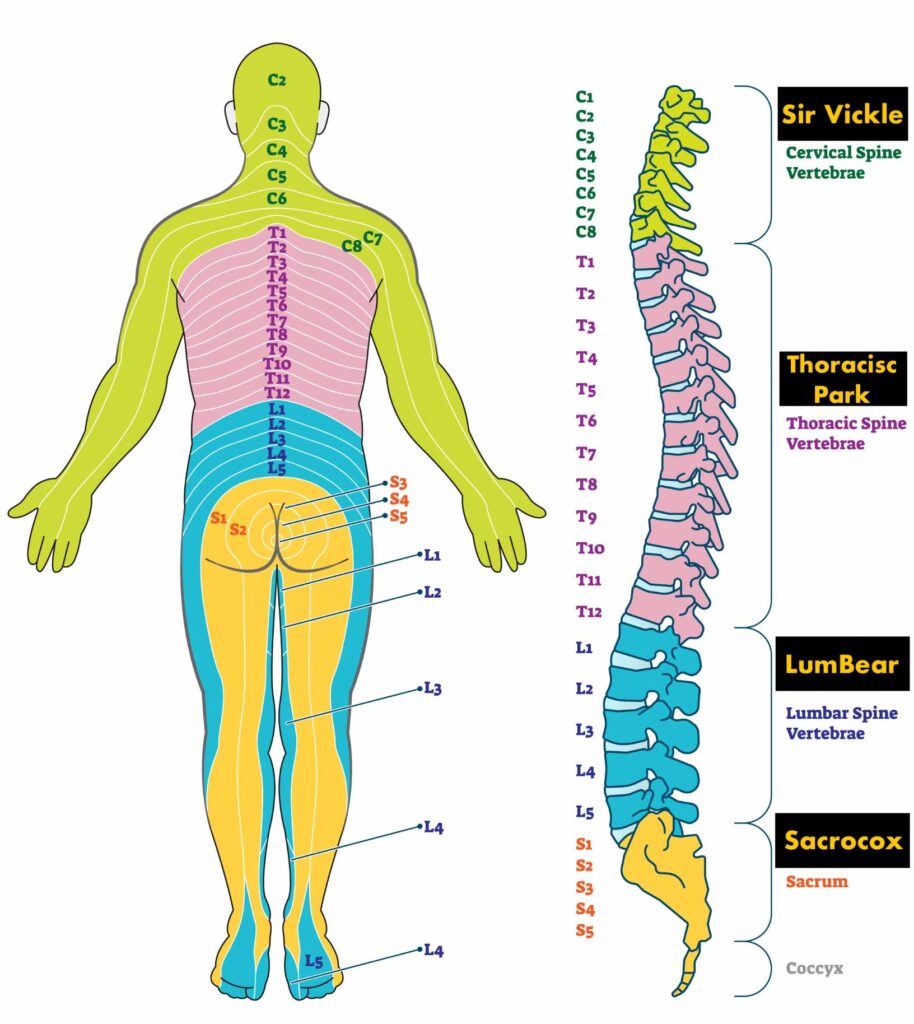
The Stem & Leaf line doesn’t. It is four separate teas, one per region, each built around herbs that classical Chinese medicine understands as directing a formula’s action to a particular part of the body. This is the guide to the whole line: what the idea is, which tea matches which pain, what the research honestly does and doesn’t support, and when back pain needs a doctor rather than a tea.

Quick answer

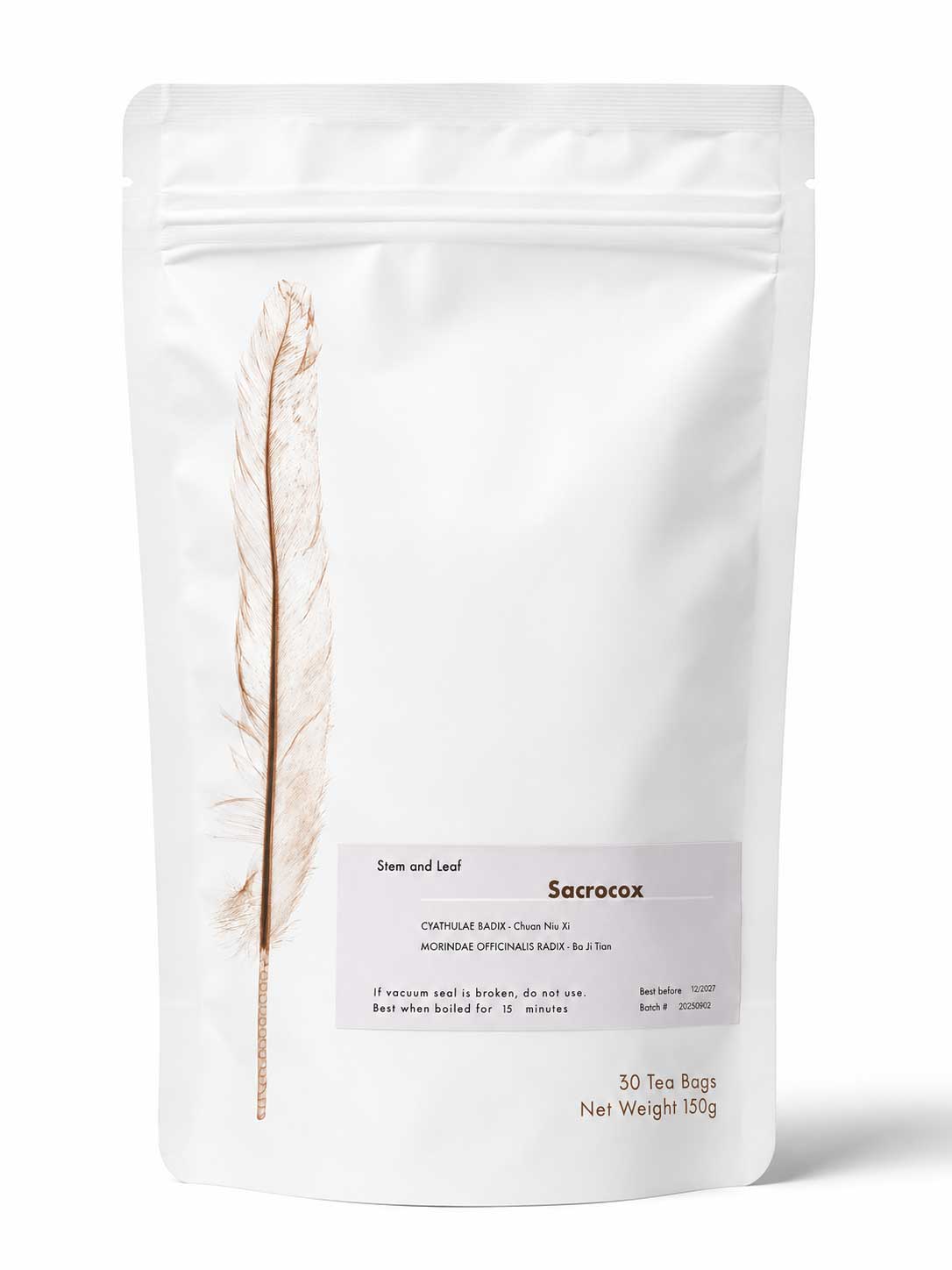
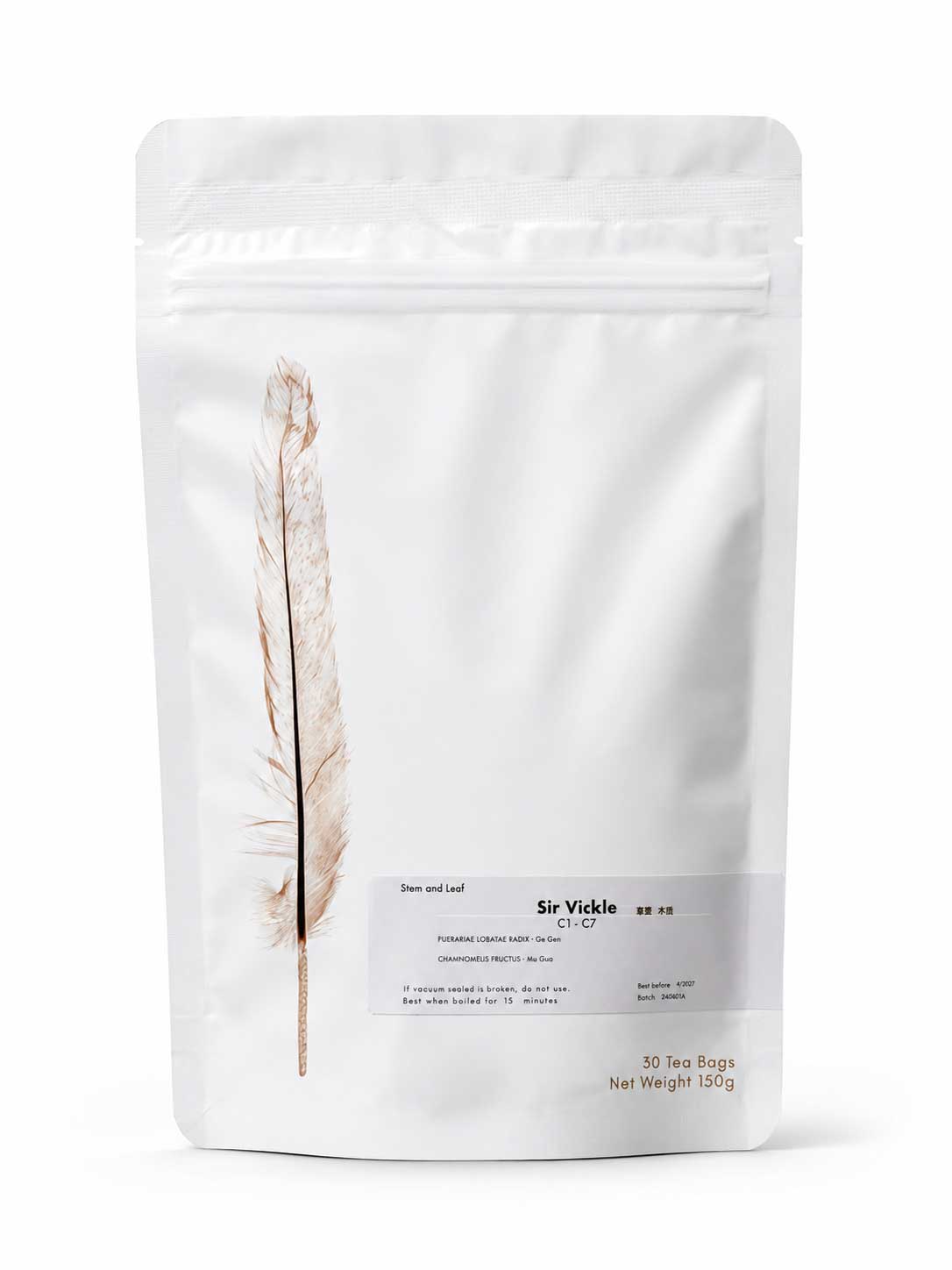
Stem & Leaf is a set of four herbal teas from Botanical Biohacking, each aimed at one region of the spine: Sir Vickle for the neck (C1–C7), Thoracic Park for the mid-back (T1–T12), LumBear for the low back (L1–L5), and Sacrocox for the sacrum and tailbone. Each is built on classical “guide herbs” — herbs traditionally understood to carry a formula’s action toward a specific region. They are a companion to movement, posture, sleep, and hands-on care, not a replacement for them. New, severe, or radiating back pain — or pain with numbness, weakness, or loss of bladder or bowel control — needs prompt medical evaluation, not tea.

What the Stem & Leaf Line Actually Is

Four teas. Thirty teabags each, about a month’s supply. Every one of them is short — two or three herbs — which is unusual for a Chinese herbal product and is the point rather than a shortcut.

A classical formula usually runs eight to fifteen herbs, because it is trying to do several things at once: address the root, address the branch, protect the digestion, and harmonize the rest. Stem & Leaf takes the opposite approach. Each tea is a small, targeted preparation aimed at a region, designed to be used on its own or layered with the others.

They are made by Botanical Biohacking, the same house behind Microgard, the Tibetan Herbal Foot Soak, and the tea line we’ve written about elsewhere. The Stem & Leaf formulations came to us through Christopher M. Volesky, L.Ac., of Rocky Mountain Herb Supply, with the neck pairing credited to Dr. Jin Zhao.

The spine is not one thing. In the clinic, a neck, a mid-back, a low back, and a tailbone are four different conversations — so it never made sense to me that they should all get the same tea.

— Will Sheppy, L.Ac.

What Is a Guide Herb?

In classical formula construction, herbs are not only chosen for what they do — they are chosen for where they go. Certain herbs are described as leading the rest of a formula toward a region or a channel: upward to the head and neck, downward to the legs and pelvis, outward to the surface. A courier, not a cure.

Modern research doesn’t test “channel tropism” directly — it isn’t a construct that translates cleanly into a trial. What it does study is the closely related idea of the herb pair, the smallest fixed unit of a Chinese formula. That literature is real: reviews describe herb pairs as the fundamental building block of formula design, chosen to amplify an effect or offset a harshness. There’s even analytical work showing that when two herbs are extracted together, the resulting chemistry differs from either herb extracted alone — new compounds appear. Combining isn’t just addition.

So when I tell you Sir Vickle is “aimed at the neck,” I want you to hear it accurately: that is a two-thousand-year-old design principle with modern chemistry that makes it plausible, not a clinical trial result.

Which Tea Matches Your Back?

Start with where the pain actually lives. Not where it radiates to — where it starts.

If the pain sits at a boundary — the base of the neck into the top of the shoulder blades, or the low back into the tailbone — pick the region where the pain starts in the morning, or use the two teas that border it. Each of the four has its own detailed write-up if you want the full herb-by-herb reasoning.

What the Research Actually Shows

This is where I’d rather be useful than impressive. The evidence behind these herbs is real in places and thin in others, and you deserve to know which is which.

Where the evidence is strongest

Duhuo Jisheng decoction — the classical formula built on Du Huo, one of Thoracic Park’s two herbs — has a genuine clinical literature behind it. A 2024 evidence-based guideline in the Journal of Evidence-Based Medicine used the GRADE system to review traditional Chinese treatments for lumbar disc herniation and included it among its recommendations. A meta-analysis pooling fourteen trials and more than 1,500 patients found modified Duhuo Jisheng decoction outperformed NSAIDs on pain scores with fewer adverse events, and a BMJ Open review found it improved knee osteoarthritis outcomes when added to conventional drugs.

That same BMJ Open review also stated plainly that the underlying trials carried a high risk of bias — which is the honest caveat that belongs on almost everything in this section.

The bone-support herbs have good laboratory evidence and little human data. Du Zhong and Xu Duan, the two lumbar herbs, are among the most-studied bone herbs in the materia medica: reviews across dozens of studies describe them consistently pushing bone metabolism toward formation and away from breakdown, with asperosaponin VI (Xu Duan’s marker compound) concentrated by the traditional frying processes. Almost all of that is cell and animal work. The human data is described by the researchers themselves as preliminary.

Where there are no human trials at all

Mu Gua, in Sir Vickle, has analgesic and anti-arthritic activity demonstrated in rats and none in people. Ba Ji Tian, in Sacrocox, is the same story. And Ge Gen — the neck herb — is the most frequently used ingredient across Chinese patent medicines for cervical spondylosis, which tells you what practitioners reach for, not that it has been proven to work. There is no English-language randomized trial of Ge Gen Tang for neck pain, and I’m not going to pretend otherwise.

What that adds up to

Rou Gui is the one place with clean human data, and it isn’t about backs: a meta-analysis of twelve randomized trials found cinnamon supplementation measurably lowered inflammatory markers in people with cardiometabolic conditions. Suggestive. Not the same as pain relief.

So: traditional use that runs a thousand years deep, a real evidence base for one branch of the family, and honest gaps everywhere else. That’s the picture, and you should be suspicious of anyone who paints it more confidently.

Using the Four Together

The teas can be used alone or combined. Two adjacent regions is the common case — most backs don’t respect anatomical boundaries.

What none of them do is replace the boring fundamentals. Movement, sleep, how you sit, and hands-on care do the heavy lifting for chronic back pain. I say that to patients constantly, and it stays true when I’m the one selling the tea.

How They're Sourced and Tested

The same protocol runs across the entire Botanical Biohacking line. Every batch is tested before formulation for three classes of contamination: heavy metals (lead, cadmium, arsenic, mercury), pesticide residue — which even herbs labeled organic can pick up from neighboring fields — and microbial load, including bacteria, mold, and aflatoxins. Growers test first; the company re-tests at a contracted lab. A batch that fails either round doesn’t enter the line.

I mention this because it’s the question I’d want asked of me. If a supplier can’t tell you their contamination-testing protocol, that’s the thing to ask about — not the marketing.

Stem and Leaf Spinal Tea body chart

The Stem & Leaf Line

All four spinal teas — Sir Vickle, Thoracic Park, LumBear, and Sacrocox. Region-specific guide herbs, thirty teabags each. Practitioner-formulated and batch-tested, available at Valley Health Market.

When Back Pain Needs a Doctor, Not a Tea

Get evaluated promptly for back pain that is new and severe, pain that radiates down a limb, or pain accompanied by numbness, weakness, fever, unexplained weight loss, or any loss of bladder or bowel control. That last one is an emergency, not a wait-and-see.

Herbal formulas also aren’t neutral. If you are pregnant or nursing, taking anticoagulants, managing a chronic condition, or on prescription medication, talk to a qualified practitioner before starting any of these — Rou Gui in particular is a warming herb that doesn’t suit everyone, and herb-drug interactions are real. If you’re local to Albany and want help choosing, call the clinic at 541-760-9670.

Related Reading

References

  1. Qin X, Sun K, Xu W, et al. An evidence-based guideline on treating lumbar disc herniation with traditional Chinese medicine. Journal of Evidence-Based Medicine. 2024;17(1):187–206. Link
  2. Xiong Z, Yi P, Zhang L, et al. Efficacy and Safety of Modified Duhuo Jisheng Decoction in the Treatment of Lumbar Disc Herniation: A Systematic Review and Meta-Analysis. Evidence-Based Complementary and Alternative Medicine. 2020;2020:2381462. Link
  3. Zhang W, Wang S, Zhang R, et al. Evidence of Chinese herbal medicine Duhuo Jisheng decoction for knee osteoarthritis: a systematic review of randomised clinical trials. BMJ Open. 2016;6(1):e008973. Link
  4. Wang Y, et al. Traditional medicine in a modern light: a scoping review on the osteoprotective potential of Eucommia ulmoides. Frontiers in Pharmacology. 2026;16:1673870. Link
  5. Tao Y, Huang S, Yan J, Cai B. Traditional uses, processing methods, phytochemistry, pharmacology and quality control of Dipsacus asper Wall. ex C.B. Clarke: A review. Journal of Ethnopharmacology. 2020;258:112912. Link
  6. Huang D, et al. Analgesic and Anti-Arthritic Activities of Polysaccharides in Chaenomeles speciosa. Frontiers in Pharmacology. 2022;13:744915. (Animal study.) Link
  7. Liu M, et al. A systematic review on polysaccharides from Morinda officinalis How. Journal of Ethnopharmacology. 2024;328:118090. (Preclinical.) Link
  8. Meng KY, et al. Achyranthes bidentata Bl. and Cyathula officinalis Kuan: ethnopharmacology, phytochemistry, and pharmacology. Journal of Pharmacy and Pharmacology. 2025;77(11):1461–1490. Link
  9. Zhu C, Yan H, Zheng Y, et al. Impact of Cinnamon Supplementation on cardiometabolic Biomarkers of Inflammation and Oxidative Stress: A Systematic Review and Meta-Analysis of Randomized Controlled Trials. Complementary Therapies in Medicine. 2020;53:102517. Link
  10. Fan Y, et al. Chinese Patent Medicines for Cervical Spondylosis: A Comprehensive Review and Current Status of Clinical Research. International Journal of General Medicine. 2026;19:575879. Link
  11. Wang S, Hu Y, Tan W, et al. Compatibility art of traditional Chinese medicine: from the perspective of herb pairs. Journal of Ethnopharmacology. 2012;143(2):412–423. Link
  12. Xie Q, et al. A Comprehensive Review of Coptidis Rhizoma and Magnoliae Officinalis Cortex Drug Pair. Drug Design, Development and Therapy. 2024;18:4413–4426. Link
  13. Christopher M. Volesky, L.Ac., Rocky Mountain Herb Supply. Stem and Leaf guide herb formulations. Distributor product note, July 2026.
  14. Bensky D, Clavey S, Stöger E. Chinese Herbal Medicine: Materia Medica, 3rd ed. Eastland Press, 2004.

A note on evidence: the Stem & Leaf line is a practitioner-formulated support product. We are not attaching clinical-trial claims to it. What we can tell you is which herbs are in it, why they were chosen, who formulated them, and — as above — where the published research is strong and where it is thin.

Educational content rooted in 20+ years of clinical practice in Traditional Chinese Medicine. The information provided is for educational purposes and is not intended to replace consultation with a qualified healthcare practitioner. Please consult your physician before starting any new herbal protocol, especially if pregnant, nursing, on anticoagulants, or managing a chronic condition.

Share on

Will Sheppy, Founder and Acupuncturist at Valley Health Clinic
Willard Sheppy
Willard Sheppy is a licensed acupuncturist (LAc) and Founder of Valley Health Clinic specializing in using Traditional Chinese Medicine to treat acute injuries and chronic conditions, and to improve sports performance and rehabilitation.

FAQ's

Which Stem & Leaf tea should I choose?

Choose by where the pain starts, not where it radiates. Sir Vickle is the neck (C1–C7), Thoracic Park is the mid-back (T1–T12), LumBear is the low back (L1–L5), and Sacrocox is the sacrum and tailbone. If your pain spans a boundary, pick the region that bothers you first thing in the morning, or use the two teas that border it.

In classical Chinese formula construction, some herbs are chosen not only for what they do but for where they carry the rest of the formula — upward to the head and neck, downward to the pelvis and legs. Modern research doesn’t test that idea directly, but it does study herb pairs as the smallest fixed unit of a formula, and there is analytical work showing that extracting two herbs together produces different chemistry than extracting either alone.

Partly, and it’s uneven. The strongest evidence belongs to Duhuo Jisheng decoction, the classical formula built on Du Huo (one of Thoracic Park’s herbs), which appears in a 2024 GRADE-based guideline and in meta-analyses for lumbar disc herniation and knee osteoarthritis — though reviewers consistently note the underlying trials carry a high risk of bias. Du Zhong and Xu Duan have strong laboratory bone data and preliminary human data. Mu Gua, Ba Ji Tian, and Ge Gen for neck pain have no human trials in the English literature. We’d rather tell you that than imply otherwise.

Yes. The teas can be used alone or combined, and combining two adjacent regions is common because backs don’t respect anatomical boundaries. That said, start with one and give it a few weeks — if you start two at once, you learn nothing about either.

Promptly, for back pain that is new and severe, pain that radiates down a limb, or pain with numbness, weakness, fever, unexplained weight loss, or any loss of bladder or bowel control — that last one is an emergency. Herbal formulas are a companion to movement, posture, sleep, and hands-on care, not a replacement, and anyone pregnant, nursing, on anticoagulants, or managing a chronic condition should talk to a qualified practitioner first.

Recent Posts

Stem & Leaf Sacrocox: For Tailbone Pain You Can’t Sit Through

Sacrocox Herbal Tea product mockup
7 minutes read

Materia Medica · The Stem & Leaf Series

Stem & Leaf Sacrocox: For Tailbone Pain You Can’t Sit Through

Willard Sheppy Dipl. OM, LAc, BS

Willard Sheppy is a licensed acupuncturist (LAc) and Founder of Valley Health Clinic specializing in using Traditional Chinese Medicine to treat acute injuries and chronic conditions, and to improve sports performance and rehabilitation.

Sacrocox Herbal Tea product mockup

Table of Contents

Sacral and tailbone pain is the kind you cannot stretch out and cannot sit through.

The sacrum and tailbone anchor everything above them — and in classical herbal medicine, reaching them is a question of not just direction but depth.

Here’s what Stem & Leaf — Sacrocox actually is, how the guide-herb principle works, and what’s inside.

Quick Answer

Stem & Leaf — Sacrocox is the sacrum-and-tailbone formula in Botanical Biohacking’s region-by-region spinal line. Two guide herbs, aimed at one region: Chuan Niu Xi, the classical downward-guiding herb, carries the action all the way to the base of the spine, and Ba Ji Tian warms and strengthens it. It is a companion to the fundamentals — and new, severe, or radiating pain, or pain with numbness, weakness, or loss of bladder or bowel control, needs prompt medical evaluation.

What Stem & Leaf — Sacrocox Actually Is

The Stem & Leaf line takes a region-by-region approach to spinal support. Rather than one general back formula, each product is built around guide herbs — herbs that classical medicine understands as directing a formula’s action to a particular part of the body.

Stem & Leaf — Sacrocox is the sacrum and tailbone formula. Two guide herbs, aimed at one region.

That specificity is the whole idea, and it mirrors how a practitioner actually thinks about a back. The spine is not one thing.

The Guide Herb Principle

A guide herb carries a formula’s action toward a region. For the very base of the spine, the challenge is not just direction but depth — the action has to travel all the way down.

Chuan Niu Xi is the classical answer to that problem. It is used across the tradition specifically to lead other herbs downward, to the lowest reaches of the body.

How It's Sourced and Tested

The same protocol runs across the entire Botanical Biohacking line.

Inside the Formula

Chuan Niu Xi is the herb classical medicine uses when action needs to go down — it is the descending guide, and it is why this formula reaches the sacrum rather than stopping at the lumbar spine. Ba Ji Tian adds warming, strengthening support to the base.

The Sacrococcygeal Guide Herbs

Using the Line Together

A Practitioner’s Note

Spinal support formulas are a companion to the fundamentals, not a replacement. Movement, posture, sleep, and hands-on care do the heavy lifting. New, severe, or radiating back pain — or pain with numbness, weakness, or loss of bladder or bowel control — needs prompt medical evaluation.

The sacrum and tailbone anchor everything above them. Chuan Niu Xi is the herb the tradition uses to send a formula all the way down there. — Will Sheppy, L.Ac.

Stem & Leaf — Sacrocox

The sacrococcygeal formula from the Stem & Leaf line. Region-specific guide herbs, thirty teabags. Available at Valley Health Market.

Research & Resources

  1. Christopher M. Volesky, L.Ac., Rocky Mountain Herb Supply. Stem and Leaf guide herb formulations. Distributor product note, July 2026.
  2. Bensky D, Clavey S, Stöger E. Chinese Herbal Medicine: Materia Medica, 3rd ed. Eastland Press, 2004. (Reference for guide herbs and channel-directing action.)

A note on evidence: the Stem & Leaf line is a practitioner-formulated support product. We are not attaching clinical-trial claims to it. What we can tell you is which herbs are in it, why they were chosen, and who formulated them.

Educational content rooted in 20+ years of clinical practice in Traditional Chinese Medicine. The information provided is for educational purposes and is not intended to replace consultation with a qualified healthcare practitioner. Please consult your physician before starting any new herbal protocol, especially if pregnant, nursing, on anticoagulants, or managing a chronic condition.

Share on

Will Sheppy, Founder and Acupuncturist at Valley Health Clinic
Willard Sheppy
Willard Sheppy is a licensed acupuncturist (LAc) and Founder of Valley Health Clinic specializing in using Traditional Chinese Medicine to treat acute injuries and chronic conditions, and to improve sports performance and rehabilitation.

FAQ's

What is Stem & Leaf — Sacrocox?

Sacrocox is the sacrum-and-tailbone formula in Botanical Biohacking’s Stem & Leaf line, which takes a region-by-region approach to spinal support. It is built around two guide herbs aimed at the sacrococcygeal region and comes as thirty teabags.

A guide herb is an herb that classical medicine understands as directing a formula’s action to a particular part of the body. For the very base of the spine the challenge is not just direction but depth — Chuan Niu Xi is the herb the tradition uses specifically to lead other herbs downward, to the lowest reaches of the body.

Two guide herbs: Chuan Niu Xi (cyathula root), the classical downward-guiding herb that directs the formula’s action to the lowest part of the body, and Ba Ji Tian (morinda root), which traditionally warms and strengthens the base, supporting the low back and legs.

Yes — the Stem & Leaf teas can be used alone or combined to cover the better part of the neck and back: Sir Vickle for the cervical spine (C1–C7), Thoracic Park for the thoracic spine (T1–T12), LumBear for the lumbar spine (L1–L5), and Sacrocox for the sacrum and tailbone.

Spinal support formulas are a companion to the fundamentals — movement, posture, sleep, and hands-on care — not a replacement. New, severe, or radiating back pain, or pain with numbness, weakness, or loss of bladder or bowel control, needs prompt medical evaluation.

Recent Posts

Sir Vickle: For the Neck That Has Hurt for Years

Sir Vickle Herbal Tea product mockup
7 minutes read

Materia Medica · The Stem & Leaf Series

Sir Vickle: For the Neck That Has Hurt for Years

Willard Sheppy Dipl. OM, LAc, BS

Willard Sheppy is a licensed acupuncturist (LAc) and Founder of Valley Health Clinic specializing in using Traditional Chinese Medicine to treat acute injuries and chronic conditions, and to improve sports performance and rehabilitation.

Sir Vickle Herbal Tea product mockup

Table of Contents

If your neck has hurt for years rather than weeks, you have probably already tried the imaging and the ergonomic chair.

Stem & Leaf — Sir Vickle is the neck formula: two guide herbs, aimed at one region, C1 through C7.

Here’s the guide-herb principle behind it, what’s inside, and how the line fits together.

Quick Answer

Stem & Leaf — Sir Vickle is the cervical formula in Botanical Biohacking’s region-by-region spinal line: two guide herbs aimed at C1 through C7. Ge Gen has been used for cervical tension and stiffness for roughly two thousand years; Mu Gua adds the damp-clearing, circulation-moving side. It is a companion to the fundamentals — and new, severe, or radiating pain, or pain with numbness, weakness, or loss of bladder or bowel control, needs prompt medical evaluation.

What Stem & Leaf — Sir Vickle Actually Is

The Stem & Leaf line takes a region-by-region approach to spinal support. Rather than one general back formula, each product is built around guide herbs — herbs that classical medicine understands as directing a formula’s action to a particular part of the body.

Stem & Leaf — Sir Vickle is the neck formula. Two guide herbs, aimed at one region.

That specificity is the whole idea, and it mirrors how a practitioner actually thinks about a back. The spine is not one thing.

The Guide Herb Principle

A guide herb is not a filler. In classical formula construction, certain herbs are understood to carry a formula’s action toward a specific region — the way a courier carries a letter to an address rather than to a city.

For the neck, that herb is Ge Gen. It has been used for cervical tension and stiffness for roughly two thousand years, and it remains one of the first things a practitioner reaches for when someone’s shoulders are up around their ears.

How It's Sourced and Tested

The same protocol runs across the entire Botanical Biohacking line.

Inside the Formula

Ge Gen is the neck herb — it is the reason formulas like Ge Gen Tang exist at all. Pairing it with Mu Gua adds the damp-clearing, circulation-moving side. This is described as a combination commonly used by Dr. Jin Zhao for neck problems, which is exactly the provenance you want on a product like this.

The Cervical Guide Herbs

Using the Line Together

A Practitioner’s Note

Spinal support formulas are a companion to the fundamentals, not a replacement. Movement, posture, sleep, and hands-on care do the heavy lifting. New, severe, or radiating back pain — or pain with numbness, weakness, or loss of bladder or bowel control — needs prompt medical evaluation.

Ge Gen is the herb practitioners reach for when the shoulders have crept up toward the ears and stayed there. Pair it with Mu Gua and you have a formula aimed at one region, not at the whole back. — Will Sheppy, L.Ac.

Sir Vickle Herbal Tea product mockup with a green background by Valley Health Market

Stem & Leaf — Sir Vickle

The cervical formula from the Stem & Leaf line. Region-specific guide herbs, thirty teabags. Available at Valley Health Market.

Research & Resources

  1. Christopher M. Volesky, L.Ac., Rocky Mountain Herb Supply. Stem and Leaf guide herb formulations. Distributor product note, July 2026.
  2. Bensky D, Clavey S, Stöger E. Chinese Herbal Medicine: Materia Medica, 3rd ed. Eastland Press, 2004. (Reference for guide herbs and channel-directing action.)
  3. A note on evidence: the Stem & Leaf line is a practitioner-formulated support product. We are not attaching clinical-trial claims to it. What we can tell you is which herbs are in it, why they were chosen, and who formulated them.

Educational content rooted in 20+ years of clinical practice in Traditional Chinese Medicine. The information provided is for educational purposes and is not intended to replace consultation with a qualified healthcare practitioner. Please consult your physician before starting any new herbal protocol, especially if pregnant, nursing, on anticoagulants, or managing a chronic condition.

Share on

Will Sheppy, Founder and Acupuncturist at Valley Health Clinic
Willard Sheppy
Willard Sheppy is a licensed acupuncturist (LAc) and Founder of Valley Health Clinic specializing in using Traditional Chinese Medicine to treat acute injuries and chronic conditions, and to improve sports performance and rehabilitation.

FAQ's

What is Stem & Leaf — Sir Vickle?

Sir Vickle is the neck formula in Botanical Biohacking’s Stem & Leaf line, which takes a region-by-region approach to spinal support. It is built around two guide herbs — Ge Gen and Mu Gua — aimed at the cervical spine, C1 through C7. It comes as thirty teabags.

In classical formula construction, certain herbs are understood to carry a formula’s action toward a specific region of the body — the way a courier carries a letter to an address rather than to a city. For the neck, that herb is Ge Gen, which has been used for cervical tension and stiffness for roughly two thousand years.

Yes — the Stem & Leaf teas can be used alone or combined to cover the better part of the neck and back: Sir Vickle for the cervical region (C1–C7), Thoracic Park for the thoracic (T1–T12), LumBear for the lumbar (L1–L5), and Sacrocox for the sacrococcygeal region.

New, severe, or radiating back pain — or pain with numbness, weakness, or loss of bladder or bowel control — needs prompt medical evaluation. Spinal support formulas are a companion to the fundamentals, not a replacement: movement, posture, sleep, and hands-on care do the heavy lifting.

Recent Posts

Wind Tea: For When You’re Neither Sick nor Well

Wind Tea with Glass and Tea Bag
8 minutes read

Materia Medica · The Formula Series

Wind Tea: For When You’re Neither Sick nor Well

Willard Sheppy Dipl. OM, LAc, BS

Willard Sheppy is a licensed acupuncturist (LAc) and Founder of Valley Health Clinic specializing in using Traditional Chinese Medicine to treat acute injuries and chronic conditions, and to improve sports performance and rehabilitation.

Wind Tea with Glass and Tea Bag

Table of Contents

Some people don’t get knocked down by a bug. They get stuck halfway.

Wind Tea is the formula for the stage where you are neither sick nor well — not sick enough to stay in bed, not well enough to get your life back.

Here’s what the formula actually is, who formulates it, and its limits.

Quick Answer

Wind Tea is built on Xiao Chai Hu Tang — the Minor Bupleurum Decoction, the definitive formula for the in-between Shaoyang stage — with San Ren Tang-type damp-clearing herbs layered in by Botanical Biohacking, and real Ren Shen (Asian ginseng) rather than the cheaper Dang Shen substitute. It suits the more deficient presentation; its sibling Peak suits excess and heat. It is not a long-term formula: roughly two weeks, never longer than three months — and a high fever, a severe or worsening infection, or trouble breathing needs real medical care, not tea.

What Wind Tea Actually Is

Wind Tea is built on Xiao Chai Hu Tang — the Minor Bupleurum Decoction, one of the most important formulas in the entire Chinese herbal tradition. It is the definitive formula for the Shaoyang stage: the in-between layer where a pathogen is neither fully outside the body nor fully settled inside it.

The classical picture is unmistakable once you’ve seen it. Alternating chills and warmth. A bitter taste. No appetite. That stuck, half-well-half-sick feeling that lingers for weeks after everyone else has bounced back. The formula’s job is not to attack. It is to harmonize — to help the body finish what it started.

Botanical Biohacking then layers in San Ren Tang-type herbs — apricot kernel, coix, talc, white cardamom — for the damp-heat sluggishness that so often rides along with modern constitutions.

Who Formulates This

Dr. Jin Zhao is the main formulator for the Botanical Biohacking line. He practices in Chengdu, sees up to 200 patients a day, and specializes in one thing: dampness. The approach isn’t new — it’s rooted in Qing dynasty herbal theory — but he refined it in clinic across tens of thousands of patients, working through the upper, middle, and lower jiao.

His conclusion, in the company’s own words: clear the dampness and complicated cases become simple again.

Wind was fine-tuned by pharmacology professor Dr. Zhong Shi Hong, who added one thing that matters enormously — super high-grade white ginseng, specifically to strengthen the formula and keep it from draining qi over a course of use.

The Sourcing Detail That Matters

Most Xiao Chai Hu Tang on the market uses Dang Shen (codonopsis) to reduce cost. Wind uses real Ren Shen — Asian ginseng. It’s there for a structural reason, not as a marketing bullet.

Wind or Peak? The Formulators’ Own Rule

Wind has a sibling formula, Peak. Both are San Ren Tang remixes from the same team. They are not interchangeable, and Botanical Biohacking states the difference plainly:

Inside the Formula

Wind marries two classical strategies — harmonize the exterior and interior, and clear damp.

The Harmonizing Core

The Damp-Clearing Layer

An Important Limit

San Ren Tang is not a long-term formula. The makers’ own guidance is roughly two weeks, and not longer than three months, because over time it can drain qi. A high fever, a severe or worsening infection, or trouble breathing needs real medical care — not tea.

Wind is for the stage most people don’t have a name for. Not sick enough to stay in bed. Not well enough to get their life back. That’s a real pattern, and the tradition built a formula for it. — Will Sheppy, L.Ac.

Wind Tea with Glass and Tea Bag

Wind Tea

Xiao Chai Hu Tang with San Ren Tang. Real Ren Shen, not Dang Shen. Formulated by Dr. Jin Zhao, fine-tuned by Dr. Zhong Shi Hong. Available at Valley Health Market.

Research & Resources

  1. Li M, Dan W, Zhang H, Yun Y, He Q. Xiao Chai Hu Tang for Peptic Ulcers: A Systematic Review and Meta-Analysis of Randomized Controlled Trials. Evid Based Complement Alternat Med. 2021;2021:6693677. Link →
  2. Memorial Sloan Kettering Cancer Center. Sho-saiko-to (Xiao Chai Hu Tang) — About Herbs professional monograph. Includes important interaction cautions. Link →
  3. Wu Ju Tong. Wen Bing Tiao Bian (Systematic Differentiation of Warm Diseases), 1813. (Classical source for the San Ren Tang strategy.)
  4. Bensky D, Barolet R. Chinese Herbal Medicine: Formulas & Strategies. Eastland Press. (Standard reference for Xiao Chai Hu Tang.)

Educational content rooted in 20+ years of clinical practice in Traditional Chinese Medicine. The information provided is for educational purposes and is not intended to replace consultation with a qualified healthcare practitioner. Please consult your physician before starting any new herbal protocol, especially if pregnant, nursing, on anticoagulants, or managing a chronic condition.

Share on

Will Sheppy, Founder and Acupuncturist at Valley Health Clinic
Willard Sheppy
Willard Sheppy is a licensed acupuncturist (LAc) and Founder of Valley Health Clinic specializing in using Traditional Chinese Medicine to treat acute injuries and chronic conditions, and to improve sports performance and rehabilitation.

FAQ's

What is Wind Tea?

Wind Tea is built on Xiao Chai Hu Tang — the Minor Bupleurum Decoction, one of the most important formulas in the Chinese herbal tradition — with San Ren Tang-type damp-clearing herbs layered in by Botanical Biohacking. It uses real Ren Shen (Asian ginseng) rather than the cheaper Dang Shen substitute.

It was written for the Shaoyang stage — the in-between layer where a pathogen is neither fully outside the body nor fully settled inside it. The classical picture: alternating chills and warmth, a bitter taste, no appetite, and that stuck, half-well-half-sick feeling that lingers for weeks after everyone else has bounced back.

Both are San Ren Tang remixes from the same team, but they are not interchangeable. More relative deficiency points to Wind — the ginseng holds the person up while the dampness clears. More excess and heat points to Peak, which has no ginseng and strengthens heat-clearing with Yin Chen Hao and Tibetan Plateau Chai Hu instead.

San Ren Tang is not a long-term formula. The makers’ own guidance is roughly two weeks, and not longer than three months, because over time it can drain qi. A high fever, a severe or worsening infection, or trouble breathing needs real medical care — not tea.

Recent Posts

Warm Hearth Tea: For the Heavy Head and the Foggy Morning

Warm Hearth Tea product mockup with a green background by Valley Health market
7 minutes read

Materia Medica · The Formula Series

Warm Hearth Tea: For the Heavy Head and the Foggy Morning

Willard Sheppy Dipl. OM, LAc, BS

Willard Sheppy is a licensed acupuncturist (LAc) and Founder of Valley Health Clinic specializing in using Traditional Chinese Medicine to treat acute injuries and chronic conditions, and to improve sports performance and rehabilitation.

Warm Hearth Tea product mockup with a green background by Valley Health market

Table of Contents

This one is for the heavy head, the foggy morning, and the neck tension that travels with them.

Phlegm in Chinese medicine is broader than what you cough up. It is a whole pattern of heaviness.

Here’s what the formula actually is, why nearly everything in the phlegm category is built on it, and who it’s not for.

Quick Answer

Warm Hearth is Er Chen Er Zhu Tang — Er Chen Tang, the foundational damp-phlegm formula of Chinese herbal medicine, plus the two great damp-drying atractylodes herbs — made as a warm everyday tea. It is built for the heavy, congested, sluggish, coated damp-phlegm picture: the heavy head, the foggy morning, and the neck tension that travels with them. If you tend to run dry, this is probably not your formula; if you are pregnant or take prescription medication, check with your practitioner first.

What Warm Hearth Actually Is

Er Chen Tang — the Two-Aged Decoction — is the base formula for damp-phlegm in Chinese herbal medicine. Nearly every phlegm formula in the tradition is built on top of it.

It addresses the heavy, congested, sluggish, coated feeling that comes when the body accumulates thick fluid it cannot transform. Not a cough formula. A whole-system formula.

Warm Hearth is the classical modification Er Chen Er Zhu Tang — the base plus Bai Zhu and Cang Zhu, the two great damp-drying atractylodes herbs, for more drying and strengthening power.

Why This Is a Foundation Stone

Practitioners think of Er Chen Tang the way builders think of a footing. It rarely gets the credit, and almost everything sits on it.

Botanical Biohacking took that foundation and made it a warm, everyday tea — thirty teabags to a box — so damp-phlegm support becomes a daily ritual rather than a decoction to prepare.

How It's Sourced and Tested

The same protocol runs across the whole line.

Inside the Formula

The Er Chen core, plus the atractylodes pair.

The Er Chen Core

The Atractylodes Reinforcement

Who This Is Not For

Warm Hearth is built for the damp-phlegm picture. If you tend to run dry, this is probably not your formula. If you are pregnant or take prescription medication, check with your practitioner before making any phlegm-drying formula a daily habit.

Formulas do not survive a thousand years of continuous clinical use by accident. Er Chen Tang is still the base that everything else gets built on. — Will Sheppy, L.Ac.

Warm Hearth Tea product mockup with a green background by Valley Health market

Warm Hearth Tea

Er Chen Er Zhu Tang — the foundational phlegm formula, reinforced with two atractylodes. Thirty teabags, one month’s supply. Available at Valley Health Market.

Research & Resources

  1. Bensky D, Barolet R. Chinese Herbal Medicine: Formulas & Strategies. Eastland Press. (Standard reference for Er Chen Tang and its modifications.)
  2. Bensky D, Clavey S, Stöger E. Chinese Herbal Medicine: Materia Medica, 3rd ed. Eastland Press, 2004. (Reference for Bai Zhu and Cang Zhu.)
  3. A note on evidence: rigorous modern clinical trials on the specific Er Chen Er Zhu blend are limited. We would rather say so than overstate a thin literature. What stands behind this formula is roughly a thousand years of documented clinical use.

Educational content rooted in 20+ years of clinical practice in Traditional Chinese Medicine. The information provided is for educational purposes and is not intended to replace consultation with a qualified healthcare practitioner. Please consult your physician before starting any new herbal protocol, especially if pregnant, nursing, on anticoagulants, or managing a chronic condition.

Share on

Will Sheppy, Founder and Acupuncturist at Valley Health Clinic
Willard Sheppy
Willard Sheppy is a licensed acupuncturist (LAc) and Founder of Valley Health Clinic specializing in using Traditional Chinese Medicine to treat acute injuries and chronic conditions, and to improve sports performance and rehabilitation.

FAQ's

What is Warm Hearth Tea?

Warm Hearth is Er Chen Er Zhu Tang — the classical modification of Er Chen Tang, the foundational damp-phlegm formula of Chinese herbal medicine, with Bai Zhu and Cang Zhu (the two atractylodes) added for more drying and strengthening power. Botanical Biohacking makes it as a warm everyday tea: thirty teabags, a one-month supply.

No. Phlegm in Chinese medicine is broader than what you cough up — it is a whole pattern of heaviness. Er Chen Tang addresses the heavy, congested, sluggish, coated feeling that comes when the body accumulates thick fluid it cannot transform. It is a whole-system formula, not a cough formula.

Practitioners think of Er Chen Tang the way builders think of a footing: it rarely gets the credit, and almost everything sits on it. Nearly every phlegm formula in the tradition is built on top of this base, and it has roughly a thousand years of documented clinical use behind it.

Warm Hearth is built for the damp-phlegm picture. If you tend to run dry, this is probably not your formula. If you are pregnant or take prescription medication, check with your practitioner before making any phlegm-drying formula a daily habit.

The Er Chen core — Chen Pi (aged tangerine peel), Fa Ban Xia (prepared pinellia), Fu Ling (poria), and Gan Cao (licorice) — plus the atractylodes reinforcement: Bai Zhu (white atractylodes) and Cang Zhu (grey atractylodes).

Recent Posts