
Psoriasis Flare Ups and Why You Need Three Sprays
Dr. Meli, in her own words, on why she and her husband built the Shu Hong


Willard Sheppy is a licensed acupuncturist (LAc) and Founder of Valley Health Clinic specializing in using Traditional Chinese Medicine to treat acute injuries and chronic conditions, and to improve sports performance and rehabilitation.
Tendons and ligaments are the slowest-healing tissue most of us ever injure. Muscle strains settle down in a couple of weeks. A cranky Achilles, a tennis elbow, an ankle you rolled last spring that still complains on uneven ground — those drag on for months, and the advice you get is usually some version of rest it.
In the clinic, that is the conversation I have most often about tendons: not “what is wrong with it,” but “why is this taking so long, and is there anything I can actually do while I wait?” It is a fair question. Poor blood supply is a real part of the answer, and it is also the part traditional Chinese medicine has been aiming at for a very long time.
Which brings me to a herb with an unforgettable name. Below, what Gu Sui Bu is, what the research does and does not show, and how to tell whether a topical Chinese herbal formula belongs in your recovery plan.
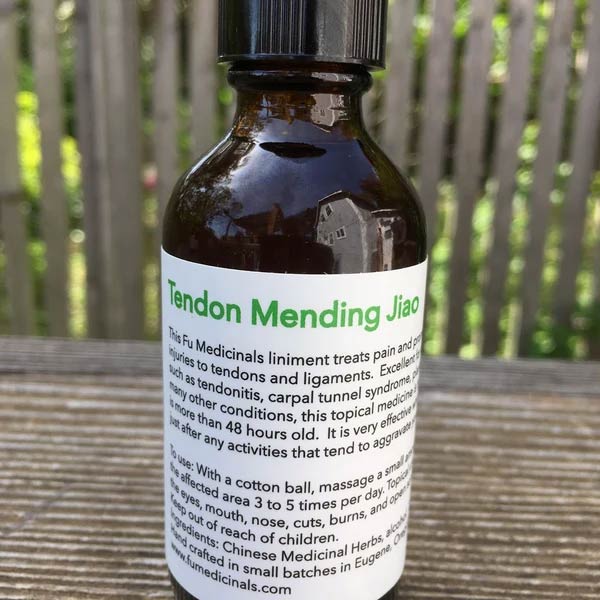
Gu Sui Bu (Drynaria rhizome) is a Chinese herb whose name translates roughly as “mender of shattered bones.” It is traditionally used for broken bones and for tendon and ligament injuries, and it is the chief herb in Fu Medicinals’ Tendon Mending Jiao, a topical salve for chronic tendonitis, tendinosis, and old sprains.
The modern research on Drynaria is real but mostly about bone — lab and animal work on bone formation, plus some evidence it supports blood-vessel growth and cell migration. Direct human research on tendons is not there yet. Treat it as a well-established traditional strategy with promising mechanism data behind it, not a proven tendon cure. External use only; check the safety section before you use it.
Muscle is thick with blood vessels. Tendon and ligament are not. They are dense, fibrous, built for tensile strength rather than metabolic activity — which is exactly what makes them good at their job and bad at repairing themselves. Less circulation means fewer of the raw materials of repair arriving, and it means they arrive slowly.
That is also why the picture changes name over time. What starts as tendonitis — genuine inflammation in the first days and weeks — often becomes tendinosis, where the inflammation has largely burned out and what is left is disorganised, degenerated tissue that simply never finished rebuilding. Anti-inflammatories are aimed at the first problem. Most people who are still hurting at the six-month mark have the second one.
In Chinese medicine the framing is different but it points at the same target: an old injury leaves behind stagnant blood and obstructed circulation in the sinews, and the job is to move it. Whatever vocabulary you prefer, the practical question is the same — how do I get more circulation into a tissue that does not have much?
Which is where one particular herb has been the traditional answer for a very long time.
"Gu Sui Bu in Chinese means the mender of broken bones. And not only is it fantastic for broken bones, it is really good for your tendons and ligaments."
— John Ditmars, Fu Medicinals
Gu Sui Bu (骨碎补), known botanically as Drynaria fortunei, is the rhizome of a fern that grows on rocks and tree trunks. It is covered in a golden-brown fuzz, and it looks nothing like a pharmaceutical. It has been used in Chinese medicine for bone and sinew injuries for centuries, and it is the reason John Ditmars — the practitioner-maker behind Fu Medicinals, whose liniments we carry — built the Tendon Mending formula around it.
Gu Sui Bu translates literally as something close to “mend the shattered bone.” Ditmars calls it the Great Mender of Broken Bones, and that is a fair reading of the classical use. What is less obvious to English speakers is that in Chinese medicine, bone and sinew are treated as neighbours rather than separate departments — the same herbs that address one are routinely reached for with the other. So a bone herb heading up a tendon formula is not a stretch of the tradition. It is the tradition.
Drynaria has a genuine and growing modern literature — but nearly all of it is about bone. Animal and cell studies show its flavonoid fraction stimulates bone-forming cells and improves bone density and bone strength, and a 2023 study traced that effect to the TGF-β signalling pathway. A small randomised trial in older women with postmenopausal osteoporosis found improvements in bone density and inflammatory markers.
The finding most relevant to a tendon, though, is a 2018 Taiwanese study showing that Drynaria extract promoted new blood-vessel formation and cell migration in lab and embryo models, working through VEGF and matrix metalloproteinase pathways. Circulation and cell migration are precisely what a poorly-vascularised tendon is short of. That is a mechanism worth taking seriously.
What does not exist is a human trial of Gu Sui Bu for tendonitis, and none of the research above tested a topical preparation.
A long traditional track record, plausible mechanism, real bone data, and no direct tendon proof. That is better than most herbs and less than a guarantee. Sources are listed at the end.
A jiao is a salve — herbs extracted into an oil-and-wax base and rubbed in. The appeal for tendon problems is location: an Achilles, a lateral elbow, a wrist or a finger sits close to the surface, and you can put the medicine directly over it and massage it in, several times a day, for as long as it takes. You are combining the herbs with mechanical work on the tissue, which is a large part of why topicals earn their keep in a sports practice.
Gu Sui Bu is the chief, but a jiao is a formula, not a single herb. Tendon Mending Jiao carries 28 botanicals in an organic coconut oil and beeswax base. A few of the ones doing recognisable work:
The full ingredient list is on the product page. If you have a known herbal allergy, read it before you buy — with 28 botanicals, that is not a formality.
Fu Medicinals does not make one universal liniment — the line is deliberately split by injury type, and picking the wrong one is the most common way people get a disappointing result. Here is how I sort it.
Fu Medicinals’ Tendon Mending Jiao is the formula built around Gu Sui Bu — 2 fl oz, small-batch, made in Oregon in an organic coconut oil and beeswax base. We carry it because it is the one I reach for with the chronic tendon and old-sprain cases that come through the clinic, and because John makes it the way it should be made.
These statements have not been evaluated by the FDA. This product is not intended to diagnose, treat, cure, or prevent any disease.
Research located via PubMed.
Huang ST, Chang CC, Pang JS, et al. Drynaria fortunei promoted angiogenesis associated with modified MMP-2/TIMP-2 balance and activation of VEGF ligand/receptors expression. Front Pharmacol. 2018;9:979. Link
Zhao Y, Cai X, Sun J, Bi W, Yu Y. Active components and mechanisms of total flavonoids from Rhizoma Drynariae in enhancing cranial bone regeneration. J Ethnopharmacol. 2023;319(Pt 3):117253. Link
Lee YE, Liu HC, Lin YL, Liu SH, Yang RS, Chen RM. Drynaria fortunei J. Sm. improves the bone mass of ovariectomized rats through osteocalcin-involved endochondral ossification. J Ethnopharmacol. 2014;158(Pt A):94-101. Link
Wong KC, Pang WY, Wang XL, et al. Drynaria fortunei-derived total flavonoid fraction and isolated compounds exert oestrogen-like protective effects in bone. Br J Nutr. 2013;110(3):475-485. Link
Lu L, Wang Z, Zhang H, Liu T, Fang H. Drynaria improves lipid profiles of elderly patients with postmenopausal osteoporosis via regulation of Notch1-NLRP3 inflammasome-mediated inflammation. Gynecol Endocrinol. 2022;38(2):176-180. Link
Ditmars J. Fu Medicinals: Gu Sui Bu and the Tendon Mending formula. Video interview, 2026.
Most reported concerns about Gu Sui Bu come from taking it internally, which should be supervised by a trained herbalist. Used topically in a salve, the main cautions are about the formula as a whole: external use only, never on broken skin, avoid sensitive areas, and keep it away from children. Stop if your skin reacts, and check the full ingredient list if you have known herbal allergies.
Tendon tissue turns over slowly, so a week is not a verdict. Use it consistently, several times a day over several weeks, while you keep loading the tendon sensibly. If nothing has shifted after a fair trial, or the problem is getting worse, get the injury properly examined rather than continuing on your own.
For fresh trauma that is hot, swollen, and bruised, a dit da trauma liniment is the better fit. Tendon Mending Jiao is built for the chronic stage. If you cannot bear weight, the joint looks deformed, or you have numbness or tingling, that needs imaging and a hands-on exam first.
Evil Bone Water is the broad-use foundation for general aches, bruises, sprains, and stiff joints, and it is what most people apply first. Tendon Mending Jiao is targeted at chronic tendon and ligament injury. They layer rather than compete, foundation first and the targeted salve on top.
Consult your doctor before using it if you are pregnant or might be, as several herbs in this formula are blood-moving, which is traditionally avoided in pregnancy. If you take anticoagulants or have a bleeding disorder, run it past your prescriber first.
Dr. Meli, in her own words, on why she and her husband built the Shu Hong
Does Evil Bone Water work? An acupuncturist reviews the evidence for Zheng Gu Shui, camphor, menthol,

Learn which acupuncture points Will Sheppy uses for Ménière’s disease, vertigo and dizziness, plus treatment frequency