
Tag: Botanical Biohacking

Warm Hearth Tea: For the Heavy Head and the Foggy Morning

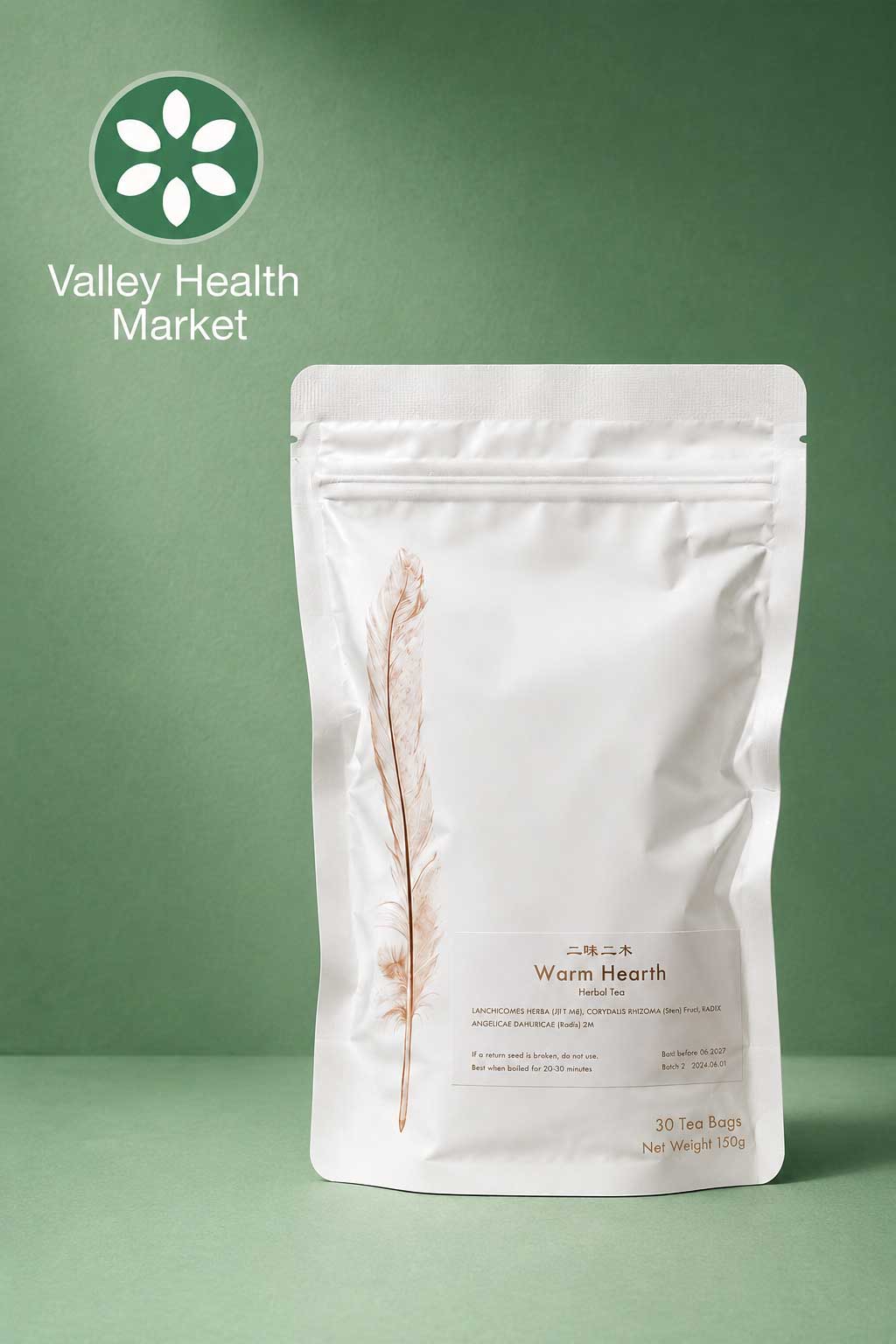
Warm Hearth Tea product mockup with a green background by Valley Health market
7 minutes read

Materia Medica · The Formula Series

Warm Hearth Tea: For the Heavy Head and the Foggy Morning

Willard Sheppy Dipl. OM, LAc, BS

Willard Sheppy is a licensed acupuncturist (LAc) and Founder of Valley Health Clinic specializing in using Traditional Chinese Medicine to treat acute injuries and chronic conditions, and to improve sports performance and rehabilitation.


Warm Hearth Tea product mockup with a green background by Valley Health market

Table of Contents

This one is for the heavy head, the foggy morning, and the neck tension that travels with them.

Phlegm in Chinese medicine is broader than what you cough up. It is a whole pattern of heaviness.

Here’s what the formula actually is, why nearly everything in the phlegm category is built on it, and who it’s not for.

Quick Answer

Warm Hearth is Er Chen Er Zhu Tang — Er Chen Tang, the foundational damp-phlegm formula of Chinese herbal medicine, plus the two great damp-drying atractylodes herbs — made as a warm everyday tea. It is built for the heavy, congested, sluggish, coated damp-phlegm picture: the heavy head, the foggy morning, and the neck tension that travels with them. If you tend to run dry, this is probably not your formula; if you are pregnant or take prescription medication, check with your practitioner first.

What Warm Hearth Actually Is

Er Chen Tang — the Two-Aged Decoction — is the base formula for damp-phlegm in Chinese herbal medicine. Nearly every phlegm formula in the tradition is built on top of it.

It addresses the heavy, congested, sluggish, coated feeling that comes when the body accumulates thick fluid it cannot transform. Not a cough formula. A whole-system formula.

Warm Hearth is the classical modification Er Chen Er Zhu Tang — the base plus Bai Zhu and Cang Zhu, the two great damp-drying atractylodes herbs, for more drying and strengthening power.

Why This Is a Foundation Stone

Practitioners think of Er Chen Tang the way builders think of a footing. It rarely gets the credit, and almost everything sits on it.

Botanical Biohacking took that foundation and made it a warm, everyday tea — thirty teabags to a box — so damp-phlegm support becomes a daily ritual rather than a decoction to prepare.

How It's Sourced and Tested

The same protocol runs across the whole line.

Inside the Formula

The Er Chen core, plus the atractylodes pair.

The Er Chen Core

The Atractylodes Reinforcement

Who This Is Not For

Warm Hearth is built for the damp-phlegm picture. If you tend to run dry, this is probably not your formula. If you are pregnant or take prescription medication, check with your practitioner before making any phlegm-drying formula a daily habit.

Formulas do not survive a thousand years of continuous clinical use by accident. Er Chen Tang is still the base that everything else gets built on. — Will Sheppy, L.Ac.

Warm Hearth Tea product mockup with a green background by Valley Health market

Warm Hearth Tea

Er Chen Er Zhu Tang — the foundational phlegm formula, reinforced with two atractylodes. Thirty teabags, one month’s supply. Available at Valley Health Market.

Research & Resources

  1. Bensky D, Barolet R. Chinese Herbal Medicine: Formulas & Strategies. Eastland Press. (Standard reference for Er Chen Tang and its modifications.)
  2. Bensky D, Clavey S, Stöger E. Chinese Herbal Medicine: Materia Medica, 3rd ed. Eastland Press, 2004. (Reference for Bai Zhu and Cang Zhu.)
  3. A note on evidence: rigorous modern clinical trials on the specific Er Chen Er Zhu blend are limited. We would rather say so than overstate a thin literature. What stands behind this formula is roughly a thousand years of documented clinical use.

Educational content rooted in 20+ years of clinical practice in Traditional Chinese Medicine. The information provided is for educational purposes and is not intended to replace consultation with a qualified healthcare practitioner. Please consult your physician before starting any new herbal protocol, especially if pregnant, nursing, on anticoagulants, or managing a chronic condition.

Share on

Will Sheppy, Founder and Acupuncturist at Valley Health Clinic
Willard Sheppy
Willard Sheppy is a licensed acupuncturist (LAc) and Founder of Valley Health Clinic specializing in using Traditional Chinese Medicine to treat acute injuries and chronic conditions, and to improve sports performance and rehabilitation.

FAQ's

What is Warm Hearth Tea?

Warm Hearth is Er Chen Er Zhu Tang — the classical modification of Er Chen Tang, the foundational damp-phlegm formula of Chinese herbal medicine, with Bai Zhu and Cang Zhu (the two atractylodes) added for more drying and strengthening power. Botanical Biohacking makes it as a warm everyday tea: thirty teabags, a one-month supply.

No. Phlegm in Chinese medicine is broader than what you cough up — it is a whole pattern of heaviness. Er Chen Tang addresses the heavy, congested, sluggish, coated feeling that comes when the body accumulates thick fluid it cannot transform. It is a whole-system formula, not a cough formula.

Practitioners think of Er Chen Tang the way builders think of a footing: it rarely gets the credit, and almost everything sits on it. Nearly every phlegm formula in the tradition is built on top of this base, and it has roughly a thousand years of documented clinical use behind it.

Warm Hearth is built for the damp-phlegm picture. If you tend to run dry, this is probably not your formula. If you are pregnant or take prescription medication, check with your practitioner before making any phlegm-drying formula a daily habit.

The Er Chen core — Chen Pi (aged tangerine peel), Fa Ban Xia (prepared pinellia), Fu Ling (poria), and Gan Cao (licorice) — plus the atractylodes reinforcement: Bai Zhu (white atractylodes) and Cang Zhu (grey atractylodes).

Recent Posts

Thoracic Park: For Mid-Back Pain That Gets Minimised

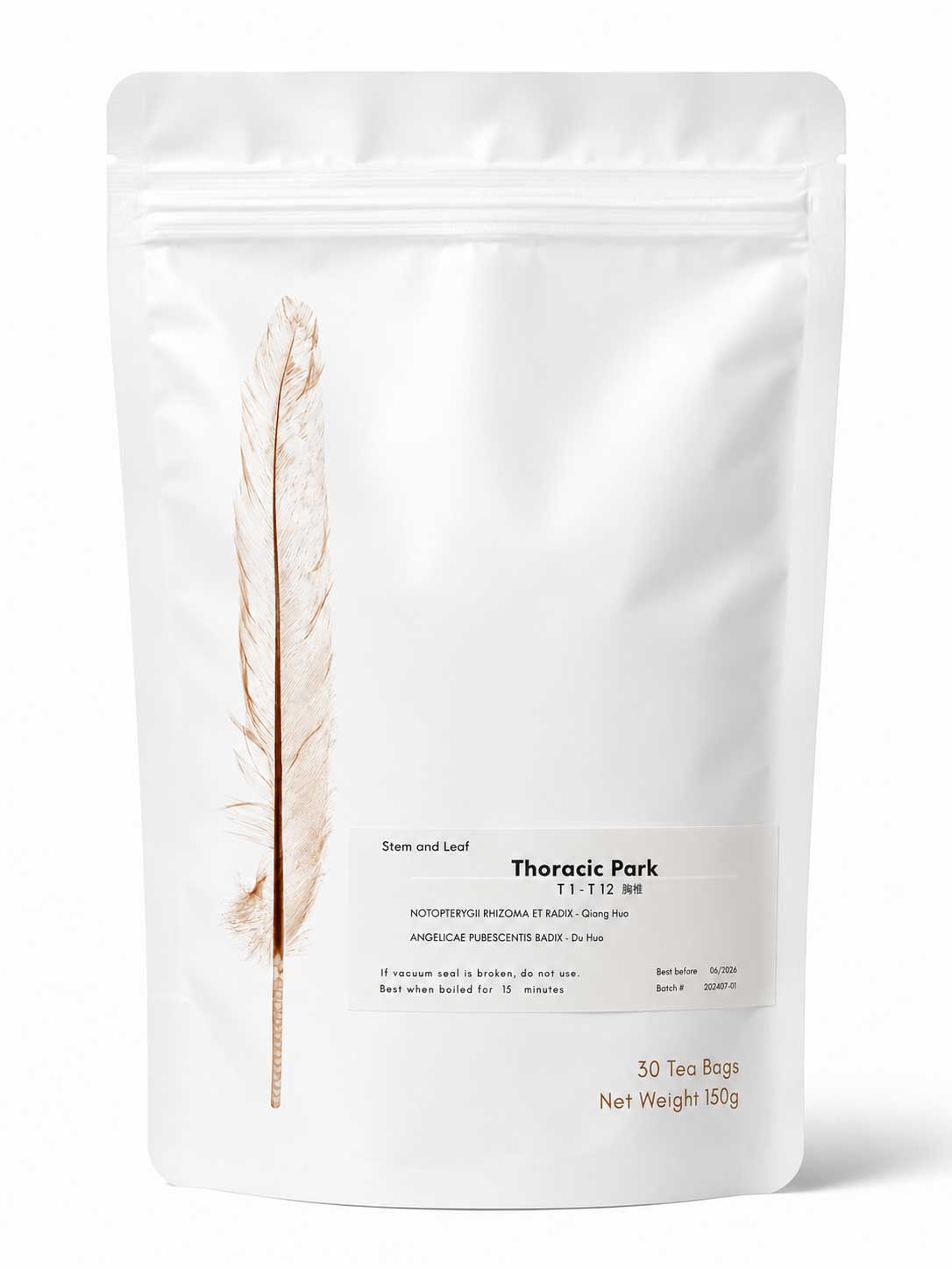
Thoracic Park Herbal Tea product mockup
7 minutes read

Materia Medica · The Stem & Leaf Series

Thoracic Park: For Mid-Back Pain That Gets Minimised

Willard Sheppy Dipl. OM, LAc, BS

Willard Sheppy is a licensed acupuncturist (LAc) and Founder of Valley Health Clinic specializing in using Traditional Chinese Medicine to treat acute injuries and chronic conditions, and to improve sports performance and rehabilitation.

Thoracic Park Herbal Tea product mockup

Table of Contents

Educational content from Valley Health Market. Not medical advice. Statements have not been evaluated by the FDA. This product is not intended to diagnose, treat, cure, or prevent any disease.

Mid-back pain is the one that gets minimised. It rarely shows cleanly on imaging and it does not radiate anywhere dramatic.

Stem & Leaf — Thoracic Park is the mid-back formula: two guide herbs, aimed at T1 through T12.

Here’s what the formula actually is, how the guide-herb principle works, and what’s inside.

Quick Answer

Stem & Leaf — Thoracic Park is the mid-back formula in Botanical Biohacking’s region-by-region spinal line: two guide herbs aimed at T1 through T12. Du Huo works from below and Qiang Huo from above — together they cover the length of the Du channel, which is why the pair appears in spinal formulas going back centuries. It is a companion to the fundamentals — and new, severe, or radiating pain, or pain with numbness, weakness, or loss of bladder or bowel control, needs prompt medical evaluation.

What Thoracic Park Actually Is

The Stem & Leaf line takes a region-by-region approach to spinal support. Rather than one general back formula, each product is built around guide herbs — herbs that classical medicine understands as directing a formula’s action to a particular part of the body.

Stem & Leaf — Thoracic Park is the mid-back formula. Two guide herbs, aimed at one region.

That specificity is the whole idea, and it mirrors how a practitioner actually thinks about a back. The spine is not one thing.

The Guide Herb Principle

A guide herb carries a formula’s action toward a specific region. For the mid-back, the classical answer is a pair rather than a single herb: Du Huo working from below, Qiang Huo from above.

Between them they cover the length of the Du channel, which is why this combination shows up again and again in spinal formulas going back centuries.

How It's Sourced and Tested

The same sourcing and testing protocol runs across the entire Botanical Biohacking line.

Inside the Formula

Du Huo and Qiang Huo together are described as one of the few specific herb combinations that hone to the Du channel — the channel running up the midline of the back — which is what makes the pair particularly suited to the thoracic spine. The same combination is also used for shoulder problems and for musculoskeletal pain that worsens with cold and damp weather changes.

The Thoracic Guide Herbs

Using the Line Together

A Practitioner’s Note

Spinal support formulas are a companion to the fundamentals, not a replacement. Movement, posture, sleep, and hands-on care do the heavy lifting.

New, severe, or radiating back pain — or pain with numbness, weakness, or loss of bladder or bowel control — needs prompt medical evaluation.

The thoracic spine carries the rib cage and absorbs every hour you spend at a desk. It deserves a formula aimed at it specifically, not a general back remedy. — Will Sheppy, L.Ac.

Thoracic Park Herbal Tea product mockup ith a green background by Valley Health Market

Stem & Leaf — Thoracic Park

The thoracic formula from the Stem & Leaf line. Region-specific guide herbs, thirty teabags. Available at Valley Health Market.

Research & Resources

  1. Christopher M. Volesky, L.Ac., Rocky Mountain Herb Supply. Stem and Leaf guide herb formulations. Distributor product note, July 2026.
  2. Bensky D, Clavey S, Stöger E. Chinese Herbal Medicine: Materia Medica, 3rd ed. Eastland Press, 2004. (Reference for guide herbs and channel-directing action.)
  3. A note on evidence: the Stem & Leaf line is a practitioner-formulated support product. We are not attaching clinical-trial claims to it. What we can tell you is which herbs are in it, why they were chosen, and who formulated them.

Educational content rooted in 20+ years of clinical practice in Traditional Chinese Medicine. The information provided is for educational purposes and is not intended to replace consultation with a qualified healthcare practitioner. Please consult your physician before starting any new herbal protocol, especially if pregnant, nursing, on anticoagulants, or managing a chronic condition.

Share on

Will Sheppy, Founder and Acupuncturist at Valley Health Clinic
Willard Sheppy
Willard Sheppy is a licensed acupuncturist (LAc) and Founder of Valley Health Clinic specializing in using Traditional Chinese Medicine to treat acute injuries and chronic conditions, and to improve sports performance and rehabilitation.

FAQ's

What is Stem & Leaf — Thoracic Park?

Thoracic Park is the mid-back formula in the Stem & Leaf line by Botanical Biohacking — a region-by-region approach to spinal support. It is built around two guide herbs, Du Huo and Qiang Huo, aimed at the thoracic spine (T1 through T12), and comes as thirty teabags.

A guide herb carries a formula’s action toward a specific region of the body. For the mid-back, the classical answer is a pair: Du Huo working from below and Qiang Huo from above. Between them they cover the length of the Du channel — the channel running up the midline of the back — which is why this combination appears in spinal formulas going back centuries.

Yes — the Stem & Leaf teas can be used alone or combined to cover the better part of the neck and back: Sir Vickle for the cervical spine (C1–C7), Thoracic Park for the thoracic spine (T1–T12), LumBear for the lumbar spine (L1–L5), and Sacrocox for the sacrococcygeal region.

New, severe, or radiating back pain — or pain with numbness, weakness, or loss of bladder or bowel control — needs prompt medical evaluation. Spinal support formulas are a companion to the fundamentals, not a replacement: movement, posture, sleep, and hands-on care do the heavy lifting.

Recent Posts

Stem & Leaf LumBear: Three Guide Herbs for the Low Back

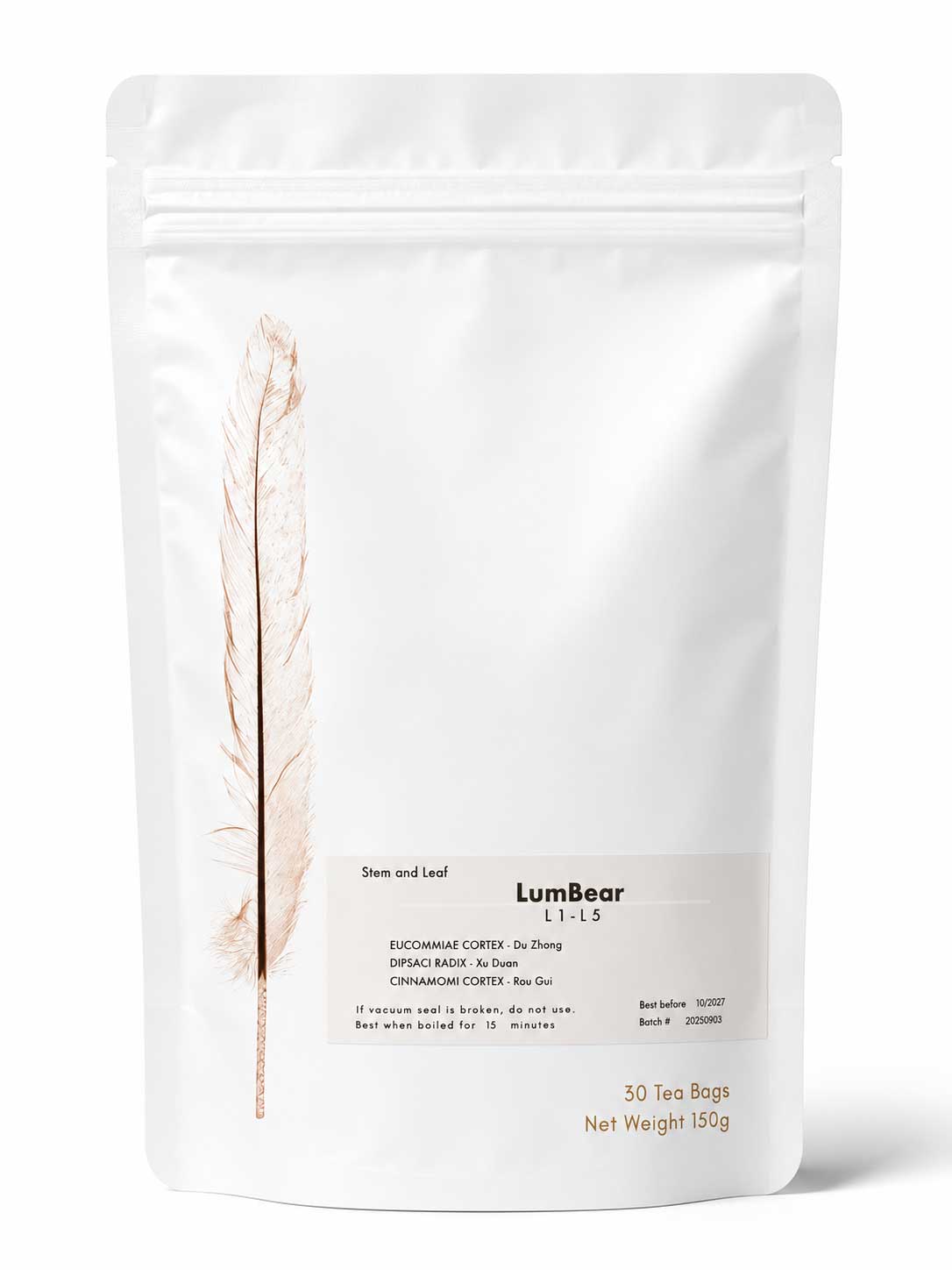
LumBear herbal tea product mockup
8 minutes read

Materia Medica · The Stem & Leaf Series

Stem & Leaf LumBear: Three Guide Herbs for the Low Back

Willard Sheppy Dipl. OM, LAc, BS

Willard Sheppy is a licensed acupuncturist (LAc) and Founder of Valley Health Clinic specializing in using Traditional Chinese Medicine to treat acute injuries and chronic conditions, and to improve sports performance and rehabilitation.

LumBear herbal tea product mockup

Table of Contents

Educational content from Valley Health Market. Not medical advice. Statements have not been evaluated by the FDA. This product is not intended to diagnose, treat, cure, or prevent any disease.

Chronic low back pain reorganizes a life quietly. It changes how you sleep, what you lift, and which chairs you avoid.

Stem & Leaf — LumBear is the lower-back formula in a line built region by region: three guide herbs, aimed at L1 through L5.

Here’s the guide-herb idea behind it, what’s inside, and when back pain needs a doctor instead.

Quick Answer

Stem & Leaf — LumBear is the lumbar formula in Botanical Biohacking’s region-by-region spinal line: three guide herbs aimed at L1 through L5. Du Zhong and Xu Duan have been paired for the low back for over a thousand years, and Rou Gui adds warming depth. It is a companion to the fundamentals — movement, posture, sleep, hands-on care — and new, severe, or radiating back pain, or pain with numbness, weakness, or loss of bladder or bowel control, needs prompt medical evaluation.

What Stem & Leaf LumBear Actually Is

The Stem & Leaf line takes a region-by-region approach to spinal support. Rather than one general back formula, each product is built around guide herbs — herbs that classical medicine understands as directing a formula’s action to a particular part of the body.

Stem & Leaf — LumBear is the lower back formula. Three guide herbs, aimed at one region.

That specificity is the whole idea, and it mirrors how a practitioner actually thinks about a back. The spine is not one thing.

The Guide Herb Principle

A guide herb carries a formula’s action toward a region. The lumbar spine has the most-developed guide herb tradition of any part of the back, because it is the region that fails most often.

Du Zhong and Xu Duan appear together in low-back formulas going back well over a thousand years. The pairing is close to canonical.

How It's Sourced and Tested

The same protocol runs across the entire Botanical Biohacking line: contamination testing covering heavy metals, pesticide residue, and microbial load.

Inside the Formula

This is the classical low-back trio. Du Zhong and Xu Duan are the two herbs most associated with lumbar support in the entire materia medica, and Rou Gui adds the warming depth that a cold, tired low back tends to want. Three guide herbs rather than two, because the lumbar region carries the most load.

The Lumbar Guide Herbs

Using the Line Together

A Practitioner’s Note

Spinal support formulas are a companion to the fundamentals, not a replacement. Movement, posture, sleep, and hands-on care do the heavy lifting. New, severe, or radiating back pain — or pain with numbness, weakness, or loss of bladder or bowel control — needs prompt medical evaluation.

The lumbar spine is the most heavily loaded region of the back, and it has the deepest guide-herb tradition behind it. Du Zhong and Xu Duan have been paired for the low back for over a thousand years. — Will Sheppy, L.Ac.

LumBear herbal tea product mockup with a green background by Valley Health Market

Stem & Leaf — LumBear

The lumbar formula from the Stem & Leaf line. Region-specific guide herbs, thirty teabags. Available at Valley Health Market.

Research & Resources

  1. Christopher M. Volesky, L.Ac., Rocky Mountain Herb Supply. Stem and Leaf guide herb formulations. Distributor product note, July 2026.
  2. Bensky D, Clavey S, Stöger E. Chinese Herbal Medicine: Materia Medica, 3rd ed. Eastland Press, 2004. (Reference for guide herbs and channel-directing action.)

A note on evidence: the Stem & Leaf line is a practitioner-formulated support product. We are not attaching clinical-trial claims to it. What we can tell you is which herbs are in it, why they were chosen, and who formulated them.

Educational content rooted in 20+ years of clinical practice in Traditional Chinese Medicine. The information provided is for educational purposes and is not intended to replace consultation with a qualified healthcare practitioner. Please consult your physician before starting any new herbal protocol, especially if pregnant, nursing, on anticoagulants, or managing a chronic condition.

Share on

Will Sheppy, Founder and Acupuncturist at Valley Health Clinic
Willard Sheppy
Willard Sheppy is a licensed acupuncturist (LAc) and Founder of Valley Health Clinic specializing in using Traditional Chinese Medicine to treat acute injuries and chronic conditions, and to improve sports performance and rehabilitation.

FAQ's

What is Stem & Leaf LumBear?

LumBear is the lower-back formula in the Stem & Leaf line, made by Botanical Biohacking. Instead of one general back formula, the line is built region by region around guide herbs — herbs classical medicine understands as directing a formula’s action to a particular part of the body. LumBear is aimed at the lumbar spine, L1 through L5, and comes as thirty teabags.

Three guide herbs: Du Zhong (eucommia bark), the classical lumbar herb that traditionally strengthens the low back and knees; Xu Duan (dipsacus root), whose name means “restore what is broken” and which traditionally knits and strengthens sinew and bone; and Rou Gui (cinnamon bark), which warms the deep interior and the lower back.

Yes — the Stem & Leaf teas can be used alone or combined to cover the better part of the neck and back: Sir Vickle for the cervical spine (C1–C7), Thoracic Park for the thoracic spine (T1–T12), LumBear for the lumbar spine (L1–L5), and Sacrocox for the sacrococcygeal region.

LumBear is a practitioner-formulated support product, and we are not attaching clinical-trial claims to it. What we can tell you is which herbs are in it, why they were chosen, and who formulated them. Du Zhong and Xu Duan have appeared together in classical low-back formulas for well over a thousand years.

New, severe, or radiating back pain — or pain with numbness, weakness, or loss of bladder or bowel control — needs prompt medical evaluation. Spinal support formulas are a companion to the fundamentals, not a replacement: movement, posture, sleep, and hands-on care do the heavy lifting.

Recent Posts

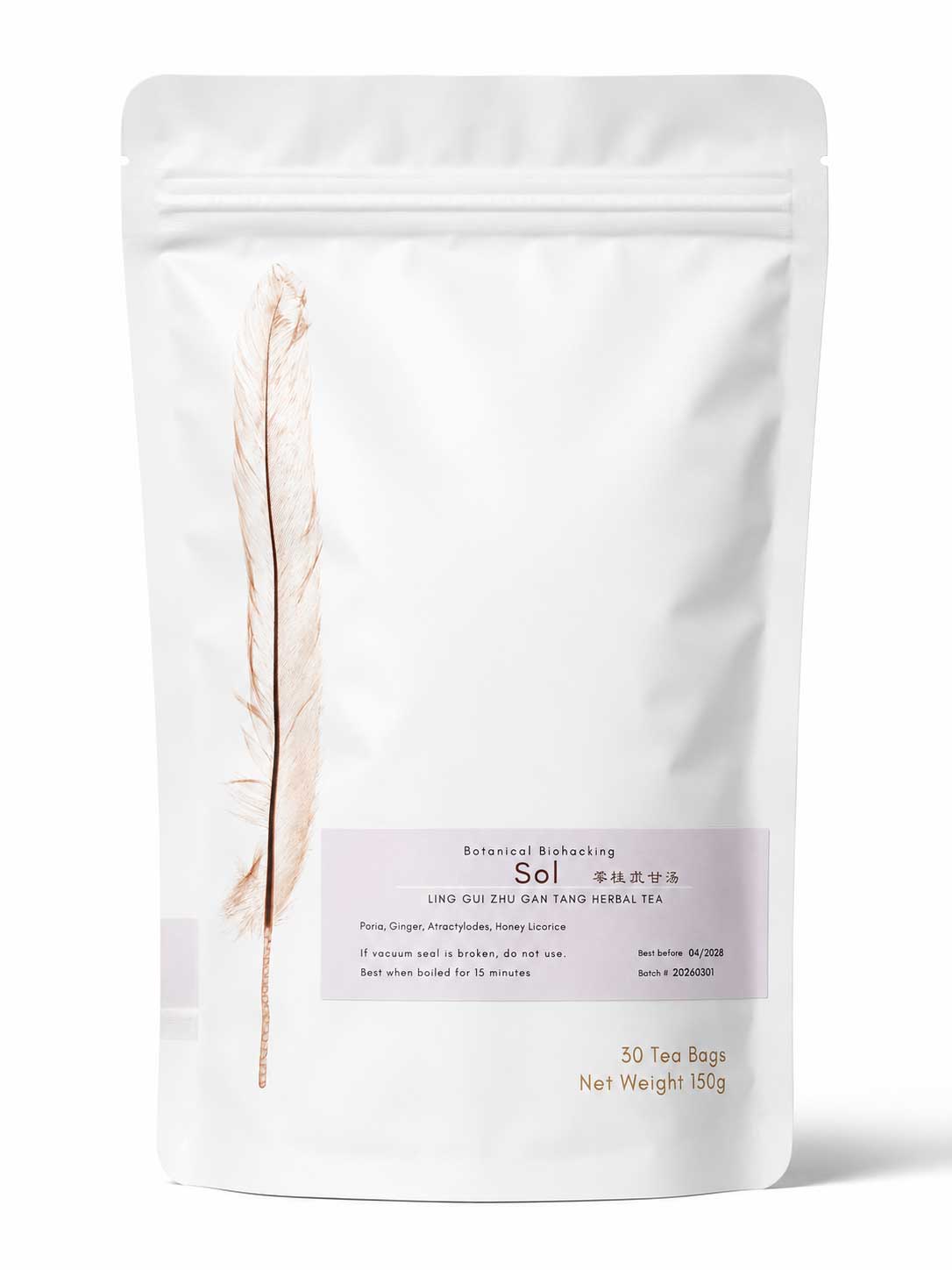
Sol Tea: For the Foggy, Heavy Head That Feels Waterlogged

Sol Tea product mockup
6 minutes read

Materia Medica · The Formula Series

Sol Tea: For the Foggy, Heavy Head That Feels Waterlogged

Willard Sheppy Dipl. OM, LAc, BS

Willard Sheppy is a licensed acupuncturist (LAc) and Founder of Valley Health Clinic specializing in using Traditional Chinese Medicine to treat acute injuries and chronic conditions, and to improve sports performance and rehabilitation.

Sol Tea product mockup

Table of Contents

Educational content from Valley Health Market. Not medical advice. Statements have not been evaluated by the FDA. This product is not intended to diagnose, treat, cure, or prevent any disease.

Sometimes the head feels foggy because the body is waterlogged.

Sol Tea is built on Ling Gui Zhu Gan Tang — four herbs, two thousand years — written for the patient too depleted to tonify. Not enough heat to move fluid, so fluid pools and then rises.

Here’s what the formula actually is, why four herbs is the point, and what’s inside.

Quick Answer

Sol Tea is built on Ling Gui Zhu Gan Tang — Poria, Cinnamon Twig, Atractylodes and Licorice Decoction — one of the great phlegm-fluid formulas, in continuous use for roughly two thousand years. It was written for the heavy, dizzy, cotton-wool-head pattern where fluid pools because there isn’t enough warmth to move it, and for the patient who gets foggier when tonified. If head symptoms are new, severe, or worsening, get properly evaluated first — Sol is a fit for the right pattern, not a substitute for a diagnosis.

What Sol Tea Actually Is

Ling Gui Zhu Gan Tang — Poria, Cinnamon Twig, Atractylodes and Licorice Decoction — is one of the great phlegm-fluid formulas. It warms yang, strengthens the spleen’s handling of fluids, and transforms the thin, sloshing dampness that rises up to cloud the head.

That is the pattern behind the heavy, dizzy, cotton-wool feeling: not enough heat to move fluid, so fluid pools and then rises.

It is a small formula — only four herbs — but elegantly constructed, which is why it has stayed in constant use for roughly two thousand years and why so many later formulas are built on top of it.

Why Four Herbs Is the Point

There is a clinical situation this formula was made for: the patient who needs support but cannot tolerate being tonified. Rich, building formulas sit heavily on a system that is already damp, and the result is more fog, not less.

Sol works the other direction. It removes what is in the way first. Four of the safest, most-used herbs in the entire materia medica, doing one job cleanly.

How It's Sourced and Tested

The same protocol applies across the line — heavy metals, pesticide residue, and microbial load.

Inside the Formula

Four herbs, four clearly defined roles — classic monarch-to-envoy construction.

Warm and Drain

Strengthen and Harmonize

Before You Start

Dizziness has many causes, and not all of them are the fluid pattern this formula addresses. If head symptoms are new, severe, or worsening, get properly evaluated first. Sol is a good fit for the right pattern — not a substitute for a diagnosis.

This is the formula for the person who gets worse when you try to build them up. Clear what is in the way first, and the building becomes possible. — Will Sheppy, L.Ac.

Sol Tea

Ling Gui Zhu Gan Tang. Four herbs, thirty teabags. Gentle enough for people who cannot tolerate a tonic. Available at Valley Health Market.

Research & Resources

  1. Lu Y, et al. Lingguizhugan Decoction in the Treatment of Non-Alcoholic Fatty Liver Disease: A Systematic Review and Meta-Analysis. Endocr Metab Immune Disord Drug Targets. 2025;25(13):1060–1072. Link →
  2. Ma H, et al. Linggui Zhugan Decoction for peripheral vertigo: A protocol for systematic review and meta-analysis. Medicine (Baltimore). 2021;100(16):e25563. Link →
  3. Memorial Sloan Kettering Cancer Center. Ling Gui Zhu Gan Tang — About Herbs monograph. Link →

Educational content rooted in 20+ years of clinical practice in Traditional Chinese Medicine. The information provided is for educational purposes and is not intended to replace consultation with a qualified healthcare practitioner. Please consult your physician before starting any new herbal protocol, especially if pregnant, nursing, on anticoagulants, or managing a chronic condition.

Share on

Will Sheppy, Founder and Acupuncturist at Valley Health Clinic
Willard Sheppy
Willard Sheppy is a licensed acupuncturist (LAc) and Founder of Valley Health Clinic specializing in using Traditional Chinese Medicine to treat acute injuries and chronic conditions, and to improve sports performance and rehabilitation.

FAQ's

What is Sol Tea?

Sol Tea is built on Ling Gui Zhu Gan Tang — Poria, Cinnamon Twig, Atractylodes and Licorice Decoction — one of the great phlegm-fluid formulas of the Chinese medicine canon, in continuous use for roughly two thousand years. It comes as thirty teabags, a one-month supply.

It was written for the patient who needs support but cannot tolerate being tonified — the heavy, dizzy, cotton-wool-head pattern where fluid pools because there isn’t enough warmth to move it. Rich, building formulas make that person foggier; Sol works the other direction and removes what is in the way first.

No — and that is the point. It is a small, four-herb formula that clears fluid rather than builds. Four of the safest, most-used herbs in the entire materia medica, doing one job cleanly. Clear what is in the way first, and the building becomes possible.

Dizziness has many causes, and not all of them are the fluid pattern this formula addresses. If head symptoms are new, severe, or worsening, get properly evaluated first. Sol is a good fit for the right pattern — not a substitute for a diagnosis.

Recent Posts

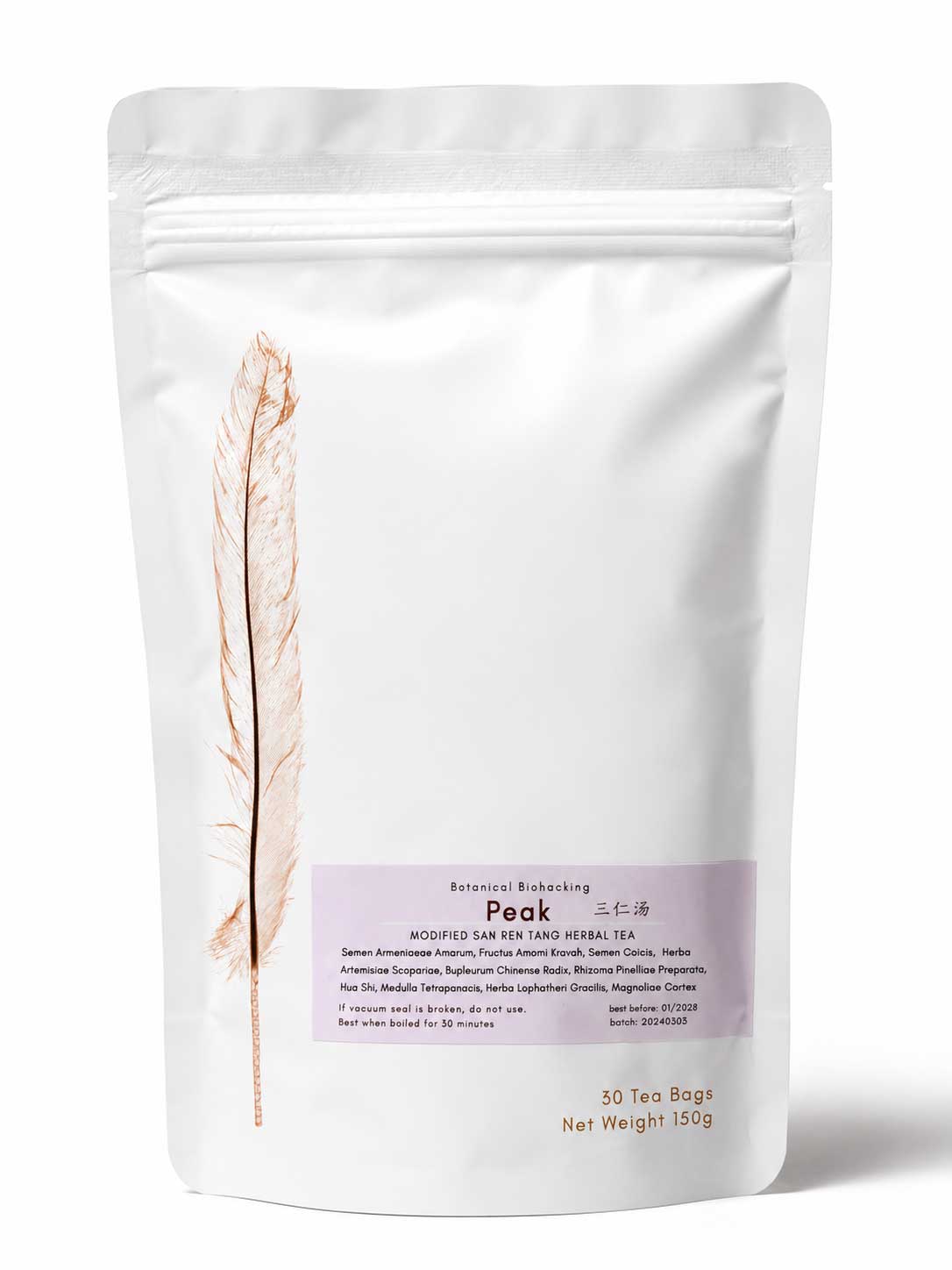
Peak Tea: For the Illness That Never Fully Left

Peak Tea product mockup
8 minutes read

Materia Medica · The Formula Series

Peak Tea: For the Illness That Never Fully Left

Willard Sheppy Dipl. OM, LAc, BS

Willard Sheppy is a licensed acupuncturist (LAc) and Founder of Valley Health Clinic specializing in using Traditional Chinese Medicine to treat acute injuries and chronic conditions, and to improve sports performance and rehabilitation.

Peak Tea product mockup

Table of Contents

This one is for the illness that never fully left.

Here’s where the formula comes from, how Botanical Biohacking rebuilt it, how to tell Peak from its sibling Wind, and what’s inside.

Quick Answer

Peak Tea is San Ren Tang — Wu Ju Tong’s 1813 formula for the lingering damp pattern — remixed with Xiao Chai Hu Tang by Dr. Jin Zhao, with Yin Chen Hao and Tibetan Plateau Chai Hu strengthening the heat-clearing side. It suits the more excess, heated presentation; its sibling Wind (with white ginseng) suits relative deficiency. It is a targeted tool, not a daily tea: roughly two weeks, never longer than three months.

Where This Formula Comes From

Wu Ju Tong described this pattern in 1813, and the description still reads like a modern chart note.

San Ren Tang — the Three-Kernel Decoction — has a specific, datable origin, which is more than most herbal products can claim. It appears in the Wen Bing Tiao Bian (溫病條辨, Systematic Differentiation of Warm Diseases), published in 1813 by Wu Ju Tong.

His original description of the pattern reads almost like a modern symptom checklist: headache, aversion to cold, a heavy aching body, a pale tongue without thirst, a yellowish complexion, chest tightness, no appetite, and a fever that rises in the afternoon.

What makes his account genuinely sophisticated is the section on errors. He warns that sweating the patient makes them foggy and unwell, purging causes qi to leak away, and moistening drives the dampness deeper. It is a catch-22 — and San Ren Tang was his answer to it.

How Botanical Biohacking Rebuilt It

Peak is not a straight copy. It is a deliberate remix, formulated by Dr. Jin Zhao, DTCM and fine-tuned by pharmacology professor Dr. Zhong Shi Hong.

Dr. Jin brings in Xiao Chai Hu Tang, the Shang Han Lun classic, to help the Shaoyang layer govern the body. Then, for Peak specifically, they strengthen the heat-clearing side with Yin Chen Hao and Chai Hu sourced from the Tibetan Plateau.

Notably, they leave ginseng out of Peak. Its sibling formula, Wind, gets high-grade white ginseng added. Peak does not — because it is aimed at a different person entirely.

Peak or Wind? The Formulators’ Own Rule

This settles a question people ask constantly. Both are San Ren Tang remixes from the same team. They are not interchangeable:

Inside the Formula

Peak opens all three burners — the classical three seeds anchor each level.

Open the Top

Transform the Middle

Drain the Bottom

An Important Limit, From the Makers

San Ren Tang is not a long-term formula. Botanical Biohacking’s own guidance is roughly two weeks, and not longer than three months, because over time it can drain too much qi. Classical texts also caution against it when heat clearly outstrips damp. This is a targeted tool, not a daily forever-tea.

As with any new herbal protocol: talk with your practitioner or physician first, especially if you are pregnant, nursing, on anticoagulants, or managing a chronic condition.

Wu Ju Tong warned that you cannot sweat this pattern out, cannot purge it out, and cannot moisten it away. That is why he needed a new formula. Two hundred years later it is still the answer. — Will Sheppy, L.Ac.

Peak Tea product mockup with a green background by Valley Health Market

Peak Tea

San Ren Tang remixed with Xiao Chai Hu Tang, by Dr. Jin Zhao. Yin Chen Hao and Tibetan Plateau Chai Hu. Thirty teabags. Available at Valley Health Market.

Research & Resources

  1. Wu Ju Tong. Wen Bing Tiao Bian (溫病條辨, Systematic Differentiation of Warm Diseases), 1813. (Original source text for San Ren Tang.)
  2. Yin Y, et al. Hepatic transcriptome delineates the therapeutic effects of Sanren Tang on high-fat diet-induced non-alcoholic fatty liver disease. J Tradit Chin Med. 2023;43(6):1092-1102. Link →
  3. Andrew Miles, DOM & Qiu Xuelan, PhD, Botanical Biohacking. How to use Wind and Peak. Practitioner guidance, June 2025.

Educational content rooted in 20+ years of clinical practice in Traditional Chinese Medicine. The information provided is for educational purposes and is not intended to replace consultation with a qualified healthcare practitioner. Please consult your physician before starting any new herbal protocol, especially if pregnant, nursing, on anticoagulants, or managing a chronic condition.

Share on

Will Sheppy, Founder and Acupuncturist at Valley Health Clinic
Willard Sheppy
Willard Sheppy is a licensed acupuncturist (LAc) and Founder of Valley Health Clinic specializing in using Traditional Chinese Medicine to treat acute injuries and chronic conditions, and to improve sports performance and rehabilitation.

FAQ's

What is Peak Tea?

Peak Tea is San Ren Tang — the Three-Kernel Decoction, first published by Wu Ju Tong in 1813 — remixed with Xiao Chai Hu Tang by Dr. Jin Zhao, DTCM, and fine-tuned by pharmacology professor Dr. Zhong Shi Hong. The heat-clearing side is strengthened with Yin Chen Hao and Chai Hu sourced from the Tibetan Plateau. It comes as thirty teabags.

It was built for the lingering damp pattern Wu Ju Tong described: a heavy aching body, chest tightness, poor appetite, a pale tongue without thirst, and a fever that rises in the afternoon — the illness that never fully left. Within that pattern, Peak is the version for the more excess, heated presentation.

Both are San Ren Tang remixes from the same team, but they are not interchangeable. More excess and heat points to Peak, which has extra heat-clearing (Yin Chen Hao, Tibetan Plateau Chai Hu) and no ginseng. More relative deficiency points to Wind, which adds high-grade white ginseng so the formula doesn’t drain qi.

San Ren Tang is not a long-term formula. Botanical Biohacking’s own guidance is roughly two weeks, and not longer than three months, because over time it can drain too much qi. Classical texts also caution against it when heat clearly outstrips damp. It is a targeted tool, not a daily forever-tea.

Please consult your physician before starting any new herbal protocol, especially if you are pregnant, nursing, on anticoagulants, or managing a chronic condition. This is educational content, not medical advice.

Recent Posts

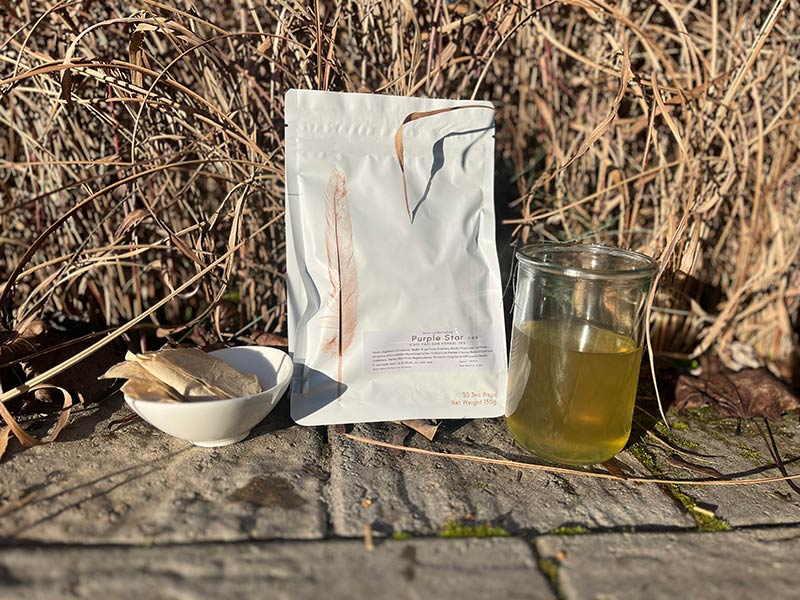
Purple Star: Xiao Yao San for Emotional Balance

Purple Star Xiao Yao Wan tea from Botanical Biohacking and Valley Health Clinic
7 minutes read

Materia Medica · The Formula Series

Purple Star: Xiao Yao San for Emotional Balance

Willard Sheppy Dipl. OM, LAc, BS

Willard Sheppy is a licensed acupuncturist (LAc) and Founder of Valley Health Clinic specializing in using Traditional Chinese Medicine to treat acute injuries and chronic conditions, and to improve sports performance and rehabilitation.

Purple Star Xiao Yao Wan tea from Botanical Biohacking and Valley Health Clinic

Table of Contents

This one is for the patient who is tired, but not the kind of tired sleep fixes.

She is not in crisis. She has just been carrying too much, for too long.

Here’s what the formula actually is, the pattern it was written for, and what’s inside.

Quick Answer

Purple Star is Xiao Yao San — the Free and Easy Wanderer — an eight-herb classical formula with nearly a thousand years of continuous clinical use, for liver qi stagnation with spleen weakness: the tight, irritable, sighing, bloated, running-on-fumes pattern. This batch reduces the Bo He dose and uses wildcrafted Tibetan Chai Hu. It never replaces care for a diagnosed mood condition — if you take psychiatric or sedative medication, or you’re pregnant, talk with your practitioner first.

What Purple Star Actually Is

Purple Star is Xiao Yao San — the Free and Easy Wanderer. Eight herbs, nearly a thousand years of continuous clinical use, and still one of the most-prescribed formulas in the entire tradition.

It is the classical prescription for Liver qi stagnation with Spleen weakness: the tight, irritable, sighing, bloated, running-on-fumes pattern that shows up when tension outpaces resilience. Its whole purpose is to let stuck energy wander freely again while quietly rebuilding the digestion underneath.

In the classical model, the Liver governs the smooth movement of qi. When that movement is blocked — by chronic stress, held emotion, overwork, or sleep that’s been thin for too long — the qi pools where the channels run. At the ribs and breast. At the temples and around the eye. In the shoulder. At the throat, where it becomes the lump the texts call mei he qi, plum-pit qi.

Ten Complaints, One Pattern

Botanical Biohacking’s herbal pharmacologist, Dr. Lan, PhD, describes this patient better than we could. She comes in for the headache. Or the PMS. Or the chest tightness her cardiologist couldn’t explain. Or the irritability that has begun to alarm her family. Or the digestive heaviness after small meals. Or the breast tenderness, the eye strain, the shoulder tension she has carried for two years.

She rarely connects these to each other. She often apologizes for mentioning them.

They are one pattern. Western diagnostic categories run sideways to this — they name each symptom but miss the connection, and the patient ends up with a folder of partial labels and no integrated approach.

What This Batch Does Differently

This is where Botanical Biohacking’s attention shows. The formula has been adjusted, deliberately, by people who use it clinically:

Inside the Formula

Purple Star keeps the classical scaffolding: soothe the liver, nourish the blood, support the spleen.

Soothe and Spread

Nourish the Blood

Support the Middle

A Note on Scope

“Stress formula” is a convenient shorthand, but Xiao Yao San is specifically for the liver-qi-stuck, spleen-tired pattern. It pairs well with the basics — sleep, movement, boundaries — and it never replaces care for a diagnosed mood condition. If you take psychiatric or sedative medication, or you’re pregnant, talk with your practitioner first.

Prescribe the formula and prescribe the conversation. Patients holding this much rarely have anyone in their week who simply asks how they are doing. — Will Sheppy, L.Ac.

close up of xiao yao wan with tea bag

Purple Star — Xiao Yao Wan Tea

Xiao Yao San with a reduced Bo He adjustment and wildcrafted Tibetan Chai Hu. Nearly a thousand years of clinical use, in a daily cup. Available at Valley Health Market.

Related Reading

Research & Resources

  1. Zhang Y, Han M, Liu Z, Wang J, He Q, Liu J. Chinese herbal formula Xiao Yao San for treatment of depression: a systematic review of randomized controlled trials. Evid Based Complement Alternat Med. 2012;2012:931636. (26 RCTs, 1,837 participants.) Link →
  2. Lin J, Ji Y, Si J, Wang G, Li X, Shen L. Evaluation of the Safety and Efficacy of Xiao Yao San as a Treatment for Anxiety: A Systematic Review and Meta-Analysis. Evid Based Complement Alternat Med. 2022;2022:1319592. Link →
  3. Bensky D, Barolet R. Chinese Herbal Medicine: Formulas & Strategies. Eastland Press. (Standard reference for Xiao Yao San.)

Educational content rooted in 20+ years of clinical practice in Traditional Chinese Medicine. The information provided is for educational purposes and is not intended to replace consultation with a qualified healthcare practitioner. Please consult your physician before starting any new herbal protocol, especially if pregnant, nursing, on anticoagulants, or managing a chronic condition.

Share on

Will Sheppy, Founder and Acupuncturist at Valley Health Clinic
Willard Sheppy
Willard Sheppy is a licensed acupuncturist (LAc) and Founder of Valley Health Clinic specializing in using Traditional Chinese Medicine to treat acute injuries and chronic conditions, and to improve sports performance and rehabilitation.

FAQ's

What is Purple Star?

Purple Star is Xiao Yao San — the Free and Easy Wanderer — an eight-herb classical formula with nearly a thousand years of continuous clinical use, made by Botanical Biohacking as a daily tea. It is still one of the most-prescribed formulas in the entire tradition.

It is the classical prescription for liver qi stagnation with spleen weakness: the tight, irritable, sighing, bloated, running-on-fumes pattern that shows up when tension outpaces resilience — the patient who is tired, but not the kind of tired sleep fixes. The headache, the PMS, the chest tightness, the digestive heaviness, and the shoulder tension are often one pattern, not ten separate problems.

“Stress formula” is a convenient shorthand, but Xiao Yao San is specifically for the liver-qi-stuck, spleen-tired pattern. It pairs well with the basics — sleep, movement, boundaries — and it never replaces care for a diagnosed mood condition.

If you take psychiatric or sedative medication, or you’re pregnant, talk with your practitioner before starting this formula.

Recent Posts

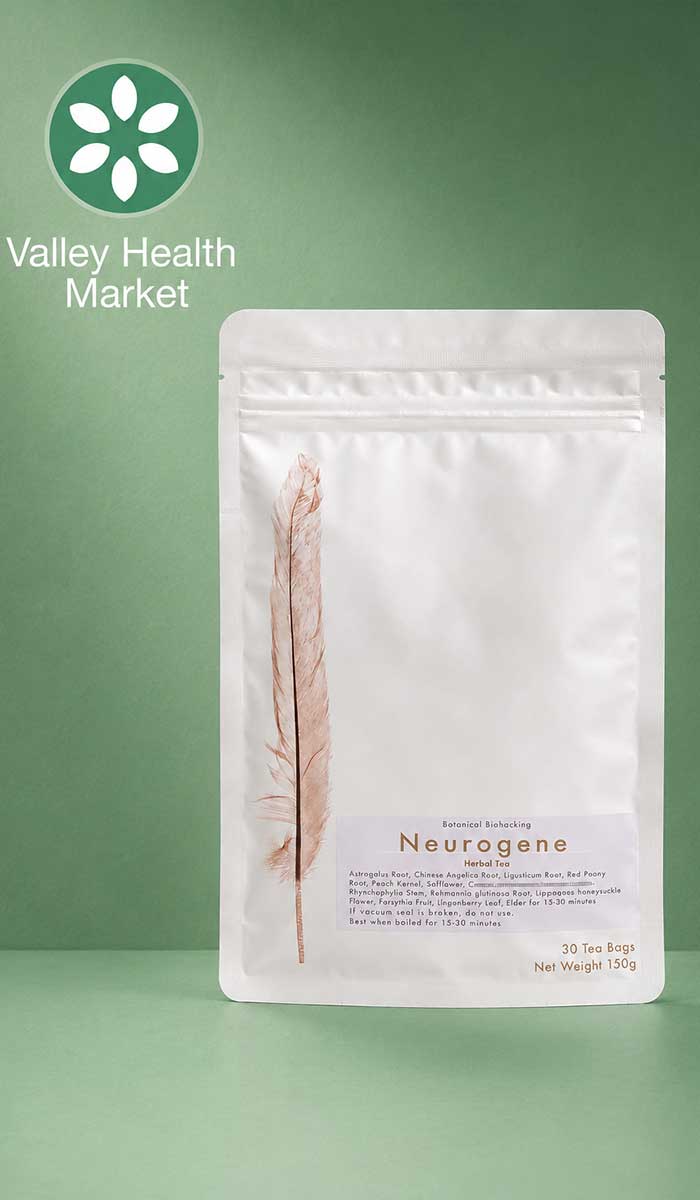
Neurogene Tea: For Numbness and Tingling in Hands and Feet

Neurogene Tea product with green backing Valley Health Market
7 minutes read

Materia Medica · The Formula Series

Neurogene Tea: For Numbness and Tingling in Hands and Feet

Willard Sheppy Dipl. OM, LAc, BS

Willard Sheppy is a licensed acupuncturist (LAc) and Founder of Valley Health Clinic specializing in using Traditional Chinese Medicine to treat acute injuries and chronic conditions, and to improve sports performance and rehabilitation.

Neurogene Tea product with green backing Valley Health Market

Table of Contents

Numbness and tingling are not always a nerve problem. Sometimes they are a delivery problem.

When circulation is too weak to reach the far end of a nerve, the sensation at the fingertips and toes is often the first thing to fade. Neurogene Tea was built for that picture — to support the pressure behind circulation rather than force it.

Here’s what the formula actually is, who formulates it, and what’s inside.

Quick Answer

Neurogene Tea is an Imperial-grade modification of Bu Yang Huan Wu Tang — the most-studied blood-moving formula in Chinese medicine — built for the picture where circulation is too weak to reach the far end of a nerve. A very large dose of Huang Qi (astragalus) supplies the push; a small team of blood-movers clears the path. It is a blood-moving formula: not used during pregnancy, and anyone on anticoagulants, with a bleeding disorder, or recovering from a stroke should talk with their physician and practitioner first.

What Neurogene Tea Actually Is

Neurogene is an Imperial-grade modification of Bu Yang Huan Wu Tang — Tonify the Yang to Restore Five-Tenths Decoction. In China it is the single most-used formula for post-stroke recovery, and it has been studied more than almost any other blood-moving prescription.

The classical logic is elegant. A very large dose of Huang Qi (astragalus) supplies the qi that pushes blood; a small team of blood-movers clears the obstruction that qi is pushing against. The formula does not force circulation. It restores the pressure behind it.

The modification adds herbs aimed at the neuro-inflammatory side of the picture — Tian Ma and Gou Teng to settle wind, Jin Yin Hua and Lian Qiao to clear heat, Da Huang to keep things moving downward.

Who Formulates This

Dr. Jin Zhao is the main formulator for Botanical Biohacking. He practices in Chengdu, sees up to 200 patients a day, and specializes in dampness. His approach was refined across tens of thousands of patients, working through the upper, middle, and lower jiao.

Pharmacology professor Dr. Zhong Shi Hong fine-tunes the formulas. Dr. Lan, PhD — Dr. Jin’s younger classmate — is the herbal pharmacologist who oversees testing and writes the practitioner letters.

A sourcing detail worth noting: this blend uses Qing Lian Qiao — unripe green forsythia — rather than the ripe fruit. It carries a higher concentration of forsythiaside. A small decision, made by someone paying attention.

How It's Sourced and Tested

Three categories of contamination matter for plant material from anywhere in the world: heavy metals, pesticide residue, and microbial load. Botanical Biohacking’s protocol addresses all three.

Inside the Formula

Eleven herbs, organized around one idea: supply the push, then clear the path.

Supply the Push

Move the Blood

Settle and Clear

Before You Start

This is a blood-moving formula. It is not used during pregnancy. If you take anticoagulants, have a bleeding disorder, or are recovering from a stroke or any neurological event, this belongs in a conversation with your physician and practitioner — not in a self-directed experiment.

Numbness at the fingertips and toes is often the last stop on a long supply line. When you improve what reaches the end of that line, the sensation frequently follows. — Will Sheppy, L.Ac.

Neurogene Tea product with green backing Valley Health Market

Neurogene Tea

An Imperial-grade modification of Bu Yang Huan Wu Tang. Eleven herbs, thirty teabags, one month’s supply. Available at Valley Health Market.

Research & Resources

  1. Wang R, Ren J, Li S, et al. Efficacy evaluation of Buyang Huanwu Decoction in the treatment of ischemic stroke in the recovery period: a systematic review of randomized controlled trials. Front Pharmacol. 2022;13:975816. Frontiers →
  2. Hao CZ, Wu F, Shen J, et al. Clinical efficacy and safety of Buyang Huanwu Decoction for acute ischemic stroke: a systematic review and meta-analysis of 19 randomized controlled trials. Evid Based Complement Alternat Med. 2012;2012:630124. PubMed →
  3. Wei RL, Teng HJ, Yin B, et al. A systematic review and meta-analysis of Buyang Huanwu Decoction in animal model of focal cerebral ischemia. Evid Based Complement Alternat Med. 2013;2013:138484. PubMed →

Educational content rooted in 20+ years of clinical practice in Traditional Chinese Medicine. The information provided is for educational purposes and is not intended to replace consultation with a qualified healthcare practitioner. Please consult your physician before starting any new herbal protocol, especially if pregnant, nursing, on anticoagulants, or managing a chronic condition.

Share on

Will Sheppy, Founder and Acupuncturist at Valley Health Clinic
Willard Sheppy
Willard Sheppy is a licensed acupuncturist (LAc) and Founder of Valley Health Clinic specializing in using Traditional Chinese Medicine to treat acute injuries and chronic conditions, and to improve sports performance and rehabilitation.

FAQ's

What is Neurogene Tea?

Neurogene Tea is an Imperial-grade modification of Bu Yang Huan Wu Tang (Tonify the Yang to Restore Five-Tenths Decoction) — the most-used and most-studied blood-moving formula in Chinese medicine. Botanical Biohacking builds it from eleven herbs and adds a team aimed at the neuro-inflammatory side of the picture. It comes as thirty teabags, a one-month supply.

It was written for the picture where circulation is too weak to reach the far end of a nerve — numbness and tingling at the fingertips and toes that behaves less like a nerve problem and more like a delivery problem. The formula’s strategy is to supply the push behind circulation with a large dose of Huang Qi (astragalus), then clear the path with blood-movers.

No — this is a blood-moving formula and it is not used during pregnancy. If you take anticoagulants, have a bleeding disorder, or are recovering from a stroke or any neurological event, this belongs in a conversation with your physician and practitioner, not a self-directed experiment.

Dr. Jin Zhao, Botanical Biohacking’s main formulator, practices in Chengdu and specializes in dampness, refining his approach across tens of thousands of patients. Pharmacology professor Dr. Zhong Shi Hong fine-tunes the formulas, and Dr. Lan, PhD, the herbal pharmacologist, oversees testing. One detail of their care: the blend uses unripe green forsythia (Qing Lian Qiao) for its higher forsythiaside content.

Recent Posts

Atone Tea: For the Heavy, Queasy, Nothing-Is-Moving Stall

Glow Herbal Tea product mockup
7 minutes read

Materia Medica · The Formula Series

Atone Tea: For the Heavy, Queasy, Nothing-Is-Moving Stall

Willard Sheppy Dipl. OM, LAc, BS

Willard Sheppy is a licensed acupuncturist (LAc) and Founder of Valley Health Clinic specializing in using Traditional Chinese Medicine to treat acute injuries and chronic conditions, and to improve sports performance and rehabilitation.

Glow Herbal Tea product mockup

Table of Contents

This one is for the heavy, queasy, nothing-is-moving stall. Bad food, bad water, or a bug going around.

Huo Xiang Zheng Qi San is the formula households across Asia keep on hand for exactly this picture. It works by aromatically waking up the digestion — not by attacking anything.

Here’s what the formula actually is, why it uses eleven herbs, and when it’s the wrong tool.

Quick Answer

Atone Tea is Huo Xiang Zheng Qi San — Agastache Powder to Rectify the Qi — the classic formula for external damp obstructing the middle: the summer bug, the questionable takeout, the travel tummy. It settles the gut by aromatically waking up digestion, not by attacking anything. It is not for every stomach upset — dehydration, blood in the stool, high fever, or symptoms lasting more than a couple of days call for medical attention. If you are pregnant, check with your practitioner first.

What Atone Tea Actually Is

Huo Xiang Zheng Qi San — Agastache Powder to Rectify the Qi — is the classic prescription for external damp obstructing the middle. The summer-bug, questionable-takeout, travel-tummy, damp-and-queasy picture.

It works by aromatically waking up the digestion, releasing the exterior, and getting stuck qi and fluid moving again in the right direction. Not by attacking anything.

It is a household staple across much of Asia for exactly this reason: it is what you reach for when your gut feels waterlogged and rebellious and you want it settled today.

Why Eleven Herbs

This is a larger formula than most, and each group has a job. Botanical Biohacking keeps the full aromatic architecture intact rather than trimming it for cost — agastache, perilla, angelica dahurica, the two bark qi-movers, and the digestive support herbs.

Then they turn it into a tea you can sip at the first sign of trouble, rather than a formula you have to track down mid-misery. That is the practical difference.

How It's Sourced and Tested

For a formula you reach for when already unwell, contamination testing matters more, not less.

Inside the Formula

Three classical jobs: aromatically transform damp, release the exterior, harmonize the gut.

Aromatically Transfor Damp

Move Qi and Drain Damp

Support and Harmonize

When to Stop and Call Someone

Atone is for the damp, sluggish, queasy pattern — not every stomach upset. Signs of dehydration, blood in the stool, high fever, or symptoms lasting more than a couple of days call for medical attention, not more tea. If you are pregnant, check with your practitioner first.

This is the one people stash for travel, summer heat, and questionable meals. It has been a household staple across much of Asia for centuries, and for good reason. — Will Sheppy, L.Ac.

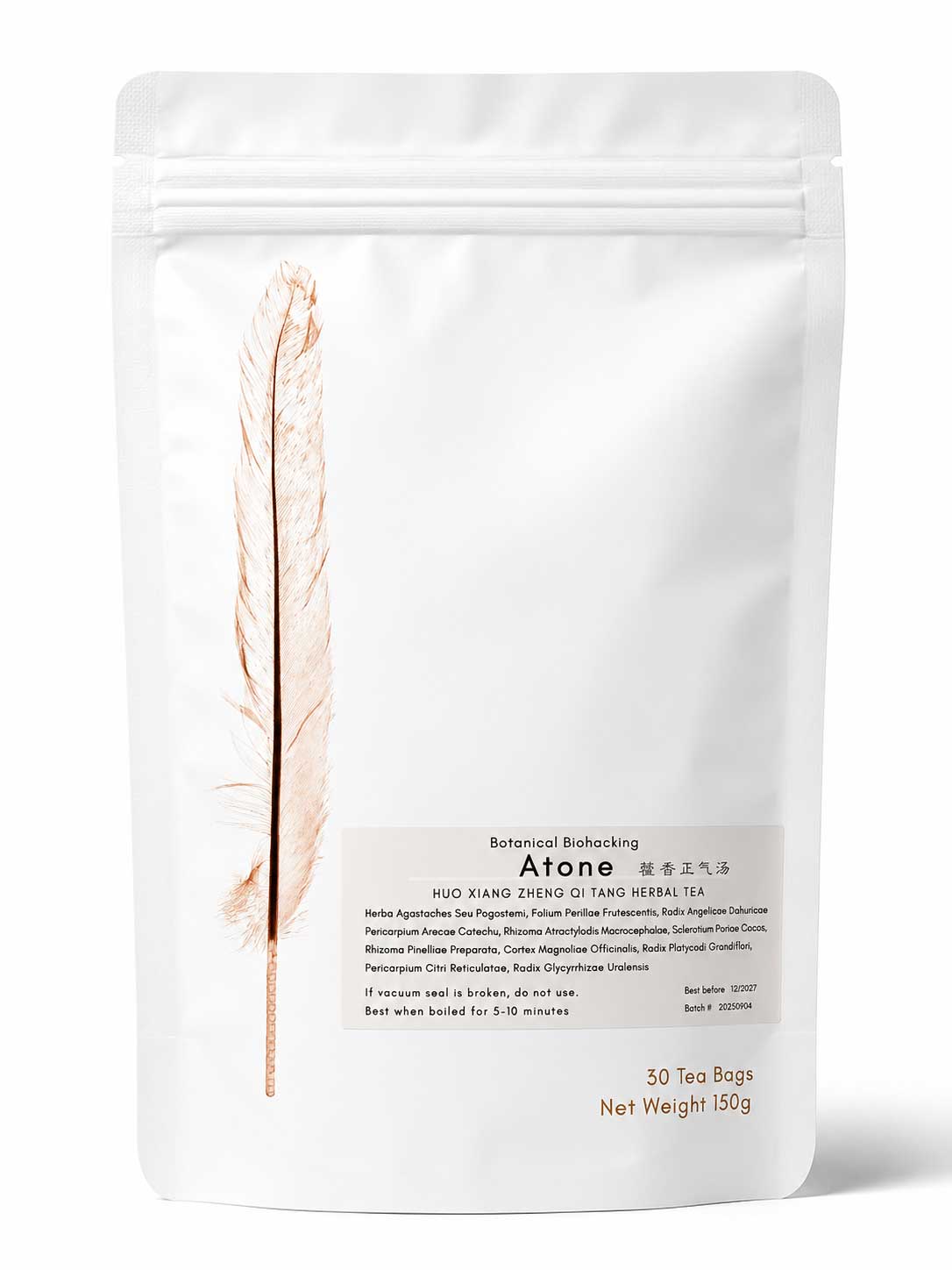
Atone Herbal Tea product mockup green background

Atone Tea

Huo Xiang Zheng Qi San. Eleven herbs, full aromatic architecture intact. Thirty teabags, one month’s supply. Available at Valley Health Market.

Research & Resources

  1. Yu DD, et al. Systematic review and meta-analysis of Huoxiang Zhengqi Pills combined with Western medicine for acute gastroenteritis (44 studies, 4,153 participants). Zhongguo Zhong Yao Za Zhi. 2019;44(14):2914–2925. [Article in Chinese] PubMed →
  2. Zhao HJ, et al. Huoxiang Zhengqi formulas for treatment of gastrointestinal-type cold: a systematic review and meta-analysis (8 RCTs, 680 participants). Zhongguo Zhong Yao Za Zhi. 2017;42(8):1495–1499. [Article in Chinese] PubMed →
  3. Bensky D, Barolet R. Chinese Herbal Medicine: Formulas & Strategies. Eastland Press. (Standard reference for Huo Xiang Zheng Qi San.)

Educational content from Valley Health Market. Not medical advice. Statements have not been evaluated by the FDA. This product is not intended to diagnose, treat, cure, or prevent any disease. Valley Health Market Educational content rooted in 20+ years of clinical practice in Traditional Chinese Medicine. The information provided is for educational purposes and is not intended to replace consultation with a qualified healthcare practitioner. Please consult your physician before starting any new herbal protocol, especially if pregnant, nursing, on anticoagulants, or managing a chronic condition.

© Valley Health Market · Albany, Oregon

Share on

Will Sheppy, Founder and Acupuncturist at Valley Health Clinic
Willard Sheppy
Willard Sheppy is a licensed acupuncturist (LAc) and Founder of Valley Health Clinic specializing in using Traditional Chinese Medicine to treat acute injuries and chronic conditions, and to improve sports performance and rehabilitation.

FAQ's

What is Atone Tea?

Atone Tea is Huo Xiang Zheng Qi San — Agastache Powder to Rectify the Qi — the classic Chinese formula for external damp obstructing the middle, made by Botanical Biohacking as a tea with the full eleven-herb architecture intact. It comes as thirty teabags, a one-month supply.

For the damp, sluggish, queasy pattern: the summer bug, the questionable takeout, the travel tummy — when your gut feels waterlogged and rebellious and nothing is moving. It’s made as a tea so you can sip it at the first sign of trouble rather than tracking down a formula mid-misery.

It’s a larger formula than most, and each group has a job: aromatically transform damp (agastache), release the exterior (perilla leaf, angelica dahurica), move qi and drain damp (areca husk, magnolia bark, tangerine peel, pinellia), and support and harmonize the gut (bai zhu, poria, platycodon, licorice). Botanical Biohacking keeps the full architecture intact rather than trimming it for cost.

If you are pregnant, check with your practitioner before taking it.

Atone is for the damp, sluggish, queasy pattern — not every stomach upset. Signs of dehydration, blood in the stool, high fever, or symptoms lasting more than a couple of days call for medical attention, not more tea.

Recent Posts

Glow Tea: For Period Pain

Glow Herbal Tea product mockup
7 minutes read

Materia Medica · The Formula Series

Glow Tea: For Period Pain

Willard Sheppy Dipl. OM, LAc, BS

Willard Sheppy is a licensed acupuncturist (LAc) and Founder of Valley Health Clinic specializing in using Traditional Chinese Medicine to treat acute injuries and chronic conditions, and to improve sports performance and rehabilitation.

Glow Herbal Tea product mockup

Table of Contents

This one is for period pain that keeps getting called normal.

In classical medicine, moving blood is a strategy — not a catch-all. Glow Tea is for stasis-type patterns: blood stasis with cold congealing. It is a specific pattern, and it has a specific answer.

Here’s what the formula actually is, who it was written for, and what’s inside.

Quick Answer

Glow Tea is built on Gui Zhi Fu Ling — Cinnamon Twig and Poria — with Ai Ye (mugwort) added, made for one specific pattern: blood stasis with cold congealing. That pattern looks like heaviness in the days before the cycle, period pain that over-the-counter options don’t quite settle, and spotting on no predictable schedule. It is not used during pregnancy — and if you take anticoagulant medication or have a bleeding condition, talk with your practitioner first.

What Glow Tea Actually Is

Glow is built on Gui Zhi Fu Ling — Cinnamon Twig and Poria — one of the most enduring formulas in the canon. You will see it written both as Wan (a pill) and Tang (a decoction). Botanical Biohacking builds theirs on the decoction form, with Ai Ye (mugwort) added.

The traditional strategy is deliberately balanced: warm the channels enough that blood moves, soften what has hardened, drain the damp — without ever being harsh. It is a formula of steady pressure rather than force.

That balance is why it has survived two thousand years of continuous use, and why it remains one of the most-studied formulas in modern Chinese medicine research.

The Patient This Was Written For

Botanical Biohacking’s herbal pharmacologist, Dr. Lan, PhD, is specific about who this is for, and her description is worth reading closely.

Heaviness in the days before the cycle. Period pain that no over-the-counter option quite settles. Spotting on no predictable schedule. Skin that loses its composure in the warmer months. She notes this pattern shows up most in her colleagues’ practices through May and June.

She also flags something practitioners care about more than patients expect: the taste is mild. She frames that as a compliance issue, not a luxury. People finish it.

How It's Sourced and Tested

Botanical Biohacking’s contamination protocol covers heavy metals, pesticide residue, and microbial load.

Inside the Formula

Glow layers its herbs the way the classical formula does — each with a defined job.

The Movers

The Softeners

Before You Start

Moving blood is a specific strategy, not a general tonic. This formula is not used during pregnancy. If you take anticoagulant medication or have a bleeding condition, talk with your practitioner or physician first.

In classical medicine, moving blood is a strategy — not a catch-all. Glow is for stasis-type patterns. That precision is the point. — Will Sheppy, L.Ac.

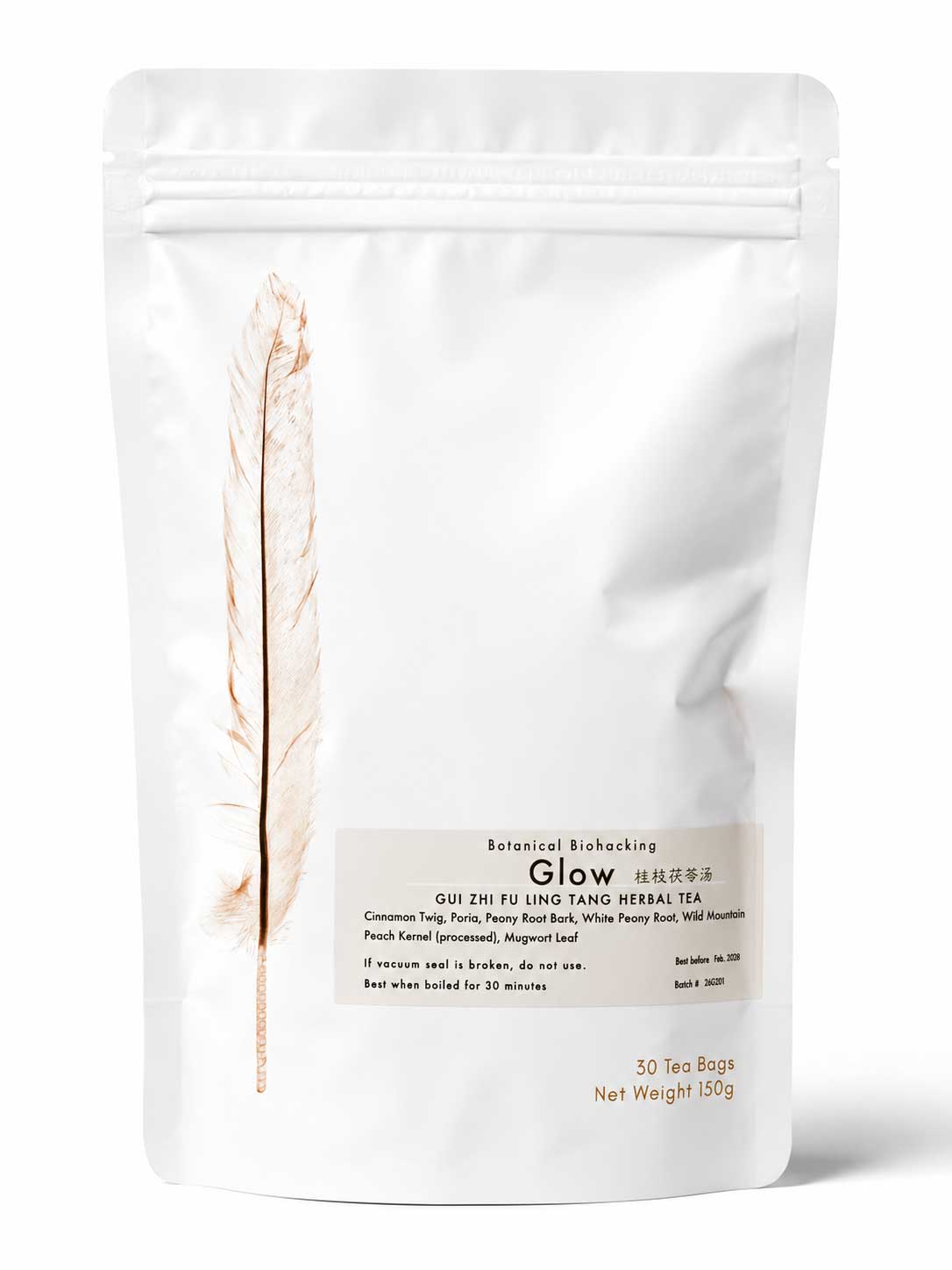
Glow Tea

Gui Zhi Fu Ling with Ai Ye. Thirty teabags, one month’s supply. Mild enough that people actually finish it. Available at Valley Health Market.

Research & Resources

  1. Lei Y, et al. The efficacy and safety of Chinese herbal medicine Guizhi Fuling capsule combined with low dose mifepristone in the treatment of uterine fibroids: a systematic review and meta-analysis of 28 randomized controlled trials. BMC Complement Med Ther. 2023;23(1):54. Link →
  2. Bensky D, Barolet R. Chinese Herbal Medicine: Formulas & Strategies. Eastland Press. (Standard reference for Gui Zhi Fu Ling Wan.)
  3. Dr. Lan, PhD, Botanical Biohacking. Glow Tea, a practical note. Practitioner letter, May 2026.

Educational content from Valley Health Market. Not medical advice. Statements have not been evaluated by the FDA. This product is not intended to diagnose, treat, cure, or prevent any disease. Valley Health Market Educational content rooted in 20+ years of clinical practice in Traditional Chinese Medicine. The information provided is for educational purposes and is not intended to replace consultation with a qualified healthcare practitioner. Please consult your physician before starting any new herbal protocol, especially if pregnant, nursing, on anticoagulants, or managing a chronic condition.

© Valley Health Market · Albany, Oregon

Share on

Will Sheppy, Founder and Acupuncturist at Valley Health Clinic
Willard Sheppy
Willard Sheppy is a licensed acupuncturist (LAc) and Founder of Valley Health Clinic specializing in using Traditional Chinese Medicine to treat acute injuries and chronic conditions, and to improve sports performance and rehabilitation.

FAQ's

What is the most common trigger for Meniere’s attacks?
Stress is the most consistently reported trigger, and research backs it: one large study found attack odds nearly tripled on stressful days. Just before an attack, the sympathetic nervous system spikes — which is why a stress-pattern attack often feels like a panic attack.
For some people, yes — especially those with a damp, fluid-retaining pattern. Honestly, the research on strict salt restriction is mixed, so it helps some people far more than others. It’s a low-risk lever worth trying, but it isn’t a guaranteed fix, and it matters most for the congested pattern rather than the stress-driven or heat-driven ones.
The inner ear is pressure-sensitive, and falling barometric pressure and higher temperatures are documented to correlate with more attacks — risk is roughly 1.3 times higher when pressure drops below 1013 hectopascal. This hits the hot, inflamed pattern hardest. You can’t change the weather, but you can use the forecast as an early-warning system and tighten your routine on those days.
Because your underlying terrain is different. The same diagnosis sits on top of different patterns — stressed, damp, or hot — and each is loaded by a different lever. That’s why a generic trigger list helps less than learning your own pattern, and why two people with Meniere’s often need different plans.
Start by confirming the diagnosis itself — Meniere’s is often confused with BPPV, vestibular neuritis, and vestibular migraine, which are treated very differently. Our companion article, “Meniere’s vs. BPPV vs. Vestibular Disorders,” walks through how to tell them apart by duration, trigger, and hearing change.

Recent Posts

Microgard for Chronic Indigestion

Microgard
14 minutes read
Dr. Joshua
Dr. Joshua Park, DSOM, L.Ac

Dr. Joshua Park is a digestive health specialist and among the first in North America to receive a clinical doctorate in Acupuncture and East Asian Medicine. He trained at the National University of Natural Medicine, studying with leading physicians from Korea, China, Europe, and the United States.

DR-Joshua
Microgard

Table of Contents

The Natural Solution for Chronic Indigestion (Functional Dyspepsia)

When your antacids and acid blockers aren’t fixing your chronic indigestion, it’s time for a different approach. Most treatments for upset stomach only target one issue at a time, which is why they often leave you still dealing with bloating, burning, or feeling full too quickly after meals.
Microgard is a comprehensive, all natural herbal formula that draws on the legacy of Bao He Wan, and Po Chai Pills, digestive remedies trusted across Asia for generations. Microgard has proven to be one of the most effective options available for treating functional dyspepsia.
If you’ve never heard the term before, functional dyspepsia is the medical name for chronic indigestion with no clear cause. Functional dyspepsia can present with symptoms such as persistent bloating after eating, early fullness, nausea, or burning discomfort in the upper abdomen that can’t be explained by ulcers or structural disease.
Microgard combines the effects of multiple botanical ingredients to restore balance across the digestive system. It supports enzyme activity, calms inflammation, repairs the gut barrier, improves motility, and regulates the gut-brain axis so that stress and indigestion no longer fuel each other.

What You’ll Learn in This Article

I use this test with patients when the source of their anxiety is unclear. It’s simple but telling:

What Causes Functional Dyspepsia

Functional dyspepsia is chronic indigestion without ulcers or structural disease. In other words, your stomach isn’t working right, but tests and imaging don’t show anything obvious. Symptoms might feeling full after just a few bites, bloating that lingers for hours, nausea after eating, burning in your upper stomach, acid reflux, and that heavy sensation where food just sits.
What’s actually happening with functional dyspepsia isn’t one single issue, but several overlapping systems breaking down:

Slow Stomach Emptying

Food lingers too long in the stomach instead of moving along normally. This delayed emptying causes bloating and that “stuffed” feeling even from small meals.

Oversensitive Stomach Nerves

Nerves in the stomach overreact to normal signals, turning mild fullness into pain, cramping, or nausea.

Low-Grade Inflammation

Chronic irritation in the stomach lining interferes with normal function and keeps symptoms coming back.

Disrupted Gut-Brain Communication

Stress worsens digestion, and poor digestion amplifies stress, creating a feedback loop where anxiety and stomach upset feed off each other.

Digestive Enzyme Problems

When the body doesn’t produce or release enough digestive enzymes, food breaks down poorly, leading to gas, fermentation, and bloating.

Why Conventional Drugs Fall Short

If you’ve tried the usual treatments for functional dyspepsia (chronic indigestion), you already know they don’t work very well. Here’s why:

Acid Blockers Have Limited Success (And Serious Side Effects)

Proton pump inhibitors (PPIs) like Prilosec and Nexium are the most common prescriptions, but research shows they only work 7–10% better than placebo. If 30% of people feel better on a sugar pill, only about 37–40% feel better on acid blockers. Long term use of these medications can also come with severe side effects, including nutrient deficiencies, kidney problems, increased risk of stroke or cardiovascular disease, bone fractures, infections, and dementia.

H. pylori Treatment Rarely Helps

Doctors often test for Helicobacter pylori bacteria and prescribe a combination of antibiotics and proton pump inhibitors (called “Triple Therapy”) to eliminate it. But this only helps 6–14% of functional dyspepsia patients, meaning 85–94% still have symptoms afterward.

Motility Drugs Are Inconsistent

Prokinetic medications that help food move through the stomach can work for some people, but not reliably. Many of the most effective ones, like cisapride, were pulled from the market due to dangerous cardiac side effects.

Antidepressants Come with Heavy Costs

Tricyclic antidepressants are prescribed for functional dyspepsia when other treatments fail. Although some studies have shown they may help up to 64–70% of patients, their side effects, which can include sedation, dry mouth, weight gain, constipation, heart problems, anxiety and sexual dysfunction, make them difficult to tolerate long-term.

Single-Target Treatments for a Multi-System Problem

Functional dyspepsia is caused by overlapping dysfunctions: delayed gastric emptying, inflammation, nerve hypersensitivity, enzyme issues, and gut-brain disruption. Conventional drugs only address one piece at a time, leaving the rest untouched which is why so many patients stay stuck with symptoms.

How Microgard Works For Chronic Indigestion (Functional Dyspepsia)

Microgard addresses functional dyspepsia (chronic indigestion) by restoring function across digestion, inflammation, barrier integrity, motility signaling, and the gut–brain axis.

Direct Stomach Protection

Gastric Motility Enhancement

Digestive Enzyme Support

Anti-Inflammatory Mechanisms

Gut–Brain Axis Modulation

Microgard

Microgard

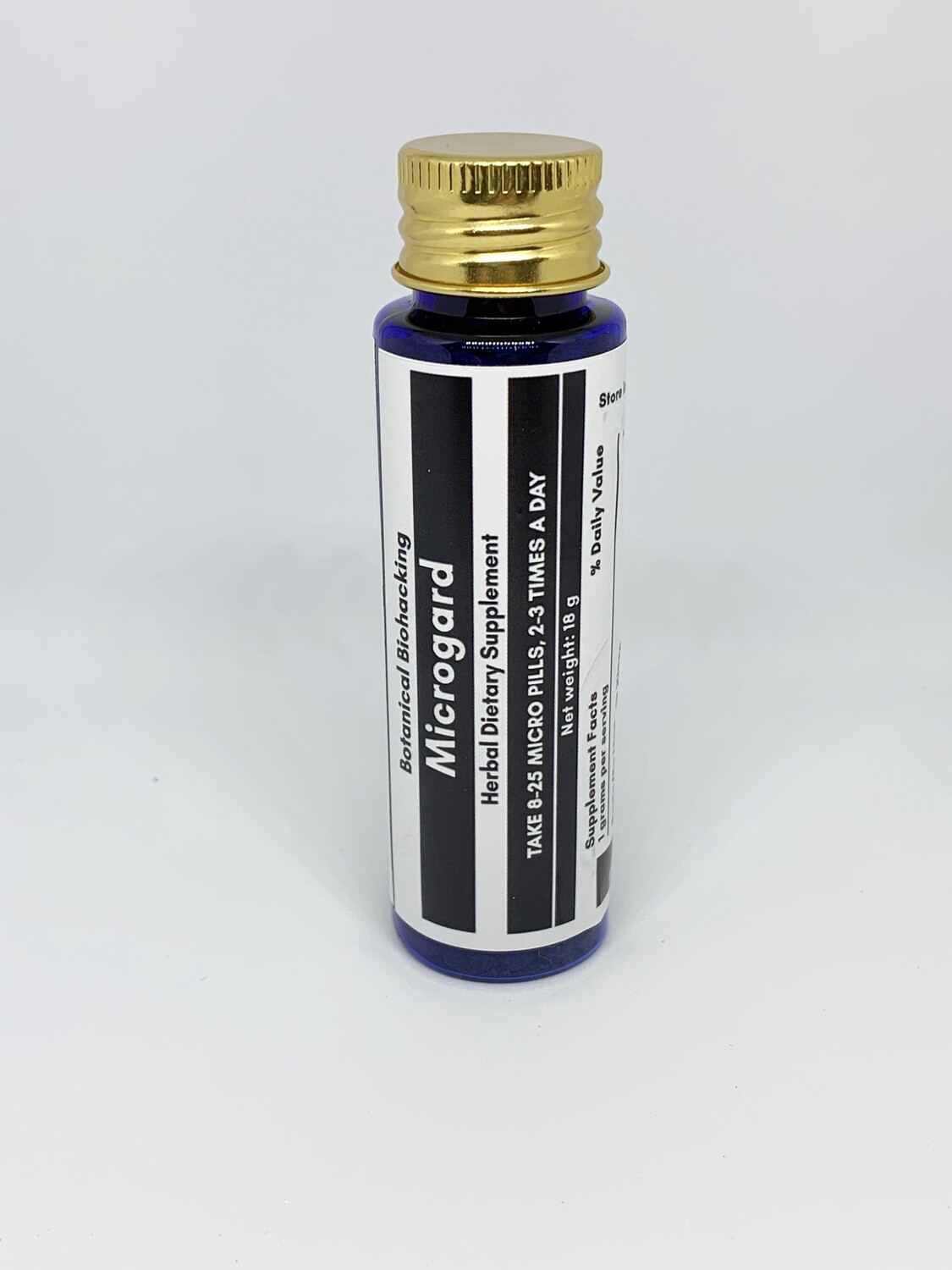
Microgard, an imperial grade herbal formula from Botanical Biohacking, is expertly crafted to enhance digestive health and balance. Microgard gently stimulates gastric motility, aiding in smoother intestinal movement and elimination. This synergistic action restores the diversity of the gastrointestinal microbiome and decreases the prevalence of biofilm.

Why Microgard Is Different

Most treatments for chronic indigestion (functional dyspepsia) work like using a single wrench on an entire engine. They might tighten one bolt, but they leave the rest of the system broken.

Multi-System Approach

Microgard works through enzyme support, inflammation, barrier repair, gut-brain signaling, and mucosal protection so you're not left with half your symptoms still bothering you.

Built on Proven Formulas

Microgard evolved from Bao He Wan and Po Chai Pills, trusted for centuries. The difference is that Microgard has been refined for functional dyspepsia using modern biomedical insight.

Gentler Than Pharmaceuticals

Prescription drugs often bring side effects like nutrient deficiencies, infection risk, and heart complications. Herbs in Microgard have centuries of safe use. You get broad relief without the side effect burden.

Addresses What Drugs Miss

Conventional meds don’t provide digestive enzymes, regulate the gut-brain axis, and hit multiple inflammatory pathways at once. Microgard does, by working with your body's natural systems instead of overriding them.

Share on

Dr. Joshua
Dr. Joshua Park, DSOM, L.Ac
Dr. Joshua Park is a digestive health specialist and among the first in North America to receive a clinical doctorate in Acupuncture and East Asian Medicine. He trained at the National University of Natural Medicine, studying with leading physicians from Korea, China, Europe, and the United States.

FAQ's

About Microgard
What is Microgard?
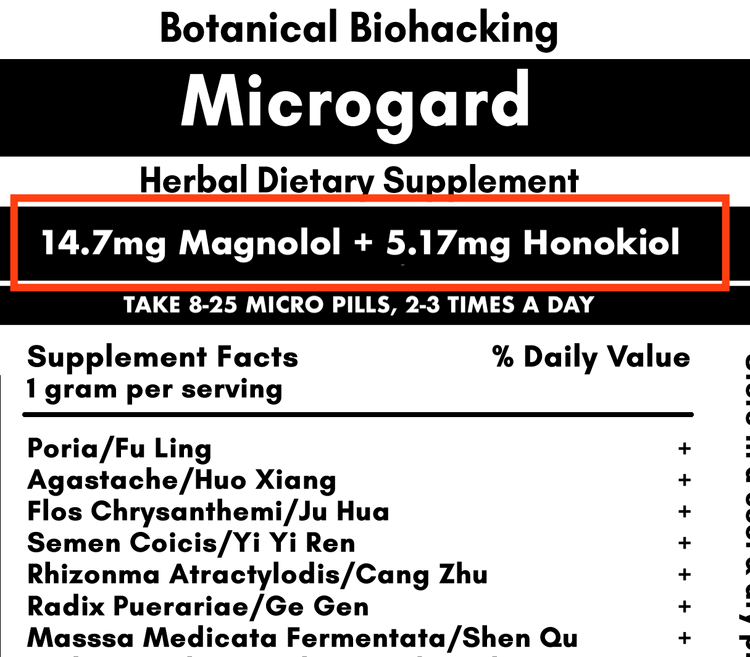
Microgard is a 16-herb formula evolved from the traditional digestive remedies Bao He Wan and Po Chai Pills, refined for functional dyspepsia (chronic indigestion). It addresses multiple causes of persistent upset stomach at the same time, from poor motility to inflammation and gut-brain signaling.
Take 8–25 micro pills, 2–3 times daily, or follow your healthcare practitioner’s instructions. Because these are micro pills — much smaller than standard capsules or tablets — the dosage may sound high, but the tiny size makes them easy to swallow and adjust to your needs.
Each bottle contains 18 g of traditional micro pills. Since there are no preservatives, keep the bottle in a cool, dry place and refrigerate after opening. For best results, finish the bottle as soon as possible once opened.
If you eat a Standard American Diet, have chronic indigestion (functional dyspepsia) or other digestive symptoms, and have signs of gut dysbiosis like a thick tongue coating, Microgard is likely a good formula for you. If you are unsure about Microgard, contact a TCM professional (licensed acupuncturist) who can determine if it’s the best fit.
Yes. Microgard contains no additives or preservatives, only the 16 traditional herbs. Ingredients are sourced from authentic growing regions, verified by TCM botanical experts, and tested for purity, heavy metals, and pesticide residues at a Chinese FDA-certified lab.
Microgard is not suitable during pregnancy, or for people with Celiac Disease. Consult your healthcare practitioner if you are nursing or taking medications.
Many people notice reduced bloating and post-meal heaviness within 1–2 weeks. More complete resolution of functional dyspepsia symptoms develops over several months as digestive function rebalances.
Most digestive aids only target one problem acid blockers reduce acid, enzymes help with breakdown, probiotics support gut bacteria. Microgard does all three plus more: improving motility, calming inflammation, protecting the stomach lining, and regulating the gut-brain axis. That’s why it’s uniquely effective for complex conditions like functional dyspepsia.
Microgard is manufactured by Botanical Biohacking, using time-honored herbal methods combined with modern GMP-certified quality testing to ensure safety and potency.

References

Yang, X., Wang, Y., Bai, L., Miao, T., & Wen, X. (2023). Mechanism of action of Baohe pills in improving functional dyspepsia. MEDS Chinese Medicine, 5(7), 48–55. Clausius Scientific Press. https://doi.org/10.23977/medcm.2023.050707

Maideen N. M. P. (2023). Adverse Effects Associated with Long-Term Use of Proton Pump Inhibitors. Chonnam medical journal, 59(2), 115–127. https://doi.org/10.4068/cmj.2023.59.2.115

Tu, Y., Luo, X., Liu, D., Li, H., Xia, H., Ma, C., Zhang, D., Yang, Y., Pan, X., Wang, T., Xia, Y., Dan, H., You, P., & Ye, X. (2022). Extracts of Poria cocos improve functional dyspepsia via regulating brain-gut peptides, immunity and repairing of gastrointestinal mucosa. Phytomedicine : international journal of phytotherapy and phytopharmacology, 95, 153875. https://doi.org/10.1016/j.phymed.2021.153875

Chen, X. Y., Chen, H. M., Liu, Y. H., Zhang, Z. B., Zheng, Y. F., Su, Z. Q., Zhang, X., Xie, J. H., Liang, Y. Z., Fu, L. D., Lai, X. P., Su, Z. R., & Huang, X. Q. (2016). The gastroprotective effect of pogostone from Pogostemonis Herba against indomethacin-induced gastric ulcer in rats. Experimental biology and medicine (Maywood, N.J.), 241(2), 193–204. https://doi.org/10.1177/1535370215600099

Zhen, B. X., Cai, Q., & Li, F. (2023). Chemical components and protective effects of Atractylodes japonica Koidz. ex Kitam against acetic acid-induced gastric ulcer in rats. World journal of gastroenterology, 29(43), 5848–5864. https://doi.org/10.3748/wjg.v29.i43.5848

Lee, H.-A., Yoo, J.-H., Chung, Y., & Kim, O. (2017). Inhibition of Helicobacter pylori-induced inflammation in human gastric epithelial AGS cells by the fruits of Tribulus terrestris L. extracts. Journal of Biomedical and Translational Research, 18(3), 121–124. https://doi.org/10.12729/jbtr.2017.18.3.121

Wang, Q., Shen, Z. N., Zhang, S. J., Sun, Y., Zheng, F. J., & Li, Y. H. (2022). Protective effects and mechanism of puerarin targeting PI3K/Akt signal pathway on neurological diseases. Frontiers in pharmacology, 13, 1022053. https://doi.org/10.3389/fphar.2022.1022053

Zhao, H., Feng, Y. L., Wang, M., Wang, J. J., Liu, T., & Yu, J. (2022). The Angelica dahurica: A Review of Traditional Uses, Phytochemistry and Pharmacology. Frontiers in pharmacology, 13, 896637. https://doi.org/10.3389/fphar.2022.896637

Feng, L., A, L., Li, H., Mu, X., Ta, N., Bai, L., Fu, M., & Chen, Y. (2023). Pharmacological Mechanism of Aucklandiae Radix against Gastric Ulcer Based on Network Pharmacology and In Vivo Experiment. Medicina (Kaunas, Lithuania), 59(4), 666. https://doi.org/10.3390/medicina59040666

Fu, X., Wang, Q., Kuang, H., & Pinghui, J. (2020). Mechanism of Chinese medicinal-medicated leaven for preventing and treating gastrointestinal tract diseases. Digestion, 101(6), 659–666. https://doi.org/10.1159/000493424

Microgard By Botanical BioHacking Close up

The Bottom Line on Microgard

If you’re ready to stop living with bloating, burning, and meals that leave you feeling weighed down, now is the perfect time to make a change. Microgard delivers comprehensive support for functional dyspepsia and chronic indigestion by addressing every system involved: inflammation, barrier repair, motility, and the gut-brain connection.

Don’t settle for band-aid solutions that only mask symptoms. Order Microgard today and take the first
step toward eating comfortably, restoring balance, and feeling like yourself again.