8 minutes read

Materia Medica · The Formula Series

Peak Tea: For the Illness That Never Fully Left

Willard Sheppy Dipl. OM, LAc, BS

Willard Sheppy is a licensed acupuncturist (LAc) and Founder of Valley Health Clinic specializing in using Traditional Chinese Medicine to treat acute injuries and chronic conditions, and to improve sports performance and rehabilitation.
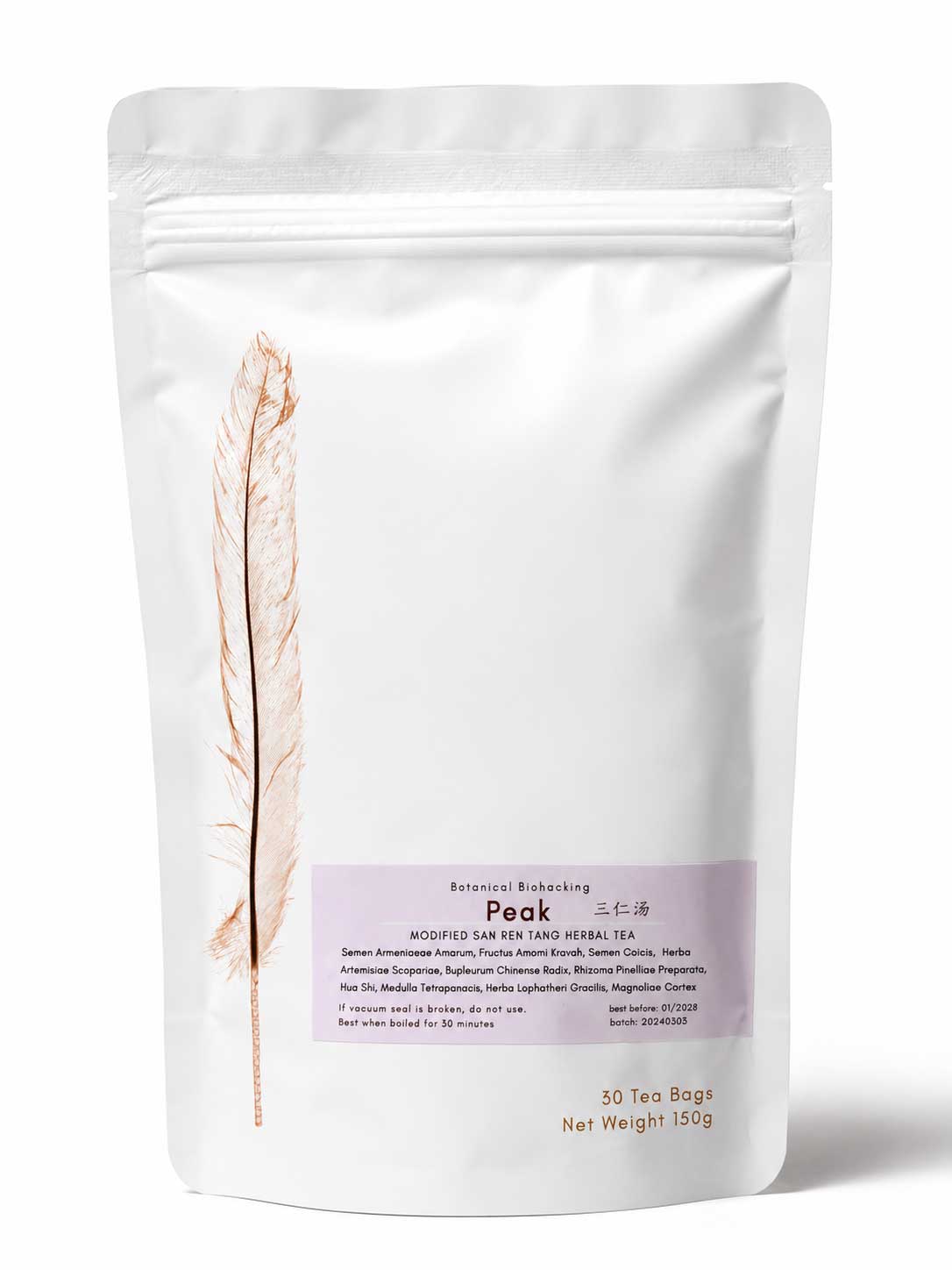
Peak Tea product mockup

Table of Contents

This one is for the illness that never fully left.

Here’s where the formula comes from, how Botanical Biohacking rebuilt it, how to tell Peak from its sibling Wind, and what’s inside.

Quick Answer

Peak Tea is San Ren Tang — Wu Ju Tong’s 1813 formula for the lingering damp pattern — remixed with Xiao Chai Hu Tang by Dr. Jin Zhao, with Yin Chen Hao and Tibetan Plateau Chai Hu strengthening the heat-clearing side. It suits the more excess, heated presentation; its sibling Wind (with white ginseng) suits relative deficiency. It is a targeted tool, not a daily tea: roughly two weeks, never longer than three months.

Where This Formula Comes From

Wu Ju Tong described this pattern in 1813, and the description still reads like a modern chart note.

San Ren Tang — the Three-Kernel Decoction — has a specific, datable origin, which is more than most herbal products can claim. It appears in the Wen Bing Tiao Bian (溫病條辨, Systematic Differentiation of Warm Diseases), published in 1813 by Wu Ju Tong.

His original description of the pattern reads almost like a modern symptom checklist: headache, aversion to cold, a heavy aching body, a pale tongue without thirst, a yellowish complexion, chest tightness, no appetite, and a fever that rises in the afternoon.

What makes his account genuinely sophisticated is the section on errors. He warns that sweating the patient makes them foggy and unwell, purging causes qi to leak away, and moistening drives the dampness deeper. It is a catch-22 — and San Ren Tang was his answer to it.

How Botanical Biohacking Rebuilt It

Peak is not a straight copy. It is a deliberate remix, formulated by Dr. Jin Zhao, DTCM and fine-tuned by pharmacology professor Dr. Zhong Shi Hong.

Dr. Jin brings in Xiao Chai Hu Tang, the Shang Han Lun classic, to help the Shaoyang layer govern the body. Then, for Peak specifically, they strengthen the heat-clearing side with Yin Chen Hao and Chai Hu sourced from the Tibetan Plateau.

Notably, they leave ginseng out of Peak. Its sibling formula, Wind, gets high-grade white ginseng added. Peak does not — because it is aimed at a different person entirely.

Peak or Wind? The Formulators’ Own Rule

This settles a question people ask constantly. Both are San Ren Tang remixes from the same team. They are not interchangeable:

Inside the Formula

Peak opens all three burners — the classical three seeds anchor each level.

Open the Top

Transform the Middle

Drain the Bottom

An Important Limit, From the Makers

San Ren Tang is not a long-term formula. Botanical Biohacking’s own guidance is roughly two weeks, and not longer than three months, because over time it can drain too much qi. Classical texts also caution against it when heat clearly outstrips damp. This is a targeted tool, not a daily forever-tea.

As with any new herbal protocol: talk with your practitioner or physician first, especially if you are pregnant, nursing, on anticoagulants, or managing a chronic condition.

Wu Ju Tong warned that you cannot sweat this pattern out, cannot purge it out, and cannot moisten it away. That is why he needed a new formula. Two hundred years later it is still the answer. — Will Sheppy, L.Ac.

Peak Tea product mockup with a green background by Valley Health Market

Peak Tea

San Ren Tang remixed with Xiao Chai Hu Tang, by Dr. Jin Zhao. Yin Chen Hao and Tibetan Plateau Chai Hu. Thirty teabags. Available at Valley Health Market.

Research & Resources

  1. Wu Ju Tong. Wen Bing Tiao Bian (溫病條辨, Systematic Differentiation of Warm Diseases), 1813. (Original source text for San Ren Tang.)
  2. Yin Y, et al. Hepatic transcriptome delineates the therapeutic effects of Sanren Tang on high-fat diet-induced non-alcoholic fatty liver disease. J Tradit Chin Med. 2023;43(6):1092-1102. Link →
  3. Andrew Miles, DOM & Qiu Xuelan, PhD, Botanical Biohacking. How to use Wind and Peak. Practitioner guidance, June 2025.

Educational content rooted in 20+ years of clinical practice in Traditional Chinese Medicine. The information provided is for educational purposes and is not intended to replace consultation with a qualified healthcare practitioner. Please consult your physician before starting any new herbal protocol, especially if pregnant, nursing, on anticoagulants, or managing a chronic condition.

Share on

Will Sheppy, Founder and Acupuncturist at Valley Health Clinic
Willard Sheppy
Willard Sheppy is a licensed acupuncturist (LAc) and Founder of Valley Health Clinic specializing in using Traditional Chinese Medicine to treat acute injuries and chronic conditions, and to improve sports performance and rehabilitation.

FAQ's

What is Peak Tea?

Peak Tea is San Ren Tang — the Three-Kernel Decoction, first published by Wu Ju Tong in 1813 — remixed with Xiao Chai Hu Tang by Dr. Jin Zhao, DTCM, and fine-tuned by pharmacology professor Dr. Zhong Shi Hong. The heat-clearing side is strengthened with Yin Chen Hao and Chai Hu sourced from the Tibetan Plateau. It comes as thirty teabags.

It was built for the lingering damp pattern Wu Ju Tong described: a heavy aching body, chest tightness, poor appetite, a pale tongue without thirst, and a fever that rises in the afternoon — the illness that never fully left. Within that pattern, Peak is the version for the more excess, heated presentation.

Both are San Ren Tang remixes from the same team, but they are not interchangeable. More excess and heat points to Peak, which has extra heat-clearing (Yin Chen Hao, Tibetan Plateau Chai Hu) and no ginseng. More relative deficiency points to Wind, which adds high-grade white ginseng so the formula doesn’t drain qi.

San Ren Tang is not a long-term formula. Botanical Biohacking’s own guidance is roughly two weeks, and not longer than three months, because over time it can drain too much qi. Classical texts also caution against it when heat clearly outstrips damp. It is a targeted tool, not a daily forever-tea.

Please consult your physician before starting any new herbal protocol, especially if you are pregnant, nursing, on anticoagulants, or managing a chronic condition. This is educational content, not medical advice.

Recent Posts