What Is a Dit Da Jiao? Fu Medicinals

Willard Sheppy Dipl. OM, LAc, BS
Willard Sheppy is a licensed acupuncturist (LAc) and Founder of Valley Health Clinic specializing in using Traditional Chinese Medicine to treat acute injuries and chronic conditions, and to improve sports performance and rehabilitation.
Table of Contents
When you buy something for pain, you assume newer is better. Fresher herbs, a more recent batch, more punch.
With liniments it runs the other way. Some of the bottles we carry are more than ten years old — on purpose. That isn’t old stock sitting around. That’s the medicine finishing itself.
I’ve been using Fu Medicinals on patients in my Albany clinic for a while now, and it’s one of the few topical lines where I can point to a person, a place, and a process. That person is John, an acupuncturist who spent fourteen years developing these formulas in a working treatment room. Here’s what a jiao actually is, what the aging does, and which of the three formulas fits which kind of pain.
Quick answer
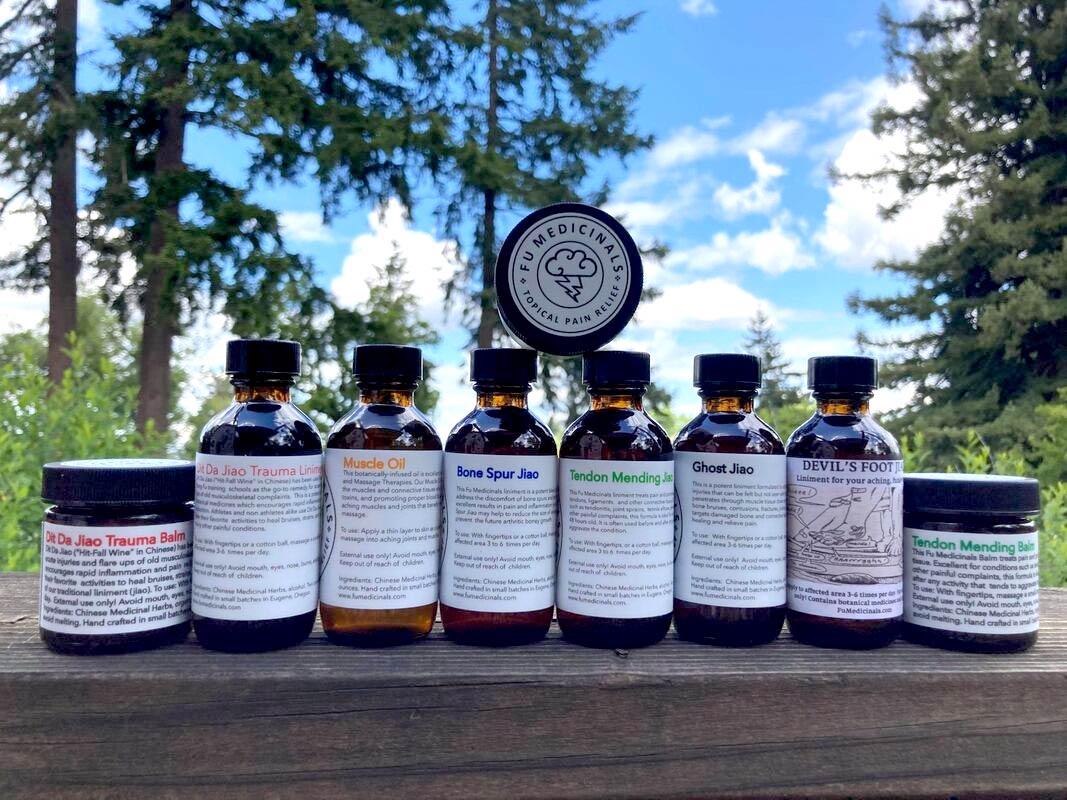
A jiao (roughly “jee-yow”) is a traditional Chinese herbal liniment — medicinal herbs steeped in alcohol and applied to the skin, never swallowed. Fu Medicinals makes three of them, handcrafted in small batches in Oregon, and nothing is released until it has aged at least two years. Each formula targets a different depth of injury: PNW Dit Da Trauma for acute injury and bruising, Tendon Mending for tendons and ligaments, Bone Spur for chronic joint and bone pain. External use only — talk to your doctor first if you are pregnant.
What Is a Jiao — and Why Does Age Matter?
A jiao is an alcohol extraction. Herbs go into high-proof spirits, and the alcohol pulls the medicinal constituents out of the plant material over time. Unlike a cream or a gel, it isn’t finished the day it’s bottled — the extraction keeps going.
That’s the whole argument for aging it. The longer the herbs and the alcohol sit together, the more completely the formula comes out, and the more the individual herbs stop behaving like a list and start behaving like one medicine. John’s rule is that nothing leaves his shop under two years old, and some of what ends up on our shelf is well past a decade.
Dit da jiao is the most famous member of the family. It translates, almost comically literally, to “hit fall wine” — the medicine you reach for when someone got hit, or fell. It has been the standard first-aid topical in Chinese martial arts halls for a very long time, which is exactly the pedigree you want in something meant for a fresh bruise.
"When it comes to liniments, the older the more potent."
— John Ditmars, maker of Fu Medicinals
Meet John Ditmars, the Maker Behind Fu Medicinals
Fu Medicinals didn’t start as a product line. It started as an acupuncturist making liniments for his own aches — John is an athlete, and he specializes in pain-based conditions — and then for the patients in front of him. Fourteen years of adjusting the recipes based on what actually worked in the treatment room is how three formulas came out the other side. The name nods to the Kung Fu healing tradition these recipes come from.
He’s clear about what he was reacting against. He had tried the brands sitting in his acupuncture school clinics and on store shelves and didn’t want any of it: no synthetic chemicals, no overpowering odor, and nothing formulated to produce a dramatic tingle. As he puts it, that sensation doesn’t necessarily mean the product is working — it just means people have been trained to expect it.
Here is what actually separates these from the topical aisle:
- Small batches, by hand — the herbs are hand-crushed rather than machine-milled, in quantities one person can actually manage.
- Oregon-sourced where possible — most ingredients come from within the state, and the alcohol is distilled at the base of Mount Hood.
- Real Chinese medicinals, named on the label — mugwort, safflower, myrrh, frankincense, peach kernel, salvia, drynaria, zedoary and two dozen more. No "proprietary blend."
- Aged before release — a minimum of two years in the bottle, no exceptions.
- One problem per formula — rather than one topical claiming to handle every kind of pain, each recipe is built for a specific tissue at a specific stage.
I care about that history for a practical reason. A topical made by someone who has to look a patient in the eye next week gets revised. A topical made to hit a price point does not. That’s the standard anything has to clear before it earns shelf space at Valley Health Market.
The Three Formulas, and When I Reach for Each
Chinese medicine thinks about injury in layers — blood and muscle nearest the surface, then sinew and connective tissue, then bone. Fu Medicinals color-codes the labels to match: red for the blood and muscle level, green for tendon, blue for bone. Once you know that, choosing is mostly a matter of asking how deep the problem sits and how long it has been there.
PNW Dit Da Trauma — the acute one
Fresh injury, bruising, swelling, the ankle you rolled on Saturday
This is the “hit fall wine” formula, and it’s the one to have in the cupboard before you need it. The Pacific Northwest version leans on mugwort (Ai Ye) to answer the cold and damp we actually live in, and it combines warming and cooling herbs so it can be used while things are still hot and swollen. Twenty-eight herbs in total.
Tendon Mending — the connective-tissue one
Tendonitis, a ligament sprain that hasn’t settled, any nagging tweak in a tendon. It’s built around Gu Sui Bu (drynaria), the herb whose name translates roughly as “mender of shattered bones,” and the base is organic coconut oil and beeswax in the balm version. Worth knowing: this one is warming, which is the point of it — and which is why it isn’t the right choice in the first day or two after a fresh injury.
Bone Spur — the deep, chronic one
Bone spurs and osteoarthritis — which in Chinese medicine is always read as a long-standing pattern rather than an acute event. E Zhu (zedoary rhizome) does the heavy lifting here, aimed at blood and qi stagnation that has had years to set in. Thirty-plus herbs, and the one I reach for when someone’s joint pain has been part of their life long enough that they’ve stopped mentioning it.
| PNW Dit Da Traumared — blood & muscle | Tendon Mendinggreen — sinew | Bone Spurblue — bone | |
|---|---|---|---|
| Best for | Bruises, sprains, knocks, fresh swelling | Tendonitis, ligament sprains, nagging tweaks | Bone spurs, osteoarthritis, deep joint ache |
| Stage | Acute — hours to days old | Sub-acute to chronic — weeks to months | Chronic — months to years |
| Signature herb | Ai Ye (mugwort) | Gu Sui Bu (drynaria) | E Zhu (zedoary rhizome) |
| Temperature | Warming and cooling together — usable while hot and swollen | Warming — wait 1–2 days after a fresh injury | Warming — built for long-standing stagnation |
| Comes as | Jiao (2 oz liniment) or balm | Jiao (2 oz liniment) or balm | Jiao (2 oz liniment) or balm |
Jiao or Balm? How to Choose
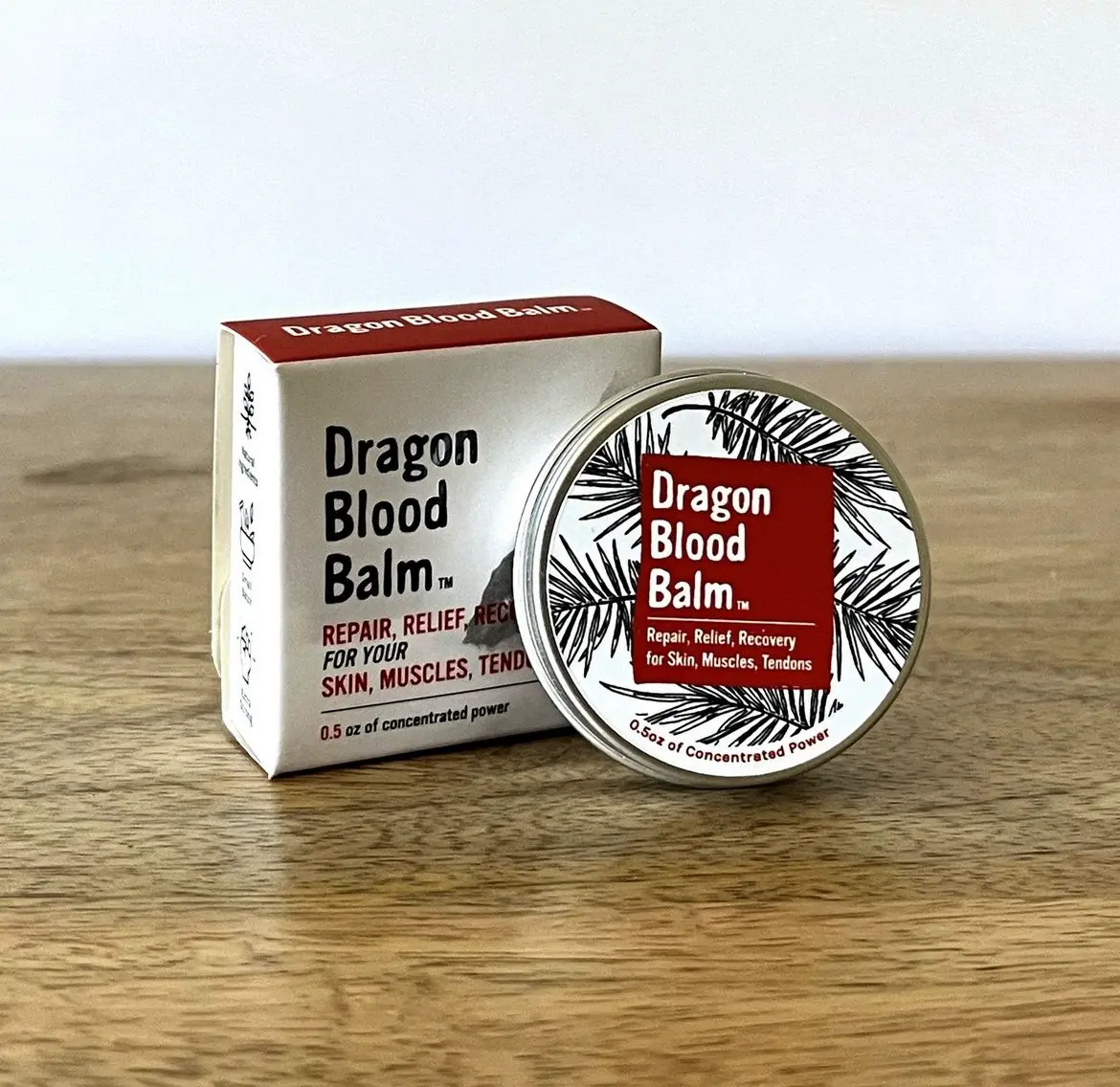
Every recipe comes two ways: the traditional jiao — a 2 oz alcohol liniment — and a modern balm that puts the same formula in an organic coconut oil and beeswax base. They aren’t competing versions of the same thing. They suit different situations, and plenty of patients end up owning both.
Reach for the jiao when…
You want fast penetration and you’re applying several times a day
The alcohol carries the herbs in and then evaporates, so nothing is left sitting on the skin. That makes it easy to reapply through the day without building up a greasy layer, and it’s the form that has been aged.
Reach for the balm when…
The skin is dry or irritated, you’re using it as a glide medium for massage or cupping, or you’re traveling and would rather not carry a liquid. The balm stays put longer and is gentler on skin that’s already unhappy.
The gauze trick
For a longer soak, put the jiao on a piece of gauze and tape it over the area rather than rubbing it in. It’s a traditional method and it keeps the herbs in contact with the tissue far longer than a two-minute massage does. Good for an evening on the couch or overnight on a stubborn joint.
What the Research Actually Shows
I want to be straight about this: these specific formulas have not been through clinical trials. Handmade, small-batch liniments almost never are — there is nobody to fund the study. What has been studied, in laboratories and in animals, is the individual herbs, and some of that work lines up neatly with what the tradition has been claiming for centuries.
Frankincense and myrrh, tested as a pair
The combination outperformed either resin used alone
Ru Xiang and Mo Yao appear together in nearly every trauma formula in the Chinese materia medica, and researchers have tested whether the pairing is actually doing something. In mouse models of inflammation and pain, the combined extract suppressed swelling and reduced pain behavior more effectively than frankincense or myrrh on their own (Su et al., 2012).
Gu Sui Bu and the bone-and-sinew claim
Drynaria, the anchor of Tendon Mending, has a connective-tissue reputation going back centuries. In cell studies its water extract protected osteoblasts — the cells that build bone — from oxidative damage and pushed them toward maturity (Hsu et al., 2011). Naringin, its main constituent, sped up fracture healing in rats by improving blood-vessel growth at the fracture site (Song et al., 2017).
Ai Ye, the herb that makes it a Pacific Northwest formula
More than 200 compounds have been identified in mugwort’s essential oil, with anti-inflammatory and analgesic activity documented across a wide body of work — alongside a clear note from the same reviewers that the oil is not harmless in quantity (Liu et al., 2021).
None of that proves a liniment will fix your shoulder. It is laboratory and animal evidence about ingredients, not human trials of a finished product. But it is a good deal more than nothing, and it is consistent with what I see when I use these in the treatment room.
"That sensation doesn't necessarily mean that the product is working — but people are familiar with those tingles via products they've previously tried, and might expect it to be a sign that the topical is working."
— John Ditmars, on why Fu Medicinals doesn't chase the burn
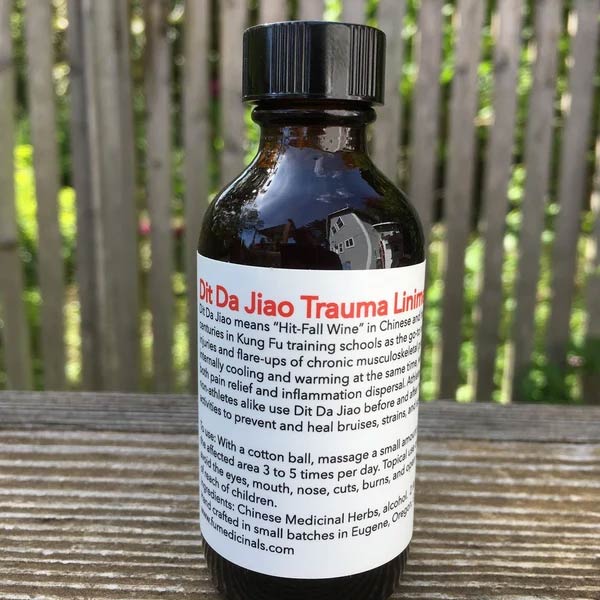
Fu Medicinals at Valley Health Market
Three formulas. Two forms. Aged at least two years.
We carry all three Fu Medicinals formulas at Valley Health Market, in both the traditional jiao and the balm, starting at $25 for a 2 oz liniment. There are also two bundles if you’d rather keep the acute and the chronic option on hand at the same time.
How to Use a Liniment — and When Not To
Application is simple, and doing it often matters more than doing it heavily.
- Massage a small amount into the sore area with your fingertips or a cotton ball until it’s absorbed.
- Repeat several times a day — three or four is reasonable for something you’re actively working on.
- For deeper contact, apply the liniment to a piece of gauze and tape it over the area for a longer stretch.
- Wash your hands afterward, and keep it well away from your eyes.
Cautions, and I mean these
External use only — never take a jiao internally
- Not on broken skin, open wounds, or mucous membranes. Avoid sensitive areas and keep it out of reach of children.
- If you are pregnant, talk to your doctor before using any of these. Several of the herbs in these formulas move blood, which is exactly why they work on bruises and exactly why pregnancy is a different conversation.
- Tendon Mending is warming — that’s the point of it — which makes it the wrong choice in the first day or two after a fresh injury, while things are still hot and swollen. Use the Dit Da formula in that window instead.
- If you have herbal or plant allergies, read the full ingredient list on the product page first. The equipment these are made on contacts a wide range of medicinal herbs.
When to stop rubbing and get it looked at
A liniment supports tissue while it heals. It is not a way of finding out what’s wrong. Get the injury assessed if you can’t bear weight, the joint looks deformed, the swelling came on hard and fast, or you have numbness, tingling, or weakness anywhere downstream of it. The same goes for pain that hasn’t budged after a couple of weeks of sensible self-care — that’s information, and it’s worth acting on rather than covering up.
Which Formula Should You Start With?
If you’re standing in front of the three of them trying to decide, the question isn’t “which is strongest.” It’s how deep is the problem, and how long has it been there. Something that happened this week, at the level of muscle and bruise, wants the Dit Da. Something in a tendon that has been grumbling for a month wants Tendon Mending. Something in a joint that has been part of your life for years wants Bone Spur.
And if you genuinely can’t tell — which is common, because pain is a bad narrator — start with the acute formula. It’s the most broadly useful of the three, it’s the one martial artists have kept on the shelf for centuries for exactly that reason, and it won’t be wasted.
Your Next Step
Not sure which one fits what you’re dealing with?
Call the clinic at (541) 760-9670 or stop by at 220 5th Ave SW in Albany and ask. That’s a two-minute conversation and it’s free — and if what you’re describing sounds like something a topical won’t touch, I’d rather tell you that than sell you a bottle.
These statements have not been evaluated by the Food and Drug Administration. These products are not intended to diagnose, treat, cure, or prevent any disease. This article is educational and is not a substitute for individual medical advice.
References
Su S, Hua Y, Wang Y, et al. Evaluation of the anti-inflammatory and analgesic properties of individual and combined extracts from Commiphora myrrha and Boswellia carterii. Journal of Ethnopharmacology. 2012;139(2):649–656. Link →
Hsu CK, Liao MH, Tai YT, et al. Nanoparticles prepared from the water extract of Gusuibu (Drynaria fortunei J. Sm.) protects osteoblasts against insults and promotes cell maturation. International Journal of Nanomedicine. 2011;6:1405–1413. Link →
Song N, Zhao Z, Ma X, et al. Naringin promotes fracture healing through stimulation of angiogenesis by regulating the VEGF/VEGFR-2 signaling pathway in osteoporotic rats. Chemico-Biological Interactions. 2017;261:11–17. (animal study) Link →
Liu Y, He Y, Wang F, et al. From longevity grass to contemporary soft gold: Explore the chemical constituents, pharmacology, and toxicology of Artemisia argyi H.Lév. & Vaniot essential oil. Journal of Ethnopharmacology. 2021;279:114404. Link →
Ditmars J. About John Ditmars the Maker — interview and product FAQ. Valley Health Clinic. Link →

FAQ's
What does "dit da jiao" mean?
It translates almost literally as “hit fall wine” — the medicine you use after someone has been hit or has fallen. It’s an alcohol-based herbal liniment that has been the standard first-aid topical in Chinese martial arts for a very long time, and it’s the tradition the PNW Dit Da Trauma formula comes out of.
Why are the liniments aged for two years or more?
A jiao is an alcohol extraction, and the alcohol keeps drawing constituents out of the herbs long after the bottle is sealed. Fu Medicinals releases nothing under two years old, and some bottles are well over ten. As maker John Ditmars puts it: with liniments, the older the more potent.
What is the difference between the jiao and the balm?
Same formula, different carrier. The jiao is the traditional 2 oz alcohol liniment — it penetrates quickly and evaporates, which suits applying several times a day. The balm puts the same herbs in an organic coconut oil and beeswax base, so it stays on the skin longer and is gentler on dry or irritated skin. Plenty of people keep both.
Which Fu Medicinals formula should I use for tendonitis?
Tendon Mending is the one built for connective tissue — tendonitis, ligament sprains, and lingering tweaks. It’s a warming formula, though, so it isn’t the right choice in the first day or two after a fresh injury while things are still hot and swollen. Use PNW Dit Da Trauma in that window instead.
Are these safe to use if I am pregnant?
Talk to your doctor first. Several of the herbs in these formulas move blood — which is precisely why they help with bruising and stagnation — and that makes pregnancy a conversation to have with your provider rather than a decision to make from a label. All of these are for external use only, and none should go on broken skin.
Recent Posts
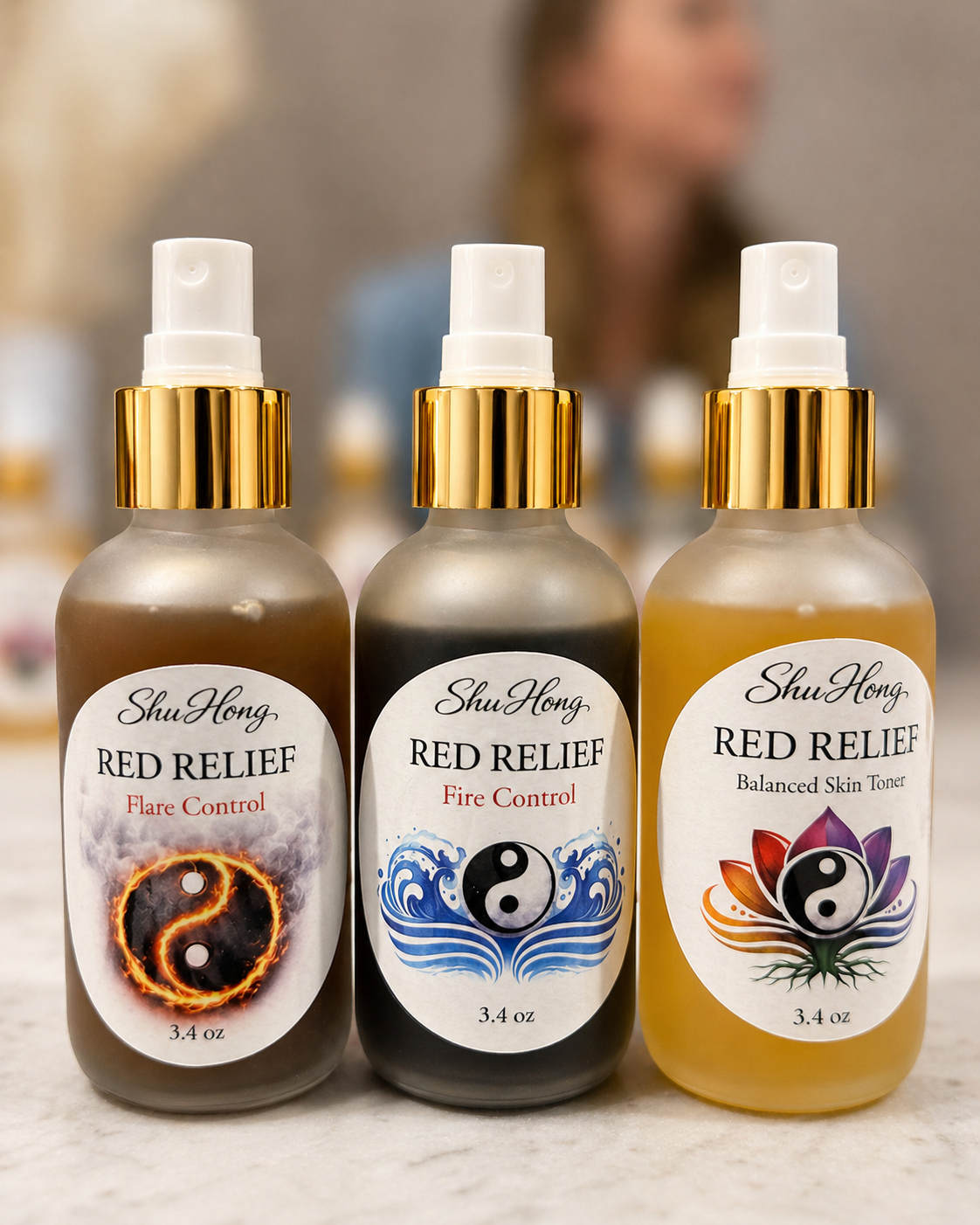
Psoriasis Flare Ups and Why You Need Three Sprays
Dr. Meli, in her own words, on why she and her husband built the Shu Hong
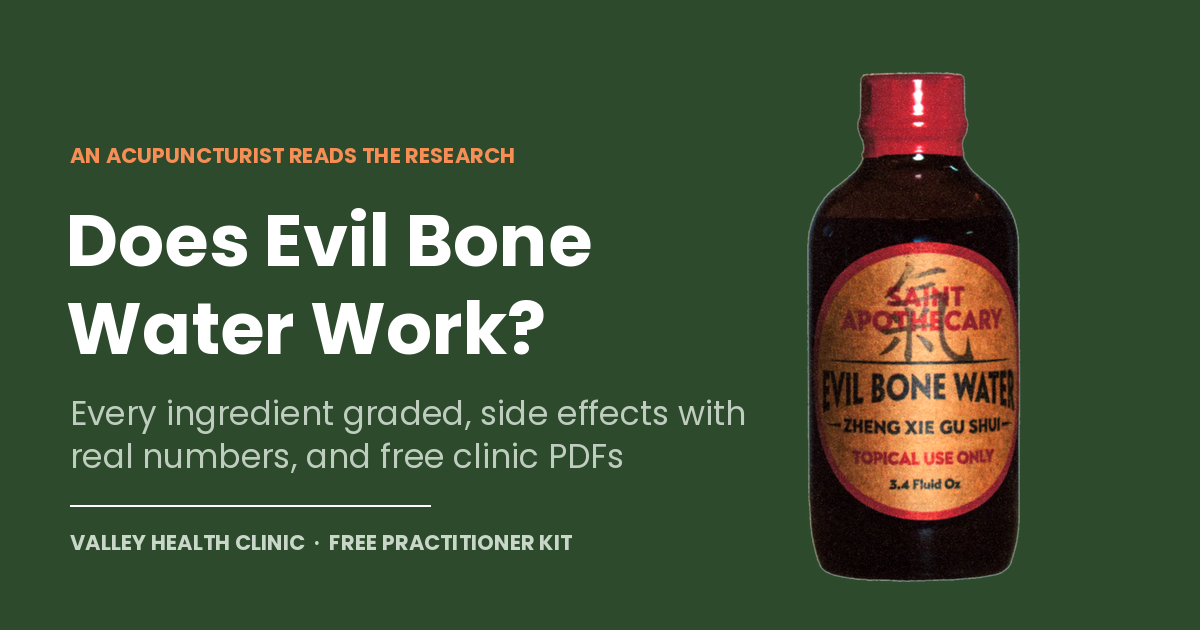
Does Evil Bone Water Work? An Acupuncturist Reads the Research
Does Evil Bone Water work? An acupuncturist reviews the evidence for Zheng Gu Shui, camphor, menthol,

Acupuncture for Ménière’s Disease: The Points I Use
Learn which acupuncture points Will Sheppy uses for Ménière’s disease, vertigo and dizziness, plus treatment frequency