
Tag: Botainical Biohacking

Stem & Leaf Sacrocox: For Tailbone Pain You Can’t Sit Through

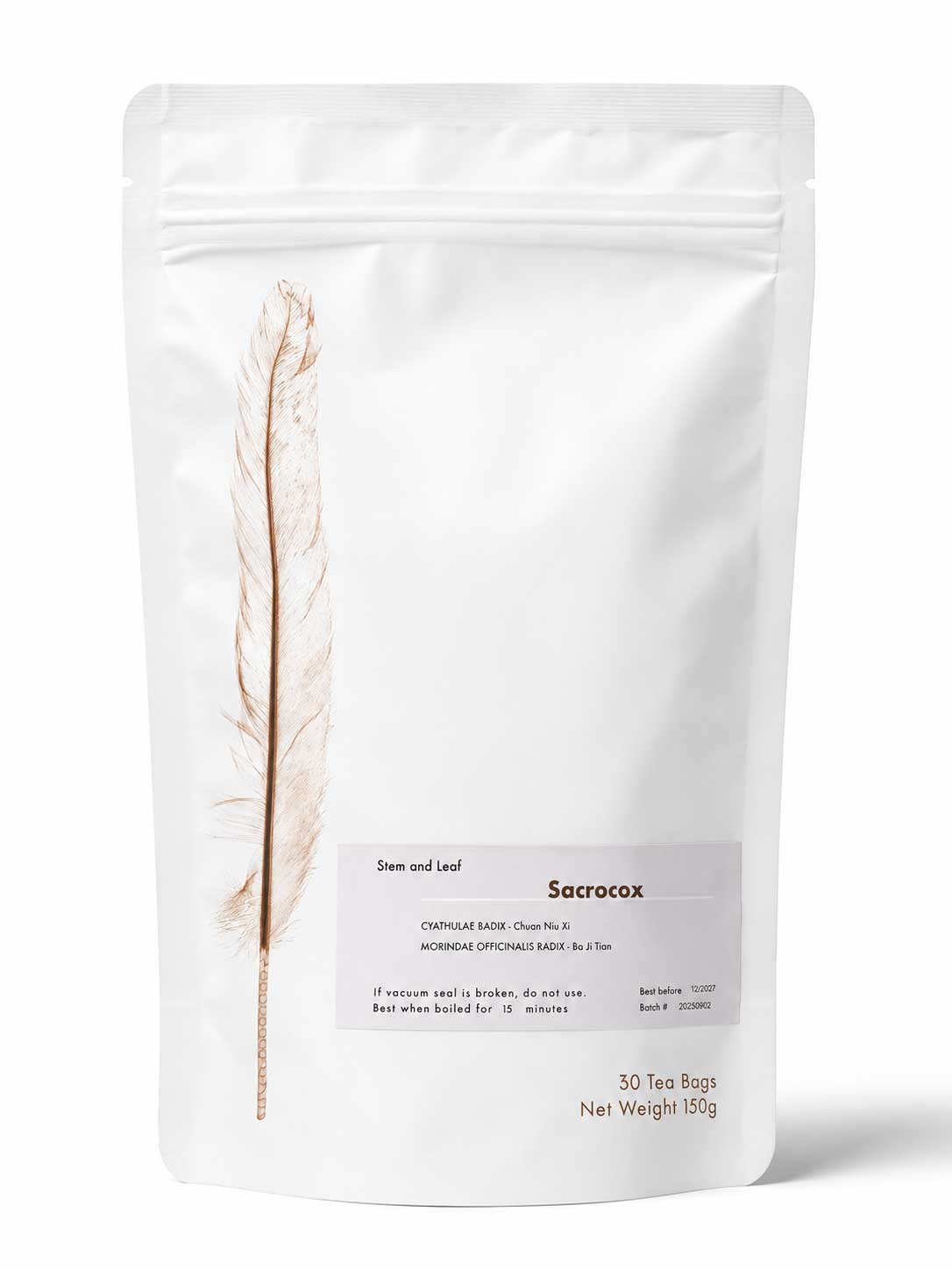
Sacrocox Herbal Tea product mockup
7 minutes read

Materia Medica · The Stem & Leaf Series

Stem & Leaf Sacrocox: For Tailbone Pain You Can’t Sit Through

Willard Sheppy Dipl. OM, LAc, BS

Willard Sheppy is a licensed acupuncturist (LAc) and Founder of Valley Health Clinic specializing in using Traditional Chinese Medicine to treat acute injuries and chronic conditions, and to improve sports performance and rehabilitation.
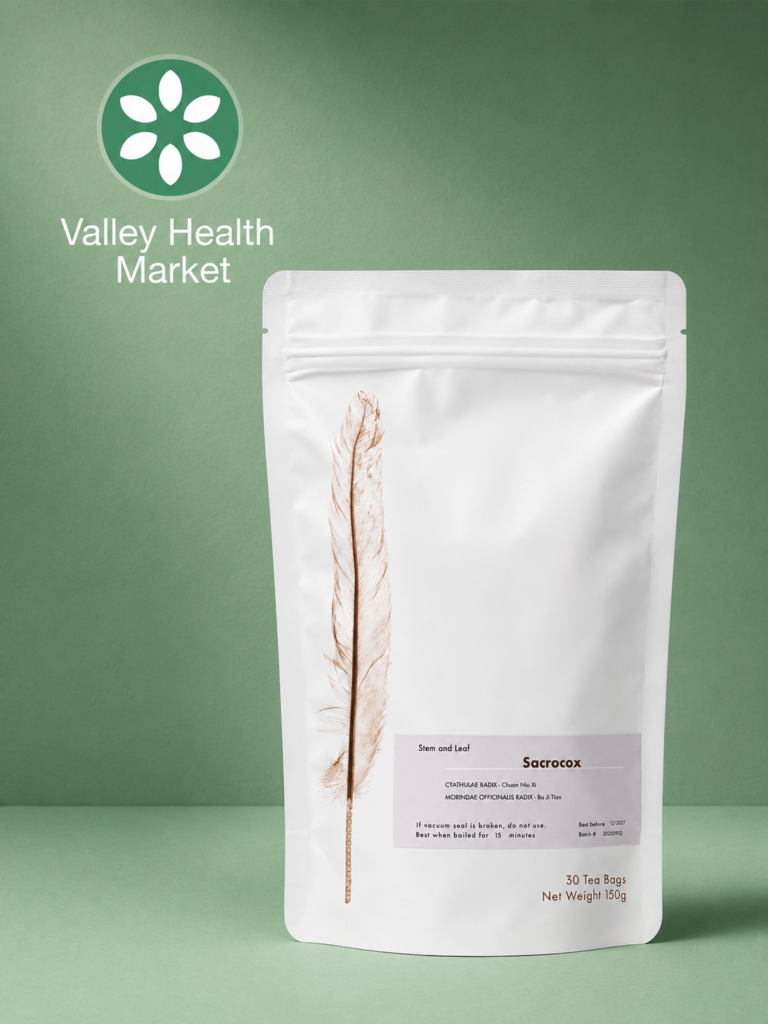

Sacrocox Herbal Tea product mockup

Table of Contents

Sacral and tailbone pain is the kind you cannot stretch out and cannot sit through.

The sacrum and tailbone anchor everything above them — and in classical herbal medicine, reaching them is a question of not just direction but depth.

Here’s what Stem & Leaf — Sacrocox actually is, how the guide-herb principle works, and what’s inside.

Quick Answer

Stem & Leaf — Sacrocox is the sacrum-and-tailbone formula in Botanical Biohacking’s region-by-region spinal line. Two guide herbs, aimed at one region: Chuan Niu Xi, the classical downward-guiding herb, carries the action all the way to the base of the spine, and Ba Ji Tian warms and strengthens it. It is a companion to the fundamentals — and new, severe, or radiating pain, or pain with numbness, weakness, or loss of bladder or bowel control, needs prompt medical evaluation.

What Stem & Leaf — Sacrocox Actually Is

The Stem & Leaf line takes a region-by-region approach to spinal support. Rather than one general back formula, each product is built around guide herbs — herbs that classical medicine understands as directing a formula’s action to a particular part of the body.

Stem & Leaf — Sacrocox is the sacrum and tailbone formula. Two guide herbs, aimed at one region.

That specificity is the whole idea, and it mirrors how a practitioner actually thinks about a back. The spine is not one thing.

The Guide Herb Principle

A guide herb carries a formula’s action toward a region. For the very base of the spine, the challenge is not just direction but depth — the action has to travel all the way down.

Chuan Niu Xi is the classical answer to that problem. It is used across the tradition specifically to lead other herbs downward, to the lowest reaches of the body.

How It's Sourced and Tested

The same protocol runs across the entire Botanical Biohacking line.

Inside the Formula

Chuan Niu Xi is the herb classical medicine uses when action needs to go down — it is the descending guide, and it is why this formula reaches the sacrum rather than stopping at the lumbar spine. Ba Ji Tian adds warming, strengthening support to the base.

The Sacrococcygeal Guide Herbs

Using the Line Together

A Practitioner’s Note

Spinal support formulas are a companion to the fundamentals, not a replacement. Movement, posture, sleep, and hands-on care do the heavy lifting. New, severe, or radiating back pain — or pain with numbness, weakness, or loss of bladder or bowel control — needs prompt medical evaluation.

The sacrum and tailbone anchor everything above them. Chuan Niu Xi is the herb the tradition uses to send a formula all the way down there. — Will Sheppy, L.Ac.

Stem & Leaf — Sacrocox

The sacrococcygeal formula from the Stem & Leaf line. Region-specific guide herbs, thirty teabags. Available at Valley Health Market.

Research & Resources

  1. Christopher M. Volesky, L.Ac., Rocky Mountain Herb Supply. Stem and Leaf guide herb formulations. Distributor product note, July 2026.
  2. Bensky D, Clavey S, Stöger E. Chinese Herbal Medicine: Materia Medica, 3rd ed. Eastland Press, 2004. (Reference for guide herbs and channel-directing action.)

A note on evidence: the Stem & Leaf line is a practitioner-formulated support product. We are not attaching clinical-trial claims to it. What we can tell you is which herbs are in it, why they were chosen, and who formulated them.

Educational content rooted in 20+ years of clinical practice in Traditional Chinese Medicine. The information provided is for educational purposes and is not intended to replace consultation with a qualified healthcare practitioner. Please consult your physician before starting any new herbal protocol, especially if pregnant, nursing, on anticoagulants, or managing a chronic condition.

Share on

Will Sheppy, Founder and Acupuncturist at Valley Health Clinic
Willard Sheppy
Willard Sheppy is a licensed acupuncturist (LAc) and Founder of Valley Health Clinic specializing in using Traditional Chinese Medicine to treat acute injuries and chronic conditions, and to improve sports performance and rehabilitation.

FAQ's

What is Stem & Leaf — Sacrocox?

Sacrocox is the sacrum-and-tailbone formula in Botanical Biohacking’s Stem & Leaf line, which takes a region-by-region approach to spinal support. It is built around two guide herbs aimed at the sacrococcygeal region and comes as thirty teabags.

A guide herb is an herb that classical medicine understands as directing a formula’s action to a particular part of the body. For the very base of the spine the challenge is not just direction but depth — Chuan Niu Xi is the herb the tradition uses specifically to lead other herbs downward, to the lowest reaches of the body.

Two guide herbs: Chuan Niu Xi (cyathula root), the classical downward-guiding herb that directs the formula’s action to the lowest part of the body, and Ba Ji Tian (morinda root), which traditionally warms and strengthens the base, supporting the low back and legs.

Yes — the Stem & Leaf teas can be used alone or combined to cover the better part of the neck and back: Sir Vickle for the cervical spine (C1–C7), Thoracic Park for the thoracic spine (T1–T12), LumBear for the lumbar spine (L1–L5), and Sacrocox for the sacrum and tailbone.

Spinal support formulas are a companion to the fundamentals — movement, posture, sleep, and hands-on care — not a replacement. New, severe, or radiating back pain, or pain with numbness, weakness, or loss of bladder or bowel control, needs prompt medical evaluation.

Recent Posts

Tibetan Herbal Foot Soak: For Heavy, Swollen Summer Feet

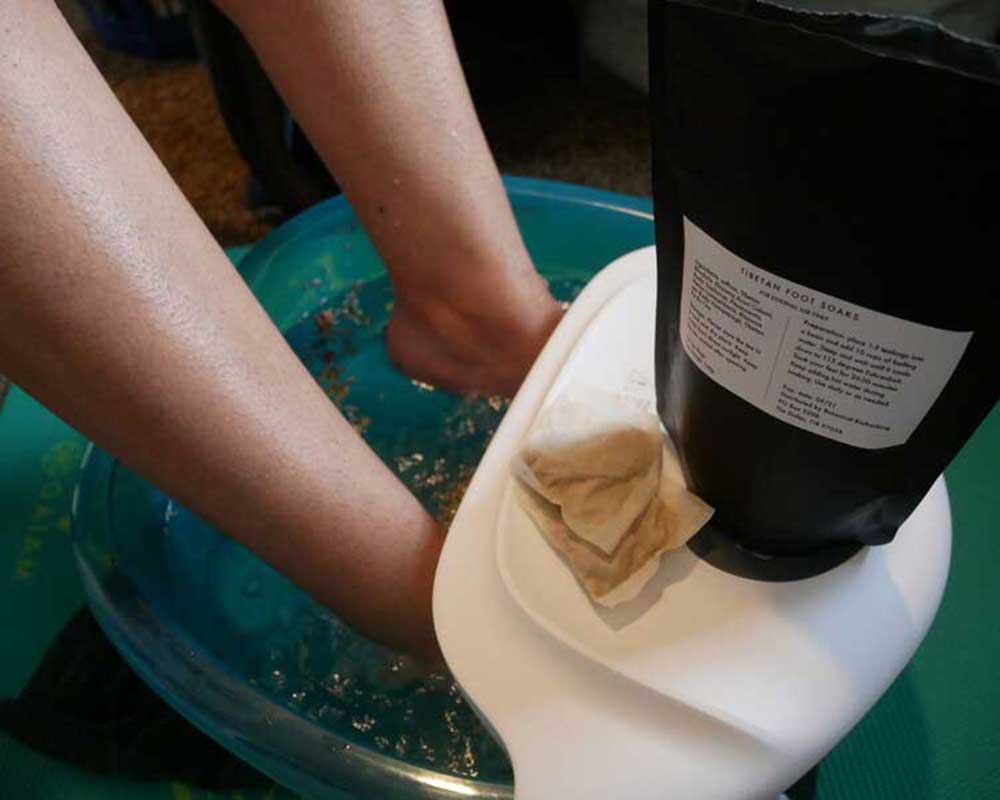
Tibetan Herbal Foot Soaks in Foot Bath
6 minutes read

Materia Medica · The Ritual Series

Tibetan Herbal Foot Soak: For Heavy, Swollen Summer Feet

Willard Sheppy Dipl. OM, LAc, BS

Willard Sheppy is a licensed acupuncturist (LAc) and Founder of Valley Health Clinic specializing in using Traditional Chinese Medicine to treat acute injuries and chronic conditions, and to improve sports performance and rehabilitation.

Tibetan Herbal Foot Soaks in Foot Bath

Table of Contents

This one is for the patients who feel heavy in summer.

Warm herbal foot soaking is one of the oldest self-care rituals in the world. In the Tibetan tradition it draws on plants that grow where almost nothing else will — at brutal altitude and cold. Those are the herbs this soak is built around.

Here’s the pattern it was written for, the one instruction that matters most, and what’s inside.

Quick Answer

The Tibetan Herbal Foot Soak is a warm evening soak built on high-altitude Tibetan plateau herbs and mineral-rich Tibetan salt, for the summer damp-heat pattern: swollen feet by evening, sleep that breaks in the second half of the night, and a leaden heaviness that lifts only with movement. The protocol is specific — twenty minutes, not longer, three to four times a week through the warmer months. If you have diabetes, neuropathy, reduced sensation, or open wounds, check the water temperature carefully and talk with your provider first.

Who This Soak Is For

Dr. Xuelan Qiu of Botanical Biohacking describes the person these were built for with real precision: swollen feet by evening. Sleep that begins well and then breaks in the second half of the night. A leaden quality through the lower body that lifts only with movement.

That’s a damp-heat pattern — one that rises with the season and refuses to clear with diet alone. The company’s own shorthand for the product is direct: high-altitude Tibetan growers, damp-heat.

The Protocol: Twenty Minutes, Not Longer

This is the most useful thing we can pass along, and it comes straight from the formulator. It is refreshingly specific, and it corrects the most common mistake.

Inside the Formula

The blend leans on some of the most revered plants of the Tibetan plateau, grouped by the job each does.

Regenerate

Relax and Warm

Replenish

Before You Soak

If you have diabetes, neuropathy, reduced sensation in your feet, or any open wounds, check the water temperature carefully and talk with your provider first. Skip it entirely on broken skin.

An evening foot soak draws heat downward and quiets the upward churn that keeps a busy mind from settling. That is the whole mechanism, and it is why people sleep better the same night. — Will Sheppy, L.Ac.

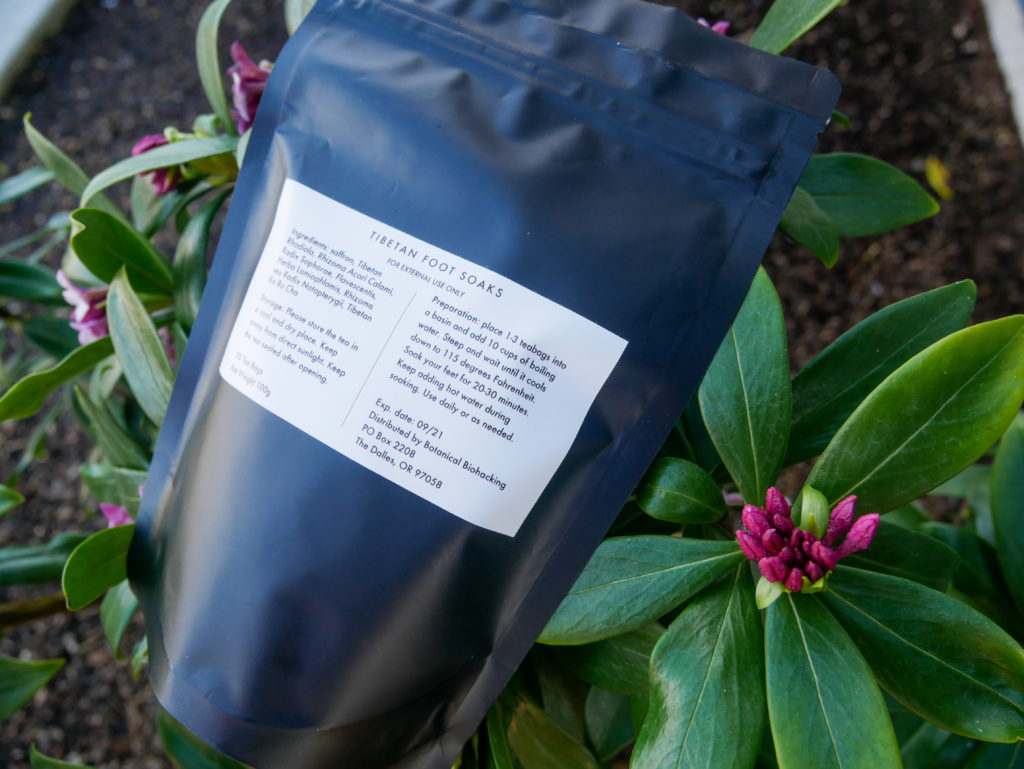
Tibetan Foot Soak Product Photo

Tibetan Herbal Foot Soak

20 tea bags. High-altitude Tibetan herbs and mineral-rich salt, for the heavy, swollen, damp-heat pattern that rises with the season. Available at Valley Health Market.

Research & Resources

  1. Qiu X, Botanical Biohacking. Summer use of Tibetan Herbal Foot Soaks. Practitioner note distributed via Rocky Mountain Herb Supply, June 2026.
  2. Bensky D, Clavey S, Stöger E. Chinese Herbal Medicine: Materia Medica, 3rd ed. Eastland Press, 2004. (Reference for Hong Hua, Ai Ye, Qiang Huo, and Ku Shen.)
  3. Cui ZH, Qin SS, Zang EH, et al. Traditional uses, phytochemistry, pharmacology and toxicology of Lamiophlomis rotata (Benth.) Kudo: a review. RSC Adv. 2020;10(19):11463–11474. PubMed →

Educational content rooted in 20+ years of clinical practice in Traditional Chinese Medicine. The information provided is for educational purposes and is not intended to replace consultation with a qualified healthcare practitioner. Please consult your physician before starting any new herbal protocol, especially if pregnant, nursing, on anticoagulants, or managing a chronic condition.

Share on

Will Sheppy, Founder and Acupuncturist at Valley Health Clinic
Willard Sheppy
Willard Sheppy is a licensed acupuncturist (LAc) and Founder of Valley Health Clinic specializing in using Traditional Chinese Medicine to treat acute injuries and chronic conditions, and to improve sports performance and rehabilitation.

FAQ's

What is the Tibetan Herbal Foot Soak for?

It was built for a summer damp-heat pattern: swollen feet by evening, sleep that begins well and then breaks in the second half of the night, and a leaden heaviness through the lower body that lifts only with movement. It draws on high-altitude Tibetan plateau herbs and mineral-rich Tibetan salt.

Twenty minutes is the working window — not longer. Three to four times a week through the warmer months. Longer is not better; soaking for an hour does not improve the result, and people often describe deeper sleep the same night.

Some of the most revered plants of the Tibetan plateau, grouped by job: to regenerate — Du Yi Wei (Lamiophlomis rotata), Hong Jing Tian (Rhodiola), and Hong Hua (safflower); to relax and warm — Zang Chang Pu (Acorus), Qiang Huo, Ai Ye (mugwort), and Gan Jiang (dried ginger); and to replenish — mineral-rich Tibetan salt and Ku Shen.

If you have diabetes, neuropathy, reduced sensation in your feet, or any open wounds, check the water temperature carefully and talk with your provider first. Skip it entirely on broken skin.

Recent Posts

Purple Star: Xiao Yao San for Emotional Balance

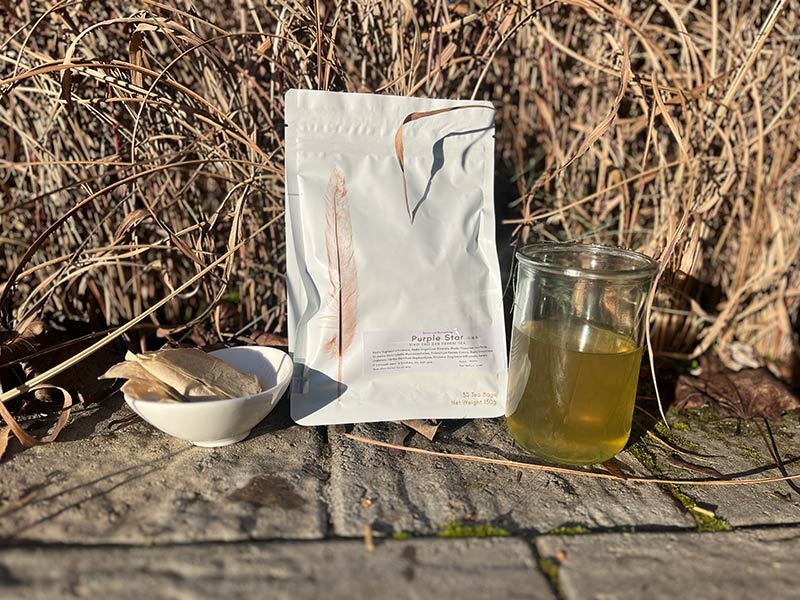
Purple Star Xiao Yao Wan tea from Botanical Biohacking and Valley Health Clinic
7 minutes read

Materia Medica · The Formula Series

Purple Star: Xiao Yao San for Emotional Balance

Willard Sheppy Dipl. OM, LAc, BS

Willard Sheppy is a licensed acupuncturist (LAc) and Founder of Valley Health Clinic specializing in using Traditional Chinese Medicine to treat acute injuries and chronic conditions, and to improve sports performance and rehabilitation.

Purple Star Xiao Yao Wan tea from Botanical Biohacking and Valley Health Clinic

Table of Contents

This one is for the patient who is tired, but not the kind of tired sleep fixes.

She is not in crisis. She has just been carrying too much, for too long.

Here’s what the formula actually is, the pattern it was written for, and what’s inside.

Quick Answer

Purple Star is Xiao Yao San — the Free and Easy Wanderer — an eight-herb classical formula with nearly a thousand years of continuous clinical use, for liver qi stagnation with spleen weakness: the tight, irritable, sighing, bloated, running-on-fumes pattern. This batch reduces the Bo He dose and uses wildcrafted Tibetan Chai Hu. It never replaces care for a diagnosed mood condition — if you take psychiatric or sedative medication, or you’re pregnant, talk with your practitioner first.

What Purple Star Actually Is

Purple Star is Xiao Yao San — the Free and Easy Wanderer. Eight herbs, nearly a thousand years of continuous clinical use, and still one of the most-prescribed formulas in the entire tradition.

It is the classical prescription for Liver qi stagnation with Spleen weakness: the tight, irritable, sighing, bloated, running-on-fumes pattern that shows up when tension outpaces resilience. Its whole purpose is to let stuck energy wander freely again while quietly rebuilding the digestion underneath.

In the classical model, the Liver governs the smooth movement of qi. When that movement is blocked — by chronic stress, held emotion, overwork, or sleep that’s been thin for too long — the qi pools where the channels run. At the ribs and breast. At the temples and around the eye. In the shoulder. At the throat, where it becomes the lump the texts call mei he qi, plum-pit qi.

Ten Complaints, One Pattern

Botanical Biohacking’s herbal pharmacologist, Dr. Lan, PhD, describes this patient better than we could. She comes in for the headache. Or the PMS. Or the chest tightness her cardiologist couldn’t explain. Or the irritability that has begun to alarm her family. Or the digestive heaviness after small meals. Or the breast tenderness, the eye strain, the shoulder tension she has carried for two years.

She rarely connects these to each other. She often apologizes for mentioning them.

They are one pattern. Western diagnostic categories run sideways to this — they name each symptom but miss the connection, and the patient ends up with a folder of partial labels and no integrated approach.

What This Batch Does Differently

This is where Botanical Biohacking’s attention shows. The formula has been adjusted, deliberately, by people who use it clinically:

Inside the Formula

Purple Star keeps the classical scaffolding: soothe the liver, nourish the blood, support the spleen.

Soothe and Spread

Nourish the Blood

Support the Middle

A Note on Scope

“Stress formula” is a convenient shorthand, but Xiao Yao San is specifically for the liver-qi-stuck, spleen-tired pattern. It pairs well with the basics — sleep, movement, boundaries — and it never replaces care for a diagnosed mood condition. If you take psychiatric or sedative medication, or you’re pregnant, talk with your practitioner first.

Prescribe the formula and prescribe the conversation. Patients holding this much rarely have anyone in their week who simply asks how they are doing. — Will Sheppy, L.Ac.

close up of xiao yao wan with tea bag

Purple Star — Xiao Yao Wan Tea

Xiao Yao San with a reduced Bo He adjustment and wildcrafted Tibetan Chai Hu. Nearly a thousand years of clinical use, in a daily cup. Available at Valley Health Market.

Related Reading

Research & Resources

  1. Zhang Y, Han M, Liu Z, Wang J, He Q, Liu J. Chinese herbal formula Xiao Yao San for treatment of depression: a systematic review of randomized controlled trials. Evid Based Complement Alternat Med. 2012;2012:931636. (26 RCTs, 1,837 participants.) Link →
  2. Lin J, Ji Y, Si J, Wang G, Li X, Shen L. Evaluation of the Safety and Efficacy of Xiao Yao San as a Treatment for Anxiety: A Systematic Review and Meta-Analysis. Evid Based Complement Alternat Med. 2022;2022:1319592. Link →
  3. Bensky D, Barolet R. Chinese Herbal Medicine: Formulas & Strategies. Eastland Press. (Standard reference for Xiao Yao San.)

Educational content rooted in 20+ years of clinical practice in Traditional Chinese Medicine. The information provided is for educational purposes and is not intended to replace consultation with a qualified healthcare practitioner. Please consult your physician before starting any new herbal protocol, especially if pregnant, nursing, on anticoagulants, or managing a chronic condition.

Share on

Will Sheppy, Founder and Acupuncturist at Valley Health Clinic
Willard Sheppy
Willard Sheppy is a licensed acupuncturist (LAc) and Founder of Valley Health Clinic specializing in using Traditional Chinese Medicine to treat acute injuries and chronic conditions, and to improve sports performance and rehabilitation.

FAQ's

What is Purple Star?

Purple Star is Xiao Yao San — the Free and Easy Wanderer — an eight-herb classical formula with nearly a thousand years of continuous clinical use, made by Botanical Biohacking as a daily tea. It is still one of the most-prescribed formulas in the entire tradition.

It is the classical prescription for liver qi stagnation with spleen weakness: the tight, irritable, sighing, bloated, running-on-fumes pattern that shows up when tension outpaces resilience — the patient who is tired, but not the kind of tired sleep fixes. The headache, the PMS, the chest tightness, the digestive heaviness, and the shoulder tension are often one pattern, not ten separate problems.

“Stress formula” is a convenient shorthand, but Xiao Yao San is specifically for the liver-qi-stuck, spleen-tired pattern. It pairs well with the basics — sleep, movement, boundaries — and it never replaces care for a diagnosed mood condition.

If you take psychiatric or sedative medication, or you’re pregnant, talk with your practitioner before starting this formula.

Recent Posts

Neurogene Tea: For Numbness and Tingling in Hands and Feet

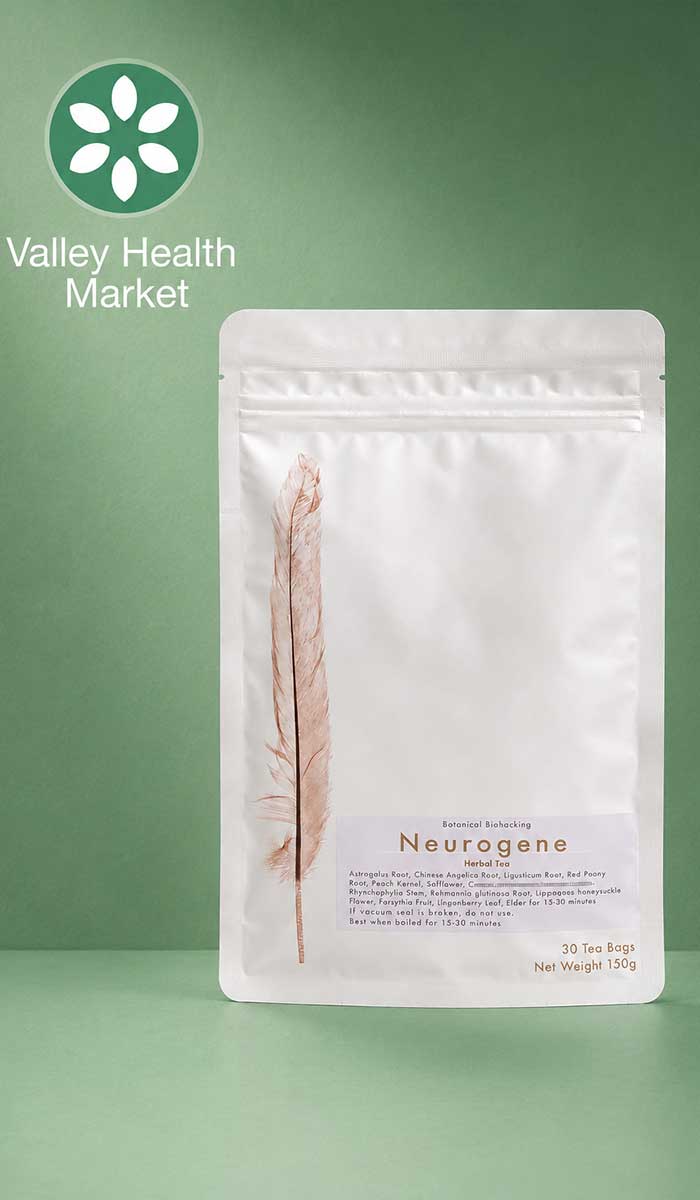
Neurogene Tea product with green backing Valley Health Market
7 minutes read

Materia Medica · The Formula Series

Neurogene Tea: For Numbness and Tingling in Hands and Feet

Willard Sheppy Dipl. OM, LAc, BS

Willard Sheppy is a licensed acupuncturist (LAc) and Founder of Valley Health Clinic specializing in using Traditional Chinese Medicine to treat acute injuries and chronic conditions, and to improve sports performance and rehabilitation.

Neurogene Tea product with green backing Valley Health Market

Table of Contents

Numbness and tingling are not always a nerve problem. Sometimes they are a delivery problem.

When circulation is too weak to reach the far end of a nerve, the sensation at the fingertips and toes is often the first thing to fade. Neurogene Tea was built for that picture — to support the pressure behind circulation rather than force it.

Here’s what the formula actually is, who formulates it, and what’s inside.

Quick Answer

Neurogene Tea is an Imperial-grade modification of Bu Yang Huan Wu Tang — the most-studied blood-moving formula in Chinese medicine — built for the picture where circulation is too weak to reach the far end of a nerve. A very large dose of Huang Qi (astragalus) supplies the push; a small team of blood-movers clears the path. It is a blood-moving formula: not used during pregnancy, and anyone on anticoagulants, with a bleeding disorder, or recovering from a stroke should talk with their physician and practitioner first.

What Neurogene Tea Actually Is

Neurogene is an Imperial-grade modification of Bu Yang Huan Wu Tang — Tonify the Yang to Restore Five-Tenths Decoction. In China it is the single most-used formula for post-stroke recovery, and it has been studied more than almost any other blood-moving prescription.

The classical logic is elegant. A very large dose of Huang Qi (astragalus) supplies the qi that pushes blood; a small team of blood-movers clears the obstruction that qi is pushing against. The formula does not force circulation. It restores the pressure behind it.

The modification adds herbs aimed at the neuro-inflammatory side of the picture — Tian Ma and Gou Teng to settle wind, Jin Yin Hua and Lian Qiao to clear heat, Da Huang to keep things moving downward.

Who Formulates This

Dr. Jin Zhao is the main formulator for Botanical Biohacking. He practices in Chengdu, sees up to 200 patients a day, and specializes in dampness. His approach was refined across tens of thousands of patients, working through the upper, middle, and lower jiao.

Pharmacology professor Dr. Zhong Shi Hong fine-tunes the formulas. Dr. Lan, PhD — Dr. Jin’s younger classmate — is the herbal pharmacologist who oversees testing and writes the practitioner letters.

A sourcing detail worth noting: this blend uses Qing Lian Qiao — unripe green forsythia — rather than the ripe fruit. It carries a higher concentration of forsythiaside. A small decision, made by someone paying attention.

How It's Sourced and Tested

Three categories of contamination matter for plant material from anywhere in the world: heavy metals, pesticide residue, and microbial load. Botanical Biohacking’s protocol addresses all three.

Inside the Formula

Eleven herbs, organized around one idea: supply the push, then clear the path.

Supply the Push

Move the Blood

Settle and Clear

Before You Start

This is a blood-moving formula. It is not used during pregnancy. If you take anticoagulants, have a bleeding disorder, or are recovering from a stroke or any neurological event, this belongs in a conversation with your physician and practitioner — not in a self-directed experiment.

Numbness at the fingertips and toes is often the last stop on a long supply line. When you improve what reaches the end of that line, the sensation frequently follows. — Will Sheppy, L.Ac.

Neurogene Tea product with green backing Valley Health Market

Neurogene Tea

An Imperial-grade modification of Bu Yang Huan Wu Tang. Eleven herbs, thirty teabags, one month’s supply. Available at Valley Health Market.

Research & Resources

  1. Wang R, Ren J, Li S, et al. Efficacy evaluation of Buyang Huanwu Decoction in the treatment of ischemic stroke in the recovery period: a systematic review of randomized controlled trials. Front Pharmacol. 2022;13:975816. Frontiers →
  2. Hao CZ, Wu F, Shen J, et al. Clinical efficacy and safety of Buyang Huanwu Decoction for acute ischemic stroke: a systematic review and meta-analysis of 19 randomized controlled trials. Evid Based Complement Alternat Med. 2012;2012:630124. PubMed →
  3. Wei RL, Teng HJ, Yin B, et al. A systematic review and meta-analysis of Buyang Huanwu Decoction in animal model of focal cerebral ischemia. Evid Based Complement Alternat Med. 2013;2013:138484. PubMed →

Educational content rooted in 20+ years of clinical practice in Traditional Chinese Medicine. The information provided is for educational purposes and is not intended to replace consultation with a qualified healthcare practitioner. Please consult your physician before starting any new herbal protocol, especially if pregnant, nursing, on anticoagulants, or managing a chronic condition.

Share on

Will Sheppy, Founder and Acupuncturist at Valley Health Clinic
Willard Sheppy
Willard Sheppy is a licensed acupuncturist (LAc) and Founder of Valley Health Clinic specializing in using Traditional Chinese Medicine to treat acute injuries and chronic conditions, and to improve sports performance and rehabilitation.

FAQ's

What is Neurogene Tea?

Neurogene Tea is an Imperial-grade modification of Bu Yang Huan Wu Tang (Tonify the Yang to Restore Five-Tenths Decoction) — the most-used and most-studied blood-moving formula in Chinese medicine. Botanical Biohacking builds it from eleven herbs and adds a team aimed at the neuro-inflammatory side of the picture. It comes as thirty teabags, a one-month supply.

It was written for the picture where circulation is too weak to reach the far end of a nerve — numbness and tingling at the fingertips and toes that behaves less like a nerve problem and more like a delivery problem. The formula’s strategy is to supply the push behind circulation with a large dose of Huang Qi (astragalus), then clear the path with blood-movers.

No — this is a blood-moving formula and it is not used during pregnancy. If you take anticoagulants, have a bleeding disorder, or are recovering from a stroke or any neurological event, this belongs in a conversation with your physician and practitioner, not a self-directed experiment.

Dr. Jin Zhao, Botanical Biohacking’s main formulator, practices in Chengdu and specializes in dampness, refining his approach across tens of thousands of patients. Pharmacology professor Dr. Zhong Shi Hong fine-tunes the formulas, and Dr. Lan, PhD, the herbal pharmacologist, oversees testing. One detail of their care: the blend uses unripe green forsythia (Qing Lian Qiao) for its higher forsythiaside content.

Recent Posts

Atone Tea: For the Heavy, Queasy, Nothing-Is-Moving Stall

Glow Herbal Tea product mockup
7 minutes read

Materia Medica · The Formula Series

Atone Tea: For the Heavy, Queasy, Nothing-Is-Moving Stall

Willard Sheppy Dipl. OM, LAc, BS

Willard Sheppy is a licensed acupuncturist (LAc) and Founder of Valley Health Clinic specializing in using Traditional Chinese Medicine to treat acute injuries and chronic conditions, and to improve sports performance and rehabilitation.

Glow Herbal Tea product mockup

Table of Contents

This one is for the heavy, queasy, nothing-is-moving stall. Bad food, bad water, or a bug going around.

Huo Xiang Zheng Qi San is the formula households across Asia keep on hand for exactly this picture. It works by aromatically waking up the digestion — not by attacking anything.

Here’s what the formula actually is, why it uses eleven herbs, and when it’s the wrong tool.

Quick Answer

Atone Tea is Huo Xiang Zheng Qi San — Agastache Powder to Rectify the Qi — the classic formula for external damp obstructing the middle: the summer bug, the questionable takeout, the travel tummy. It settles the gut by aromatically waking up digestion, not by attacking anything. It is not for every stomach upset — dehydration, blood in the stool, high fever, or symptoms lasting more than a couple of days call for medical attention. If you are pregnant, check with your practitioner first.

What Atone Tea Actually Is

Huo Xiang Zheng Qi San — Agastache Powder to Rectify the Qi — is the classic prescription for external damp obstructing the middle. The summer-bug, questionable-takeout, travel-tummy, damp-and-queasy picture.

It works by aromatically waking up the digestion, releasing the exterior, and getting stuck qi and fluid moving again in the right direction. Not by attacking anything.

It is a household staple across much of Asia for exactly this reason: it is what you reach for when your gut feels waterlogged and rebellious and you want it settled today.

Why Eleven Herbs

This is a larger formula than most, and each group has a job. Botanical Biohacking keeps the full aromatic architecture intact rather than trimming it for cost — agastache, perilla, angelica dahurica, the two bark qi-movers, and the digestive support herbs.

Then they turn it into a tea you can sip at the first sign of trouble, rather than a formula you have to track down mid-misery. That is the practical difference.

How It's Sourced and Tested

For a formula you reach for when already unwell, contamination testing matters more, not less.

Inside the Formula

Three classical jobs: aromatically transform damp, release the exterior, harmonize the gut.

Aromatically Transfor Damp

Move Qi and Drain Damp

Support and Harmonize

When to Stop and Call Someone

Atone is for the damp, sluggish, queasy pattern — not every stomach upset. Signs of dehydration, blood in the stool, high fever, or symptoms lasting more than a couple of days call for medical attention, not more tea. If you are pregnant, check with your practitioner first.

This is the one people stash for travel, summer heat, and questionable meals. It has been a household staple across much of Asia for centuries, and for good reason. — Will Sheppy, L.Ac.

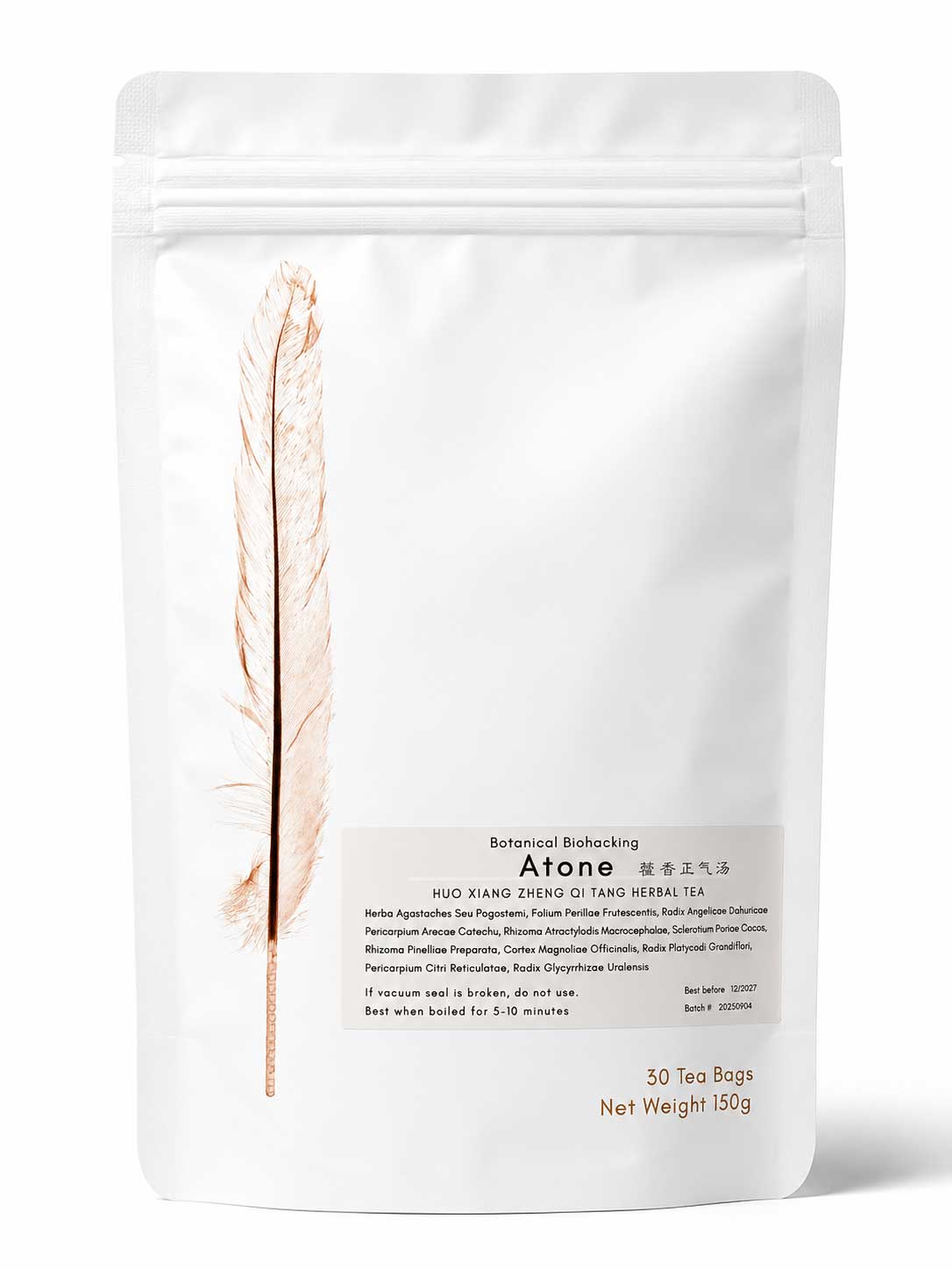
Atone Herbal Tea product mockup green background

Atone Tea

Huo Xiang Zheng Qi San. Eleven herbs, full aromatic architecture intact. Thirty teabags, one month’s supply. Available at Valley Health Market.

Research & Resources

  1. Yu DD, et al. Systematic review and meta-analysis of Huoxiang Zhengqi Pills combined with Western medicine for acute gastroenteritis (44 studies, 4,153 participants). Zhongguo Zhong Yao Za Zhi. 2019;44(14):2914–2925. [Article in Chinese] PubMed →
  2. Zhao HJ, et al. Huoxiang Zhengqi formulas for treatment of gastrointestinal-type cold: a systematic review and meta-analysis (8 RCTs, 680 participants). Zhongguo Zhong Yao Za Zhi. 2017;42(8):1495–1499. [Article in Chinese] PubMed →
  3. Bensky D, Barolet R. Chinese Herbal Medicine: Formulas & Strategies. Eastland Press. (Standard reference for Huo Xiang Zheng Qi San.)

Educational content from Valley Health Market. Not medical advice. Statements have not been evaluated by the FDA. This product is not intended to diagnose, treat, cure, or prevent any disease. Valley Health Market Educational content rooted in 20+ years of clinical practice in Traditional Chinese Medicine. The information provided is for educational purposes and is not intended to replace consultation with a qualified healthcare practitioner. Please consult your physician before starting any new herbal protocol, especially if pregnant, nursing, on anticoagulants, or managing a chronic condition.

© Valley Health Market · Albany, Oregon

Share on

Will Sheppy, Founder and Acupuncturist at Valley Health Clinic
Willard Sheppy
Willard Sheppy is a licensed acupuncturist (LAc) and Founder of Valley Health Clinic specializing in using Traditional Chinese Medicine to treat acute injuries and chronic conditions, and to improve sports performance and rehabilitation.

FAQ's

What is Atone Tea?

Atone Tea is Huo Xiang Zheng Qi San — Agastache Powder to Rectify the Qi — the classic Chinese formula for external damp obstructing the middle, made by Botanical Biohacking as a tea with the full eleven-herb architecture intact. It comes as thirty teabags, a one-month supply.

For the damp, sluggish, queasy pattern: the summer bug, the questionable takeout, the travel tummy — when your gut feels waterlogged and rebellious and nothing is moving. It’s made as a tea so you can sip it at the first sign of trouble rather than tracking down a formula mid-misery.

It’s a larger formula than most, and each group has a job: aromatically transform damp (agastache), release the exterior (perilla leaf, angelica dahurica), move qi and drain damp (areca husk, magnolia bark, tangerine peel, pinellia), and support and harmonize the gut (bai zhu, poria, platycodon, licorice). Botanical Biohacking keeps the full architecture intact rather than trimming it for cost.

If you are pregnant, check with your practitioner before taking it.

Atone is for the damp, sluggish, queasy pattern — not every stomach upset. Signs of dehydration, blood in the stool, high fever, or symptoms lasting more than a couple of days call for medical attention, not more tea.

Recent Posts