Tag: Fu Medicinals

What Is a Dit Da Jiao? Fu Medicinals

Fu Medicine Formulas Herbal Line up
17 minutes read

What Is a Dit Da Jiao? Fu Medicinals

Willard Sheppy Dipl. OM, LAc, BS

Willard Sheppy is a licensed acupuncturist (LAc) and Founder of Valley Health Clinic specializing in using Traditional Chinese Medicine to treat acute injuries and chronic conditions, and to improve sports performance and rehabilitation.

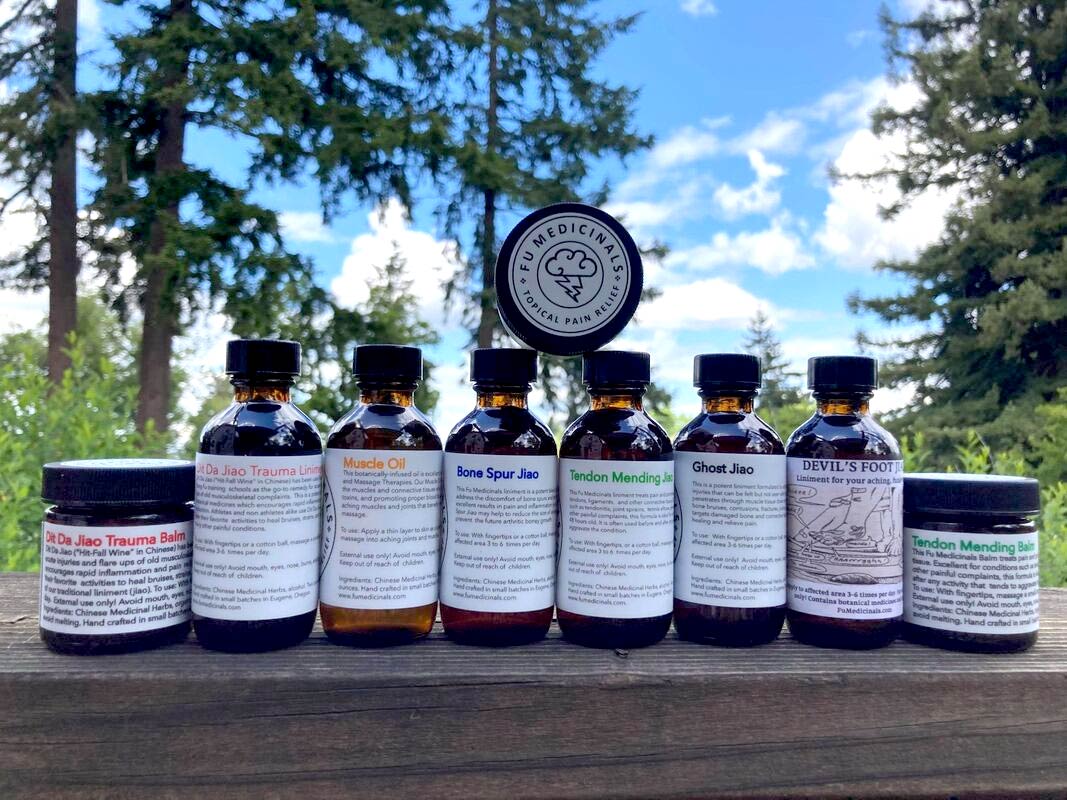
Fu Medicine Formulas Herbal Line up

Table of Contents

When you buy something for pain, you assume newer is better. Fresher herbs, a more recent batch, more punch.

With liniments it runs the other way. Some of the bottles we carry are more than ten years old — on purpose. That isn’t old stock sitting around. That’s the medicine finishing itself.

I’ve been using Fu Medicinals on patients in my Albany clinic for a while now, and it’s one of the few topical lines where I can point to a person, a place, and a process. That person is John, an acupuncturist who spent fourteen years developing these formulas in a working treatment room. Here’s what a jiao actually is, what the aging does, and which of the three formulas fits which kind of pain.

Quick answer

A jiao (roughly “jee-yow”) is a traditional Chinese herbal liniment — medicinal herbs steeped in alcohol and applied to the skin, never swallowed. Fu Medicinals makes three of them, handcrafted in small batches in Oregon, and nothing is released until it has aged at least two years. Each formula targets a different depth of injury: PNW Dit Da Trauma for acute injury and bruising, Tendon Mending for tendons and ligaments, Bone Spur for chronic joint and bone pain. External use only — talk to your doctor first if you are pregnant.

What Is a Jiao — and Why Does Age Matter?

A jiao is an alcohol extraction. Herbs go into high-proof spirits, and the alcohol pulls the medicinal constituents out of the plant material over time. Unlike a cream or a gel, it isn’t finished the day it’s bottled — the extraction keeps going.

That’s the whole argument for aging it. The longer the herbs and the alcohol sit together, the more completely the formula comes out, and the more the individual herbs stop behaving like a list and start behaving like one medicine. John’s rule is that nothing leaves his shop under two years old, and some of what ends up on our shelf is well past a decade.

Dit da jiao is the most famous member of the family. It translates, almost comically literally, to “hit fall wine” — the medicine you reach for when someone got hit, or fell. It has been the standard first-aid topical in Chinese martial arts halls for a very long time, which is exactly the pedigree you want in something meant for a fresh bruise.

"When it comes to liniments, the older the more potent."
— John Ditmars, maker of Fu Medicinals

Meet John Ditmars, the Maker Behind Fu Medicinals

Fu Medicinals didn’t start as a product line. It started as an acupuncturist making liniments for his own aches — John is an athlete, and he specializes in pain-based conditions — and then for the patients in front of him. Fourteen years of adjusting the recipes based on what actually worked in the treatment room is how three formulas came out the other side. The name nods to the Kung Fu healing tradition these recipes come from.

He’s clear about what he was reacting against. He had tried the brands sitting in his acupuncture school clinics and on store shelves and didn’t want any of it: no synthetic chemicals, no overpowering odor, and nothing formulated to produce a dramatic tingle. As he puts it, that sensation doesn’t necessarily mean the product is working — it just means people have been trained to expect it.

Here is what actually separates these from the topical aisle:

I care about that history for a practical reason. A topical made by someone who has to look a patient in the eye next week gets revised. A topical made to hit a price point does not. That’s the standard anything has to clear before it earns shelf space at Valley Health Market.

The Three Formulas, and When I Reach for Each

Chinese medicine thinks about injury in layers — blood and muscle nearest the surface, then sinew and connective tissue, then bone. Fu Medicinals color-codes the labels to match: red for the blood and muscle level, green for tendon, blue for bone. Once you know that, choosing is mostly a matter of asking how deep the problem sits and how long it has been there.

PNW Dit Da Trauma — the acute one

Fresh injury, bruising, swelling, the ankle you rolled on Saturday

This is the “hit fall wine” formula, and it’s the one to have in the cupboard before you need it. The Pacific Northwest version leans on mugwort (Ai Ye) to answer the cold and damp we actually live in, and it combines warming and cooling herbs so it can be used while things are still hot and swollen. Twenty-eight herbs in total.

Tendon Mending — the connective-tissue one

Tendonitis, a ligament sprain that hasn’t settled, any nagging tweak in a tendon. It’s built around Gu Sui Bu (drynaria), the herb whose name translates roughly as “mender of shattered bones,” and the base is organic coconut oil and beeswax in the balm version. Worth knowing: this one is warming, which is the point of it — and which is why it isn’t the right choice in the first day or two after a fresh injury.

Bone Spur — the deep, chronic one

Bone spurs and osteoarthritis — which in Chinese medicine is always read as a long-standing pattern rather than an acute event. E Zhu (zedoary rhizome) does the heavy lifting here, aimed at blood and qi stagnation that has had years to set in. Thirty-plus herbs, and the one I reach for when someone’s joint pain has been part of their life long enough that they’ve stopped mentioning it.

  PNW Dit Da Traumared — blood & muscle Tendon Mendinggreen — sinew Bone Spurblue — bone
Best forBruises, sprains, knocks, fresh swellingTendonitis, ligament sprains, nagging tweaksBone spurs, osteoarthritis, deep joint ache
StageAcute — hours to days oldSub-acute to chronic — weeks to monthsChronic — months to years
Signature herbAi Ye (mugwort)Gu Sui Bu (drynaria)E Zhu (zedoary rhizome)
TemperatureWarming and cooling together — usable while hot and swollenWarming — wait 1–2 days after a fresh injuryWarming — built for long-standing stagnation
Comes asJiao (2 oz liniment) or balmJiao (2 oz liniment) or balmJiao (2 oz liniment) or balm

Jiao or Balm? How to Choose

Every recipe comes two ways: the traditional jiao — a 2 oz alcohol liniment — and a modern balm that puts the same formula in an organic coconut oil and beeswax base. They aren’t competing versions of the same thing. They suit different situations, and plenty of patients end up owning both.

Reach for the jiao when…

You want fast penetration and you’re applying several times a day

The alcohol carries the herbs in and then evaporates, so nothing is left sitting on the skin. That makes it easy to reapply through the day without building up a greasy layer, and it’s the form that has been aged.

Reach for the balm when…

The skin is dry or irritated, you’re using it as a glide medium for massage or cupping, or you’re traveling and would rather not carry a liquid. The balm stays put longer and is gentler on skin that’s already unhappy.

The gauze trick

For a longer soak, put the jiao on a piece of gauze and tape it over the area rather than rubbing it in. It’s a traditional method and it keeps the herbs in contact with the tissue far longer than a two-minute massage does. Good for an evening on the couch or overnight on a stubborn joint.

What the Research Actually Shows

I want to be straight about this: these specific formulas have not been through clinical trials. Handmade, small-batch liniments almost never are — there is nobody to fund the study. What has been studied, in laboratories and in animals, is the individual herbs, and some of that work lines up neatly with what the tradition has been claiming for centuries.

Frankincense and myrrh, tested as a pair

The combination outperformed either resin used alone

Ru Xiang and Mo Yao appear together in nearly every trauma formula in the Chinese materia medica, and researchers have tested whether the pairing is actually doing something. In mouse models of inflammation and pain, the combined extract suppressed swelling and reduced pain behavior more effectively than frankincense or myrrh on their own (Su et al., 2012).

Gu Sui Bu and the bone-and-sinew claim

Drynaria, the anchor of Tendon Mending, has a connective-tissue reputation going back centuries. In cell studies its water extract protected osteoblasts — the cells that build bone — from oxidative damage and pushed them toward maturity (Hsu et al., 2011). Naringin, its main constituent, sped up fracture healing in rats by improving blood-vessel growth at the fracture site (Song et al., 2017).

Ai Ye, the herb that makes it a Pacific Northwest formula

More than 200 compounds have been identified in mugwort’s essential oil, with anti-inflammatory and analgesic activity documented across a wide body of work — alongside a clear note from the same reviewers that the oil is not harmless in quantity (Liu et al., 2021).

None of that proves a liniment will fix your shoulder. It is laboratory and animal evidence about ingredients, not human trials of a finished product. But it is a good deal more than nothing, and it is consistent with what I see when I use these in the treatment room.

"That sensation doesn't necessarily mean that the product is working — but people are familiar with those tingles via products they've previously tried, and might expect it to be a sign that the topical is working."
— John Ditmars, on why Fu Medicinals doesn't chase the burn
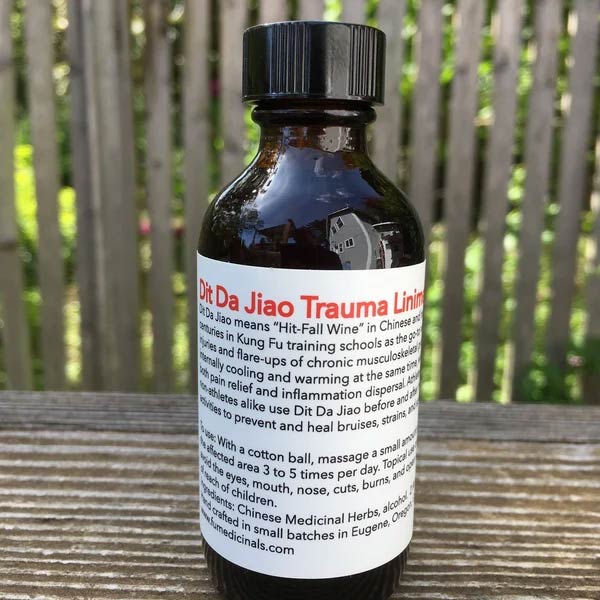
PNW Dit Da Jiao Trauma Liniment by Fu Medicinals

Fu Medicinals at Valley Health Market

Three formulas. Two forms. Aged at least two years.

We carry all three Fu Medicinals formulas at Valley Health Market, in both the traditional jiao and the balm, starting at $25 for a 2 oz liniment. There are also two bundles if you’d rather keep the acute and the chronic option on hand at the same time.

How to Use a Liniment — and When Not To

Application is simple, and doing it often matters more than doing it heavily.

  1. Massage a small amount into the sore area with your fingertips or a cotton ball until it’s absorbed.
  2. Repeat several times a day — three or four is reasonable for something you’re actively working on.
  3. For deeper contact, apply the liniment to a piece of gauze and tape it over the area for a longer stretch.
  4. Wash your hands afterward, and keep it well away from your eyes.

Cautions, and I mean these

External use only — never take a jiao internally

  • Not on broken skin, open wounds, or mucous membranes. Avoid sensitive areas and keep it out of reach of children.
  • If you are pregnant, talk to your doctor before using any of these. Several of the herbs in these formulas move blood, which is exactly why they work on bruises and exactly why pregnancy is a different conversation.
  • Tendon Mending is warming — that’s the point of it — which makes it the wrong choice in the first day or two after a fresh injury, while things are still hot and swollen. Use the Dit Da formula in that window instead.
  • If you have herbal or plant allergies, read the full ingredient list on the product page first. The equipment these are made on contacts a wide range of medicinal herbs.

When to stop rubbing and get it looked at

A liniment supports tissue while it heals. It is not a way of finding out what’s wrong. Get the injury assessed if you can’t bear weight, the joint looks deformed, the swelling came on hard and fast, or you have numbness, tingling, or weakness anywhere downstream of it. The same goes for pain that hasn’t budged after a couple of weeks of sensible self-care — that’s information, and it’s worth acting on rather than covering up.

Which Formula Should You Start With?

If you’re standing in front of the three of them trying to decide, the question isn’t “which is strongest.” It’s how deep is the problem, and how long has it been there. Something that happened this week, at the level of muscle and bruise, wants the Dit Da. Something in a tendon that has been grumbling for a month wants Tendon Mending. Something in a joint that has been part of your life for years wants Bone Spur.

And if you genuinely can’t tell — which is common, because pain is a bad narrator — start with the acute formula. It’s the most broadly useful of the three, it’s the one martial artists have kept on the shelf for centuries for exactly that reason, and it won’t be wasted.

Your Next Step

Not sure which one fits what you’re dealing with?

Call the clinic at (541) 760-9670 or stop by at 220 5th Ave SW in Albany and ask. That’s a two-minute conversation and it’s free — and if what you’re describing sounds like something a topical won’t touch, I’d rather tell you that than sell you a bottle.

These statements have not been evaluated by the Food and Drug Administration. These products are not intended to diagnose, treat, cure, or prevent any disease. This article is educational and is not a substitute for individual medical advice.

References

Su S, Hua Y, Wang Y, et al. Evaluation of the anti-inflammatory and analgesic properties of individual and combined extracts from Commiphora myrrha and Boswellia carterii. Journal of Ethnopharmacology. 2012;139(2):649–656. Link →

Hsu CK, Liao MH, Tai YT, et al. Nanoparticles prepared from the water extract of Gusuibu (Drynaria fortunei J. Sm.) protects osteoblasts against insults and promotes cell maturation. International Journal of Nanomedicine. 2011;6:1405–1413. Link →

Song N, Zhao Z, Ma X, et al. Naringin promotes fracture healing through stimulation of angiogenesis by regulating the VEGF/VEGFR-2 signaling pathway in osteoporotic rats. Chemico-Biological Interactions. 2017;261:11–17. (animal study) Link →

Liu Y, He Y, Wang F, et al. From longevity grass to contemporary soft gold: Explore the chemical constituents, pharmacology, and toxicology of Artemisia argyi H.Lév. & Vaniot essential oil. Journal of Ethnopharmacology. 2021;279:114404. Link →

Ditmars J. About John Ditmars the Maker — interview and product FAQ. Valley Health Clinic. Link →

Share on

Will Sheppy, Founder and Acupuncturist at Valley Health Clinic
Willard Sheppy
Willard Sheppy is a licensed acupuncturist (LAc) and Founder of Valley Health Clinic specializing in using Traditional Chinese Medicine to treat acute injuries and chronic conditions, and to improve sports performance and rehabilitation.

FAQ's

What does "dit da jiao" mean?

It translates almost literally as “hit fall wine” — the medicine you use after someone has been hit or has fallen. It’s an alcohol-based herbal liniment that has been the standard first-aid topical in Chinese martial arts for a very long time, and it’s the tradition the PNW Dit Da Trauma formula comes out of.

A jiao is an alcohol extraction, and the alcohol keeps drawing constituents out of the herbs long after the bottle is sealed. Fu Medicinals releases nothing under two years old, and some bottles are well over ten. As maker John Ditmars puts it: with liniments, the older the more potent.

Same formula, different carrier. The jiao is the traditional 2 oz alcohol liniment — it penetrates quickly and evaporates, which suits applying several times a day. The balm puts the same herbs in an organic coconut oil and beeswax base, so it stays on the skin longer and is gentler on dry or irritated skin. Plenty of people keep both.

Tendon Mending is the one built for connective tissue — tendonitis, ligament sprains, and lingering tweaks. It’s a warming formula, though, so it isn’t the right choice in the first day or two after a fresh injury while things are still hot and swollen. Use PNW Dit Da Trauma in that window instead.

Talk to your doctor first. Several of the herbs in these formulas move blood — which is precisely why they help with bruising and stagnation — and that makes pregnancy a conversation to have with your provider rather than a decision to make from a label. All of these are for external use only, and none should go on broken skin.

Recent Posts
FAQ For Fu Medicinals

Fu Medicine Formulas Herbal Line up

Fu Medicinal FAQ

 Learn more about Fu Medicinals, where tradition meets modern healing. Our exclusive range of topical liniments, rooted in the ancient wisdom of Chinese Kung Fu Martial Arts, offers targeted relief for various pain-based conditions. Each product is meticulously hand-crafted in Oregon, using the highest quality organic ingredients. Fu Medicinals is dedicated to providing natural, solutions targeted to your specific injury.

Frequently Asked Questions (FAQ)

What is Fu Medicinals?

Fu Medicinals specializes in topical liniments derived from traditional Chinese Kung Fu recipes, that are targeted for specific injuries and problems.

How are Fu Medicinals products made?

Each product is hand-crafted in small batches in Oregon using organic, locally-sourced ingredients and high-quality Chinese Medicinal Herbs, prepared with traditional methods.

What are the key ingredients in Fu Medicinals products?

Fu Medicinals uses a variety of traditional Chinese herbs such as Mugwort, Mint, Rhubarb Root, Salvia Miltiorrhiza, Chinese Angelica, Clove, Licorice Root, Safflower, Sichuan Pepper, Myrrh, Frankincense, Peach Kernel, and Camphor.

Are Fu Medicinals ingredients safe?

All ingredients are selected for their historical use in traditional Chinese medicine. We ensure they are sourced responsibly and prepared safely, adhering to high-quality standards.

Are there any allergen concerns with Fu Medicinals products?

Our products contain a range of Chinese Herbs. If you have severe allergies to specific herbs, please refer to our full list of ingredients.

  • Ai Ye – Mugwort
  • Bai Zhu – Atractylodes
  • Bo He – Mint
  • Cao Wu – Radix Aconiti
  • Chuan Wu – Radix
  • Aconiti Preparata
  • Da Huang – Rhubarb Root
  • Dan Shen – Salvia Miltiorrhiza
  • Dang Gui Pian – Chinese Angelica Slice
  • Dang Gui Wei – Chinese Angelica Tail
  • Ding Xiang – Clove
  • E Zhu – Zedoary Rhizome
  • Gan Cao – Licorice Root
  • Gan Jiang – Dried Ginger
  • Gu Sui Bu – Drynaria Rhizome
  • Gui Pi – Angelica Root
  • Gui Zhi – Cinnamon Twig
  • Hong Hua – Safflower
  • Hua Jiao – Sichuan Pepper
  • Lu Lu Tong – Liquidambar Resin
  • Mo Yao – Myrrh
  • Rou Gui – Cinnamon Bark
  • Ru Xiang – Frankincense
  • Tao Ren – Peach Kernel
  • Wei Ling Xian – Clematis
  • Xing Ren – Apricot Kernel
  • Xue Jie – Dragon’s Blood
  • Xu Dan
  • Zi Ran Tong – Greenbrier Rhizome
  • Zhang Nao – Camphor
  • Zhi Zi – Gardenia Fruit

What conditions do Fu Medicinals products address?

Our products are designed for specific ailments, including acute injuries, chronic tendon and ligament issues, bone spurs, arthritis, and more.

Which product is best?

Our products are designed for specific ailments, including acute injuries, chronic tendon and ligament issues, bone spurs, arthritis, and more.

PNW Dit Da Jiao Trauma Liniment

Ideal for acute injuries and flare-ups from older injuries, this liniment reduces inflammation, relieves pain, and aids healing by moving stagnant blood and relaxing tissues.

Tendon Mending Jiao

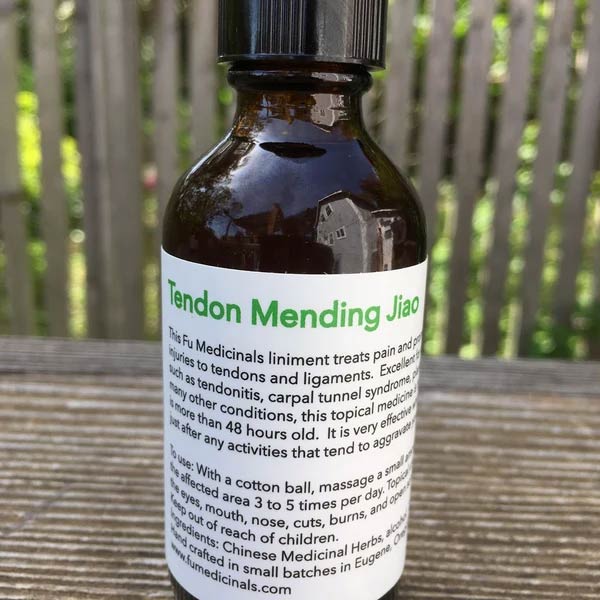
Specially formulated for chronic tendon and ligament injuries, like tendonitis or ligament sprains. Recommended for use before and after activities, but not immediately after a new injury due to its warming properties.

Bone Spur Jiao

Effective for conditions involving bone growths such as spurs and osteoarthritis. It works to reduce inflammation in both soft tissue and bone, potentially preventing further growth and alleviating pain.

Ghost Jiao

A potent liniment for deep-level pain such as bone bruises, fractures, and chronic joint pain, including arthritis. It’s versatile for both acute and chronic conditions, focusing on removing phlegm and inflammation.

Can Fu Medicinals products be used with other treatments?

Yes, they can complement other treatments like acupuncture. However, consult with a healthcare provider for personalized advice.

Buy Fu Medicinals Today!

PNW Dit Da Jiao Trauma Liniment by fu medicinals

PNW Dit Da Jiao Trauma Liniment

Tendon Mending Jiao by Fu Medicinals

Tendon Mending Jiao

Bone Spur Jiao by Fu Medicinals

Bone Spur Jiao

About the Author

Author Willard Sheppy Exporing the Coast

Willard Sheppy is a writer and healthcare practitioner who seamlessly melds scientific knowledge with practical applications in engaging and authoritative articles. He holds a Bachelor of Science in Environmental Science from Oregon State University and a Master’s in Acupuncture and Oriental Medicine from the distinguished Oregon College of Oriental Medicine.

In his work, Willard skillfully combines his extensive educational background in scientific research with his practical experience as a healthcare practitioner. Willard balances his life with martial arts and cherished family adventures. As a father of three, he often leads his family on camping and hiking trips along the breathtaking Oregon coast.

Connect with Willard on LinkedIn at linkedin.com/in/valleyhealthclinic or learn more about his services at valleyhealthclinic.com. Embark on this journey towards holistic health with Willard!

Fu Medicinals Topical Liniments

Fu Medicine Formulas Herbal Line up

Fu Medicinals

Fu Medicinals brings the power of ancient Chinese Kung Fu healing traditions to the modern world with their range of topical liniments designed to provide effective pain relief for a variety of injuries and pain-based conditions.

Hand-crafted in small batches in Oregon, these liniments are made using organic and locally-produced ingredients whenever possible, ensuring the highest quality.

What sets Fu Medicinals apart is their commitment to specific ailment targeting, following the principles of Chinese Medicine to address the root causes of pain.

Quick Links to the Sections Below

 We’ll explore their product offerings, from the PNW Dit Da Jiao Trauma Liniment to the Tendon Mending Jiao,and  Bone Spur Jiao,.  Additionally, we’ll delve FAQ, Ingredients that make Fu Medicinals’ liniments stand out, Learn about the maker and share some remarkable customer testimonials that attest to their effectiveness.

What is Fu Medicine

The Fu (pronounced foo) Medicinals topical liniments provide pain relief for a wide range of injuries and pain-based conditions.

These liniments are rooted in ancient recipes of the Chinese Kung Fu Martial Arts lineages. Each medicine is hand-crafted in small batches in Oregon, using organic and locally-produced ingredients whenever the option is there. We choose to use the highest-quality Chinese Medicinal Herbs which are crushed by hand with mortar and pestle prior to starting an infusion process. The herbs we utilize are sourced through importers and farmers in Oregon, the alcohol we use for jiao infusions is distilled by the base of Mount Hood,

What are Fu Medicinals Good For?

All of Fu Medicinal products are designed for specific ailments as opposed to a One-All topical that claims address all of your various pains. At Fu Medicinals, our goal is to follow the theories of Chinese Medicine according to the levels of damage to the body and bodily systems. When choosing a topical medicine for your own condition, it’s important to understand what is going on that is causing your pain in the first place. If your doctor has given you a diagnosis, then you’re already off to a good start. If not, read the descriptions of our products below and perhaps your complaints will match up with a solid choice.

PNW Dit Da Jiao Trauma Liniment

PNW Dit Da Jiao Trauma Liniment and Balm Dit Da Jiao (dit-dah-jow) is translated from Chinese as “Hit-Fall Wine” and has been a classic remedy in Kung Fu schools for centuries. The liniment is made from medicinal herbs that reduce inflammation and eliminate pain very quickly. This formula is called a “Pacific North West” Dit Da Jiao and is perfect for acute injuries, as well as flare-ups from older injuries. It removes swelling, moves stagnant blood, and relaxes tense tissues to aid in healing.

Red Blood Muscle Level

The significance of the Red Label on PNW Dit Da Jiao Trauma Liniment lies in its ability to target Acute Bruising at the Blood Muscle Level. It serving as a substitute for ice and is both warming and cooling at the same time. Think of a medicine that helps pump and flush old blood and toxins out while bringing in new and fresh blood and nutrients. Hong Hua is important as a blood mover. If it is an old injury, the go-to formula is Tendon mending

In the “Pacific North West” It is very cold and wet Dit Da Jiao uses Mugwart (Ai Ye) to help injuries that are aggravated by the cold and dampness. According to the principles of traditional Chinese medicine, Mugwort typically grows near water, along streams or river banks in large patches.

You can often smell the sage-mint-like scent before you realize what it is. Mugwarts association with water and its strong smell. Help cut through and dispel dampness. Mugwort leaf has bitter, pungent and warm properties, and is associated with the Liver, Spleen and Kidney meridians. Its main functions are to warm the meridians and stop bleeding and to dispel cold and stop the pain.

Tendon Mending Jiao

Tendon Mending Jiao This formula, is made to treat chronic tendon and ligament injury, such as tendonitis and ligament (joint) sprains. This formula has a reputation for relieving stubborn cases of tendonitis and it is best when applied to the problem area before and after activity. However, because this is a warming formula, it is recommended that you avoid use during the first 24-48 hours of a new injury.

Green Tendon Level

The Tendon Meding formula are represented in Green for the Wood. According to the Huang Di Nei Jing Su Wen (Yellow Emperor’s Internal Medicine Classic) Chapter 5, spring is related to the Wood Element, which has a resonance with the Liver, Gallbladder, the sinews, and tendons, If tendonitis or a ligament sprain is the diagnosis, then the Tendon Mending Jiao are both recommended

The key herb in Tendon Mending Jiao is Gu Sui Bu, which plays a crucial role in healing connective tissues. It possesses warming properties that promote improved blood circulation in the sinews, making it an essential component of this formula.

In traditional Chinese medicine, Drynaria is highly regarded as a pivotal herb for repairing damaged bones and ligaments. In fact, its Chinese name, Gu Sui Bu, translates to ‘mender of shattered bones.’

According to traditional Chinese medicine, Gu-Sui-Bu (Drynaria fortunei) has a well-documented reputation for enhancing bone healing. Some of its effects on bone cells may be attributed to its influence on osteoclast activities, as suggested by research.

It’s important to note that this formula is not suitable for acute conditions; it is most effective when used during the recovery phase, particularly for tendonitis or ligamentous sprains.

Bone Spur Jiao

Bone Spur Jiao has the reputation for working wonders with those suffering with boney growths which are sometimes called spurs. The premise behind this formula is that it works to dissipate the pain and inflammation caused by bone spurs, while providing medicinal herbs to the bone and surrounding tissues. Inflammation here is often the cause of further boney growth, so the idea is to reduce that inflammation of both the soft tissue and the bone itself, so the body can do its work preventing continued growth or perhaps dissolve some of the spur. This is a fantastic choice for reducing the pain and advancement of arthritis! This is a great formula for chronic joint pain due to the above mentioned complaints.

Blue Bone Level

Bone Spur Jiao is printed in blue ink because it is the color that represents the Water Element in Chinese Medical Theory, and the Water Element is responsible for complaints of the bony tissues.
If someone has a complaint of boney growth that is typically seen with osteoarthritis or bone spurs, I recommend the Bone Spur formulas.

the Bone spur formula is straight up for boney growths and the inflammation that usually precedes it, as seen with heel spurs. Gu Sui Bu is also a key ingrediant i. It is cooling and heating, for inflammation fighting and pain.

E Zhu (Curcumae Rhizoma) is strong, sharp and penetrating. It is a warrior on a search and destroy mission to root out and break up serious, chronic Blood and Qi stasis, palpable masses and hardnenings. Its pungent and bitter warmth reaches deep into the blood level to disperse, unblock and drain while its aroma promotes the flow of Qi.

Curcumae Rhizoma is good at treating the syndrome of food retention and accumulation of extravasated blood . It is effective in promoting blood circulation for alleviating pain and activating qi to resolve stagnation,

Most recent pharmacological researches on Curcumae Rhizoma laid emphasis on the anticancer effect particularly. Curcumae Rhizoma has been developed into a variety of formulations and used in clinical treatment.

Freqently Asked Questions

Liniments vs Salves which is best?

Are you unsure about which product to select?

Salves are solid combinations of oils and wax. They have a slower absorption rate and provide greater skin hydration. Liniments, on the other hand, have a lighter and more liquid texture, resulting in faster absorption and quicker action.

For Liniments, also known as Jiaos, the recommended application method involves gently massaging a small amount into the affected area, using either your fingertips or a cotton ball. Alternatively, some individuals prefer saturating a cotton ball or cotton wipe with the liniment and securing it over the injured area using medical or first aid tape. This approach ensures a continuous and deep absorption of the liniment into the skin, allowing for multiple applications throughout the day. Each application acts as a dose and is designed to penetrate quickly and deeply upon skin massage.

Our Balms offer user-friendly applications while maintaining the potency of the original liniments. If you enjoy massaging your injured areas, the balms might be an ideal choice for topical use. All balm formulas are crafted with organic, unrefined virgin coconut oil. In warmer climates, the balms may transform into an oil state, which is typically not an issue for most users.

However, when planning to carry the balms in your car or during travel, it’s worth considering. Additionally, the balms spread smoothly and don’t leave a greasy residue on the skin. Please note that occasional surface cracking may occur in the balms due to the coconut oil and wax combination at specific cooling temperatures, which is entirely normal.

Tips

Please note that these products may stain light-colored clothing. Also with all of these products, a little goes a long way!! All Fu Medicinals topicals carry a mild and pleasant scent but nothing that would bother most people, and in fact, most users of our products say that any scent dissolves within moments.

Fu Medicinals Allergens

If you have any concerns about severe allergens to specific medicinal herbs, we’d like to provide our customers with a full list of all of the different Chinese Herbs that we use in our “lab.

Our formulas share space and production equipment, so if you do have any known allergies to the following botanicals, we suggest refraining from using our products. Although we have never seen any adverse reactions from our products, such things are always possible with substances we may have never encountered before.

Ingredient List

We do not list our ingredients on our bottles, partly because they are proprietary blends, and also because many of our customers cannot read the directions on so many products in stores due to the print being so small! That said, if you need to know what herbs are in our bottles, it’s easiest to refer to the following,

John Ditmar Fu medicinals

About John Ditmars the Maker

Why did you start Fu Medicinals?

I started making the topicals for not only my own aches and pains, which as an athlete I tend to accumulate but also for my patients in my acupuncture practice, where I specialize in pain-based conditions.

How are Fu Medicinals Different?

Other products are out there, but I didn’t want to use any chemicals in my own formulas, and I wanted to stick within the realm of Chinese Medicinal Theory. I had tried a few brands that were in the clinics at my acupuncture schools and some that I could find on store shelves, but they weren’t what I was after. One thing I didn’t want is a super strong odor, which most topicals have. I also wasn’t seeking out the “tingling” or “burning” that many other topical medicines kick off. That sensation doesn’t necessarily mean that the product is working, but people are familiar with those tingles via products they’ve previously tried and as such might often expect it to be a sign that the topical is working. While some of the herbal constituents in Fu Medicinals may provide a tingle or burning sensation, we tend to use only the needed amount for the medicine to work on people’s conditions internally, since that is where the medicine needs to do its thing. That said, while camphor may be an important component to two of our formulas, by no means does its action dominate the recipes.

What results can I expect with Fu Medicinals?

In regards to specific results seen in my clinic and via feedback of Fu Medicinals customers who haven’t been my patient, the compliments have been massively positive. My private patients have come in with pains due to tendon, ligament, and boney growth issues and have found great relief with a combination of acupuncture and topicals. In my clinic, it’s often the case where a patient is “prescribed” a topical to use at home as part of her or his Treatment Plan in my clinic. Sometimes they get herbs to utilize internally, but the topicals are effective and easy for patients to comply by regularly using them on their own. Obviously, the Etsy retail store isn’t offering treatments nor medical advice, but the Etsy shop has thousands of happy customers and our large list of positive testimonials on our Etsy page speaks for itself!

I’m often surprised at the results that the topicals get. Never in my mind would I have expected them to work so well for so many people! I get emails and messages all the time, expressing gratitude for the products, which is the biggest reward of all.

How are Fu Medicinals better?

Fu Medicinals products stand out from others on the shelves for a few reasons. The first and main one is that our formulas are geared toward specific ailments. We don’t see brand options out there that do this unless we really do our research. Our Bone Spur Jiao and Balm are a fine examples of condition-specific targeting for this topical. If someone complains of boney growth that is typically seen with osteoarthritis or bone spurs, I recommend the Bone Spur formulas. If tendonitis or a ligament sprain is the diagnosis, then the Tendon Mending Jiao and Balm are both recommended.

One thing that I like to point out is that when you look at our topicals, we adhere to the theories of Chinese Medicine when offering the ideal product to someone for their pains. Each product’s label is color-coordinated to align with the level of injury according to the theories. For example, “Bone Spur Jiao” is printed in blue ink because it is the color that represents the Water Element in Chinese Medical Theory, and the Water Element is responsible for complaints of the bony tissues. The Tendon Meding formulas are represented in Green for the Wood, and so on. I wanted it like this to confirm that each recipe has its specific use- I prefer to avoid a “shotgun” approach to treating my clients’ conditions, where we could offer one topical for all pains.

That’s another place where Fu Medicinals might stand out above other topical options. We hear about how this or that product helps fight inflammation and pain, and that’s great. But what do these products do aside from reducing pain and inflammation? Do they help to heal the tissues that are unique to the painful complaint? That’s where we want to do a more focused job. So Fu Medicinals uses herb combinations that turn a shotgun-quality topical into specialized topicals.

Who should use Fu Medicinals?

I would recommend Fu Medicinals products to anyone who experiences painful conditions regardless of etiology, and the injuries may be acute or chronic. Our products have been used nationwide by professional healthcare providers, including Doctors and even the bodyworkers/acupuncturists for the New England Patriots and Portland Trailblazers.

Customer Reviews

About the Author

Author Willard Sheppy Exporing the Coast

Willard Sheppy is a writer and healthcare practitioner who seamlessly melds scientific knowledge with practical applications in engaging and authoritative articles. He holds a Bachelor of Science in Environmental Science from Oregon State University and a Master’s in Acupuncture and Oriental Medicine from the distinguished Oregon College of Oriental Medicine.

In his work, Willard skillfully combines his extensive educational background in scientific research with his practical experience as a healthcare practitioner. Willard balances his life with martial arts and cherished family adventures. As a father of three, he often leads his family on camping and hiking trips along the breathtaking Oregon coast.

Connect with Willard on LinkedIn at linkedin.com/in/valleyhealthclinic or learn more about his services at valleyhealthclinic.com. Embark on this journey towards holistic health with Willard!