

Does Evil Bone Water Work? An Acupuncturist Reads the Research
Does Evil Bone Water work? An acupuncturist reviews the evidence for Zheng Gu Shui, camphor, menthol,


Willard Sheppy is a licensed acupuncturist (LAc) and Founder of Valley Health Clinic specializing in using Traditional Chinese Medicine to treat acute injuries and chronic conditions, and to improve sports performance and rehabilitation.

I have Ménière’s disease.
I don’t have vertigo attacks. That didn’t happen because somebody fixed me. It happened because I work on it, and I keep working on it, using the tools I know work for me.
That is the frame for everything below. I’m going to walk through the acupuncture points I use for Ménière’s and vertigo, why I use them (classically, anatomically, and from what I see in the room), and which ones you can press with your own fingers at home.
Some of this is written for patients. Some of it is written for the practitioners who email me asking what I’m doing. I’ve kept both in, because if you’re the patient, understanding why a point is being used is the difference between showing up and participating.
Acupuncture helps most people with Ménière’s disease reduce vertigo and dizziness. It rarely eliminates tinnitus. The single biggest reason people conclude “acupuncture didn’t work” is frequency. Research protocols run two to three times a week for three to six weeks; most Americans come once a week. If you’re leaning on acupuncture for dizziness, come more often at the start.
The points do three jobs: release the tension around the occiput and ear, calm an overactive sympathetic nervous system, and help things descend. Which points you get depends on where you’re tender.
The research says yes. The research also isn’t very good. Both are true and you should know both.
The strongest paper is a 2024 systematic review and meta-analysis in Frontiers in Medicine. Six randomized controlled trials, 494 patients. Acupuncture, or acupuncture plus Western medication, beat Western medication alone on overall efficacy rate, on the Dizziness Handicap Inventory, on the Tinnitus Handicap Inventory, on ear-fullness scores, and on pure tone audiometry.
The part most clinic websites leave out: all six trials were run in China and published in Chinese. The authors graded their own confidence in the findings using the GRADE system, and it came back very low for the efficacy rate, for dizziness handicap, and for tinnitus handicap. Low for ear fullness. Only the hearing measurement reached moderate confidence. Blinding was missing in several trials. Sample sizes ran 30 to 58 people.
A second meta-analysis, from 2016, pooled 12 trials and 993 participants. It found a real effect on vertigo control and a negative result for hearing improvement and dizziness handicap. So the two big reviews don’t fully agree with each other.
I’m telling you this because I think you should hear it from an acupuncturist rather than from someone trying to talk you out of acupuncture. The evidence points in a consistent direction. It is also thin, geographically narrow, and methodologically soft. If somebody tells you acupuncture is proven for Ménière’s, they haven’t read the papers.
What I find more persuasive than the meta-analyses is a smaller study that measured something you can’t fake. In 2015, an emergency department in Taiwan ran 60 patients presenting with dizziness and vertigo, split into acupuncture and control groups, with anything life-threatening or neurological screened out first. Acupuncture patients had significantly lower vertigo scores at 30 minutes and again at 7 days. No adverse events.
The finding I care about: heart rate variability shifted. High-frequency HRV went up significantly in the acupuncture group. That’s a parasympathetic marker. It’s direct physiological evidence that needling moved these patients out of sympathetic overdrive — which is exactly the mechanism I think is doing the work in a lot of dizziness.
This is the most useful thing in this article, so I’m putting it early.
Look at how the research is actually done. Treatment courses in those trials ran anywhere from seven days to three months, with visits clustered two to three times a week. Then look at how acupuncture is actually delivered in the United States: once a week, because that’s what schedules and budgets allow.
Those are not the same treatment. When someone tells me acupuncture didn’t help their dizziness, the first question I ask is how often they went. Usually the answer is once a week for four weeks, and then they stopped.
If you are leaning on acupuncture to treat your dizziness, come two to three times a week for the first three to six weeks. Then taper. Front-load it. A dozen visits compressed into a month will do more than a dozen visits spread across a season.
Every point below rests on one idea.
In Chinese medicine, dizziness is too much rising. Too much energy coming up and getting stuck in the head, with nothing bringing it back down. It isn’t a poetic flourish. It changes what I needle.
It’s why I don’t use DU-20 alone. DU-20 (Baihui, Hundred Meetings) sits at the top of the head, in line with the tips of the ears. It’s the classic point for clearing the head. But if you only use DU-20, you get a lot of rising and no descending. I find it isn’t very effective on its own.
Pair it with DU-16 (Fengfu, Wind Mansion) at the base of the skull and it works better, for two reasons. First, DU-16 gives the rising qi somewhere to go. Second, and I’d argue this with any practitioner, DU-16 is a connective tissue point. It sits where the suboccipital muscles meet the dura. Needling there improves proprioceptive feedback and helps correct the communication between the eyes, the ears and the neck. Those three systems have to agree on where your head is in space. When they disagree, you feel dizzy.
The whole treatment is built on that logic: release what’s stuck up top, then give it a path down.
That is the Chinese medicine reasoning. The biomedical case is stronger than most people realize, and it lines up almost point for point.
In 2022, a Japanese and UCLA team published the best autonomic study we have on Ménière’s. They catalogued what else was wrong with 211 Ménière’s patients who’d had three or more vertigo attacks:
That list is a treatment map.
Ninety-six percent have neck and shoulder stiffness. That is not a coincidental finding in an ear disease. That is BL-9, BL-10, GB-20, the Huatuojiaji points, and the SCM — the exact territory I described above. Nearly every Ménière’s patient walking into my clinic has a neck problem, and the research says so too.
Sixty-nine percent have tension headache and 58% have migraine. Occipital nerve territory again. Same points.
Seventy-three percent have irritable bowel syndrome. There’s the digestive phenotype, and there’s why SI-19 is a small intestine point and why ST-36 belongs in the protocol. The gut and the ear are on the same circuit.
Eighty-seven percent have cold extremities. That’s a sympathetic sign — peripheral vasoconstriction. It’s the tell that the whole system is running hot on the wrong branch.
The cluster is a portrait of a sympathetic nervous system stuck on, and every piece of it lands on a region I needle.
The same study went further. They measured autonomic function with heart rate variability and infrared pupillometry, and they caught nine patients in the minutes before an attack.
All nine showed marked suppression of the parasympathetic nervous system and activation of the sympathetic. Pupillometry showed the sympathetic overactivation sat on the affected side, the Ménière’s ear’s side, not both. After treatment, that asymmetry shrank. Three days later, the two sides were indistinguishable again.
A measurable, one-sided sympathetic asymmetry that appears before an attack and resolves with treatment.
That is the instrument version of what my thumb finds every day. When I palpate both sides of a neck and one lights up, I’m reading the same asymmetry those researchers read with a pupillometer. And when the tenderness fades and the dizziness fades with it, that’s the same normalization they measured.
Two caveats. Nine patients is a very small number for the pre-attack data. And in the stable phase, between attacks, Ménière’s patients looked no different from healthy adults on these measures. So this is a state, not a permanent trait. Which, if anything, argues for treating closer to the flares rather than on a lazy monthly schedule.
Now connect it to the emergency department study from earlier. Ishii’s team found parasympathetic activity suppressed right before an attack. Chiu’s team found acupuncture raised the high-frequency parasympathetic marker. Those two papers point at each other. One describes the deficit; the other describes a needle intervention that moves that exact number the other way.
It is the clearest mechanism I can offer, it was measured in humans, and it is why PC-6, SP-6, ear Shen Men and the sympathetic point are not filler in my protocol. They are the point of it.
Ménière’s is a fluid problem, so this is the obvious question. The work is promising and it is, so far, animal work.
In guinea pig models of endolymphatic hydrops, electroacupuncture reduced cochlear swelling and reversed the expression of arginine vasopressin, its receptor, cAMP, and aquaporin-2. Aquaporins are the water channel proteins that move fluid across membranes. Needling GV20 specifically reduced cochlear hydrops with a corresponding drop in aquaporin-2. Moxibustion at SI-19 did something similar.
So there is a plausible route by which acupuncture could affect the fluid dynamics themselves rather than only the symptoms. But that is guinea pigs. It has not been shown in a human inner ear, and I won’t pretend it has.
This is the thing I want practitioners to take away, and the thing I want patients to understand about their own treatment.
I don’t needle a point because it’s on a list. I needle it because it’s tender.
Every point below gets palpated first. On someone with Ménière’s, tenderness is almost never symmetrical. One side of the neck will light up. One mastoid will make them flinch. That asymmetry tells me where the problem lives, and it’s more reliable than any protocol I could hand you.
As the tenderness goes away, the vertigo and dizziness improve.
— Will Sheppy, L.Ac.
That relationship holds up visit after visit. It gives me an objective marker to check at the start of every treatment, before the patient tells me anything about how their week went. If TE-17 was a 9 out of 10 two weeks ago and it is a 3 today, we’re winning, and usually the patient says so before they leave.
It also means I know early when something isn’t working. If I’ve treated somebody three times and the tender points are exactly as tender as they were on day one, I don’t keep grinding. Something else is going on and we need to look at it.
Patients: press these points yourself and find your own tender ones. That map is yours, it changes, and tracking it will tell you more than a symptom diary.
Ménière’s tends to be one-sided. Vestibular migraine, which shows up alongside it constantly, sits lower at the base of the neck. Ménière’s pulls you more lateral, around the ear. Palpate both sides. Treat the side that’s screaming.
BL-10 (Tianzhu, Celestial Pillar) and BL-9 (Yuzhen, Jade Pillow), slightly higher, sit right where the occipital nerves pinch as they wrap up over the back of the skull. Add the Huatuojiaji points at C1–C2.
These are your vestibular migraine points. If someone has both conditions, and many do, these will be exquisitely tender, and releasing them can drop headache and dizziness in the same visit.
Phase one of any treatment I do here is releasing muscle tension. You can’t ask anything to descend through a locked-up neck.
Go lateral and you land on TE-17 (Yifeng, Wind Screen), behind the ear in the depression between the mandible and the mastoid process. Motion sickness patches get placed on the same spot, and not by accident: the area is dense with vessels and nerves feeding the ear, and it is where the sternocleidomastoid attaches to the skull.
Just around it: GB-12 (Wangu) and Anmian, the extra point whose name means peaceful sleep.
This cluster is where Ménière’s separates itself from plain vestibular migraine: one-sided ear congestion, one-sided neck pain, one screaming mastoid. When I find that asymmetry, this is where I focus.
SI-19 (Tinggong, Auditory Palace) sits in front of the ear, in the depression that opens when you open your mouth. It’s a small intestine point, and the small intestine channel is a digestive channel. Hold that thought.
SI-17 (Tianrong, Celestial Countenance) is around the corner on the side of the neck, and it talks to the pterygoid muscles in the jaw. The pterygoids affect eustachian tube drainage. If your ear feels blocked and your jaw is tight, that’s not two problems. SI-16 (Tianchuang) sits nearby and comes in on the same logic.
One pattern shows up repeatedly: people whose Ménière’s flares with food. They have one-sided neck pain, a tight SCM, jaw tension, and tenderness along the small intestine channel in front of the ear. It is a recognizable phenotype, and it responds to treating the front zone rather than the back.
ST-9 (Renying) is my SCM point, and it does double duty.
The SCM is an underappreciated troublemaker in dizziness. When it is tight it produces lightheadedness on its own, independent of anything happening in the ear. Adding motor points for the SCM alongside TE-17 handles the mechanical piece.
ST-9 also sits close to the stellate ganglion, the sympathetic relay in the lower neck. That gives you a direct route into calming an overheated sympathetic nervous system.
Practitioners: this is a careful point. ST-9 sits over the carotid. It gets needled shallowly, with the artery located and avoided, and it is not a point for anyone who hasn’t been trained on it. Patients, this one is not on your press-it-at-home list.
Once the tension is off, you need to bring things down and settle the nervous system.
PC-6 (Neiguan, Inner Pass), two finger-widths above the wrist crease between the tendons, is the point for nausea, motion sickness, palpitations, and general nervous-system agitation. If you’ve ever worn a seasickness wristband, it was pressing PC-6.
SP-6 (Sanyinjiao) is my descending point. It’s also where I send patients home with something on it.
ST-36 (Zusanli, Leg Three Li), a hand’s width below the knee on the outside of the leg, is the other classic descending point. It is not my favorite point for this. To get a real descending action out of ST-36 you have to needle it deeply, and it is usually already tender, which makes it uncomfortable. It is common in the literature for dizziness and vertigo and it earns its place, but I reach for PC-6 and SP-6 first.
If food and digestion are clear triggers, I’ll do a face-up treatment: ST-36, plus SI-16 and SI-17 around the pterygoids, plus ST-9 for the SCM.
Auricular Shen Men, the Sympathetic point, and Point Zero. These go in when the picture is sympathetic overload rather than true spinning: lightheadedness, that wired-and-unsteady feeling, the sense that your nervous system never came down from something.
My baseline protocol, when I had to name one: DU-20, DU-16, ear Shen Men, PC-6, SP-6.
That is two points to open the top and give it a path down, one ear point to settle the nervous system, and two distal points to calm and descend. A nervous system treatment, not an ear treatment.
A practitioner reading this will want to know where I depart from the literature.
The 2024 meta-analysis lists the most commonly used points across those six trials: GV20, GB20, SI19, LI4, LI11, ST36, ST40, LR3, KI3.
Four of those I use often: GV20, GB20, SI19, ST36. Absent from that list and central to mine: DU-16, TE-17, PC-6, SP-6.
I am not claiming the research is wrong. Most of those trials were built around a fixed protocol applied to everyone, and I treat by palpation. The research protocols are point prescriptions. What I’m describing is point selection. A trial needs everybody to get the same needles or the statistics don’t work. A clinic doesn’t have that constraint.
If you’re a practitioner and you take one thing from this: palpate first. The tender points are the treatment.
I’ve written elsewhere about the three constitutional patterns that drive Ménière’s flares — stressed and wound-up, damp and congested, hot and inflamed. Most people are a blend with one dominant. That pattern doesn’t just tell you which triggers to watch. It tells me which points to reach for first.
Stressed and wound-up — vertigo that feels like a panic attack, racing heart, dread arriving with the spinning. This is the autonomic picture the Ishii study described, and it’s the one that responds to the calming and descending points: DU-20 with DU-16, ear Shen Men and the sympathetic point, PC-6, SP-6, and ST-9 near the stellate ganglion. Less local ear work, more nervous system.
Damp and congested — heavy, foggy, phlegmy, that waterlogged fullness in the ear. This pattern lives in the front and behind-the-ear zones: SI-19, SI-17 for the pterygoids and eustachian drainage, TE-17. ST-36 needled deeply to move things downward. This is also the pattern where diet changes pay off most and where the herbal side does the heaviest lifting.
Hot and inflamed — runs warm and reactive, flares in heat, in allergy season, when the barometer drops. Sinus inflammation feeding the ear. Local work around TE-17 and GB-12, plus TE-3 and TE-2 distally on the same side for acute fullness.
If you’re a patient reading this: you don’t have to diagnose yourself. But knowing which of the three you mostly are makes the conversation in the treatment room much faster.
These points respond to pressure. You don’t need a needle to get something out of them, and you don’t need my permission to press on your own neck.
Work the tender ones. Note which side is worse. Check them again in two weeks.
Finger pressure works while your finger is there. To keep a point working between treatments, you need something staying on it.
Press tacks are tiny retained needles on an adhesive backing — a fraction of a millimetre, left in place for a few days. They’re what I use when I want a point to keep firing after the patient leaves. TE-17 and SP-6 are the two I tack most often for dizziness.
Ao Yi Acupoint Pain Patches are the non-needle version, and they’re what I send most patients home with — herbal acupoint patches you place on the point yourself. My standard homework assignment for dizziness is a patch on SP-6 between treatments. It’s how I keep the descending action going in the six days I don’t see somebody.
That is the idea behind homework. Treatment happens once or twice a week. Your nervous system is doing something all seven days.
The other assignment I give is gua sha in the morning around the occipital muscles, the neck, and the scalp. A spoon works. A jade tool works. It takes three minutes.
Patients who do the morning gua sha get longer-lasting treatments. That is an observation, not a trial, but it is consistent enough that I keep prescribing it. It also fits everything above: occipital tension is phase one of what I’m doing with needles, and you can maintain that yourself.
If you want the specific technique, I’ve written it up in the best stretch for Ménière’s disease and vestibular migraines, and there’s a separate walkthrough for face massage and eustachian tube relief that covers the jaw and pterygoid work.
I use acupuncture and herbs together for this, in phases.
In the acute phase, with active attacks and the room moving, I use a Bai Zhu–based formula aimed at the fluid picture.
Once things settle, I shift to calming the sympathetic nervous system. That’s often Sol Tea, built on Ling Gui Zhu Gan Tang, a four-herb formula for the heavy, waterlogged, foggy head. I’ve written about what that formula is actually for separately.
If the dominant driver is pain and stress, I use Ao Yi. If there are clear digestive triggers, I treat the gut, because in that phenotype the gut is the trigger and treating the ear alone won’t hold.
Two things on diuretics, since it comes up. They can help. I think the herbal approach is more effective and safer for long-term use, and that’s a clinical opinion, not a research finding.
None of these are treatments for Ménière’s disease. They’re formulas I use for the pattern in front of me. Talk to your practitioner and tell your doctor what you’re taking — especially if you’re on betahistine or a prescription diuretic.
Rough timelines from my own patients. Yours will differ.
Those timelines assume the frequency I described above. Once a week and they stretch out, or they don’t happen.
Skeptics say it doesn’t fix anything.
They’re right. It doesn’t.
We're not in a game of fixing it. We're in a game of putting it into remission.
— Will Sheppy, L.Ac.
What we’re trying to do is increase the number of good days and decrease the number of bad days.
Ménière’s has a lot of possible causes, and the simplest way to think about it is as a disease of inflammation in the ear. Anything that lowers inflammation helps. There also aren’t a lot of good conventional options short of some fairly aggressive surgeries. Most of managing Ménière’s is exactly that: managing it.
I’ll repeat what I opened with. I have this condition. I don’t have vertigo attacks. I got there by working on it and I stay there by continuing to work on it. That’s available to most people, and it’s a better goal than a cure that isn’t on offer.
Acupuncture is not the first stop for everything that makes a room spin.
Go to an emergency room, not an acupuncture clinic, if vertigo comes with double vision, weakness or numbness on one side, slurred speech, trouble walking, or the worst headache of your life. Those are stroke signs and they are time-sensitive.
See an ENT within the week for sudden hearing loss, or new hearing loss in one ear. Sudden sensorineural hearing loss has a treatment window measured in days.
Get a real diagnosis first. Ménière’s, vestibular migraine, and BPPV are different conditions that feel similar, and they don’t respond to the same things. I’ve written about how they differ. If you haven’t been evaluated, get evaluated.
On needling: ST-9 and the points along the neck sit near the carotid artery and major nerves. They require training. Nothing in this article is instructions for needling yourself or anyone else. The acupressure is safe. The needles are not a DIY project.
1. Tang M, Li Y, Lu M, et al. Efficacy and safety of acupuncture in the treatment of Meniere’s disease: a systematic review and meta-analysis. Front Med. 2024;11:1463821. doi:10.3389/fmed.2024.1463821
2. Chiu CW, Lee TC, Hsu PC, et al. Efficacy and safety of acupuncture for dizziness and vertigo in emergency department: a pilot cohort study. BMC Complement Altern Med. 2015;15:173. doi:10.1186/s12906-015-0704-6
3. Ishii M, Ishiyama G, Ishiyama A, Kato Y, Mochizuki F, Ito Y. Relationship between the onset of Ménière’s disease and sympathetic hyperactivity. Front Neurol. 2022;13:804777. doi:10.3389/fneur.2022.804777
4. Yeo NL, White MP, Ronan N, Whinney DJ, Curnow A, Tyrrell J. Stress and unusual events exacerbate symptoms in Menière’s disease: a longitudinal study. Otol Neurotol. 2018;39(1):73–81. doi:10.1097/MAO.0000000000001592
5. He J, Jiang L, Peng T, Xia M, Chen H. Acupuncture points stimulation for Meniere’s disease/syndrome: a promising therapeutic approach. Evid Based Complement Alternat Med. 2016;2016:6404197. doi:10.1155/2016/6404197
6. Long AF, Xing M, Morgan K, Brettle A. Exploring the evidence base for acupuncture in the treatment of Ménière’s syndrome — a systematic review. Evid Based Complement Alternat Med. 2011;2011:429102. doi:10.1093/ecam/nep047
7. Jiang LY, He JJ, Chen XX, et al. Arginine vasopressin–aquaporin-2 pathway-mediated dehydration effects of electroacupuncture in guinea pig model of AVP-induced endolymphatic hydrops. Chin J Integr Med. 2019;25:763–769. doi:10.1007/s11655-017-2411-2
8. Basura GJ, Adams ME, Monfared A, et al. Clinical practice guideline: Ménière’s disease executive summary. Otolaryngol Head Neck Surg. 2020;162:415–434. doi:10.1177/0194599820909439
9. Lopez-Escamez JA, Carey J, Chung WH, et al. Diagnostic criteria for Menière’s disease. J Vestib Res. 2015;25:1–7. doi:10.3233/VES-150549
10. Pacholyk A. Alternative answers for Meniere’s disease: five-step treatment protocol. Acupuncture Today. October 2020.
Article metadata for references 2, 3, 4 and 8 retrieved from PubMed.
No. Nothing does. Acupuncture is used to reduce the frequency and severity of vertigo and dizziness and to extend the time between attacks. The goal is remission and more good days than bad — not a cure.
Two to three times a week for the first three to six weeks, then taper. That is the frequency used in the research, and in my experience it is the single biggest reason people either get results or don’t. Once a week from the start is usually not enough for active dizziness.
In my patients, severe vertigo usually decreases in the first two to three weeks and overall dizziness in the first month. Tinnitus is the slowest and least predictable — it often decreases and rarely resolves.
The ones that are tender. Commonly BL-9 and BL-10 at the back of the skull, TE-17, GB-12 and Anmian behind the ear, SI-19 and SI-17 in front of the ear and along the jaw, ST-9 on the SCM, and DU-20 with DU-16 on the midline, plus PC-6 and SP-6 to calm and descend. Ménière’s is usually one-sided, so both sides get palpated and the tender side gets treated.
Yes, most of them. BL-9, BL-10, TE-17, GB-12, Anmian, SI-19, PC-6 and SP-6 all respond to firm finger pressure. Skip ST-9 — it sits over the carotid artery and is for trained practitioners only. Needling any of these points requires a licensed acupuncturist.
Sometimes it decreases. In my clinic it does not go away. The meta-analyses disagree: a 2024 review found improvement in tinnitus handicap scores but rated its own confidence in that result as very low, and a 2016 review found no benefit for hearing outcomes.
Does Evil Bone Water work? An acupuncturist reviews the evidence for Zheng Gu Shui, camphor, menthol,
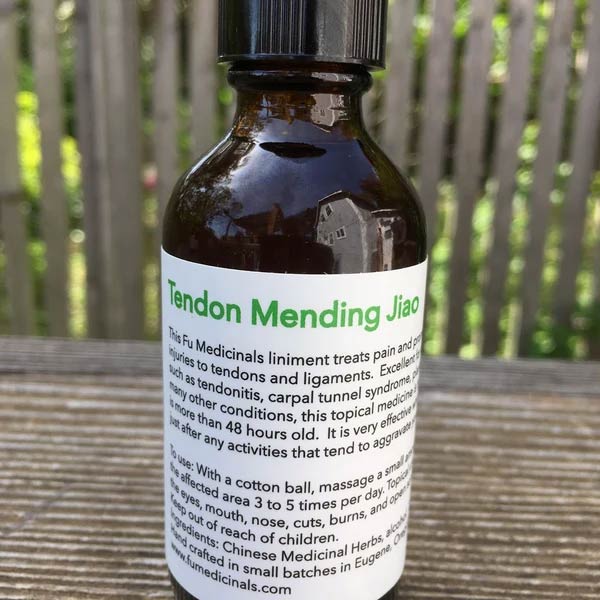
Learn how Gu Sui Bu and Tendon Mending Jiao are traditionally used to support chronic tendon,
Compare Glow and Copeia fertility teas, including Gui Zhi Fu Ling Wan and Dang Gui Shao