Psoriasis Flare Ups and Why You Need Three Sprays
Dr. Meli, in her own words, on why she and her husband built the Shu Hong


Willard Sheppy is a licensed acupuncturist (LAc) and Founder of Valley Health Clinic specializing in using Traditional Chinese Medicine to treat acute injuries and chronic conditions, and to improve sports performance and rehabilitation.
A patient sits down and tells me she’s cold all the time but wakes up sweating. Her tongue is red but her stools are loose. She’s exhausted and she can’t fall asleep. She’s thirsty and she doesn’t want to drink anything.
By the textbook, that’s three diagnoses at once, and two of them contradict each other. Early in my career I’d chase that in circles. What I understand now is that when the signs won’t resolve into one tidy picture, the disturbance usually isn’t a single organ. It’s an ecosystem — and ecosystems can run hot in one place and cold in another at the same time.
That is the idea the entire Botanical Biohacking catalog is organized around, and it’s why the line looks the way it does. This is the guide to the whole thing: who makes it, how the formulas map onto the terrain they’re meant for, what the published research honestly supports, and where to start.
Botanical Biohacking is a practitioner-founded Chinese herbal line built around the idea that many stubborn, contradictory symptom pictures come from disturbance in three internal ecosystems — the respiratory, gastrointestinal, and urogenital terrain. Each terrain has a cold-and-damp presentation and a hot-and-damp presentation, and each has a formula built for it. If you’re new to the line, most people start with Microgard for daily gut ground, then add the one tea that matches their pattern. Herbs aren’t neutral — anyone pregnant, nursing, on anticoagulants, or managing a chronic condition should talk to a qualified practitioner before starting.
Botanical Biohacking is a small practitioner-facing herb house. Their formulas are developed and fine-tuned by clinicians — Dr. Jin Zhao, DTCM, formulates; Dr. Zhong Shi Hong, a pharmacology professor, adjusts; Dr. Xuelan Qiu, PhD, writes the practitioner education — and the herbs are sourced from specific growing regions rather than bought on the open market. Their Chai Hu is wildcrafted from the Tibetan plateau. Their Bai Zhu comes with a terroir story and a quality marker you can actually see when you cut the root.
I carry a product after it has earned shelf space in my own clinic, not before. That’s the whole standard at Valley Health Market, and it’s the reason this line is here: the formulas are classical, the herb quality is visibly better than commodity grade, and the company can tell you exactly how each batch was tested. Not the cheapest. The most trustworthy I’ve found.
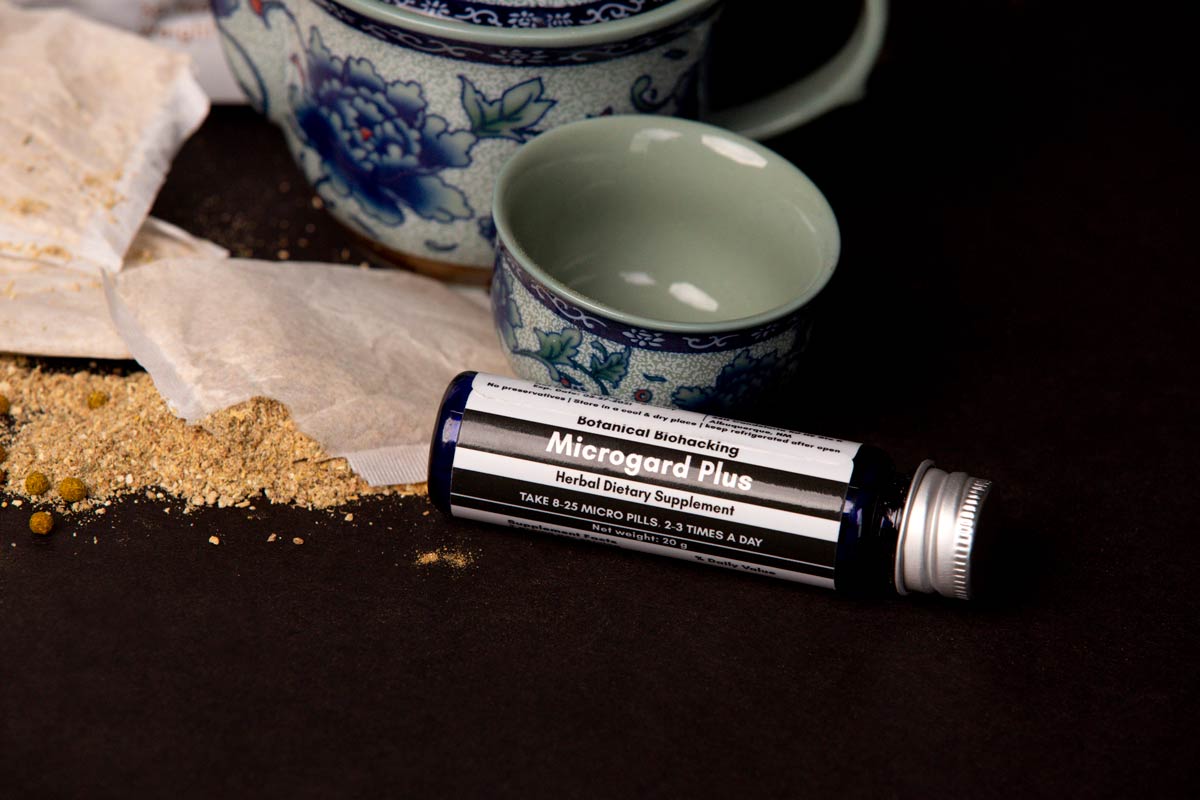
The catalog splits into teas (one-month supplies, thirty teabags each), herbal micro-pills that need no brewing, and topicals — a foot soak and acupoint patches. There’s also the Stem & Leaf spinal line, four region-specific back teas, which has its own guide.
When the signs won't resolve into one tidy diagnosis, the problem usually isn't a single organ. It's an ecosystem — and ecosystems can run hot in one place and cold in another at the same time.
— Will Sheppy, L.Ac.
Temperature and moisture are what separate a rainforest from a desert. They’re also what separate one internal terrain from another — and the living communities inside you respond to those two variables exactly the way an ecosystem outside you does.
When those communities fall out of balance, the signs they produce stop lining up. You get hot and cold at once, dry and damp at once, depleted and congested at once. The picture refuses to resolve, because you’re not looking at one tissue misbehaving. You’re looking at growing conditions that have drifted.
The working method that follows from that is simple, and it’s the opposite of chasing symptoms:
That’s not a claim that herbs cure anything. It’s a description of where to aim.
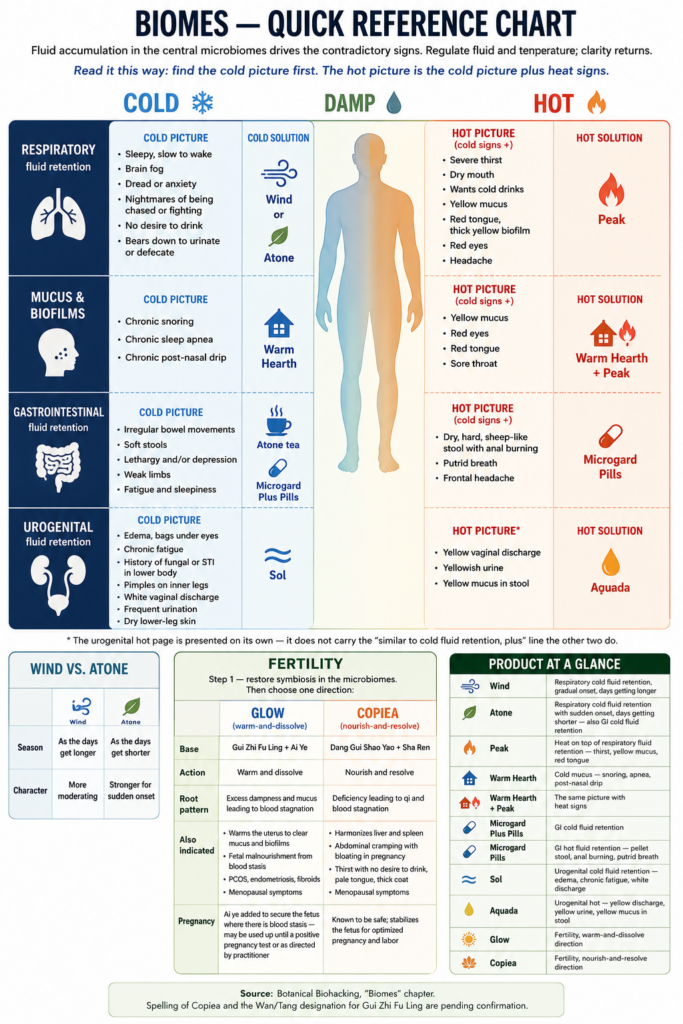
Three central terrains: respiratory, gastrointestinal, and urogenital. Each one has a cold presentation and a hot presentation, and in the first two the hot picture is simply the cold picture plus heat signs — so learn the cold one first.
When it runs cold and damp: sleepy and slow to wake, brain fog, a generalized feeling of dread, dreams of being chased, no real desire to drink water, and needing to bear down to use the bathroom. When heat is added on top: real thirst, dry mouth, wanting cold drinks, yellow mucus, red eyes, headache, and a red tongue with a thick yellow coat.
Cold and damp: irregular bowel movements, soft stools, a pull toward lethargy or low mood, weak limbs, sleepiness. With heat: dry, hard, pellet-like stool with burning afterward, foul breath, frontal headache.
Cold and damp: puffiness and water retention under the skin (the bags under the eyes), chronic fatigue, a history of fungal infections in the lower body, frequent urination, dry skin on the lower legs. With heat: the same terrain with yellowed discharge and urine, and often the dry “snake-skin” lower legs, sore or swollen knees, and toenail changes that go with damp-heat below the waist.
Not every complaint is an ecosystem problem. Some are circulation, some are the nervous system, some are the cycle, and some are simply pain that needs addressing while the slower work happens.
For back and neck pain specifically, the Stem & Leaf spinal teas take a different approach again — one tea per region of the spine, built on classical guide herbs. That line has its own guide.
Herbal marketing has a bad habit of citing a mouse study as though it were a clinical trial. Here’s an honest map of this catalog, strongest evidence first.
Four formulas in this line stand on placebo-controlled or multicenter human data. Gui Zhi Fu Ling Wan — the base of Glow Tea — was tested in a randomized, double-blinded, placebo-controlled trial of 128 women with period pain and produced significantly greater reduction in pain and symptom scores over three cycles. Huo Xiang Zheng Qi, the base of Atone, was tested across 14 hospitals in 212 adults with diarrhea-predominant IBS and beat placebo on symptom relief.
Berberine — the compound Huang Bai is prized for, and which appears in both Microgard and Aquada — cut HbA1c roughly twice as much as placebo in a 409-patient multicenter diabetes trial, with the effect traced directly to a change in gut bacteria. And herbal foot baths have been studied properly for neuropathy: a systematic review of 63 trials found hand and foot baths reduced chemotherapy-induced nerve symptoms by about 31%.
A tier down, there is human data of modest quality. Xiao Yao San — Purple Star — has meta-analyses behind it for anxiety with insomnia and for post-stroke depression. Both found benefit; both also state clearly that the underlying trials were small and methodologically weak. Ling Gui Zhu Gan Tang, the formula behind Sol, has pooled human evidence for fatty liver and for cardiac arrhythmia, with the same caveat.
The mechanism stories that make this line interesting are mostly animal work, and I’ll say so. Er Chen Tang’s effect on lipids and blood-vessel lining is a mouse study. Coix seed’s effect on gut bacteria is a mouse study. San Ren Tang — inside both Wind and Peak — has no human trials indexed in English at all. Er Miao San, behind Aquada, is rodent and computational only. Berberine’s much-discussed ability to disrupt bacterial biofilms and quorum sensing is real and quite striking — and entirely in test tubes.
None of this means the formulas don’t work. Two thousand years of clinical use is a form of evidence, and it’s the form most of Chinese medicine rests on. It means you should be suspicious of anyone — including me — who tells you a tea has been proven to do something.
Every batch is tested before formulation for three classes of contamination: heavy metals (lead, cadmium, arsenic, mercury), pesticide residue — which even herbs labeled organic can pick up from neighboring fields — and microbial load including bacteria, mold, and aflatoxins. Growers test first, then the company re-tests at a contracted lab. A batch that fails either round doesn’t enter the line.
Batches are also checked for active-compound concentration and water content. Herbs are sulfur-free, ground and sieved, with thicker pieces reground so they dissolve evenly, then dried and UV-sterilized before packing.
If a supplier can’t tell you their contamination-testing protocol, that’s the question to ask. It’s a fair question to ask me, too.
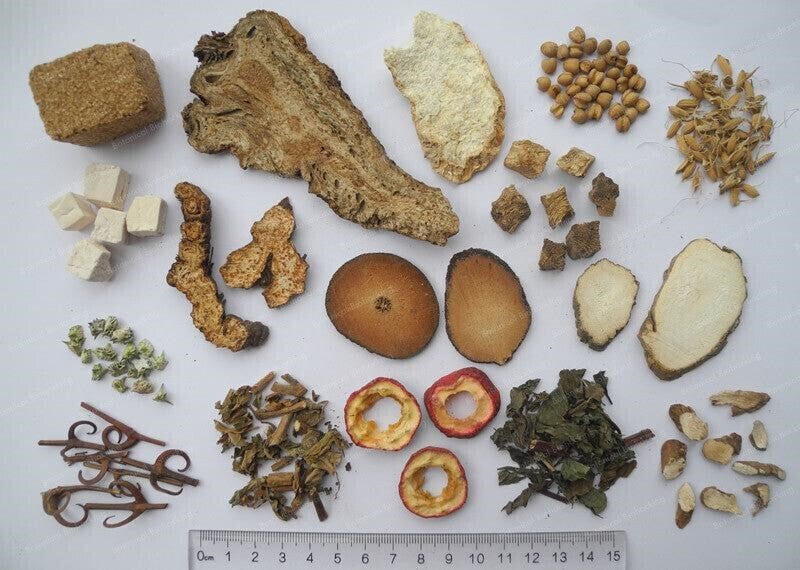
Teas, herbal micro-pills, foot soaks, and acupoint patches — practitioner-formulated, batch-tested, and stocked at Valley Health Market.
The most common mistake is starting three things at once and learning nothing from any of them.
If you’d rather not guess, that’s what a consultation is for. Bring your tongue, your sleep, and your bathroom habits — those three tell me more than a symptom list does.
Talk to a qualified practitioner before starting any of these if you are pregnant or trying to become pregnant, nursing, taking anticoagulants or antiplatelet medication, managing a chronic condition, or taking prescription medication of any kind. Herb-drug interaction is not theoretical: an exploratory study in healthy volunteers found Er Chen Tang increased the anti-platelet effect of low-dose aspirin.
Two more specifics worth naming. Tian Hua Fen, in Microgard Plus, is contraindicated in pregnancy. And Wind and Peak are built on San Ren Tang, which the tradition itself warns is no panacea — used indefinitely it can deplete the qi it’s meant to free up.
Herbs also don’t replace a diagnosis. Symptoms that are new, severe, rapidly worsening, or accompanied by fever, unexplained weight loss, or blood need medical evaluation first. A tea is a companion to good care, not a substitute for finding out what’s wrong. If you’re local to Albany and want help, call the clinic at 541-760-9670.
A note on evidence: several formulas in this line have genuine human trial data behind them and several do not. Where the research is animal or laboratory work, the text above says so. Traditional use is not the same as clinical proof, and we won’t present it as such.
Educational content rooted in 20+ years of clinical practice in Traditional Chinese Medicine. The information provided is for educational purposes and is not intended to replace consultation with a qualified healthcare practitioner. Please consult your physician before starting any new herbal protocol, especially if pregnant, nursing, on anticoagulants, or managing a chronic condition.
Botanical Biohacking is a practitioner-founded Chinese herbal line — teas, herbal micro-pills, a foot soak, and acupoint patches — formulated by clinicians and batch-tested for heavy metals, pesticide residue, and microbial load before formulation. Valley Health Market carries the line because it has earned shelf space in the clinic first.
Most people start with Microgard for daily gut ground, then add one tea matched to their pattern. Match by terrain: respiratory (Wind, Peak, Warm Hearth, Atone), gastrointestinal (Microgard, Microgard Plus, Atone), or urogenital (Sol, Aquada). Add one thing at a time and give it a few weeks — starting three at once teaches you nothing about any of them.
Because temperature and moisture differentiate every ecosystem, including the ones inside you — and an ecosystem can run hot in one place and cold in another at the same time. When the internal terrain drifts, the signs it produces stop lining up into one tidy diagnosis. The approach is to change the growing conditions rather than chase each contradictory sign.
For some, yes. Gui Zhi Fu Ling Wan (behind Glow Tea) beat placebo in a randomized double-blind trial for period pain; Huo Xiang Zheng Qi (behind Atone) beat placebo in a 14-hospital IBS trial; berberine, in Microgard and Aquada, outperformed placebo in a 409-patient diabetes trial; and herbal foot baths have systematic-review evidence for neuropathy symptoms. For others — San Ren Tang, Er Miao San, Er Chen Tang’s lipid effects, coix seed’s microbiome effects — the published work is animal or laboratory only, and we say so rather than dressing it up.
Yes. Anyone pregnant, trying to conceive, nursing, taking anticoagulant or antiplatelet medication, managing a chronic condition, or on prescription medication should talk to a qualified practitioner first — herb-drug interactions are real, and one study found Er Chen Tang increased the anti-platelet effect of low-dose aspirin. Tian Hua Fen, in Microgard Plus, is contraindicated in pregnancy. And symptoms that are new, severe, rapidly worsening, or come with fever, unexplained weight loss, or blood need medical evaluation first.
Dr. Meli, in her own words, on why she and her husband built the Shu Hong
Does Evil Bone Water work? An acupuncturist reviews the evidence for Zheng Gu Shui, camphor, menthol,
Learn which acupuncture points Will Sheppy uses for Ménière’s disease, vertigo and dizziness, plus treatment frequency