
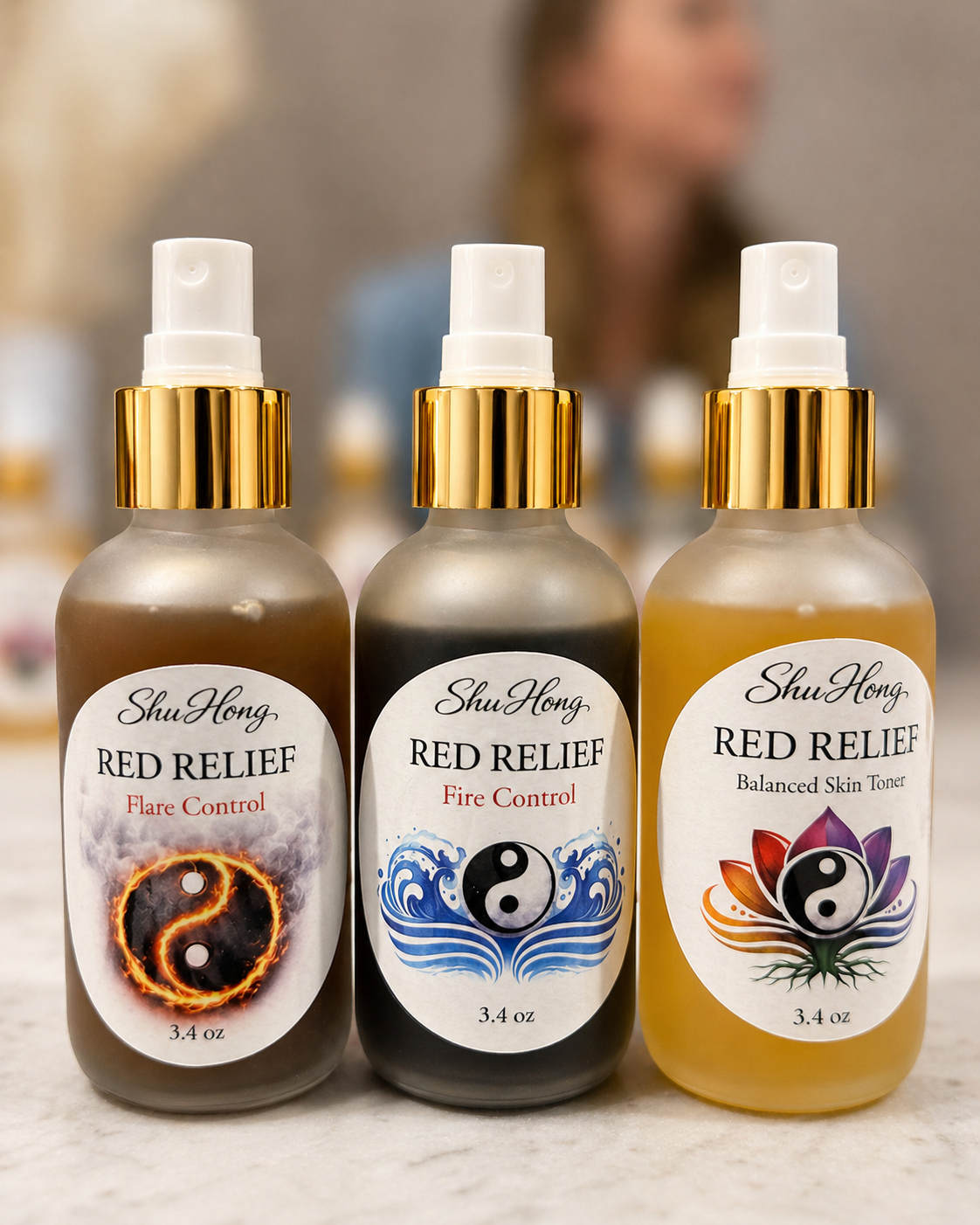
Psoriasis Flare Ups and Why You Need Three Sprays
Dr. Meli, in her own words, on why she and her husband built the Shu Hong


Willard Sheppy is a licensed acupuncturist (LAc) and Founder of Valley Health Clinic specializing in using Traditional Chinese Medicine to treat acute injuries and chronic conditions, and to improve sports performance and rehabilitation.
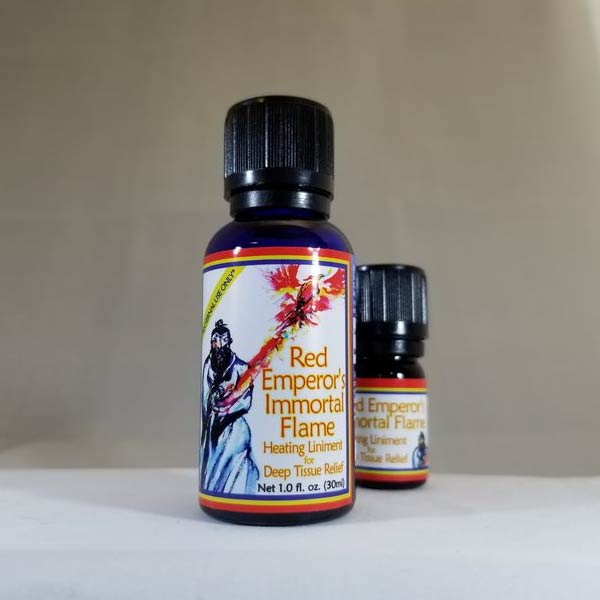
If you have ever bought an herbal oil and wondered whether there was really any herb in it, you are asking exactly the right question. A lot of what gets sold as “St. John’s wort oil” is a pale yellow-green liquid that has been sitting on a shelf under fluorescent light for a year, and there is no easy way for a customer to tell the difference.
I carry Red Emperor’s Immortal Flame in the clinic and on the shelf at Valley Health Market, and the question patients ask me about it is almost never “does it work.” It is “what is actually in it.” So I asked Hugh Turcotte, L.Ac. — the acupuncturist and clinical herbalist who makes it — to walk through the part nobody usually gets to see: how the St. John’s wort goes from a field in the last week of June to the red oil in the bottle.
Here is that process, and the two things you can look at to judge any St. John’s wort oil for yourself.
St. John’s wort (Hypericum perforatum) is identified in the field by squeezing a flower bud — the real plant stains your fingers purple. For medicinal oil, the flowering tops are harvested at full flower in late June, cold-packed the same day, screen-dried about 48 hours to drive off water, then packed into glass with organic olive oil and left in full sun for roughly two weeks. A properly made oil turns deep red. Red Emperor’s Immortal Flame is built on that infused oil and is for external use only.
There are a lot of yellow, five-petalled flowers in a summer field, and most of them are not Hypericum perforatum. Hugh’s test is the one herbalists have used for centuries, and it takes about two seconds.
Squeeze an unopened flower bud between your thumb and forefinger. If it is real St. John’s wort, your finger turns purple-red. That stain is the hypericin — the same pigment that will eventually color the oil. The species name perforatum points at the second check: hold a leaf up to the light and it looks pinpricked, because it is dotted with translucent oil glands.
This matters more than it sounds like it should. In a study of twenty-one home-made and commercial St. John’s wort olive-oil macerates, the researchers’ conclusion was blunt: the infused oils contained active components if the correct plant material was used. Identification is not a botany-nerd detail. It is the first quality-control step, and everything downstream depends on it.
“That red is one of the ways we know that it is what we say it is.”
— Hugh Turcotte, L.Ac., maker of Red Emperor’s Immortal Flame
This is the part of the process Hugh had never really shown before, and it is the part that separates a medicinal oil from a decorative one. There is nothing exotic in it — just a sequence where every step exists to protect the last one.
Here is the sequence, start to finish:
Nothing in that list is glamorous. But skip the cold pack and you lose actives to heat in transit; skip the drying and you get mold; use plastic instead of glass and you lose the sun infusion entirely. Each step is there to protect the one before it.
Hugh sources his St. John’s wort from domestic organic farmers who harvest it in the last week of June — not because of a production schedule, but because that is when the plant has put the most into its flowering tops.
Actives peak at full flowering (Pharmaceutical Biology, 2013)
In a study tracking two Hypericum species across five growth stages — vegetative, floral budding, full flowering, fresh fruiting and mature fruiting — hypericin and pseudohypericin reached their highest levels at full flowering. The authors’ recommendation was direct: harvest during flower development when the material is intended for medicinal use.
Harvest two weeks early or three weeks late and you are working with weaker raw material. No amount of careful processing afterward puts back what was never picked.
The traditional name comes from the same week. The Feast of St. John the Baptist falls on June 24, and the plant is at full flower right around it. Medieval Europeans hung it in doorways to ward off evil spirits — which is a folk memory of a plant people clearly took seriously, tied to exactly the window when it is strongest.
“When was this harvested?” is a fair question to put to anyone selling an herbal oil, and the answer tells you whether they are buying on a spec sheet or on a season. A maker who can name the week is paying attention to the plant. One who cannot is buying whatever was available.
Glass is, in Hugh’s own words, “very inconvenient, actually.” It is heavy, it breaks, and it costs more to ship. Plastic would be easier at every step. He uses glass anyway, because the extraction method depends on it: the jars have to sit in direct sunlight and take on heat, and that gentle solar warming is what pulls hyperforin and hypericin out of the plant material and into the oil.
This is a slow method by design. There is no press, no solvent, no heated tank turning out a batch in an afternoon. Two weeks of sun does the work that industrial processing does faster and cruder. You are paying for time here as much as for ingredients — which is also why a small-batch oil like this will never compete on price with a mass-market liniment, and is not trying to.
What actually ends up in an infused oil (Food Chemistry, 2013)
Researchers profiled twenty-one St. John’s wort olive-oil macerates — some home-made, some commercial — and analyzed them by LC-DAD-MS. Hypericin and pseudohypericin turned up in all of the oils. Hyperforin, which is far less stable, was detected in only four of the twenty-one, and adhyperforin in six.
That spread is the whole argument for method. Same plant, same solvent, wildly different results depending on how the oil was made. The authors’ conclusion was that infused Hypericum oils can carry active components — provided the correct plant material is used to begin with.
If hyperforin is the fragile one, then heat, light exposure at the wrong stage, and time on a warehouse shelf all work against it. Sun infusion in sealed glass is a compromise: enough warmth to extract, gentle enough not to cook. It is not the most efficient method available. It is the one that has kept producing usable oil for several hundred years.
Two weeks per batch, a fixed harvest window once a year, glass that has to be shipped carefully, and a raw material that has to be flown in cold. That is the real price of the method, and it is why this is made in small batches rather than continuously.
St. John’s wort is one part of a longer formula. The infused oil is the base, not the whole story. Red Emperor’s Immortal Flame also carries menthol, wintergreen, arnica, calendula, ginger, mustard seed and cayenne in an olive-oil carrier — a warming, circulating combination aimed at stiff, cold, achy tissue rather than at hot, acutely inflamed injury.
Made by Hugh Turcotte, L.Ac., Dipl. O.M. — carried at Valley Health Market because it earns the shelf space.
Olive oil goes into the jar green-gold. Two weeks later it comes out deep red. That color change is the single most useful thing a customer can look at, because it is hard to fake and it is the visible signature of the compounds you are buying the oil for.
Topical Hypericum has been studied in real wound healing
In a randomized, double-blind trial of 144 women following cesarean delivery, a topical Hypericum perforatum ointment applied three times daily for 16 days produced significantly better wound healing at day 10 and less scarring, pain and itching at day 40 than either placebo or no treatment. A separate seven-week pilot study of a St. John’s wort, calendula and garlic ointment on venous leg ulcers reported 99.1% epithelialization.
Neither of those studies is about muscle or joint pain, and I am not going to stretch them into a claim they do not make. What they do establish is that topical preparations of this plant have been taken seriously enough to be tested properly — which is more than most liniment ingredients can say.
Hold the bottle up to a window. If a product sold as St. John’s wort oil is pale and yellow, something in the chain — the identification, the harvest window, the drying, or the infusion — did not happen the way it should have.
It is not a laboratory assay, and I would not want anyone to read it as one. Plenty of variables sit between color and potency. But it is a real marker, and it is one you can see without taking anyone’s word for it.
Beyond the color, ask any maker two things: when was it harvested, and how was it extracted. Those two answers cover most of what separates a medicinal oil from a cosmetic one. If nobody can answer them, that tells you something too.
“The reason I use glass — it’s very inconvenient, actually. But the reason I use glass is because we’re going to get the heat infusion with the sunlight exposure.”
— Hugh Turcotte, L.Ac.
Sun-infused St. John’s wort, made the slow way
A warming herbal oil for stiff joints and soft tissue — the kind of ache that likes a heating pad. Made in small batches by Hugh Turcotte, L.Ac., and a good glide medium for cupping, gua sha and bodywork. External use only.
Red Emperor’s Immortal Flame is a warming oil, and I reach for it with the patients whose pain is worse in the cold and better with heat — stiff joints that take twenty minutes to loosen up in the morning, old injuries that ache when the weather turns, the necks and shoulders that show up in an Oregon January. In Chinese medicine terms it is aimed at Bi syndrome patterns with a cold-damp character. In plainer language: it is for the pain that likes a heating pad.
A treatment-room tool, not just a shelf product
The olive-oil base makes it genuinely useful under cupping, gua sha and hands-on bodywork, which is a large part of why it lives in my treatment room and not only on the retail shelf. If I am working a stiff shoulder with a cup, I want something with slip that is also doing something.
For an acute, hot, swollen injury I reach for something cooling instead. Matching the herb to the tissue state matters more than picking a favorite bottle.
The oil is concentrated. Six to eight drops is a liberal application, and a 30 ml bottle holds over 500 drops — roughly 60 to 80 applications. Work it in for several minutes rather than dabbing it on; the massage is part of the point.
Topical herbal preparations like this are traditionally used to support comfort in muscles and joints. They are not a treatment for any named disease, and nothing here is a substitute for evaluation of a new or worsening problem.
External use only. This is a medicinal-strength topical formula and should be used with care. Do not take it internally, keep it away from eyes and mucous membranes, and do not apply it to broken skin.
If you are pregnant or nursing, talk to your healthcare provider before using it. If you have not used a warming liniment before, test a small area first — menthol, wintergreen, ginger and cayenne together produce real heat, and skin sensitivity varies a lot from person to person.
Orhan IE, Kartal M, Gülpinar AR, Cos P, Matheeussen A, Maes L, Tasdemir D. Assessment of antimicrobial and antiprotozoal activity of the olive oil macerate samples of Hypericum perforatum and their LC-DAD-MS analyses. Food Chemistry. 2013;138(2-3):870–875. Link →
Cirak C, Radusiene J, Camas N, Caliskan O, Odabas MS. Changes in the contents of main secondary metabolites in two Turkish Hypericum species during plant development. Pharmaceutical Biology. 2013;51(3):391–399. Link →
Samadi S, Khadivzadeh T, Emami A, Moosavi NS, Tafaghodi M, Behnam HR. The effect of Hypericum perforatum on the wound healing and scar of cesarean. Journal of Alternative and Complementary Medicine. 2010;16(1):113–117. Link →
Kundaković T, Milenković M, Zlatković S, Nikolić V, Nikolić G, Binić I. Treatment of venous ulcers with the herbal-based ointment Herbadermal®: a prospective non-randomized pilot study. Forschende Komplementärmedizin. 2012;19(1):26–30. Link →
Citations located via PubMed. Product details from the Red Emperor’s Immortal Flame product page.
Squeeze an unopened flower bud between your fingers. Real Hypericum perforatum stains your skin purple-red from the hypericin it contains. As a second check, hold a leaf up to the light — it looks perforated with tiny translucent dots, which is where the species name comes from.
The red comes from hypericin and related compounds moving out of the flowering tops and into the oil during the sun infusion. Olive oil goes into the jar green-gold and comes out deep red. It is a visible marker that the right plant was used and that the extraction actually happened — not a potency measurement, but a real signal.
Because the gentle, sustained warmth of two weeks of direct sunlight is what draws hyperforin and hypericin out of the plant material and into the olive oil. That is also why the jars are glass rather than plastic, despite glass being heavier, more fragile and less convenient at every stage.
Water left in the flowering tops creates a mold risk once the material is submerged in oil. Screen-drying for about 48 hours brings the moisture down far enough that the infusion stays stable. It is a shelf-stability step, not a shortcut.
It is a warming formula, so it suits pain that feels better with heat — stiff joints, old aches that flare in cold weather, muscles that need loosening. It is for external use only. If you are pregnant or nursing, check with your provider first, and get new or worsening pain properly evaluated rather than managing it with a topical.
Dr. Meli, in her own words, on why she and her husband built the Shu Hong
Does Evil Bone Water work? An acupuncturist reviews the evidence for Zheng Gu Shui, camphor, menthol,

Learn which acupuncture points Will Sheppy uses for Ménière’s disease, vertigo and dizziness, plus treatment frequency