
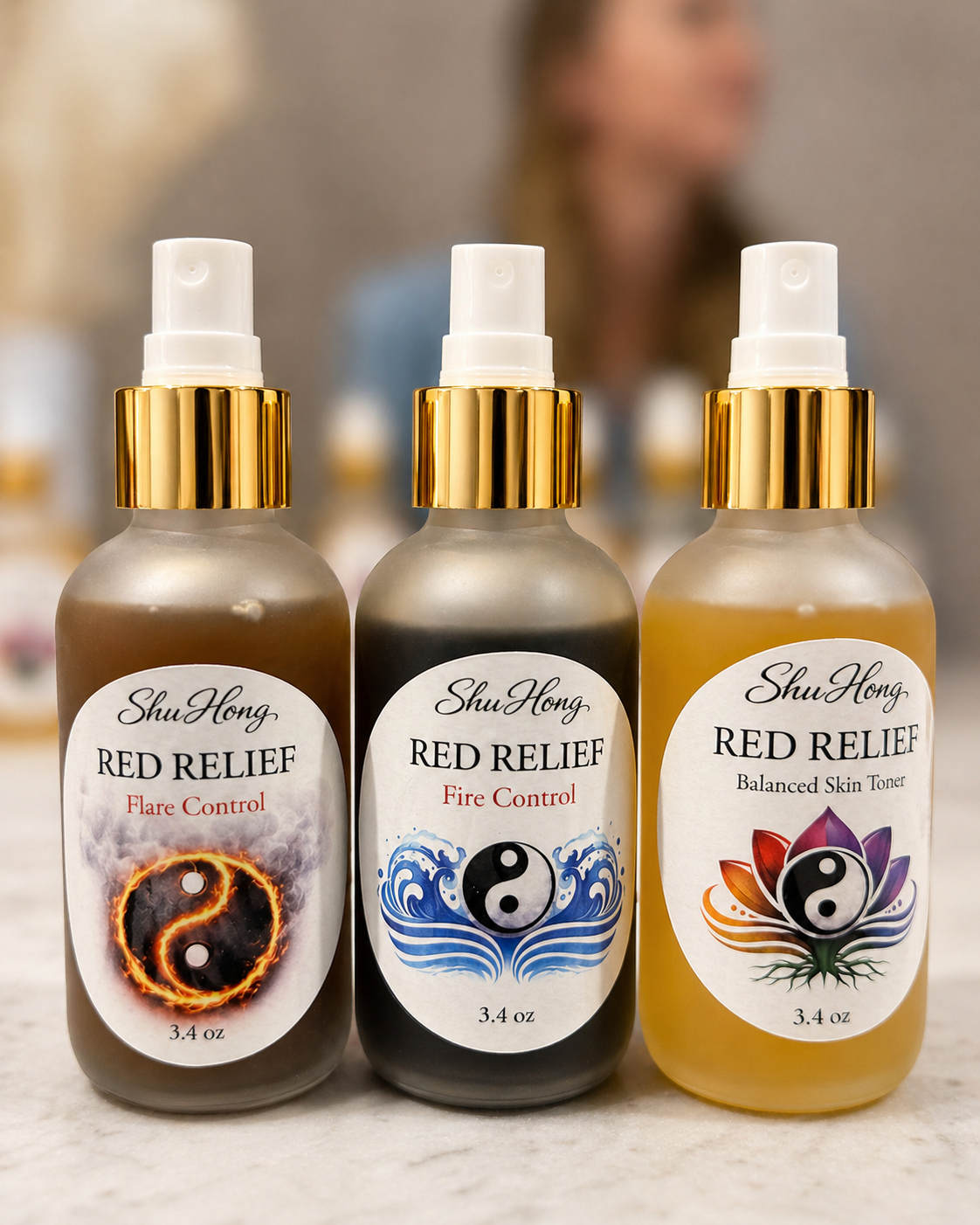
Psoriasis Flare Ups and Why You Need Three Sprays
Dr. Meli, in her own words, on why she and her husband built the Shu Hong


Willard Sheppy is a licensed acupuncturist (LAc) and Founder of Valley Health Clinic specializing in using Traditional Chinese Medicine to treat acute injuries and chronic conditions, and to improve sports performance and rehabilitation.
You can’t always control how a day is going to feel. But when you live with chronic pain, you learn to control almost everything around it — which chair you sit in, where you sit in the theater, what goes on your back and when.
In the clinic I see this constantly. A patient tells me they’re “doing fine,” and then I ask what a normal Saturday actually takes. Twenty small decisions before lunch. Route planning. A bag with a heat pack in it. None of it is visible to anyone else, and all of it is work.
Elise Britton, the practitioner who formulates Corydalis Relief Salve, filmed one of her days off recently — a dentist appointment, then two and a half hours in a movie theater with her kids. It is the clearest short picture I have seen of what pain management really looks like between appointments, so I want to walk through what she is doing and why each piece of it works.
Living well with chronic pain is mostly logistics. The people who do it best pick seats they can leave, plan topicals before the pain arrives instead of after, and build the option to stand up into every outing. In the video above, Elise Britton plans a dentist visit and a two-and-a-half-hour movie around exactly that — including layering Evil Bone Water under Corydalis Relief Salve partway through the day.
Elise opens the video with a line that will land for anyone managing pain: “I needed a day off, and now that day off is going to turn into a series of uncomfortable chairs.”
That is the whole problem in one sentence. A day off is not automatically a day of rest. A dentist appointment means an unfamiliar waiting room and then a reclined chair you cannot adjust. A movie means two and a half hours in a fixed seat in the dark. Neither of those is a hard day by anyone else’s measure, and both of them require planning.
As she puts it: “It’s a lot of forethought that goes into how we plan things for ourselves when we’re trying to manage our pain.”
I would add one thing to that. The forethought is the treatment. Patients often apologize to me for how much they plan, as though the planning were another symptom. It is not. It is the skill, and the people who do it well have more good days than the people who wing it.
"A lot of times I feel like Goldilocks trying out chairs in here."
— Elise Britton, DTCM, formulator of Corydalis Relief Salve
Watch what she does in the dentist’s waiting room. She tries one chair. Nope. Tries another. No. The third one works. “Third time’s a charm.”
From the outside this looks like fussiness. It is not. Seat height, seat depth, whether there is a gap behind your low back, whether the arms let you push yourself up without loading your spine — those variables decide whether the next twenty minutes cost you anything. Getting it right on the third try is far cheaper than getting it wrong once.
If you want a starting point for your own version of this, here is what I have patients check before they commit to a seat:
None of this is exotic. It is just the difference between arriving at the second half of your day with something left in the tank, and arriving already spent.
| Where you are | What makes it hard | What to look for | What to book |
|---|---|---|---|
| The waiting room | Deep, soft chairs let your pelvis roll back | Firm seat, feet flat, armrests you can push off | Nothing — just try three before you settle |
| A two-hour movie | One fixed position in the dark, no easy exit | Room to stand, shift, or step back without blocking anyone | Back row or an aisle seat, chosen in advance |
| A long drive or flight | No chance to stand at the moment you need to | Lumbar support and a realistic stopping plan | Aisle seat; a break roughly every 90 minutes |
“Usually buy seats in the back of the movie theater so I can do these things to feel more comfortable in my body while I enjoy these activities with my kids and their friends.”
The back row is not about the view. It is about permission. From the back you can stand, shift your weight, or take a few steps without climbing over anyone or blocking a screen. Elise says it plainly: “I might stand, I might sit, I might walk around in the back.”
Static loading is what makes long sitting hurt — not the sitting itself.
Tissues held under constant, unchanging pressure get unhappy well before they get damaged. Blood flow drops, discs load in one direction, and the muscles that were holding you get no chance to trade off. This is why a better cushion so rarely fixes the problem: the variable that matters is not how soft the seat is, it is how long you stay in one shape.
If your pain builds over the course of a long sit rather than hitting you at the start, this is your pattern. You are not looking for comfort in minute one — you are looking for the ability to change position at minute forty.
Change position every twenty to thirty minutes, and buy the seat that lets you. The same logic scales to almost anything: the end of the pew, the aisle seat on the flight, the back of the school assembly, the chair nearest the kitchen at a dinner party.
You are not being difficult when you ask for it. You are removing the part of the outing that was going to cost you.
Corydalis — yan hu suo in Chinese herbal medicine — is one of the oldest pain herbs in the materia medica, and one of the few with a modern research trail worth reading. I want to be straight about what that research does and does not show.
Corydalis extract reduced acute, inflammatory, and neuropathic pain in animal models — without producing tolerance.
According to PubMed, a 2016 study in PLoS One tested a Corydalis yanhusuo extract across all three pain types in mice and found the effect did not fade with repeat dosing — the authors traced part of it to dopamine D2 receptor antagonism rather than an opioid mechanism. A separate 2016 paper in Scientific Reports looked at dehydrocorydaline, one of the herb’s main alkaloids, and found it reduced both pain behavior and swelling while lowering inflammatory signaling in the spinal cord. Later work points at voltage-gated sodium channels — including Nav1.7, a target modern analgesic development cares a great deal about — as another likely piece of the mechanism.
What I can say from the clinic is that Corydalis Relief Salve fills a specific gap. It contains no camphor and no menthol, so it does not produce the cold blast that people with poor circulation, chemotherapy-related neuropathy, or sensitive skin often cannot tolerate. That makes it usable for a group of patients who previously had essentially nothing on the shelf.
The formula is short, and every ingredient is doing a job:
It is made by Eliz Britton, DTCM, of Botanical EZ — the practitioner in the video — and it is one of the products we tested in the clinic before it earned shelf space.
These statements have not been evaluated by the US Food & Drug Administration. This product is not intended to diagnose, treat, cure, or prevent any disease. For external use only.
When Elise says she may “do a combination of either Bone Water and salve,” she is describing the layering principle we use throughout the clinic: fast-acting foundation first, longer-lasting support on top.
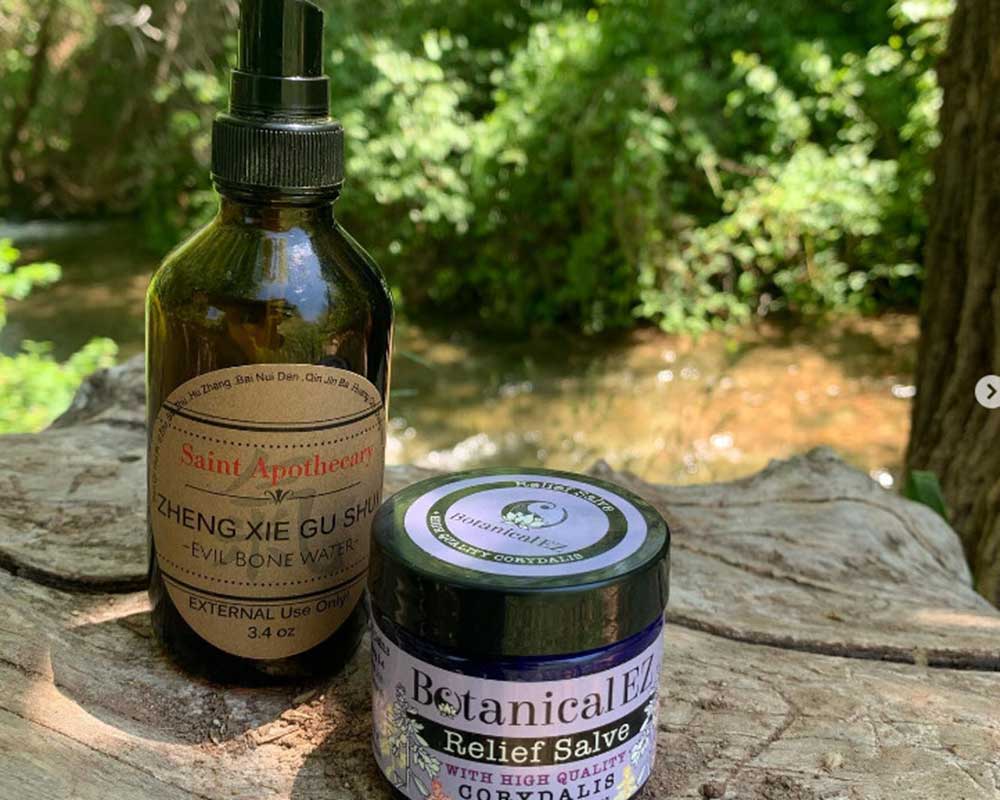
Evil Bone Water goes on first. Corydalis Relief Salve goes on second.
Evil Bone Water is alcohol-based, so it flashes in quickly and gets to work fast — but that same volatility is why it does not stay. Corydalis Relief Salve, applied over the top once the liniment has absorbed, holds its herbs against the skin for hours instead of minutes on a base of coconut oil, shea butter, and beeswax. Reverse the order and the salve simply traps the liniment on the surface, and you lose most of the benefit of both.
The two products together are what we call the Pain Power Combo. If you only ever remember one thing from this post, make it the order: liniment first, salve second, and give the first one a minute to disappear before you reach for the second.
"It's a lot of forethought that goes into how we plan things for ourselves when we're trying to manage our pain."
— Elise Britton, DTCM
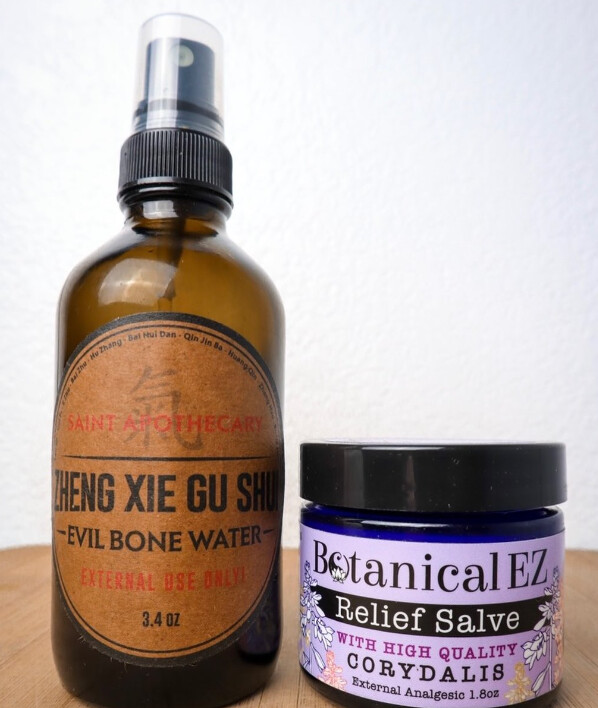
Evil Bone Water + Corydalis Relief Salve. The fast-absorbing liniment and the long-lasting salve, in the order they are meant to be used. Both are made in small batches by practitioners we know, and both were tested in the clinic before we carried them.
Here is the piece I most want people to take from the video. Elise says: “Now, for this first stop, I usually just put salve on my back. But halfway through, I may need to do a combination of either Bone Water and salve.”
Notice the timing. The salve goes on before the dentist chair, not after it starts hurting. Then the plan escalates at the halfway mark — not because something went wrong, but because she already knows what a long afternoon costs her.
Most people use a topical the way they would use a fire extinguisher.
Something has gone wrong, so they reach for the jar. Applying ahead of a known load, and reapplying on a schedule rather than on a symptom, is a different strategy — and in my experience a better one. It keeps you from spending the first half of the movie waiting to find out how bad it is going to get, which is its own kind of exhausting.
The practical version looks like this: apply before the activity, reapply at the midpoint of anything longer than about two hours, and carry the smaller stick applicator so that reapplying is realistic rather than theoretical. A jar left at home helps no one.
Everything above is about managing a known, stable pain pattern around ordinary life. It is not a substitute for having the pain properly evaluated, and there are situations where the right move is a phone call rather than a better chair.
Short of those, the goal is not to eliminate the planning. It is to make the planning cheap enough that you still say yes to the movie.
Get the pattern read by someone who treats it.
If pain is shaping how you plan your week — which chair, which seat, which invitations you turn down — that is worth a conversation rather than another workaround. We work with pain, sports injuries, and rehabilitation here in Albany, Oregon.
Wang L, Zhang Y, Wang Z, et al. The Antinociceptive Properties of the Corydalis yanhusuo Extract. PLoS One. 2016;11(9):e0162875. DOI →
Yin ZY, Li L, Chu SS, et al. Antinociceptive effects of dehydrocorydaline in mouse models of inflammatory pain involve the opioid receptor and inflammatory cytokines. Scientific Reports. 2016;6:27129. DOI →
Alhassen L, Dabbous T, Ha A, et al. The Analgesic Properties of Corydalis yanhusuo. Molecules. 2021;26(24):7498. DOI →
Xu Y, Sun J, Li W, et al. Analgesic effect of the main components of Corydalis yanhusuo is caused by inhibition of voltage gated sodium channels. Journal of Ethnopharmacology. 2021;280:114457. DOI →
Zhou MY, Yao CH, Yang YJ, et al. Based on spinal central sensitization creating analgesic screening approach to excavate anti-neuropathic pain ingredients of Corydalis yanhusuo W.T.Wang. Journal of Ethnopharmacology. 2023;319(Pt 1):117084. DOI →
Related reading
Is Evil Bone Water Good for Neuropathy?
Stem & Leaf Sacrocox: For Tailbone Pain You Can’t Sit Through
A Comprehensive Product Review of Corydalis Relief Salve
Research citations retrieved via PubMed.
Look for firm over soft, feet flat with knees at or just below hip height, and armrests you can push off from. Most importantly, pick a seat you can leave — an aisle, the end of a row, or the back of the theater — so you can stand or walk without disturbing anyone. Being able to change position every twenty to thirty minutes matters more than the cushion.
Before. Applying ahead of a known load — a long drive, a movie, a dentist appointment — and reapplying at the halfway point tends to work better than reaching for the jar once pain has already set in. Carry a smaller stick applicator so that reapplying is actually realistic when you are out.
Evil Bone Water first. It is alcohol-based and absorbs quickly, so it needs bare skin. Give it a few minutes, then apply Corydalis Relief Salve over the top — its coconut oil, shea butter, and beeswax base holds the herbs in place for hours. Salve first simply traps the liniment on the surface and you lose most of the benefit of both.
Both. According to PubMed, laboratory and animal studies have found that Corydalis yanhusuo extract reduces acute, inflammatory, and neuropathic pain responses without producing tolerance, with mechanisms pointing at dopamine D2 receptors and voltage-gated sodium channels. Most of that work used oral or injected extracts in animals, not human trials of a topical salve
Because the cold blast in conventional topicals is not tolerable for everyone. People with poor circulation, chemotherapy-related neuropathy, or sensitive skin often cannot use products like that at all. Corydalis Relief Salve contains no camphor or menthol — and no CBD or THC — so it is an option for people who previously had essentially nothing else on the shelf.
Dr. Meli, in her own words, on why she and her husband built the Shu Hong
Does Evil Bone Water work? An acupuncturist reviews the evidence for Zheng Gu Shui, camphor, menthol,
Learn which acupuncture points Will Sheppy uses for Ménière’s disease, vertigo and dizziness, plus treatment frequency