

Psoriasis Flare Ups and Why You Need Three Sprays
Dr. Meli, in her own words, on why she and her husband built the Shu Hong


Willard Sheppy is a licensed acupuncturist (LAc) and Founder of Valley Health Clinic specializing in using Traditional Chinese Medicine to treat acute injuries and chronic conditions, and to improve sports performance and rehabilitation.
If your knee hurts, you know what’s going on. There’s a joint, there’s a story, there’s a plan. Vertigo isn’t like that. The room moves, nobody else can see it happening, and the not-knowing is its own kind of awful.
I found that out the hard way. I was diagnosed with Ménière’s disease lying in a hospital bed next to my wife and our newborn third child, while the world spun so hard I assumed I had food poisoning from the sushi I’d just eaten. I’m a licensed acupuncturist with more than twenty years of clinical experience, and I still had no idea what was happening to me.
I sat down with Brodie Welch, L.Ac., on the 10-year anniversary episode of her podcast A Healthy Curiosity, to talk through all of it — the sushi, the MRI, the moment the Chinese medicine map finally made the whole thing make sense, and the unglamorous daily things that got me from “this controls my life” to more good days than bad. Here’s the conversation, and what I’d want you to take from it.
Ménière’s disease is an inner-ear condition — vertigo, tinnitus, ear pressure, fluctuating hearing — with excess fluid in the inner ear as its marker and no single known cause. Because there’s no one cause, there’s no one fix, which is exactly where Chinese medicine tends to be useful: instead of chasing the label, we look for the pattern underneath it, and for the conditions that travel with it — allergies or autoimmune activity, digestive trouble, neck tension, and an overactive nervous system. Working that pattern is how you shift from waiting out attacks to stacking up good days.
This article is educational and reflects my clinical and personal experience. It isn’t medical advice and it isn’t a diagnosis — sudden vertigo or hearing loss should be evaluated by a physician.
The frustrating thing about Ménière’s is that nobody really knows what it is. We know it involves the inner ear. We know there’s a key marker — excess fluid in the inner ear. But the cause is idiopathic, which technically means “unknown,” and practically means there is more than likely more than one cause.
That’s not a dead end. It’s a clue. If a hundred people with the same diagnosis got there by different roads, then the useful question isn’t “what is Ménière’s?” — it’s “what is your Ménière’s made of?”
It’s also uncommon, which is part of why it’s so isolating. Most estimates put it at roughly 0.05% to 0.2% of adults, with a higher reported prevalence in Europe and North America than in East Asia. When you’re one in a thousand, you don’t meet many people who get it.
Nobody really knows what Ménière's is. Which means the useful question isn't "what is Ménière's?" — it's "what is your Ménière's made of?"
— Will Sheppy, L.Ac.
Picture it: I’m in the hospital, it’s our third child, and I’m lying on the bed next to my wife and our newborn, violently spinning. My wife had been off sushi the whole pregnancy, so the moment the baby arrived she wanted sushi — and I’d gone and gotten some. I assumed food poisoning. I still have this image of her staring at me from the bed like, what is going on.
The next day I felt fine. Food poisoning, obviously. We brought the baby home. And that evening, out of nowhere, it started again.
So I went to the doctor. They ran a hearing test — my hearing was affected. They ran an MRI to rule out a brain tumor — no tumor, which is genuinely great news. And then came the diagnosis, followed immediately by the sentence that sends so many people down a rabbit hole:
“We can diagnose you. But we can’t really fix you. You’re kind of on your own.”
Take allergy pills. Take a diuretic. Change your diet. That was it. I had a newborn at home and a practice to run, and “that was it” was not going to work. Ménière’s and fibromyalgia are sisters in that way — we have a label for you, and not much else.
And then came the moment a lot of practitioners will recognize, where you realize you’ve been wearing the ruby slippers the whole time: oh — I’m an acupuncturist. This one was on me to figure out.
As I tried to work out what was happening to me, I realized there are really two different kinds of dizziness, and confusing them costs people a lot of hope.
The first is the world spinning. That one is your ear talking to your eye. Tilt your head to one side and your inner ear picks up the tilt and tells your eyes to move the opposite way — which is why everything looks stable while you walk around. When the ear goes off, it sends the signal that the world is spinning, and your eyes dutifully jump the other way. Your eye is listening to your ear. That’s the spin.
The second is everything else. Balance runs on three inputs: the inner ear, the eyes, and proprioception — your body’s sense of where it is in space. When the other two are off, you get a different flavor of trouble: not spinning, just unsteady. Wobbly.
Here’s why that matters. We can often settle the ear relatively quickly. And then people are left saying, “the world isn’t spinning anymore, but I still don’t feel stable” — and they conclude they aren’t getting better. They are. They’ve moved to the next layer. If you don’t know these are separate systems, ordinary progress feels like failure.
In Chinese medicine we work from a simple premise: what’s going on outside tends to reflect what’s going on inside. I can’t see your inner ear. I can see the rest of you. So when someone comes in with Ménière’s, I don’t start at the ear — I pan out and ask what else is happening in the landscape.
Almost always, it comes in threes. And this is where a lot of people get stuck, because comorbidities blur the picture and make triggers nearly impossible to identify on your own.
Allergy is common in Ménière’s, and psychological comorbidity is closer to the rule than the exception.
In a survey of 734 Ménière’s patients, 59.2% reported possible airborne allergy and 40.3% suspected food allergy — both significantly higher than in controls (Derebery & Berliner, 2000). And among 547 patients at a specialist vertigo clinic, 48.8% met criteria for a current psychiatric disorder — most commonly anxiety and phobic disorders — and reported markedly more vertigo-related handicap than patients without one (Lahmann et al., 2015).
Notice that not one of those is the ear. That’s the point. When people ask me what to pay attention to, I tell them to take honest inventory of the whole system: how’s your digestion, how’s your sleep, what’s your nervous system doing, is anything red and hot and itchy. Patients who arrive with almost no other symptoms are actually the harder puzzle — there’s less to work with. More detail is more map.
I’ve written the long version of this elsewhere: Ménière’s disease rarely acts alone — the comorbidities that change the picture.
I did what I’d do for any patient: I looked at what Western medicine was actually trying to accomplish, then looked for the same shape in Chinese medicine.
Western medicine’s three moves were a diuretic (reduce fluid), an antihistamine (reduce inflammation), and a dietary change (remove triggers). Chinese medicine’s most commonly researched pattern for this presentation is Liver yang rising — heat and pressure surging upward — with Dampness and Stagnation alongside it.
Line them up. Descending fluid matches the diuretic. Clearing heat matches the anti-inflammatory. Calming and descending matches the nervous system piece nobody was addressing. Two systems, built centuries and continents apart, pointing at the same three things.
That was my first moment of hope. Not because I’d been cured — because I finally had a direction.
You're lost in the woods. The world is spinning on a physical level and on an emotional level. And then it's — okay, I have a map. I have a plan. And I know that if I work this plan, I'm going to start getting better.
— Will Sheppy, L.Ac.
So I built a formula that addressed all three, did acupuncture, changed my diet, and honestly did everything at once. About two weeks later, the dizziness stopped.
I want to be precise about what that means, because this is where a lot of Ménière’s content oversells. I didn’t “fix” it. What I got was tools — a way to take care of myself so this doesn’t run my life. That formula work eventually became Bai Zhu Balance, the formula I designed around the Dampness–Heat–Stagnation pattern. It supports the pattern; it doesn’t cure a disease, and it isn’t right for everyone — people who run fatigued, low-blood-pressure or dry generally shouldn’t take it, and neither should anyone pregnant or nursing.
Because this is so individual, the first thing I say to a new Ménière’s patient is: don’t tell me you have Ménière’s disease. Tell me what you’re feeling. Don’t take the label — describe the experience. That’s where the pattern lives. Two examples of what that turns up.
I treated a triathlete with chronic swimmer’s ear. She loved the water, and she got ear infections constantly. We did topical treatment, ear drops — it helped, and it always came back. It didn’t stop until we improved her digestion.
The path there isn’t mysterious: gut to throat to sinuses, and your sinuses talk directly to your ear through the eustachian tube. Excess inflammation upstream shows up as aggravation downstream. There’s a second route too — when the gut is unhappy, stress physiology climbs, and an elevated stress response makes dizziness worse. For some people, cleaning up the diet changes the ear. For others whose digestion was never the problem, it barely moves the needle. Which is the whole reason you find your pattern first.
A patient came in recently and I asked her to walk me through an attack. She said, “I’ll be at work” — okay, daytime, active — “and I start to get sweaty,” and then she knows a dizziness attack is coming.
Sweaty, then dizzy, mid-afternoon, at work. That’s a panic response. Not “it’s all in her head” — a real, physical, autonomic cascade that was reliably preceding her vertigo. And honestly, of course it was: when a chronic illness starts flaring, the fear is entirely reasonable. It’s scary.
So we treated the stress pattern, and her vertigo improved. Her trigger was never digestion. It was an overloaded nervous system, aggravated by work and short sleep, firing in the most stressful stretch of her day. Once she knew that, she had tools: a nap at lunch, nasal breathing with long exhales. That’s the difference between being at the mercy of the condition and steering it.
Free email series
Get the Vertigo Map
Eleven at-home Ménière’s tools from Will, one short email at a time.
Check your inbox. Email 1 is on its way. If it isn’t there in a few minutes, check Promotions or Spam.
None of these replaces a workup or a treatment plan. They’re the low-cost, high-frequency things I use myself and give to almost every Ménière’s patient while we figure out the bigger picture.
Breathing through your nose is not a small intervention.
Nitric oxide concentrations in the upper airway run roughly 200 to 2,000 parts per billion, versus 4 to 160 in the lower airway; the paranasal sinuses are the main source, and the gas contributes to host defense and ciliary activity up there (Lefevere et al., 2000; Spector et al., 2021). That’s the mechanism behind a habit that costs nothing. I was as surprised as you are.
And here’s why these unglamorous things beat the dramatic ones: what you do most of the time matters more than what you do some of the time. You get acupuncture once a week, maybe twice. You breathe constantly. You eat three times a day. Small inputs, repeated, are the most powerful tools you have.
Almost everyone with Ménière’s — same as fibromyalgia — has good days and bad days. People want to talk about the bad ones. I want to talk about the good ones, because a good day is proof that your system is capable of balancing itself. It’s already doing the thing. The whole job from there is arithmetic.
Your body is strong enough to have good days. So we know the system can balance itself. Let's figure out how to get more good days than bad days.
— Will Sheppy, L.Ac.
The place people get stuck is all-or-nothing thinking. They hear “change your diet” as “I can never have a cocktail at dinner again,” decide that’s unlivable, and do nothing. So let’s pause on that. The goal of medicine is absolutely that you can handle those things. But while the world is spinning, be strict — and then reintegrate as your body gets stronger. Brodie put it better than I did: if you’re going to stand up in a canoe, don’t do it when the water is choppy. Wait until things calm down, then take the safe risk. (My version was “don’t break two laws at once,” which tells you something about my upbringing.)
Notice too that perfectionism can itself be the problem. If stress is part of your pattern, getting stressed about running the protocol perfectly is making it worse. Give yourself permission to run at 80/20. What most of your actions need to do is point in the direction of better rather than worse — not all of them, most of them. That’s the two-degree course correction: barely visible at the start, an entirely different coastline by the time you arrive. People try something, don’t see an immediate result, and quit. You’re probably on the right path. Healing just moves at the speed of the body.
To be clear about where the line is: everything above is a starting point for understanding your own pattern, not a substitute for a diagnosis.
Get evaluated by a physician if vertigo is new, sudden, or different from your usual pattern. Sudden hearing loss is time-sensitive — treat it as urgent, not as something to sit on. And seek emergency care for dizziness that arrives with double vision, slurred speech, weakness or numbness on one side, trouble walking, or the worst headache of your life. A proper Ménière’s workup — hearing testing, and imaging to rule out other causes — is worth having on the record even when the answer is “nothing scary.” Mine was.
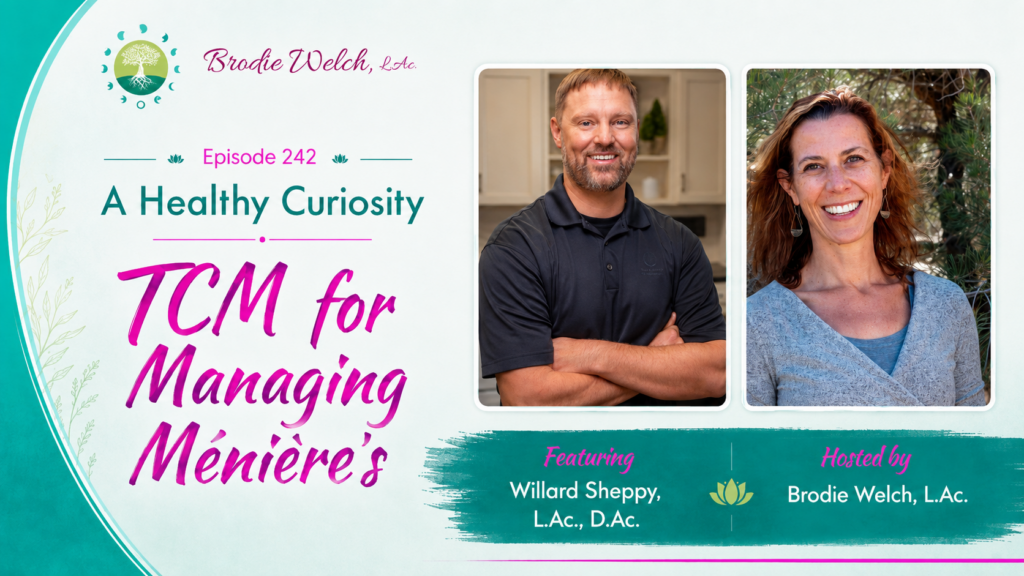
The whole episode is worth your time. Brodie asks the questions patients actually have, and we go further into the balance systems, the pattern differentiation, and the both/and case for using whatever actually works — a point she makes better than anyone: in China, roughly 90% of hospitals treat with allopathic medicine, acupuncture, herbs, or some combination, based on what the evidence supports for that condition. It isn’t alternative medicine over there. It’s just medicine.

If you’re in the thick of it right now, the hardest part isn’t finding information — it’s that the information is scattered and contradictory. That’s exactly why we built Gut Brain Synchrony, a practitioner-curated community where a group of us answer questions directly, run live and recorded classes, and keep the guidance consistent instead of scattershot. Social media groups will give you a hundred confident answers. This is a smaller, safer room with practitioners actually in it.
If you’d rather work with me directly: I practice at Valley Health Clinic in Albany, Oregon, and I see Ménière’s patients both locally and remotely. Call 541-760-9670 or get in touch here.
Keep reading:
Disclosure: the Gut Brain Synchrony link is an affiliate link. This article and the podcast episode are for informational purposes only and should not be considered medical advice. Statements about herbal formulas have not been evaluated by the FDA; no product mentioned is intended to diagnose, treat, cure, or prevent any disease.
Derebery MJ, Berliner KI. Prevalence of allergy in Meniere’s disease. Otolaryngol Head Neck Surg. 2000;123(1 Pt 1):69–75. [Link →]
Derebery MJ, Berliner KI. Allergy and Ménière’s disease. Curr Allergy Asthma Rep. 2007;7(6):451–6. [Link →]
Lahmann C, Henningsen P, Brandt T, et al. Psychiatric comorbidity and psychosocial impairment among patients with vertigo and dizziness. J Neurol Neurosurg Psychiatry. 2015;86(3):302–8. [Link →]
Karababa E, Öçal FCA, Akbaş RN, et al. Psychosocial status and quality of life in patients with Ménière’s disease and vestibular migraine. Am J Audiol. 2025;34(4):919–926. [Link →]
Lopez-Escamez JA, Xu M, Zhang Q, Tsang BK. Epidemiological and clinical differences in Meniere disease across European and East Asian populations. J Int Med Res. 2026;54(8). [Link →]
Lefevere L, Willems T, Lindberg S, Jorissen M. Nasal nitric oxide. Acta Otorhinolaryngol Belg. 2000;54(3):271–80. [Link →]
Spector BM, Shusterman DJ, Goldberg AN, et al. Computational modeling of nasal nitric oxide flux from the paranasal sinuses: validation against human experiment. Comput Biol Med. 2021;136:104723. [Link →]
Free email series · 11 tools in 3 weeks
Eleven at-home tools for Ménière’s and vertigo, one short email at a time. The same tools I use for my own Ménière’s and teach my patients in clinic, most with a video you can follow along with.
What’s inside

Will Sheppy, L.Ac., Dipl. O.M.Acupuncturist in Albany, Oregon for 20+ years. I have Ménière’s too.
Email 1 arrives in minutes
Email 1 is on its way. If it isn’t there in a few minutes, look in Promotions or Spam and move it to your inbox so the rest land where you’ll see them.
While you wait, watch the full Vertigo & Ménière’s class. It’s free, and everything in the series comes from it.
“My anxiety lessened, my tremors calmed, and I was able to return to work.”
Shawn A., Valley Health patient with Ménière’s. Results vary.I’d be careful with anyone who promises that. What I can tell you is what happened to me: my dizziness stopped about two weeks into treating the underlying pattern, and I now have tools that keep this from running my life. That’s a different and more honest goal than “cured” — and for most people it’s the one that changes everything.
Because Ménière’s is idiopathic, conventional treatment defaults to a diuretic, an antihistamine, and a dietary change. Those aren’t wrong — they’re aimed at fluid and inflammation. They’re just narrow. Chinese medicine adds the piece nobody was addressing: the nervous system, and the comorbidities feeding the ear.
Almost certainly not. Balance runs on three systems — inner ear, eyes, and proprioception. The spinning is the ear. The wobbliness is usually the other two. Settling the ear first and then working through the residual unsteadiness is what normal progress looks like, even though it doesn’t feel like it.
For some people, dramatically. For others, barely. It depends on whether digestion is part of your pattern. A useful home test: notice which foods leave your sinuses congested and which leave them clear — your sinuses and your inner ear share plumbing, so what you see up front is a reasonable read on what’s happening behind it.
No — and that all-or-nothing framing is why a lot of people never start. While things are acute, be strict. As your body gets stronger, reintegrate. The goal of good medicine is that you can eventually handle a cocktail at dinner. Aim for 80/20 rather than perfection, especially if stress is part of your pattern.
Dr. Meli, in her own words, on why she and her husband built the Shu Hong

Does Evil Bone Water work? An acupuncturist reviews the evidence for Zheng Gu Shui, camphor, menthol,

Learn which acupuncture points Will Sheppy uses for Ménière’s disease, vertigo and dizziness, plus treatment frequency