
Willard Sheppy is a licensed acupuncturist (LAc) and Founder of Valley Health Clinic specializing in using Traditional Chinese Medicine to treat acute injuries and chronic conditions, and to improve sports performance and rehabilitation.
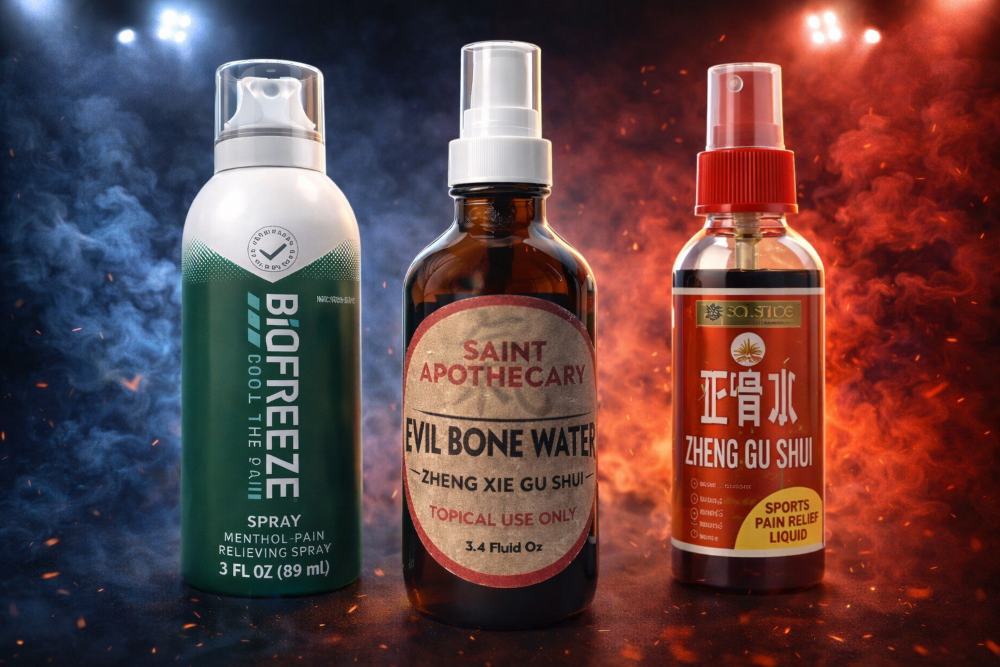
As an acupuncturist, I use topical sprays every single day in the clinic. They’re not all the same.
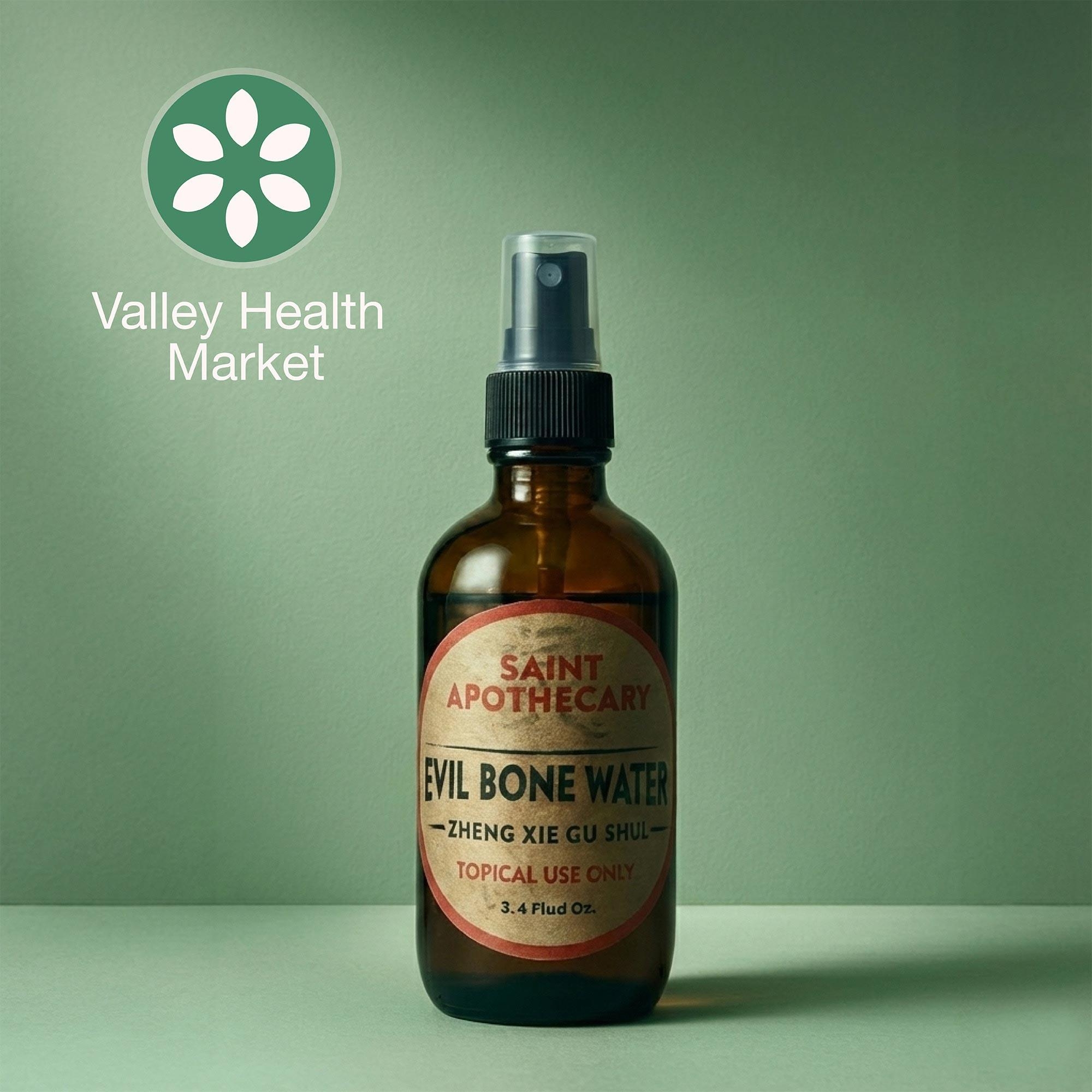
When it comes to topical pain relief, choosing the right topical matters. Zheng Gu Shui is a traditional Chinese herbal liniment with centuries of use. Evil Bone Water is a contemporary, handcrafted version of Zheng Gu Shui, made with high-grade herbs. Biofreeze gel is a widely used menthol-based analgesic. .
Below is a clear, experience-based comparison written for patients based on what I actually use, what I don’t, and why.
Video: Biofreeze vs Evil Bone Water: Side-by-Side Spray Test & Residue Comparison
https://youtube.com/shorts/o9-y46R47JQ?feature=share
In this video, I spray Biofreeze and Evil Bone Water side by side and let them dry.
What stood out immediately: Biofreeze dried into a crusty, filmy residue, while Evil Bone Water evaporated cleanly with no tacky film
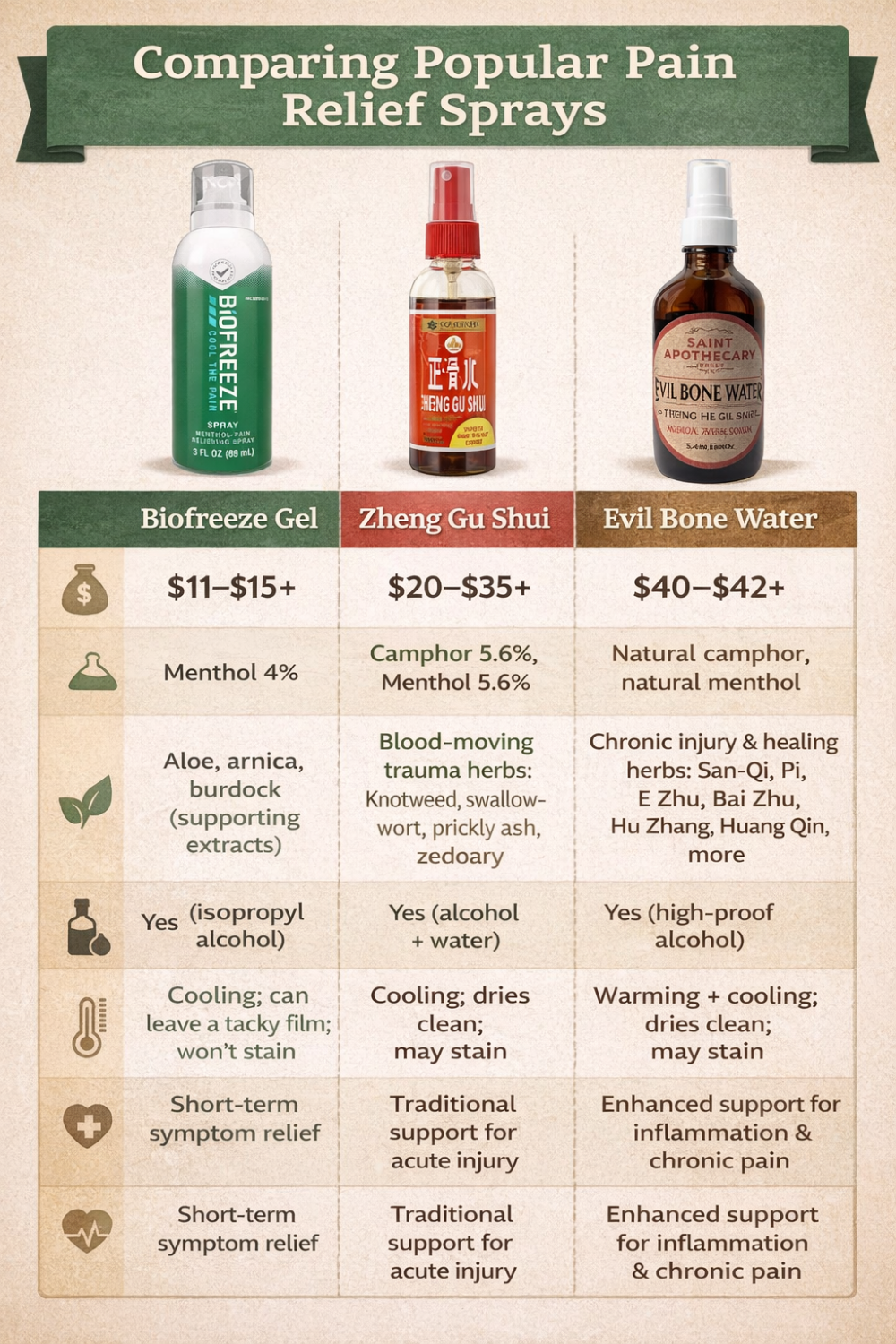
Feature | Biofreeze Gel | Zheng Gu Shui | Evil Bone Water |
Typical Price (3–4 oz) | $11–$15+ | $20–$35+ | $40–$42+ |
Active Ingredients | Menthol 4% | Camphor 5.6%, Menthol 5.6% | Natural camphor, natural menthol |
Herbal Components | Aloe, arnica, burdock (supporting extracts) | Blood-moving trauma herbs: knotweed, swallowwort, prickly ash, zedoary | Chronic injury & healing herbs: San-Qi, Gui Pi, E Zhu, Bai Zhu, Hu Zhang, Huang Qin, more |
Alcohol Base | Yes (isopropyl alcohol) | Yes (alcohol + water) | Yes (high-proof alcohol) |
Residue / Sensation | Cooling; can leave a tacky film; won’t stain | Cooling; dries clean; may stain | Warming + cooling; dries clean; may stain |
Healing Support | Short-term symptom relief | Traditional support for acute injury | Enhanced support for inflammation & chronic pain |
If you’re dealing with lingering pain or an injury that just won’t fully resolve, this is the topical I reach for in my clinic.
Evil Bone Water goes beyond surface cooling and is designed to support circulation, inflammation, and tissue recovery.
Try Evil Bone Water and feel the difference.
https://shop.valleyhealthclinic.com/products/evil-bone-water-zheng-gu-shui
I recently ran a simple test in the clinic: Biofreeze on one surface, Evil Bone Water on another, camera rolling, then wait.
What I saw surprised me.
Biofreeze dried into a visible, grimy film.
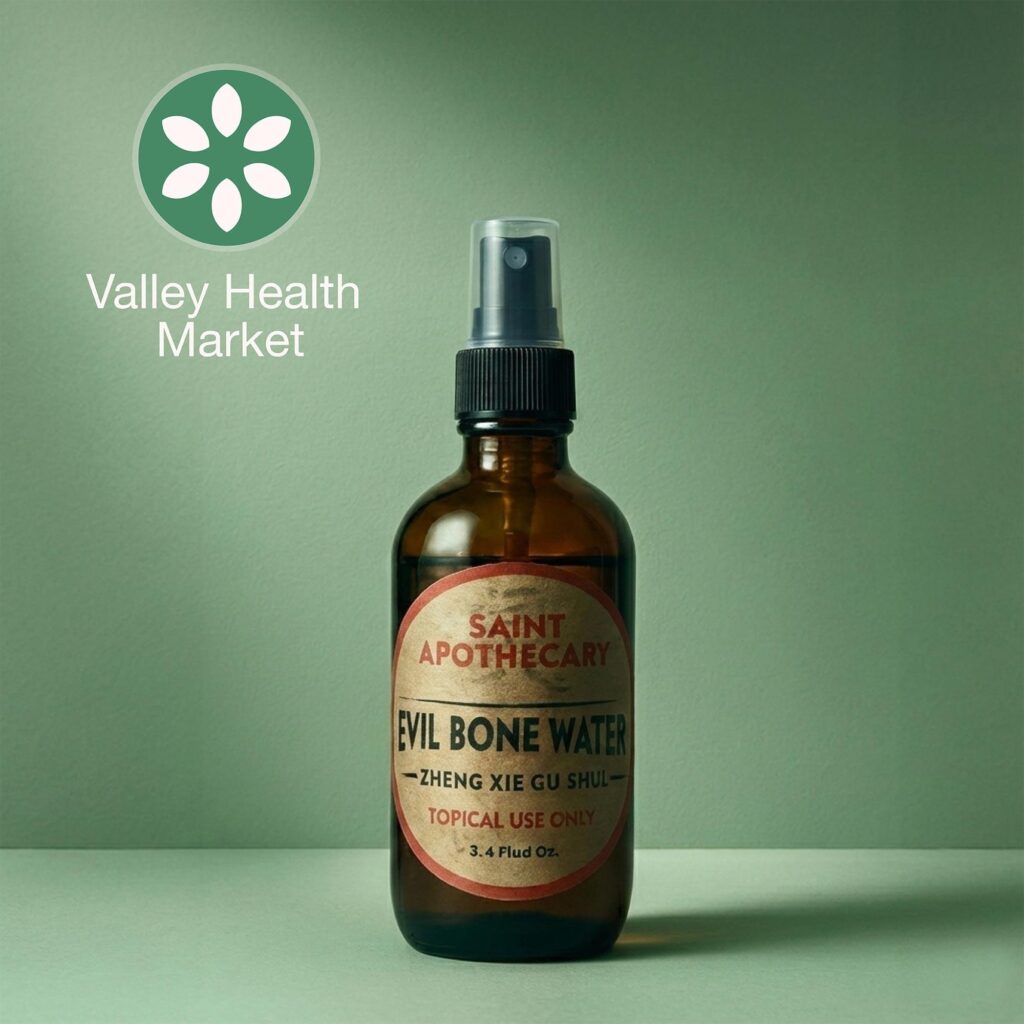
They are related but not the same. Evil Bone Water is inspired by Zheng Gu Shui–style formulas but expands on them by adding herbs that:
Think of Zheng Gu Shui as acute trauma support, and Evil Bone Water as trauma + healing.
Biofreeze relies on menthol as a counter-irritant, which creates a cooling sensation that temporarily interrupts pain signals. Its inactive ingredients are designed for:
It’s engineered more like a pharmaceutical gel than a medicinal herbal formula.
I recommend applying herbal liniments before dressing or covering the area if needed.
Yang, X., Wang, Y., Bai, L., Miao, T., & Wen, X. (2023). Mechanism of action of Baohe pills in improving functional dyspepsia. MEDS Chinese Medicine, 5(7), 48–55. Clausius Scientific Press. https://doi.org/10.23977/medcm.2023.050707
Maideen N. M. P. (2023). Adverse Effects Associated with Long-Term Use of Proton Pump Inhibitors. Chonnam medical journal, 59(2), 115–127. https://doi.org/10.4068/cmj.2023.59.2.115
Tu, Y., Luo, X., Liu, D., Li, H., Xia, H., Ma, C., Zhang, D., Yang, Y., Pan, X., Wang, T., Xia, Y., Dan, H., You, P., & Ye, X. (2022). Extracts of Poria cocos improve functional dyspepsia via regulating brain-gut peptides, immunity and repairing of gastrointestinal mucosa. Phytomedicine : international journal of phytotherapy and phytopharmacology, 95, 153875. https://doi.org/10.1016/j.phymed.2021.153875
Chen, X. Y., Chen, H. M., Liu, Y. H., Zhang, Z. B., Zheng, Y. F., Su, Z. Q., Zhang, X., Xie, J. H., Liang, Y. Z., Fu, L. D., Lai, X. P., Su, Z. R., & Huang, X. Q. (2016). The gastroprotective effect of pogostone from Pogostemonis Herba against indomethacin-induced gastric ulcer in rats. Experimental biology and medicine (Maywood, N.J.), 241(2), 193–204. https://doi.org/10.1177/1535370215600099
Zhen, B. X., Cai, Q., & Li, F. (2023). Chemical components and protective effects of Atractylodes japonica Koidz. ex Kitam against acetic acid-induced gastric ulcer in rats. World journal of gastroenterology, 29(43), 5848–5864. https://doi.org/10.3748/wjg.v29.i43.5848
Lee, H.-A., Yoo, J.-H., Chung, Y., & Kim, O. (2017). Inhibition of Helicobacter pylori-induced inflammation in human gastric epithelial AGS cells by the fruits of Tribulus terrestris L. extracts. Journal of Biomedical and Translational Research, 18(3), 121–124. https://doi.org/10.12729/jbtr.2017.18.3.121
Wang, Q., Shen, Z. N., Zhang, S. J., Sun, Y., Zheng, F. J., & Li, Y. H. (2022). Protective effects and mechanism of puerarin targeting PI3K/Akt signal pathway on neurological diseases. Frontiers in pharmacology, 13, 1022053. https://doi.org/10.3389/fphar.2022.1022053
Zhao, H., Feng, Y. L., Wang, M., Wang, J. J., Liu, T., & Yu, J. (2022). The Angelica dahurica: A Review of Traditional Uses, Phytochemistry and Pharmacology. Frontiers in pharmacology, 13, 896637. https://doi.org/10.3389/fphar.2022.896637
Feng, L., A, L., Li, H., Mu, X., Ta, N., Bai, L., Fu, M., & Chen, Y. (2023). Pharmacological Mechanism of Aucklandiae Radix against Gastric Ulcer Based on Network Pharmacology and In Vivo Experiment. Medicina (Kaunas, Lithuania), 59(4), 666. https://doi.org/10.3390/medicina59040666
Fu, X., Wang, Q., Kuang, H., & Pinghui, J. (2020). Mechanism of Chinese medicinal-medicated leaven for preventing and treating gastrointestinal tract diseases. Digestion, 101(6), 659–666. https://doi.org/10.1159/000493424
That’s why, in my clinic, Evil Bone Water is what I use when the goal is healing, not just temporary relief.
It’s built on the traditional Zheng Gu Shui framework, upgraded with higher-grade herbs, natural camphor and menthol, and a formulation designed to support circulation, calm inflammation, and help damaged tissue recover over time.
It’s not the cheapest option
But it’s the one I trust when results actually matter.
If you’re ready to move beyond surface-level relief, try Evil Bone Water the same topical I use in clinical practice