
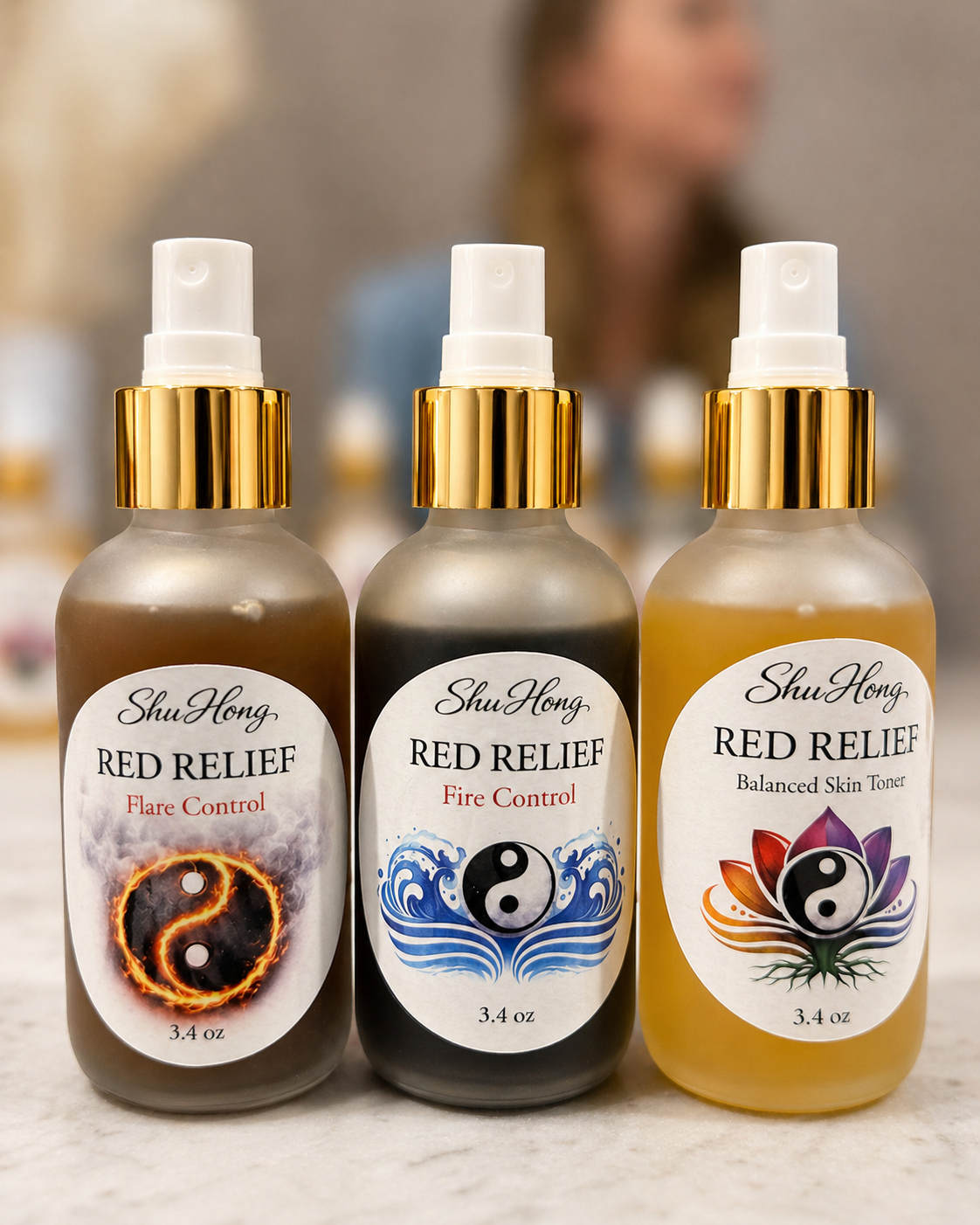
Psoriasis Flare Ups and Why You Need Three Sprays
Dr. Meli, in her own words, on why she and her husband built the Shu Hong

Materia Medica · The Formula Series

Willard Sheppy is a licensed acupuncturist (LAc) and Founder of Valley Health Clinic specializing in using Traditional Chinese Medicine to treat acute injuries and chronic conditions, and to improve sports performance and rehabilitation.
Atone is for the sudden stall — bad food, bad water, travel, a bug going around. It’s a tea you sip at the first sign of trouble. Microgard and Microgard Plus are for the terrain underneath: how your digestion runs on an ordinary week. Between those two, Microgard Plus is the warmer formula for the person who runs cold — soft irregular stools, heaviness, fatigue, low mood — and Microgard is the cooler formula for the person who runs hot — dry hard stools, bad breath, frontal headache, anxious with energy to burn. Two questions sort them: is this sudden or is this your baseline, and are there heat signs on top.
Three formulas, one zone, and the same question every time: which one?
Atone, Microgard Plus, and Microgard all work on the middle — the gastrointestinal terrain. They are not interchangeable, and the difference between them is not subtle once you know what you’re looking at. But there’s a wrinkle in this zone that catches almost everybody, including practitioners: the temperature of the formula is the opposite of the temperature of the person. The warmer product is for the colder patient. Miss that and you will reach for exactly the wrong one.
Temperature and moisture differentiate every biome on earth — rainforest to desert — and equally in the living gardens inside you. That’s the whole idea the Botanical Biohacking line is organized around.
When the microbiota in a zone drift out of balance, contradictory signs show up. A patient reads hot and cold, dry and damp, deficient and excess all at once, and the picture refuses to resolve into one tidy diagnosis. That isn’t a diagnostic failure. It means you’re not looking at one organ — you’re looking at growing conditions that drifted.
So the gastrointestinal zone doesn’t get one formula. It gets positions, and you pick the one that matches:
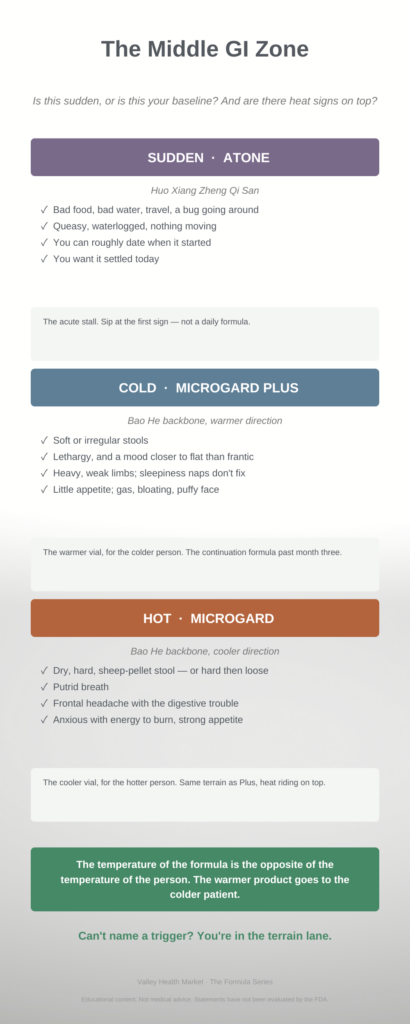
Two questions, in this order.
Sudden is the questionable takeout, the travel week, the summer bug, the water that wasn’t quite right. It arrived, you can roughly date it, and you want it settled today. That’s Atone’s lane.
Baseline is how your digestion runs on an ordinary Tuesday when nothing in particular has happened. That’s the terrain, and terrain is what the two Microgard vials are built for. If you can’t name a trigger, you’re in the terrain lane.
Once you’re in the terrain lane, the hot picture is the cold picture plus heat signs, not a separate presentation. So learn the cold one first and watch for what gets added.
And here is what heat adds on top of that picture:
The three-question screen from the original comparison still does most of the work in under a minute: How is your appetite — normal, diminished, or strong? What are your stools like — loose or hard? And emotionally, are you closer to depressed, or closer to anxious?
Huo Xiang Zheng Qi San — Agastache Powder to Rectify the Qi — is the classic prescription for external damp obstructing the middle. The summer-bug, questionable-takeout, travel-tummy, damp-and-queasy picture. It is a household staple across much of Asia for exactly this reason: it’s what you reach for when your gut feels waterlogged and rebellious and you want it settled today.
It works by aromatically waking the digestion up, releasing the exterior, and getting stuck qi and fluid moving again in the right direction. Not by attacking anything. Huo Xiang (agastache) is the monarch herb; Zi Su Ye and Bai Zhi release the exterior; Da Fu Pi and Hou Po move qi and relieve fullness; Chen Pi and Fa Ban Xia dry damp and settle nausea; Bai Zhu and Fu Ling strengthen the spleen and drain damp; Jie Geng and Gan Cao open the chest and harmonize. Eleven herbs, full aromatic architecture kept intact rather than trimmed for cost.
The source material’s own rule of thumb on timing is worth borrowing here: Atone is the stronger choice for sudden onset, and it’s most generally used as the days are getting shorter. Full breakdown in the Atone post.
This is the vial for the person whose baseline is heavy and slow. Soft or irregular stools, limbs that feel weak, sleepiness that naps don’t fix, an appetite that never quite shows up, and a mood that sits closer to flat than to frantic. Weight that goes on anyway. Often a puffy face.
Microgard Plus is the warmer of the two vials, and the herbs unique to it tell you why: Shan Zha (hawthorn), Shen Qu (medicated leaven), and Gu Ya (rice sprout) are the classical food-moving trio for overeating, eating too fast, and food that sits; Shi Chang Pu (acorus) is the orifice-opening herb the line uses for the gut-brain layer; Bai Ji Li (tribulus) calms the liver and dispels wind.
Positioned in the catalog as the continuation vial — the one that carries the work past month three. On body type, the original comparison is blunt about it: this suits the cold, yin-leaning constitution rather than the lean, hot, wired one. Full breakdown in the Microgard Plus post.
Same terrain, heat on top. Stools that are dry and hard — sheep pellets — or that start hard and finish loose, with a burning sensation after. Putrid breath. A frontal headache that shows up with the digestive trouble rather than separately. Anxious, but with energy behind it rather than the flat exhaustion of the cold picture.
Microgard is the more neutral, less warming of the two, and again the unique herbs say so: Ju Hua (chrysanthemum) releases wind-heat, Hou Po (magnolia bark) regulates qi and relieves fullness, Ji Li extinguishes wind, and Dao Ya (rice husk) works on food stagnation. It suits either the lean, acute, yang constitution — the skinny vegan end of the spectrum — or the larger, very yang presentation where heat and damp are both loud.
Here is the sentence to reread if only one thing sticks: you give the cooler formula to the hotter person. It sounds backwards for about five seconds and then it’s obvious. Full breakdown in the Microgard post, and the full side-by-side herb lists live in the original Microgard vs Microgard Plus comparison.
The temperature of the formula is the opposite of the temperature of the person. The warmer product is for the colder patient. Almost every wrong pick in this zone comes from getting that backwards.
— Will Sheppy, L.Ac.
The two vials overlap more than they differ, which is why the sorting question matters rather than the ingredient list. Both are described as clearing phlegm and dampness, relieving food stagnation, reducing inflammation and repairing the digestive system, supporting good gut bacteria, and counteracting what the standard American diet does to a middle.
They share a backbone of herbs, grouped by job:
That last name is worth pausing on. Huo Xiang is in both vials, and it is the monarch herb of Atone. The aromatic damp-transformer that settles an acute stall is the same herb doing quiet background work in the daily formulas. That’s not a coincidence — it’s the through-line of the whole zone.
Yi Yi Ren (coix seed) is the other shared name that carries weight. The line describes it as doing two jobs: washing the intestines by improving fecal moisture and promoting peristalsis, and repairing the intestinal wall by supporting the growth and differentiation of epithelial cells. Note that coix seed is frequently confused with Job’s tears; they are not the same thing.
This is where I’d rather be honest than impressive, because the honest version is more useful to you. In this zone the evidence is genuinely lopsided — the acute formula has human trials, and the daily formulas have mice.
Huo Xiang Zheng Qi has real randomized human data. A multicenter randomized trial gave the oral liquid alongside standard anti-nausea drugs to sixty chemotherapy patients on a multiday cisplatin regimen, and the complete-response rate for acute nausea and vomiting was roughly 63% against 33% for placebo, with more nausea-free days overall. A separate randomized trial of 283 COVID-19 patients found no significant difference in overall symptom improvement, but a specific advantage for nausea, vomiting, and limb soreness. Two more trials are registered — for diarrhea-predominant IBS and for atopic dermatitis with a dampness pattern — but as of this writing only the protocols are published in the English literature, not the results. So: the formula measurably does something in humans, and the something is nausea, vomiting, and damp-type symptoms. That is a narrower claim than “it works,” and it is the claim the data supports.
Bao He Wan — the backbone under both vials — is preclinical, but unusually on-point preclinical. The published work is in mice fed a high-fat, high-protein diet until they developed diarrhea. Baohe pill decoction raised intestinal microbial counts and lactase activity, shifted the structure of the lactase-producing bacterial community, and improved amylase, protease, and sucrase activity. Mechanistically that lines up remarkably well with what the product claims to do — restore flora, restore digestive function — which is more than most herbal products can say about their animal data. It’s still mice.
Coix seed is also mice. In a five-week feeding study, adding coix seed to a high-fat diet partly counteracted the weight, fat-mass, and cholesterol effects, and increased Akkermansia muciniphila and Lactobacillus — organisms that track inversely with obesity and metabolic disease. Interesting, and not a human outcome.
What stands behind these formulas is centuries of documented clinical use, which is a real form of evidence and I’m not going to pretend otherwise. It is also not the same thing as a trial, and anyone telling you it is should make you suspicious.
Four limits worth stating plainly.
And the line that matters most: signs of dehydration, blood in the stool, black or tarry stool, high fever, severe or persistent abdominal pain, unexplained weight loss, or symptoms lasting more than a couple of days need real medical care, not more tea. A change in bowel habit that doesn’t resolve deserves a workup. If you’re pregnant, nursing, on anticoagulants, or managing a chronic condition, talk with your practitioner or physician before starting any of these.

Atone, Microgard, and Microgard Plus — practitioner-formulated, batch-tested, and stocked at Valley Health Market. Atone is thirty teabags; the Microgard vials are micro-pill format.
Educational content rooted in 20+ years of clinical practice in Traditional Chinese Medicine. The information provided is for educational purposes and is not intended to replace consultation with a qualified healthcare practitioner. Please consult your physician before starting any new herbal protocol, especially if pregnant, nursing, on anticoagulants, or managing a chronic condition.
They point in opposite temperature directions. Microgard Plus is the warmer formula, meant for the person whose digestion runs cold — soft or irregular stools, heaviness, fatigue, poor appetite, low mood. Microgard is the more neutral, less warming formula, meant for the person running hot — dry hard stools, putrid breath, frontal headache, anxious with energy. The confusing part is that the warmer product goes to the colder person, which is standard practice in Chinese herbal medicine but reads backwards at first glance.
Ask whether you can date it. Atone is for the sudden stall — bad food, bad water, travel, a bug going around — and it is built on Huo Xiang Zheng Qi San, the formula households across Asia keep on hand for exactly that. The two Microgard vials are for the terrain underneath: how your digestion runs on an ordinary week when nothing in particular has happened. If you can’t name a trigger, you’re looking at terrain.
Microgard and Microgard Plus are positioned as a sequence rather than a pair to take simultaneously — Microgard Plus is described as the continuation vial that carries the work past month three. Atone is a different tool for a different moment and is generally used acutely rather than daily. Layering formulas is a conversation to have with your practitioner rather than something to work out from a product page.
All three address bloating, which is exactly why bloating alone is a poor sorting question. Look at the company it keeps instead. Bloating with soft stools, fatigue, and low mood points cold. Bloating with hard stools, bad breath, and anxious energy points hot. Bloating that arrived on Tuesday after a questionable meal points to Atone.
It’s lopsided, and worth knowing which way. Huo Xiang Zheng Qi — the formula behind Atone — has genuine randomized human trials, though in chemotherapy-induced nausea and in COVID-19 rather than in everyday digestive upset. Bao He Wan, the backbone under both Microgard vials, has no English-indexed human trial at all; what exists is mouse work on gut flora and digestive enzyme activity, which happens to line up well with what the products claim to do. Coix seed, shared by both vials, is also mice. Centuries of documented clinical use stand behind all of it, and that is a real form of evidence — just not the same thing as a trial.
Dr. Meli, in her own words, on why she and her husband built the Shu Hong

Does Evil Bone Water work? An acupuncturist reviews the evidence for Zheng Gu Shui, camphor, menthol,

Learn which acupuncture points Will Sheppy uses for Ménière’s disease, vertigo and dizziness, plus treatment frequency