8 minutes read

Materia Medica · The Formula Series

Wind Tea: For When You’re Neither Sick nor Well

Willard Sheppy Dipl. OM, LAc, BS

Willard Sheppy is a licensed acupuncturist (LAc) and Founder of Valley Health Clinic specializing in using Traditional Chinese Medicine to treat acute injuries and chronic conditions, and to improve sports performance and rehabilitation.
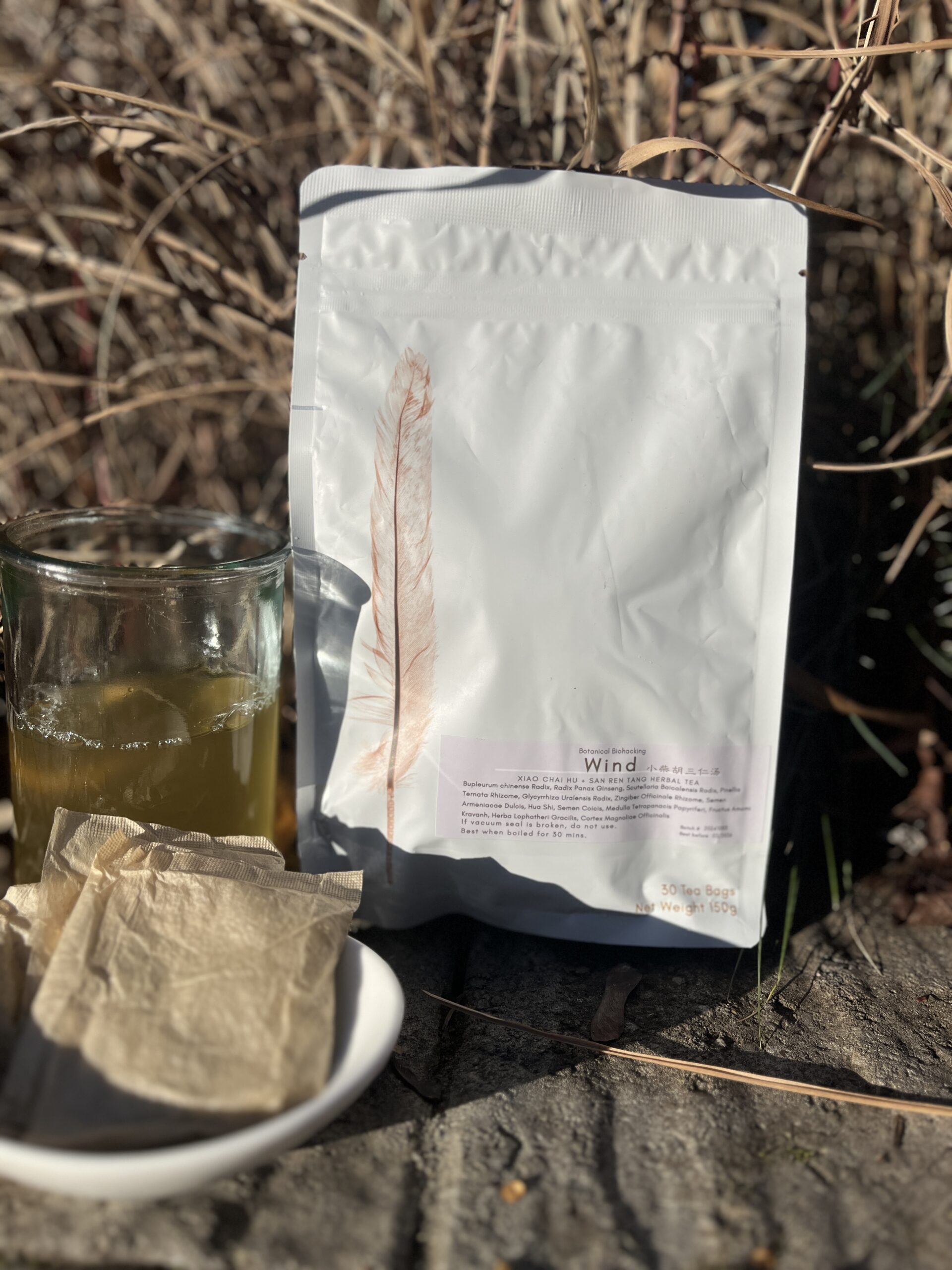
Wind Tea with Glass and Tea Bag

Table of Contents

Educational content from Valley Health Market. Not medical advice. Statements have not been evaluated by the FDA. This product is not intended to diagnose, treat, cure, or prevent any disease.

Some people don’t get knocked down by a bug. They get stuck halfway.

Wind Tea is the formula for the stage where you are neither sick nor well — not sick enough to stay in bed, not well enough to get your life back.

Here’s what the formula actually is, who formulates it, and its limits.

Quick Answer

Wind Tea is built on Xiao Chai Hu Tang — the Minor Bupleurum Decoction, the definitive formula for the in-between Shaoyang stage — with San Ren Tang-type damp-clearing herbs layered in by Botanical Biohacking, and real Ren Shen (Asian ginseng) rather than the cheaper Dang Shen substitute. It suits the more deficient presentation; its sibling Peak suits excess and heat. It is not a long-term formula: roughly two weeks, never longer than three months — and a high fever, a severe or worsening infection, or trouble breathing needs real medical care, not tea.

What Wind Tea Actually Is

Wind Tea is built on Xiao Chai Hu Tang — the Minor Bupleurum Decoction, one of the most important formulas in the entire Chinese herbal tradition. It is the definitive formula for the Shaoyang stage: the in-between layer where a pathogen is neither fully outside the body nor fully settled inside it.

The classical picture is unmistakable once you’ve seen it. Alternating chills and warmth. A bitter taste. No appetite. That stuck, half-well-half-sick feeling that lingers for weeks after everyone else has bounced back. The formula’s job is not to attack. It is to harmonize — to help the body finish what it started.

Botanical Biohacking then layers in San Ren Tang-type herbs — apricot kernel, coix, talc, white cardamom — for the damp-heat sluggishness that so often rides along with modern constitutions.

Who Formulates This

Dr. Jin Zhao is the main formulator for the Botanical Biohacking line. He practices in Chengdu, sees up to 200 patients a day, and specializes in one thing: dampness. The approach isn’t new — it’s rooted in Qing dynasty herbal theory — but he refined it in clinic across tens of thousands of patients, working through the upper, middle, and lower jiao.

His conclusion, in the company’s own words: clear the dampness and complicated cases become simple again.

Wind was fine-tuned by pharmacology professor Dr. Zhong Shi Hong, who added one thing that matters enormously — super high-grade white ginseng, specifically to strengthen the formula and keep it from draining qi over a course of use.

The sourcing detail that matters

Most Xiao Chai Hu Tang on the market uses Dang Shen (codonopsis) to reduce cost. Wind uses real Ren Shen — Asian ginseng. It’s there for a structural reason, not as a marketing bullet.

Wind or Peak? The Formulators’ Own Rule

Wind has a sibling formula, Peak. Both are San Ren Tang remixes from the same team. They are not interchangeable, and Botanical Biohacking states the difference plainly:

Inside the Formula

Wind marries two classical strategies — harmonize the exterior and interior, and clear damp.

The Harmonizing Core

The Damp-Clearing Layer

An Important Limit

San Ren Tang is not a long-term formula. The makers’ own guidance is roughly two weeks, and not longer than three months, because over time it can drain qi. A high fever, a severe or worsening infection, or trouble breathing needs real medical care — not tea.

Wind is for the stage most people don’t have a name for. Not sick enough to stay in bed. Not well enough to get their life back. That’s a real pattern, and the tradition built a formula for it. — Will Sheppy, L.Ac.

Wind Tea Close up with tea Bag and glass of tea

Wind Tea

Xiao Chai Hu Tang with San Ren Tang. Real Ren Shen, not Dang Shen. Formulated by Dr. Jin Zhao, fine-tuned by Dr. Zhong Shi Hong. Available at Valley Health Market.

Research & Resources

  1. Li M, Dan W, Zhang H, Yun Y, He Q. Xiao Chai Hu Tang for Peptic Ulcers: A Systematic Review and Meta-Analysis of Randomized Controlled Trials. Evid Based Complement Alternat Med. 2021;2021:6693677. Link →
  2. Memorial Sloan Kettering Cancer Center. Sho-saiko-to (Xiao Chai Hu Tang) — About Herbs professional monograph. Includes important interaction cautions. Link →
  3. Wu Ju Tong. Wen Bing Tiao Bian (Systematic Differentiation of Warm Diseases), 1813. (Classical source for the San Ren Tang strategy.)
  4. Bensky D, Barolet R. Chinese Herbal Medicine: Formulas & Strategies. Eastland Press. (Standard reference for Xiao Chai Hu Tang.)

Educational content rooted in 20+ years of clinical practice in Traditional Chinese Medicine. The information provided is for educational purposes and is not intended to replace consultation with a qualified healthcare practitioner. Please consult your physician before starting any new herbal protocol, especially if pregnant, nursing, on anticoagulants, or managing a chronic condition.

Share on

Will Sheppy, Founder and Acupuncturist at Valley Health Clinic
Willard Sheppy
Willard Sheppy is a licensed acupuncturist (LAc) and Founder of Valley Health Clinic specializing in using Traditional Chinese Medicine to treat acute injuries and chronic conditions, and to improve sports performance and rehabilitation.

FAQ's

What is Wind Tea?

Wind Tea is built on Xiao Chai Hu Tang — the Minor Bupleurum Decoction, one of the most important formulas in the Chinese herbal tradition — with San Ren Tang-type damp-clearing herbs layered in by Botanical Biohacking. It uses real Ren Shen (Asian ginseng) rather than the cheaper Dang Shen substitute.

It was written for the Shaoyang stage — the in-between layer where a pathogen is neither fully outside the body nor fully settled inside it. The classical picture: alternating chills and warmth, a bitter taste, no appetite, and that stuck, half-well-half-sick feeling that lingers for weeks after everyone else has bounced back.

Both are San Ren Tang remixes from the same team, but they are not interchangeable. More relative deficiency points to Wind — the ginseng holds the person up while the dampness clears. More excess and heat points to Peak, which has no ginseng and strengthens heat-clearing with Yin Chen Hao and Tibetan Plateau Chai Hu instead.

San Ren Tang is not a long-term formula. The makers’ own guidance is roughly two weeks, and not longer than three months, because over time it can drain qi. A high fever, a severe or worsening infection, or trouble breathing needs real medical care — not tea.

Recent Posts